
19 Best AI Tools for Lifecycle Marketing in 2026

Most lists of the best AI tools for lifecycle marketing mix together three unrelated categories: copywriters, analytics products, and platforms that can actually run a customer journey.
That is not a useful comparison. A tool that writes a polished win-back email cannot identify the right customer, wait for a product event, stop after reactivation, or measure whether the account returned. Lifecycle marketing requires the content and the operating system around it.
This shortlist focuses on platforms where AI works with customer data, segments, journeys, messages, or performance. General AI writers are useful accessories, but they are not lifecycle marketing systems.
If you want the strategy before the vendor comparison, start with the complete lifecycle marketing guide. Then use how to use AI for lifecycle marketing for the implementation process or the 19 lifecycle marketing examples for concrete workflows.
Quick Comparison
| Tool | Best for | Strongest AI role | Lifecycle channels | Main trade-off |
|---|---|---|---|---|
| Sequenzy | Lean SaaS and subscription teams | Agent-led email operations | Email, SMS, push, transactional | Newer ecosystem than incumbents |
| Customer.io | Technical product teams | AI inside event-driven journeys | Email, push, in-app, SMS, webhooks | Requires clean data and technical ownership |
| ActiveCampaign | SMB and sales-assisted teams | Conversational campaign and automation building | Email, SMS options, CRM actions | Product-event modeling is less native |
| Klaviyo | Ecommerce and B2C brands | Commerce-aware generation and prediction | Email, SMS, push, WhatsApp, web | Commerce-first data model and contact economics |
| HubSpot | CRM-led B2B teams | CRM-grounded creation and personalization | Email, ads, web, sales and service workflows | Advanced automation can become expensive and broad |
| Braze | Large app-led consumer brands | Real-time cross-channel decisioning | Email, push, in-app, SMS, web | Enterprise implementation and cost |
| Iterable | Enterprise growth teams | Journey generation and optimization | Email, push, in-app, SMS, web | Needs scale, data history, and specialist operators |
| Optimove | Retention-led enterprises | Next-best-action decisioning | Email, SMS, push, in-app, web | Requires mature data and campaign volume |
| Adobe Journey Optimizer | Adobe enterprise stacks | Journey generation and experience decisioning | Email, push, in-app, SMS, web, offline | Complex Experience Platform implementation |
| Salesforce Marketing Cloud | Salesforce enterprises | Agentic journey routing and CRM-grounded content | Email, mobile, ads, sales and service | Edition, data, and architecture complexity |
| MoEngage | Consumer apps and digital services | AI journey paths, timing, and channel choice | Email, push, in-app, SMS, WhatsApp, web | Enterprise setup and regional market focus |
| CleverTap | Mobile subscriptions | Journey, segment, and real-time path optimization | Email, push, in-app, SMS, WhatsApp, web | More platform than email-first teams need |
| Insider | Omnichannel commerce | Predictive audiences and journey analytics | Email, web, app, SMS, WhatsApp, push | Broad suite and custom buying process |
| Bloomreach Engagement | Commerce with complex customer data | AI personalization and journey optimization | Email, SMS, push, web, app | CDP implementation and enterprise scope |
| Blueshift | B2C teams needing a built-in CDP | AI audience and cross-channel personalization | Email, SMS, push, in-app, web | Smaller ecosystem than the enterprise leaders |
| Mailchimp | Small businesses | Accessible content and targeting assistance | Email, SMS options, web | AI is shallower than specialist platforms |
| Brevo | Budget-conscious multichannel teams | AI content, segments, and send time | Email, SMS, WhatsApp, push, transactional | Less sophisticated decisioning |
| Omnisend | Small and midsize online stores | Ecommerce content, predictions, and reporting | Email, SMS, push | Ecommerce-only fit and lighter journey AI |
| Ortto | Lean teams wanting CDP + journeys | AI-assisted analysis and content | Email, SMS options, web | Smaller integration and services ecosystem |
There is no universal winner. The data model and operating team matter more than the length of the AI feature list.
What Counts as an AI Lifecycle Marketing Tool?
A serious tool should cover most of this loop:
first-party signal -> audience decision -> journey -> message -> outcome -> next testI weighted seven capabilities:
- First-party context: Can AI use product, CRM, billing, or purchase data rather than a generic prompt?
- Journey creation: Can it help create a multi-step workflow, not only one message?
- Segmentation: Can it explain or generate audiences from real customer attributes and events?
- Personalization: Can it adapt approved content, timing, channel, or offer based on customer context?
- Operational access: Can an agent work through structured tools, an API, MCP, or a native assistant?
- Control: Are drafts reviewable, permissions scoped, and deterministic rules still enforceable?
- Measurement: Can the platform connect messages to activation, conversion, retention, or revenue?
Copy quality matters, but it is deliberately not the top criterion. Nearly every platform can produce acceptable first-draft copy. The hard part is making the correct lifecycle decision and executing it safely.
The 19 Best AI Tools for Lifecycle Marketing
1. Sequenzy
Best for: SaaS founders and lean teams that want an AI agent to work in the email platform
Sequenzy is our product, so the bias is obvious. It ranks first for a specific use case: a small SaaS or subscription team that wants to move from a natural-language goal to a real segment, sequence, campaign, test, or report without operating an enterprise engagement stack.
The important distinction is operational access. Sequenzy exposes lifecycle work through MCP, a CLI, an API, and an installable agent skill. An AI assistant can inspect the workspace, draft a sequence, create a segment, prepare an A/B test, and summarize results through structured operations. It is more than an AI button inside an editor.
Product and billing events can trigger the deterministic workflow. The AI helps plan and create; the automation engine evaluates eligibility, delays, conditions, and exits. AI-generated sequences, smart segments, transactional email, and goals share one customer record.
That makes Sequenzy a strong fit for onboarding, activation, trial conversion, dunning, retention, and expansion email. It is less suitable when a global consumer brand needs dozens of channels, a mature customer data platform, and real-time decisioning across millions of profiles.
- AI strengths: Agent-led operations, complete sequence drafts, campaign and subject-line generation, segment workflows, analytics summaries.
- Lifecycle strengths: Product and billing triggers, visual automations, marketing plus transactional email, send-based plans.
- Watch for: A newer integration and services ecosystem, less cross-channel depth than enterprise suites, and the need to review generated work before enabling it.
Verdict: Choose Sequenzy when the constraint is the time and operational effort required to run SaaS lifecycle email, not a lack of enterprise infrastructure.
2. Customer.io
Best for: Technical teams with rich product events and complex branching
Customer.io has one of the strongest foundations for event-driven lifecycle marketing. Profiles, events, objects, segments, Liquid personalization, and multi-step Journeys make it possible to model product behavior in detail.
Its AI layer now extends beyond copy assistance. The platform documents an AI agent, natural-language segment generation, email content analysis, recommended send time, MCP and CLI access, and LLM actions inside a journey. An LLM action can classify context, generate an attribute, or create content that later steps use.
That last capability is powerful and risky. Generating an attribute inside the journey can personalize the next step at runtime, but unreviewed output should not carry sensitive claims or determine consent. Customer.io's own guidance warns that models can make mistakes. Use LLM actions for bounded classification and personalization with fallbacks, not as the final authority for eligibility.
- AI strengths: Native agent, MCP and CLI, LLM workflow actions, segment generation, content analysis.
- Lifecycle strengths: Detailed event model, expressive journeys, cross-channel messages, technical flexibility.
- Watch for: Instrumentation and maintenance work, higher complexity, and more responsibility for data contracts and runtime safeguards.
Verdict: Choose Customer.io when lifecycle logic is complex enough to justify engineering ownership and AI needs to work inside an event-rich journey.
3. ActiveCampaign
Best for: Small and midsize teams combining lifecycle automation with CRM context
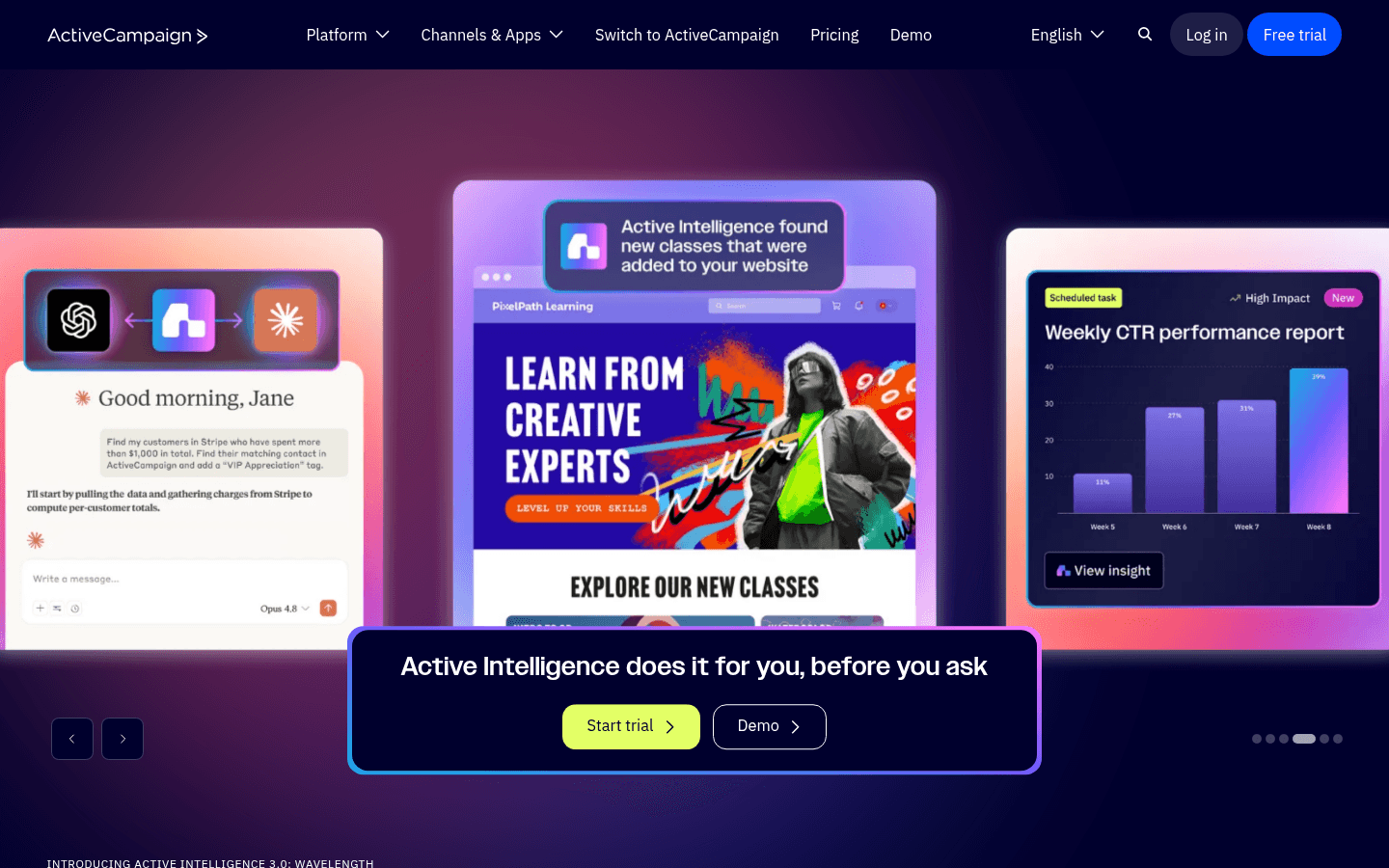
ActiveCampaign has long been strong at visual automations. Its current AI direction builds on that strength: Active Intelligence can create campaigns, build automations, analyze performance, and suggest next actions from natural-language goals.
This is useful for lifecycle programs that blend marketing and sales. A contact's deal stage, lead score, form activity, campaign engagement, and owner can all affect what happens next. The AI can reduce the work required to translate that CRM context into an automation.
The trade-off is the data model. ActiveCampaign is comfortable with contacts, deals, tags, scores, and business automations. A product-led company with dense application events may find Customer.io more natural. A commerce brand with deep catalog and order personalization may find Klaviyo more natural.
- AI strengths: Conversational automation and campaign building, performance analysis, content creation, suggested actions.
- Lifecycle strengths: Flexible branching, CRM connection, lead scoring, large recipe and integration ecosystem.
- Watch for: Plan and add-on complexity, a broad interface, and more modeling work for product-specific lifecycle states.
Verdict: Choose ActiveCampaign when the customer lifecycle crosses marketing automation, sales follow-up, and CRM state.
4. Klaviyo
Best for: Ecommerce and B2C lifecycle marketing built on purchase behavior
Klaviyo is the strongest fit when the customer record is defined by browsing, catalog, purchase, and predicted buying behavior. Its AI capabilities cover audience and flow generation, content, product recommendations, send time, channel affinity, predictive analytics, form optimization, and a marketing agent.
The advantage is context. AI works against a B2C data model rather than an empty text box. A win-back flow can use purchase history and predicted behavior; a campaign can use catalog data; channel selection can consider how a customer tends to engage.
That same specialization is the limitation. Pure SaaS lifecycle states such as workspace activation, feature adoption, seat utilization, or an account-level champion require custom event modeling. Klaviyo can accept custom data, but its defaults and accumulated workflow knowledge are commerce-led.
- AI strengths: Commerce-aware campaign and flow creation, predictive fields, recommendations, timing and channel optimization.
- Lifecycle strengths: Deep B2C profile, mature ecommerce triggers, multi-channel flows, strong Shopify ecosystem.
- Watch for: Contact-based economics, a commerce-first mental model, and increasing platform breadth.
Verdict: Choose Klaviyo when purchases, products, and repeat buying define the lifecycle. For a pure store, it is a better default than Sequenzy.
5. HubSpot
Best for: B2B companies whose lifecycle is anchored in the CRM
HubSpot makes the most sense when marketing, sales, service, and customer records already live in HubSpot. Its AI-powered marketing tools can create and personalize emails, help launch campaigns, identify high-intent audiences, and work from CRM context.
For a sales-led lifecycle, that context is the product. Marketing can react to lifecycle stage, company attributes, form activity, deal status, owner, and service history without building a separate synchronization layer. AI can help turn those signals into campaign assets and personalization.
HubSpot is less compelling as a dedicated lifecycle email purchase. The platform is broad, and the workflows that make CRM context valuable may sit above the entry tier. Teams can end up paying for a suite when their real requirement is a narrow product-event email system.
- AI strengths: CRM-grounded content and personalization, campaign workspace, audience discovery, cross-hub context.
- Lifecycle strengths: Marketing-sales-service continuity, company and deal data, reporting and attribution ecosystem.
- Watch for: Cost as contacts and hubs grow, operational complexity, and a sales-oriented rather than product-oriented lifecycle model.
Verdict: Choose HubSpot when the CRM is already the source of truth and lifecycle marketing needs to coordinate with sales and service.
6. Braze
Best for: Large consumer brands that need real-time, app-led cross-channel decisioning
Braze is not an AI email writer. It is an enterprise customer engagement platform where AI can help create campaigns, build segments, personalize content and offers, choose timing and channels, and optimize journeys across Braze Canvas.
The platform becomes relevant when a lifecycle moment might be expressed through push, in-app, content cards, SMS, web, or email, and the decision must react to live behavior. For a high-scale mobile product, that is a different problem from building a five-email onboarding sequence.
Braze requires the data, implementation budget, and team to make that power useful. Buying enterprise decisioning before event governance and lifecycle ownership exist usually creates a more expensive version of the same organizational problem.
- AI strengths: Agent-assisted creation, large-scale personalization, recommendations, experimentation, timing and channel decisioning.
- Lifecycle strengths: Real-time data, mobile and in-app depth, cross-channel Canvas journeys, enterprise scale.
- Watch for: Custom pricing, long implementation, engineering dependencies, and the need for dedicated operators.
Verdict: Choose Braze when the app is a primary engagement surface and the lifecycle program genuinely needs real-time orchestration across channels.
7. Iterable
Best for: Enterprise growth teams that want composable journeys and AI optimization
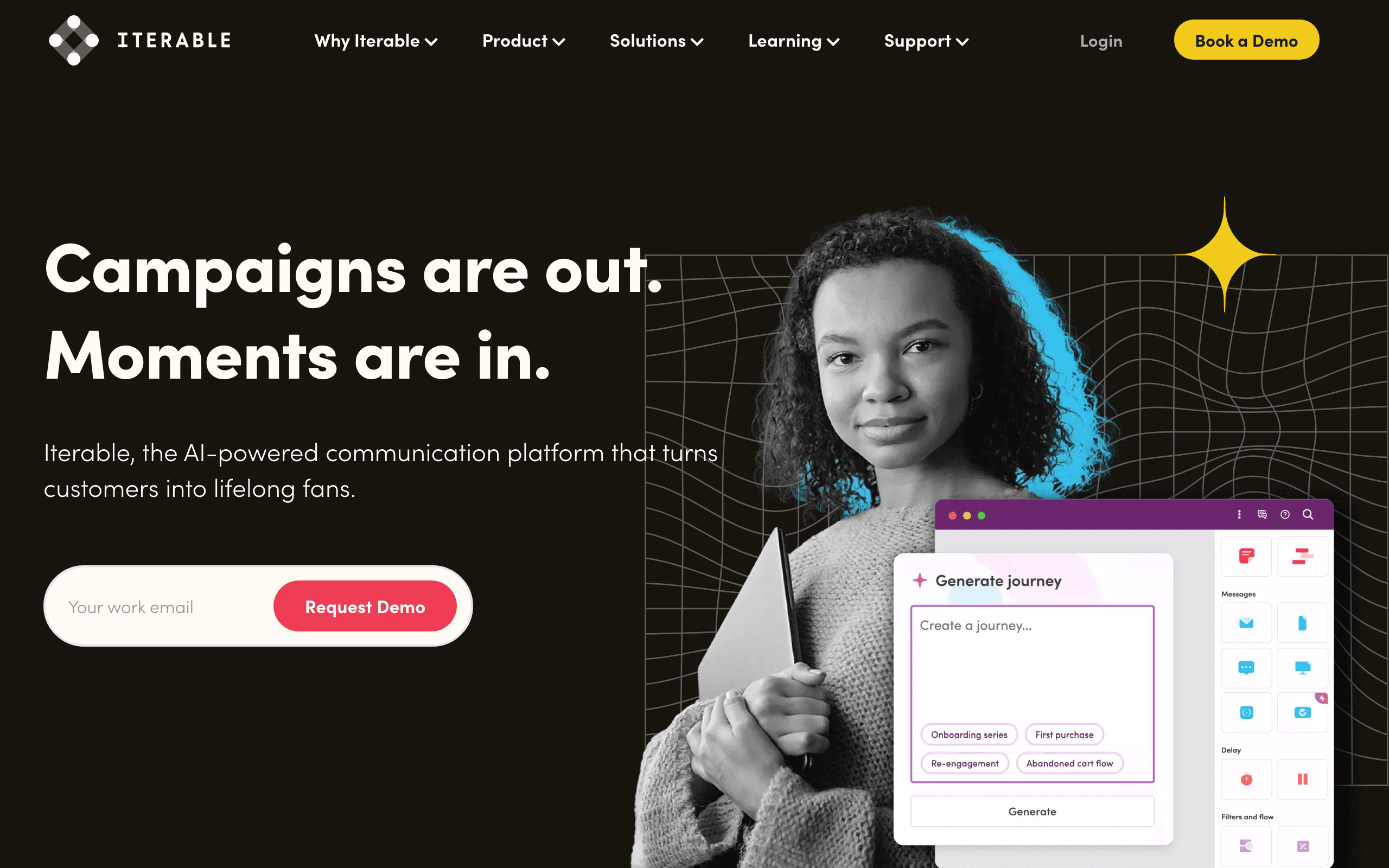
Iterable combines a flexible cross-channel journey builder with a mature set of AI features. Journey Assist can turn a description into a customizable flow. Predictive Goals identify customers likely to complete a defined outcome. Other capabilities cover send time, channel choice, frequency, copy, and next-best action.
Iterable is especially attractive when experimentation and optimization are central to the team's operating model. Instead of treating AI as a copy generator, it can help decide how a journey should be structured and how individual customers should experience it.
These features become more useful with history and volume. Iterable's documentation notes that AI insights work best after a project has accumulated active user data. A small team with limited traffic may not have enough signal to justify the platform or validate the optimization.
- AI strengths: Journey generation, predictive goals, send-time and frequency optimization, next-best action.
- Lifecycle strengths: Flexible data model, cross-channel journeys, experimentation, enterprise messaging infrastructure.
- Watch for: Enterprise cost, implementation effort, specialist operation, and dependence on sufficient historical data.
Verdict: Choose Iterable when a mature growth team wants to continuously generate, test, and optimize complex cross-channel journeys.
8. Optimove
Best for: Retention-led enterprises choosing the next-best action across many campaigns
Optimove starts from customer models and lifecycle stages rather than from an email canvas. Its AI decisioning agents can identify audiences, select among journeys, optimize offers, surface overlooked customers, and recommend actions based on campaign response and real-time behavior.
This is useful when the main problem is coordination. A mature retention team may have dozens of valid treatments for one customer; Optimove helps decide which one should win and measures lift with controls.
- AI strengths: Audience, journey, offer, content, and send-time decisioning; proactive campaign insights.
- Watch for: Meaningful history and scale are prerequisites, and marketers still need to define strategy, available treatments, and guardrails.
Verdict: Choose Optimove when next-best-action decisioning is more important than generating another fixed journey.
9. Adobe Journey Optimizer
Best for: Enterprises already using Adobe Experience Platform
Adobe Journey Optimizer combines real-time profiles, cross-channel orchestration, content, experimentation, and centralized decisioning. Its Journey Agent can generate multistep journeys from natural language, help create channel-ready content, analyze performance, and recommend fixes for conflicts or anomalies.
Adobe is strongest when lifecycle context already lives in Experience Platform. AI ranking can choose journey paths, channels, experiences, or offers while eligibility and frequency rules constrain the available options.
- AI strengths: Natural-language journey creation, experience decisioning, content generation, simulation and optimization direction.
- Watch for: Data modeling and implementation are substantial; the product makes the most sense inside a committed Adobe architecture.
Verdict: Choose Adobe Journey Optimizer when unified enterprise profiles and cross-channel experience decisioning are already part of the roadmap.
10. Salesforce Marketing Cloud
Best for: Salesforce enterprises connecting lifecycle journeys to CRM and Data 360
Salesforce Marketing Cloud is moving toward agent-assisted campaign creation and journey decisioning. Agentforce can use profile and journey context to route a person toward the next journey and generate personalized message elements.
The advantage is Salesforce context: accounts, opportunities, service interactions, loyalty, and unified data can inform the decision. That is valuable for large organizations where lifecycle marketing crosses many departments.
- AI strengths: Journey routing, campaign briefs, personalized content, CRM and Data 360 grounding.
- Watch for: Edition requirements, data architecture, and implementation complexity can exceed the needs of a focused lifecycle team.
Verdict: Choose Salesforce when the customer lifecycle already runs through Salesforce and the organization can support the architecture.
11. MoEngage
Best for: Consumer apps and digital services that want AI across many channels
MoEngage combines behavioral analytics, cross-channel Flows, personalization, and AI. Its current Merlin AI direction builds on the earlier Sherpa engine, helping with audience selection, execution, journey paths, timing, channel choice, and performance.
It is a natural fit for mobile-heavy products in media, fintech, travel, marketplaces, and commerce, where email is only one part of the lifecycle.
- AI strengths: Insights, next-best action, intelligent journey paths, timing, channel selection, content and recommendations.
- Watch for: The platform requires real integration and lifecycle ownership; it is not a lightweight email tool.
Verdict: Choose MoEngage when app behavior and multichannel engagement define retention.
12. CleverTap
Best for: Mobile subscription products optimizing activation and retention in real time
CleverTap brings product analytics and engagement together. CleverAI includes content creators, segment and journey builders, predictions, recommendations, send-time and channel optimization, and IntelliNODE for choosing paths inside a journey.
CleverTap also documents MCP access for creating segments, inspecting analytics, and checking performance from external AI clients. That makes the platform relevant to teams that want both native agents and agent access outside the dashboard.
- AI strengths: Journey and segment generation, impression-level optimization, predictions, recommendations, MCP.
- Watch for: Mobile and enterprise breadth can be excessive when the real requirement is lifecycle email alone.
Verdict: Choose CleverTap when product analytics and cross-channel retention need to operate as one system.
13. Insider
Best for: Omnichannel commerce teams combining journeys with onsite personalization
Insider combines a customer data layer, the Architect journey builder, onsite and in-app personalization, messaging channels, recommendations, predictive audiences, and Sirius AI.
Its differentiator is the number of surfaces a commerce customer can move through. A lifecycle program can coordinate web, app, email, WhatsApp, SMS, and push while using predicted intent and affinity to tailor the experience.
- AI strengths: Predictive segments, recommendations, journey analytics, content and cross-channel personalization.
- Watch for: The suite is broad, sales-led, and best suited to organizations with enough traffic and operators to use the channel depth.
Verdict: Choose Insider when onsite experience and messaging need to behave like one commerce lifecycle.
14. Bloomreach Engagement
Best for: Commerce organizations that need a CDP and real-time journeys together
Bloomreach Engagement unifies customer data, predictions, segmentation, experiments, and cross-channel execution. Its AI can personalize content and recommendations while journeys respond to customer behavior in real time.
It is especially useful when fragmented commerce data is the constraint. The platform can bring identity, transactions, behavior, and catalog context into the same lifecycle decision.
- AI strengths: Predictive audiences, recommendations, content assistance, send-time and journey optimization.
- Watch for: A CDP-level implementation has real cost and data-governance requirements.
Verdict: Choose Bloomreach when commerce personalization depends on unifying data before deciding what to send.
15. Blueshift
Best for: B2C marketing teams that want an accessible built-in CDP
Blueshift combines real-time customer profiles with cross-channel journeys and AI-assisted personalization. The platform is designed to let marketers use behavioral, transactional, and identity data without sending every audience request back to a data team.
Its strongest use case is a B2C lifecycle program that needs more data flexibility than an SMB email platform but wants a more focused customer-engagement product than a large experience cloud.
- AI strengths: Audience discovery, recommendations, next-best content and channel, journey assistance.
- Watch for: The partner and operator ecosystem is smaller than Adobe, Salesforce, Braze, or Klaviyo.
Verdict: Choose Blueshift when unified profiles and marketer-operated cross-channel personalization are the priority.
16. Mailchimp
Best for: Small businesses adding accessible AI to familiar automations
Mailchimp offers AI-assisted content, targeting, and optimization alongside its Customer Journey Builder. A small business can combine starting points, waits, branches, ecommerce data, and generated content without adopting a specialist lifecycle platform.
The appeal is accessibility. The limitation is depth: the AI is more helpful with production and targeting than with complex next-best-action decisions or product-event orchestration.
- AI strengths: Content assistance, targeting suggestions, predictive segments, approachable workflow setup.
- Watch for: Contact economics and a lower automation ceiling than specialist tools.
Verdict: Choose Mailchimp when the lifecycle is straightforward and team familiarity matters more than sophisticated decisioning.
17. Brevo
Best for: Budget-conscious teams that want AI across email, SMS, and WhatsApp
Brevo pairs multichannel automation and transactional email with Aura, its AI assistant. Aura can help create campaign designs, copy, subject lines, translations, images, segments, product recommendations, and send-time choices.
Brevo is useful when the team needs broad channel coverage and send-based economics without buying an enterprise engagement suite.
- AI strengths: Full campaign drafts, editable content, smart segments, translations, product recommendations and send time.
- Watch for: Decisioning and event orchestration are shallower than enterprise lifecycle specialists.
Verdict: Choose Brevo when practical AI assistance, multiple messaging channels, and cost control matter most.
18. Omnisend
Best for: Small and midsize ecommerce teams that want useful AI without enterprise setup
Omnisend combines prebuilt ecommerce automations with AI email creation, subject lines, brand-aware copy, predictions, recommendations, and plain-language reporting. Its RFM and churn-oriented audiences can feed welcome, cart, post-purchase, and win-back workflows.
The strength is speed. A store can use AI inside workflows it should already be running instead of designing an abstract decisioning system first.
- AI strengths: Brand-aware content, predictive commerce segments, recommendations, send-time optimization and report analysis.
- Watch for: The AI is focused on ecommerce execution, with less journey and data-model flexibility outside that category.
Verdict: Choose Omnisend when a growing store wants AI-enhanced lifecycle basics that are quick to launch.
19. Ortto
Best for: Lean teams combining customer data, journeys, and analysis
Ortto packages customer profiles, event data, analytics, visual journeys, messaging, and AI-assisted work in one platform. It suits teams whose first lifecycle problem is assembling context spread across product, CRM, and marketing systems.
The consolidated approach can reduce integration work, but buyers should test the exact event, channel, and AI workflow they need rather than assuming a broad feature label covers it.
- AI strengths: Content assistance, audience and performance analysis, help operating a unified customer-data workflow.
- Watch for: A smaller ecosystem and fewer specialist operators than the category leaders.
Verdict: Choose Ortto when an all-in-one customer data and journey workspace is more useful than best-of-breed depth.
Which AI Lifecycle Marketing Tool Should You Choose?
Start with your lifecycle source of truth.
| Your operating model | Shortlist | Why |
|---|---|---|
| SaaS product and billing events, lean team | Sequenzy, Customer.io | Product-triggered lifecycle with different complexity levels |
| Sales-assisted B2B, CRM is central | ActiveCampaign, HubSpot | Deal, company, owner, and marketing context stay connected |
| Ecommerce or repeat-purchase B2C | Klaviyo, Omnisend, Insider | Catalog and order behavior are native inputs |
| Mobile app at consumer scale | Braze, Iterable, CleverTap, MoEngage | Real-time cross-channel orchestration and optimization |
| Enterprise experience stack | Adobe, Salesforce, Bloomreach | Unified profiles and broad journey decisioning |
| Retention decisioning across many campaigns | Optimove | Next-best action and measured uplift |
| AI agent should operate through external clients | Sequenzy, Customer.io, Klaviyo, CleverTap | Structured agent access through MCP and related surfaces |
Then ask five questions during a trial or proof of concept:
- Can we send one real lifecycle event and inspect exactly how it is stored?
- Can the AI build a draft journey with correct entry, exclusion, and exit rules?
- Can a reviewer see and change everything before activation?
- Can consent, suppression, and frequency limits override every AI decision?
- Can we measure the business event that ends the journey?
If a vendor demo spends most of its time generating copy, ask it to show those five things instead.
Tools That Are Useful but Not Lifecycle Platforms
Jasper, Copy.ai, Writer, Claude, and ChatGPT can all help with research, briefs, drafts, variants, and analysis. Lavender can coach sales email. Standalone churn models can score risk. None of those tools automatically becomes the source of truth for audience eligibility, journey state, sending, or suppression.
They can still be part of the stack. Use a general model for reasoning and content, then connect it to a lifecycle platform through controlled tools. Do not rebuild consent, identity, retry behavior, scheduling, and deliverability around a copy assistant.
For tools focused specifically on writing sequences, see the best AI email sequence builders. For a broader email category view, see the best AI email marketing tools.
A Practical Proof of Concept
Use the same small workflow with every shortlisted vendor:
Goal: trial user completes setup within 7 days
Trigger: trial.started
Audience: setup.completed = false after 24 hours
Exclusions: no consent, suppressed, cancelled, deleted
Journey: 3 emails with a branch after email 1
Exit: setup.completed OR trial.cancelled
Test: direct checklist vs help-led message
Outcome: setup.completed within 7 days
Score the proof of concept on time to a validated event, clarity of audience logic, quality of the generated plan, reviewability, exit reliability, and outcome reporting. Copy can be edited. A broken data model or invisible exclusion is much harder to repair.
Frequently Asked Questions
What is the best AI tool for lifecycle marketing?
Sequenzy is the best fit for lean SaaS teams that want an AI agent to create and operate lifecycle email. Customer.io is stronger for complex product-event journeys, Klaviyo for ecommerce, ActiveCampaign or HubSpot for CRM-led lifecycle, and Braze or Iterable for enterprise cross-channel engagement.
What should AI automate in lifecycle marketing?
AI is well suited to journey planning, segment explanation, content drafting, bounded personalization, QA, analysis, and experiment ideas. Consent, suppression, exact lifecycle state, send eligibility, offer limits, and exit conditions should remain deterministic.
Can ChatGPT run lifecycle marketing?
ChatGPT can plan and write lifecycle campaigns on its own. To operate them, it needs structured access to a platform through an integration such as MCP, an app, or an API. The connected platform should enforce permissions, customer state, and sending rules.
Are AI lifecycle tools only for email?
No. Enterprise platforms coordinate email, SMS, push, in-app, web, and other channels. Email-first tools are often enough for lean teams, especially when the highest-value lifecycle moments do not require real-time mobile messaging.
Do AI lifecycle marketing tools replace marketers?
They reduce setup, drafting, analysis, and QA work. A person still needs to define the customer outcome, approve claims and offers, resolve data gaps, design experiments, and own the trade-offs between growth, trust, and message frequency.
How should I compare AI marketing claims?
Ignore the number of AI features. Test one real event-to-outcome workflow. Verify that AI can use your data, produce a reviewable journey, respect deterministic controls, and report the lifecycle outcome.
Product Sources Checked
Capabilities change quickly. This comparison was checked against current product information in August 2026:
- Customer.io AI documentation and LLM actions
- ActiveCampaign marketing automation
- Klaviyo AI
- HubSpot Marketing Hub AI
- BrazeAI
- Iterable AI overview
- Optimove AI decisioning
- Adobe Journey Optimizer
- Salesforce journey decisioning
- MoEngage product overview
- CleverTap Agent Hub
- Insider product demos
- Bloomreach real-time customer journeys
- Blueshift customer engagement platform
- Mailchimp Customer Journey Builder
- Brevo Aura
- Omnisend AI features
- Ortto AI marketing software
Confirm plan availability, limits, implementation scope, and current pricing directly with each vendor before committing.
Related Resources
- Lifecycle marketing strategy, stages, and metrics
- Lifecycle marketing strategy template
- 19 lifecycle marketing segments
- Lifecycle marketing metrics, formulas, and dashboard
- 19 lifecycle marketing examples
- How to use AI for lifecycle marketing
- Best lifecycle marketing email tools
- SaaS lifecycle marketing strategy
- AI agent email marketing workflows
- AI agent vs traditional email automation