Mailchimp's pricing page
Captured from mailchimp.com. Pricing changes often, so confirm the current numbers on the live page.
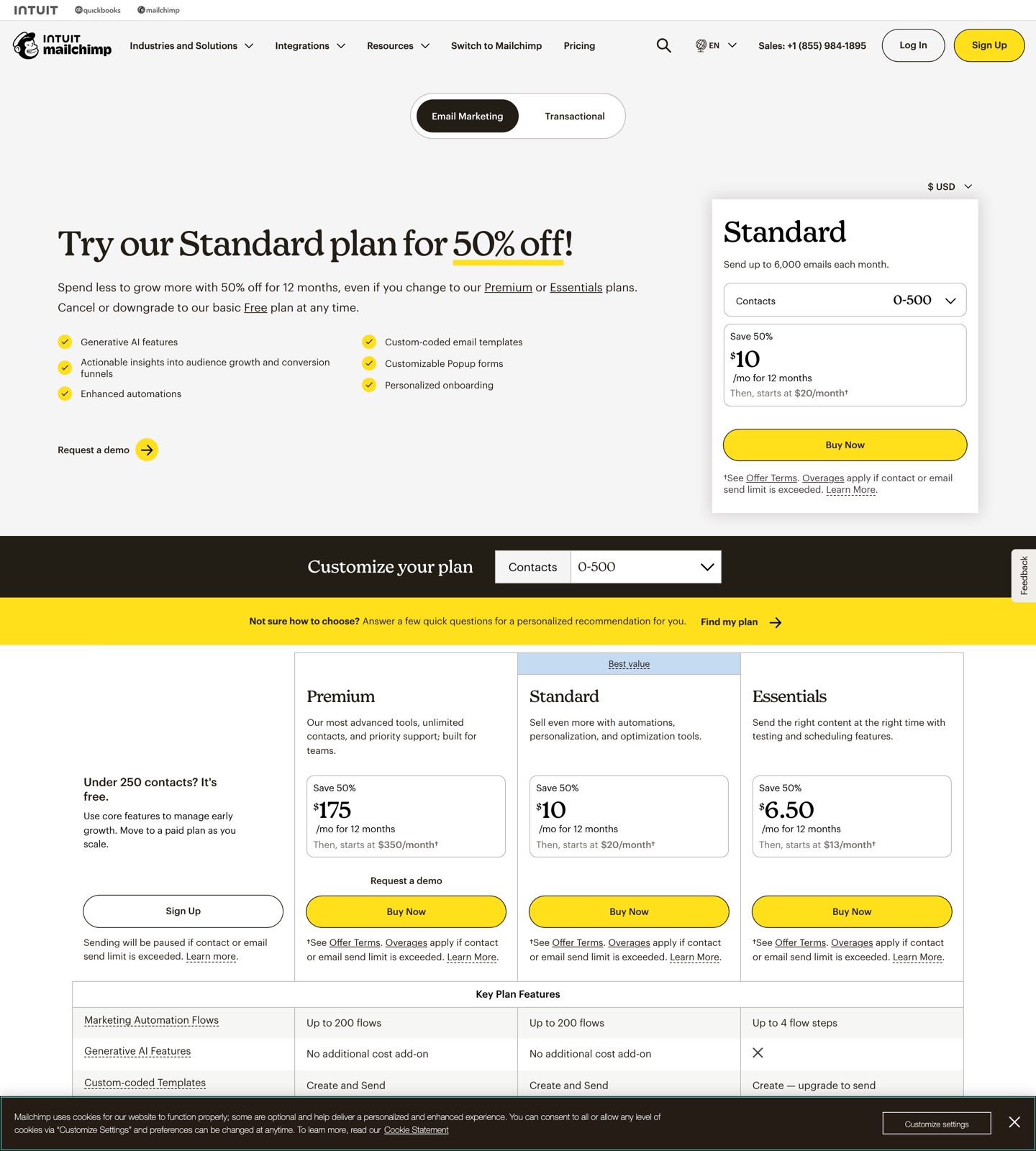
Buying shortcut
Which Mailchimp plan should you choose?
Start here
Free
Testing Mailchimp or sending occasional newsletters. It is the first tier to check when you only need the core Mailchimp workflow. Watch for: Mailchimp branding remains
Public price
$0
For very small lists and basic email marketing.
Main upgrade
Essentials
Small teams that need branded newsletters without advanced automation. Inspect this tier when the lower tier starts blocking reporting, automation, collaboration, or support needs. Watch for: Contact-based costs rise as the list grows
Public price
From about $13/mo
Entry paid plan, billed by contact tier.
High-volume or advanced
Premium
Larger marketing teams that need advanced controls and support. Treat this as the serious-operations tier, especially if the first two plans leave key limits or add-ons unresolved. Watch for: Expensive for SaaS lists with many low-frequency product users
Public price
From about $350/mo
Higher-tier plan for advanced segmentation and larger teams.
Cost scenarios
Pricing pages show the entry point. These scenarios show what the plan means in real buying situations.
Early SaaS with 2,000 users and light lifecycle email
Mailchimp: Free or low paid tier, depending on contacts and features. Sequenzy: Free up to 2,500 emails/month, then $19/month for 15,000 emails. If your send volume is low, Sequenzy can stay free even as your user list grows. The first paid Sequenzy tier works out to about $1.27 per 1k included emails when the allowance is fully used.
Growing SaaS with 10,000 users but only 50,000 monthly lifecycle emails
Mailchimp: Contact tier determines the bill, even for users who rarely receive email. Sequenzy: $49/month for 60,000 emails, about $0.82 per 1k included emails. This is where Sequenzy is easier to forecast. You pay around the actual email allowance you need, not for every dormant user sitting in the product database.
Marketing team using landing pages, newsletters, and broad campaigns
Mailchimp: Mailchimp Standard or Premium may be justified. Sequenzy: $99/month for 120,000 emails, about $0.83 per 1k included emails. Mailchimp can be a better fit if you need a general marketing suite. Sequenzy is better when product lifecycle email is the main job and you want a clear email-unit cost.
What to watch for
Mailchimp pricing depends on contact count, so inactive, low-frequency, and imported contacts can still push you into higher tiers.
Advanced automation, testing, and segmentation are tiered, so the plan you need may not be the cheapest paid plan.
SaaS teams often need lifecycle triggers, payment events, and transactional email alongside marketing email; those workflows can require extra setup or separate tools.
How Mailchimp pricing really works
Mailchimp looks simple at the entry point: start free, upgrade when you need more. The hidden complexity is that three things move together: your contact count, your feature needs, and your monthly send requirements. A small newsletter can stay inexpensive. A SaaS user base can become expensive because users who are not receiving many emails still count toward the pricing tier.
For SaaS, the most important question is not "What is the cheapest plan?" It is "What happens when we import every product user, trial user, expired trial, customer, lead, and churned account?" If all of those records count as contacts, your email platform bill starts to look like a user database tax. With Sequenzy, the practical comparison point is more direct: $99/month includes 60,000 emails, $99/month includes 120,000 emails, and the $99 tier works out to about $0.83 per 1k included emails.
When Mailchimp is worth paying for
Mailchimp makes sense when you want a broad marketing toolkit: newsletters, templates, forms, landing pages, simple campaigns, and brand-friendly creative workflows. It is familiar, mature, and approachable for non-technical teams.
It is less ideal when the core workflow is product behavior: trial started, activation milestone missed, subscription created, payment failed, account inactive, plan upgraded, feature adopted. You can build some of this in Mailchimp, but the product is not priced or shaped primarily around SaaS lifecycle email.
The Standard tier is often the realistic comparison point for teams that want customer journeys, segmentation, and optimization. Essentials can be fine for newsletters, but SaaS lifecycle work usually needs more than basic campaigns. Premium is a separate buyer profile: larger marketing teams that need advanced segmentation, testing, permissions, and support.
If Mailchimp is the default because it is familiar, use the Mailchimp alternatives guide and the Mailchimp comparison to test that assumption. Familiarity is useful, but it should not hide the cost of storing a whole product user database in a contact-priced marketing tool.
Mailchimp vs Sequenzy pricing logic
Sequenzy keeps unlimited contacts on every plan and charges based on email volume. That fits SaaS better when the user base is large but communication frequency varies by lifecycle stage.
Mailchimp is easier to justify for classic marketing teams. Sequenzy is easier to justify when your email database is your product user base and the cost should map to actual sending.
Choose Mailchimp when your email program is classic marketing: newsletters, campaigns, landing pages, and brand workflows. Choose Sequenzy when the most important emails are onboarding, trial conversion, failed payment, retention, upgrade, and product-adoption messages.
Mailchimp vs Sequenzy
How Mailchimp compares with Sequenzy, which bills on emails sent rather than contact count.
How Sequenzy prices the same volume
Sequenzy price per 1k emails
$0.82 / 1k at $49/mo for 60k emails
Verdict
Mailchimp is a credible all-purpose marketing platform, but it is not priced around SaaS lifecycle behavior. If your list is a product user base where many contacts receive irregular onboarding, trial, dunning, or reactivation emails, Sequenzy's unlimited-contact model is usually cleaner: $99/month includes 120,000 emails, or about $0.83 per 1k included emails.
FAQ
Sources checked · Jun 16, 2026