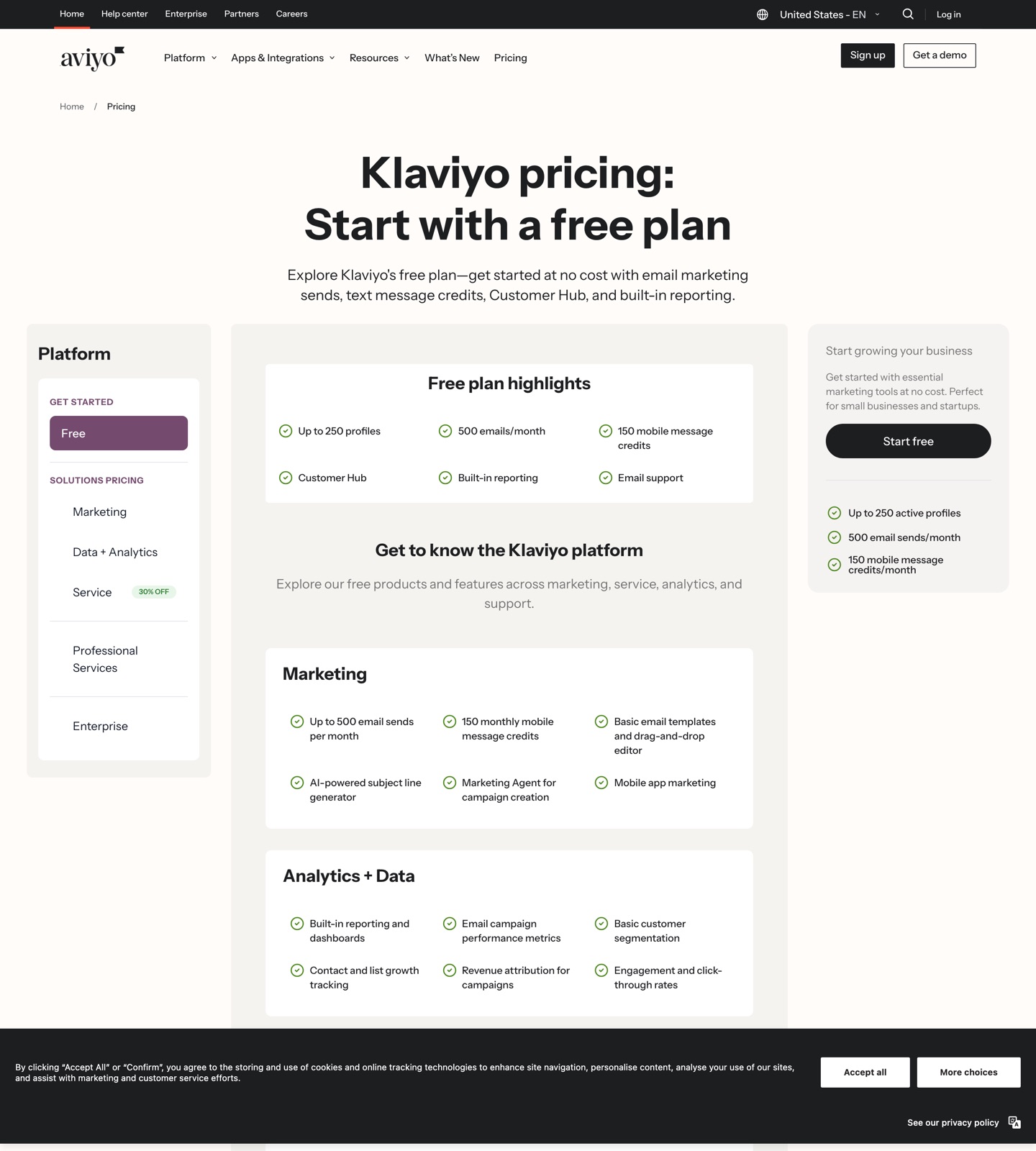
Klaviyo's pricing page
Captured from klaviyo.com. Pricing changes often, so confirm the current numbers on the live page.
Buying shortcut
Which Klaviyo plan should you choose?
Start here
Free
New stores testing Klaviyo or sending very low volume. It is the first tier to check when you only need the core Klaviyo workflow. Watch for: Profile and send limits are tight
Public price
$0
Up to 250 active profiles and 500 emails per month.
Main upgrade
Stores that primarily need email campaigns and automated flows. Inspect this tier when the lower tier starts blocking reporting, automation, collaboration, or support needs. Watch for: Costs rise as active profiles grow
Public price
From about $20/mo
Scales by active profile count and bills monthly in advance.
High-volume or advanced
Email and SMS
Ecommerce teams that use both email and text in lifecycle flows. Treat this as the serious-operations tier, especially if the first two plans leave key limits or add-ons unresolved. Watch for: SMS budgeting can be hard if message volume spikes
Public price
From $35/mo
Starts at $35/month for 251-500 active profiles with 1,250 SMS/MMS credits included. Scales with profile count alongside the email plan. SMS usage beyond included credits costs extra.
What Klaviyo costs at your size
The cheapest plan that covers each size, from Klaviyo's published pricing. Check the sources below for the date it was verified.
Cost scenarios
Pricing pages show the entry point. These scenarios show what the plan means in real buying situations.
Shopify store with abandoned cart and post-purchase flows
Klaviyo: Klaviyo paid email plan, possibly SMS add-on. Sequenzy: Lower email cost, but no ecommerce SMS suite. Klaviyo can justify its price when ecommerce revenue attribution is the main decision point.
SaaS with 20,000 product users and moderate lifecycle email
Klaviyo: Profile-based pricing grows with user count. Sequenzy: Email-volume pricing with unlimited contacts. SaaS teams usually pay for too much ecommerce-specific capability in Klaviyo.
Brand using both email and SMS heavily
Klaviyo: Email plan plus SMS usage. Sequenzy: Email only. Klaviyo is better if SMS orchestration is central. Sequenzy is better if the workload is email lifecycle automation.
What to watch for
Klaviyo bills around active profiles, so list hygiene matters.
SMS can materially change the monthly bill and should be budgeted separately from email.
Many standout Klaviyo features are ecommerce-specific and may not help SaaS teams.
Costs beyond the headline price
- The real bill follows total active profiles, not how many contacts you actually email, and exceeding your tier moves you to a profile-compliant plan on the next cycle.
- Self-serve plans bill monthly in advance with no annual discount, downgrades take effect at the next cycle with no mid-cycle refunds, and auto-downgrade must be switched on manually.
- SMS, MMS and WhatsApp run on separate credit-based mobile spend of about $15 above the email tier, and unused credits do not roll over to the next month.
- Flexible sending overages are billed upfront at your current plan unit rate when you pass your send or profile capacity.
- Add-ons such as Reviews from $25 per month, Marketing Analytics from $100 per month and Advanced KDP from $500 per month each bill separately on top of the email plan.
The real Klaviyo pricing question
Klaviyo is not priced like a simple newsletter tool. It is priced like an ecommerce revenue platform. That matters because the product is strongest when the revenue from automated flows is easy to measure: abandoned carts, browse abandonment, post-purchase upsells, winbacks, and VIP segments.
If those workflows are your business model, Klaviyo's price can be rational. If you are a SaaS company sending onboarding, activation, dunning, and retention emails, you are likely paying for ecommerce capabilities you will not use.
Where Klaviyo earns the premium
Klaviyo earns its price when your customer and product catalog data are central to email performance. Shopify stores benefit from product recommendations, purchase-based segmentation, and revenue attribution that connects emails back to orders.
SMS is another reason brands choose Klaviyo. When email and SMS live inside the same automation system, ecommerce teams can coordinate cart recovery and promotional campaigns without stitching together separate tools.
The pricing risk is carrying non-revenue profiles or enabling channels without modeling message costs. For ecommerce, list hygiene and suppression management are part of keeping Klaviyo efficient. For SaaS, the mismatch is more fundamental: active profiles are usually product users, not shoppers, and the most valuable events are usage and billing events rather than catalog and cart behavior.
If you are not an ecommerce brand, compare the Klaviyo alternatives and the Klaviyo comparison before paying for commerce-specific depth. Klaviyo is excellent when the email program recovers carts and drives repeat purchases. That is different from SaaS onboarding and retention.
Klaviyo vs Sequenzy for pricing fit
Klaviyo prices around active profiles and ecommerce growth. Sequenzy prices around email volume and SaaS lifecycle workflows. If your email list is mostly customers shopping online, Klaviyo is probably the stronger tool. If your "list" is really a product user database, Sequenzy usually maps cost to value more directly.
Choose Klaviyo when product catalog data, Shopify events, SMS, and ecommerce revenue attribution are central. Choose Sequenzy when the email program follows product usage, trial progress, subscription state, and retention risk.
Klaviyo vs Sequenzy
How Klaviyo compares with Sequenzy, which bills on emails sent rather than contact count.
How Sequenzy prices the same volume
Sequenzy price per 1k emails
$0.82 / 1k at $49/mo for 60k emails
Verdict
Klaviyo is the premium ecommerce answer. It is not trying to be the cheapest email platform, and for serious Shopify brands that is fine. For SaaS lifecycle email, profile-based pricing and ecommerce-first features usually make Sequenzy the more focused option.
FAQ
Sources checked · Oct 8, 2026