Compare customer-led retention against a CRM suite
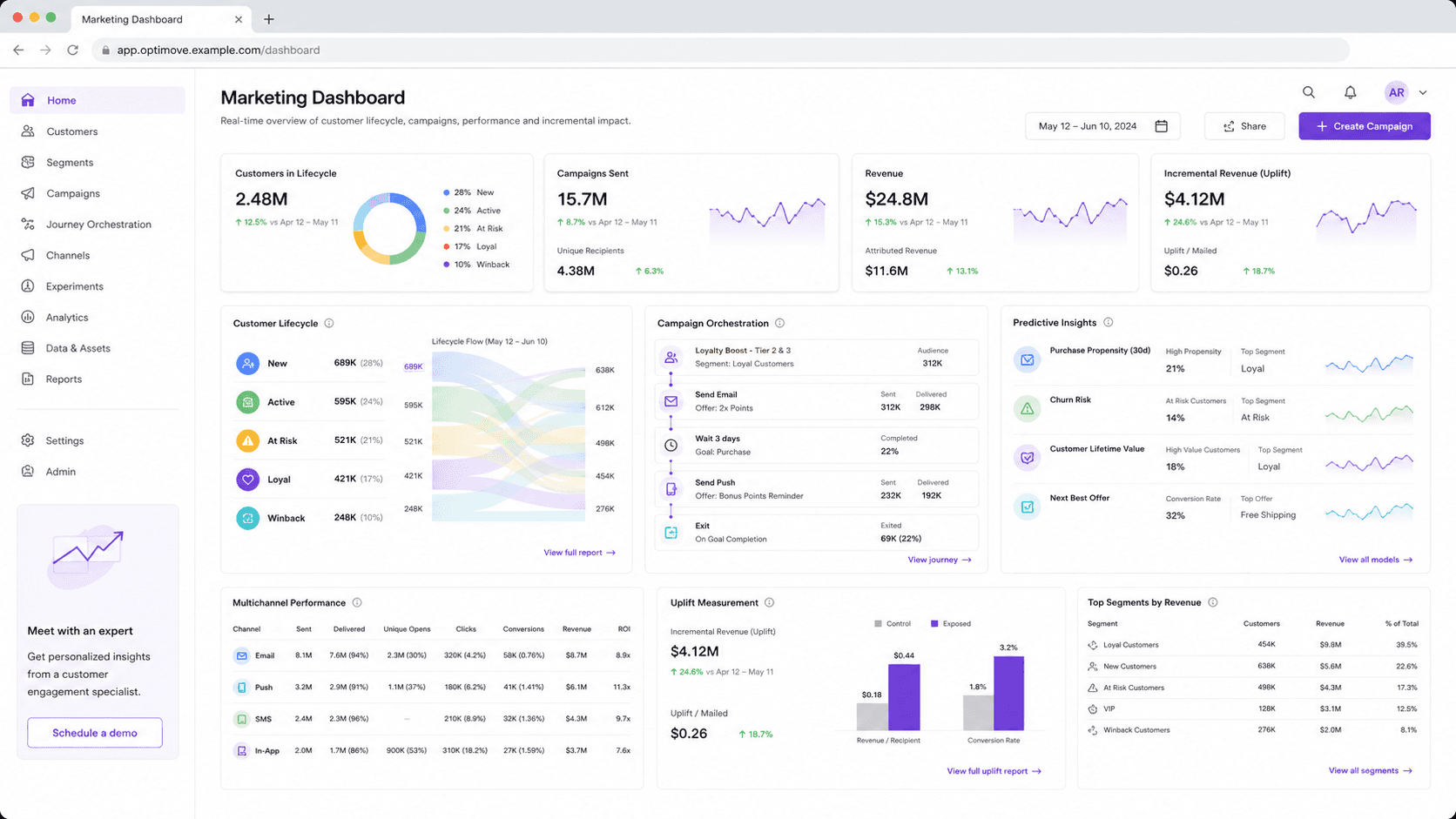
Optimove is focused on predictive retention strategy, customer analytics, and lifecycle campaign prioritization. HubSpot is a broader CRM suite for marketing, sales, service, forms, landing pages, content, and automations.
The decision depends on whether the company needs retention intelligence or a shared CRM system.
Use-case table
| Use case | Better starting point | What to verify |
|---|---|---|
| Predictive customer segmentation and retention orchestration | Optimove | Review customer models, lifecycle states, campaign priority, and retention analytics. |
| Marketing, sales, service, and CRM workflows in one ecosystem | HubSpot | Review required hubs, tiers, CRM objects, sales workflows, and service needs. |
| Team wants customer-led lifecycle strategy | Optimove | Optimove is stronger when customer value and risk determine messaging. |
| Company wants one source for contacts, deals, forms, and nurture | HubSpot | HubSpot is stronger when CRM operations are the central requirement. |
| Email-first storefront and subscription lifecycle | Sequenzy | Sequenzy fits when neither a CRM suite nor predictive retention layer is needed. |
Where Optimove is stronger
Optimove is stronger when the business wants to orchestrate campaigns based on customer state, value, and behavior. It is more retention-intelligence oriented than CRM-suite oriented.
It is less useful if sales and service workflows are the main reason to buy.
Where HubSpot is stronger
HubSpot is stronger when the company wants a shared customer record across marketing, sales, and service. It can be more coherent when email is only one part of a broader CRM process.
Before replacing Optimove, decide how predictive segments, campaign conflicts, and lifecycle states will be represented in HubSpot.
Pricing reality
Optimove is listed as custom enterprise pricing based on customer data, channels, modules, and contract scope. HubSpot is listed as variable pricing based on plan, contacts, usage, and selected features. Sequenzy is listed at $49/month for the cited email-first scope.
Optimove pricing should be justified by predictive retention orchestration. HubSpot pricing should be modeled around hubs, seats, marketing contacts, CRM usage, automation scope, and reporting needs.
Review signals
The cited Optimove review themes point to predictive segmentation, journey orchestration, customer analytics, multichannel campaigns, setup effort, and pricing clarity. The cited HubSpot review themes should be read for CRM adoption, reporting, sales and marketing alignment, ease of use, and the total cost of hubs and contacts. The review split is retention intelligence versus CRM-suite alignment.
Migration checklist
- Separate retention models from CRM records and sales workflows.
- Export segments, suppressions, custom fields, templates, and campaign baselines.
- Map customer attributes into HubSpot properties only where they will be used.
- Rebuild core CRM and email workflows before migrating advanced retention campaigns.
- Compare performance by customer segment after migration.
Buying questions to ask
- Is the goal retention intelligence or CRM centralization?
- Which HubSpot hubs and tiers are required?
- Can HubSpot preserve lifecycle states and customer scores?
- Who owns CRM governance and campaign QA?
- How will retention impact be measured?
Use-case matchups
| Need | Better fit | Why |
|---|---|---|
| Retention intelligence and customer orchestration | Optimove | Optimove is built around customer decisions, lifecycle states, and prioritizing campaigns. |
| CRM centralization across sales, marketing, and service | HubSpot | HubSpot is stronger when the company wants a broader CRM suite. |
| Focused store, Stripe, and transactional email | Sequenzy | Sequenzy fits when CRM-suite overhead and predictive orchestration are not needed. |
Best Fit by CRM Operating Model
Best retention platform for customer-led campaign decisions
Optimove fits teams whose CRM marketing program depends on customer value, lifecycle state, experimentation, and campaign priority. It should be tested first when the marketing team needs a retention-decision layer that tells them which campaign to send next across valuable customer segments.
Best CRM suite for sales, marketing, and service operations
HubSpot is the better fit when the company wants one CRM system for contacts, pipeline, service, forms, automation, and reporting. Choose it when sales and service context are as important as retention campaign orchestration.
Best email platform for focused store and Stripe lifecycle
Sequenzy fits when the team needs lifecycle and transactional email without adopting a CRM suite or predictive retention layer. It is most relevant for teams that want store, subscription, payment, and transactional triggers in one email product instead of a full customer-intelligence platform.
Decision checklist
- Choose Optimove if customer retention strategy is the main problem.
- Choose HubSpot if CRM centralization and cross-team operations matter most.
- Avoid Optimove if sales and service CRM are the real gaps.
- Avoid HubSpot if it cannot preserve the needed customer scores and retention logic.
- Consider Sequenzy if email automation and transactional messaging are enough.
Where Sequenzy fits
Sequenzy is the focused email alternative for Shopify/WooCommerce automations, newsletters, transactional email, and Stripe lifecycle messages without CRM-suite overhead or Optimove-level analytics.