Compare predictive retention strategy against flexible event messaging
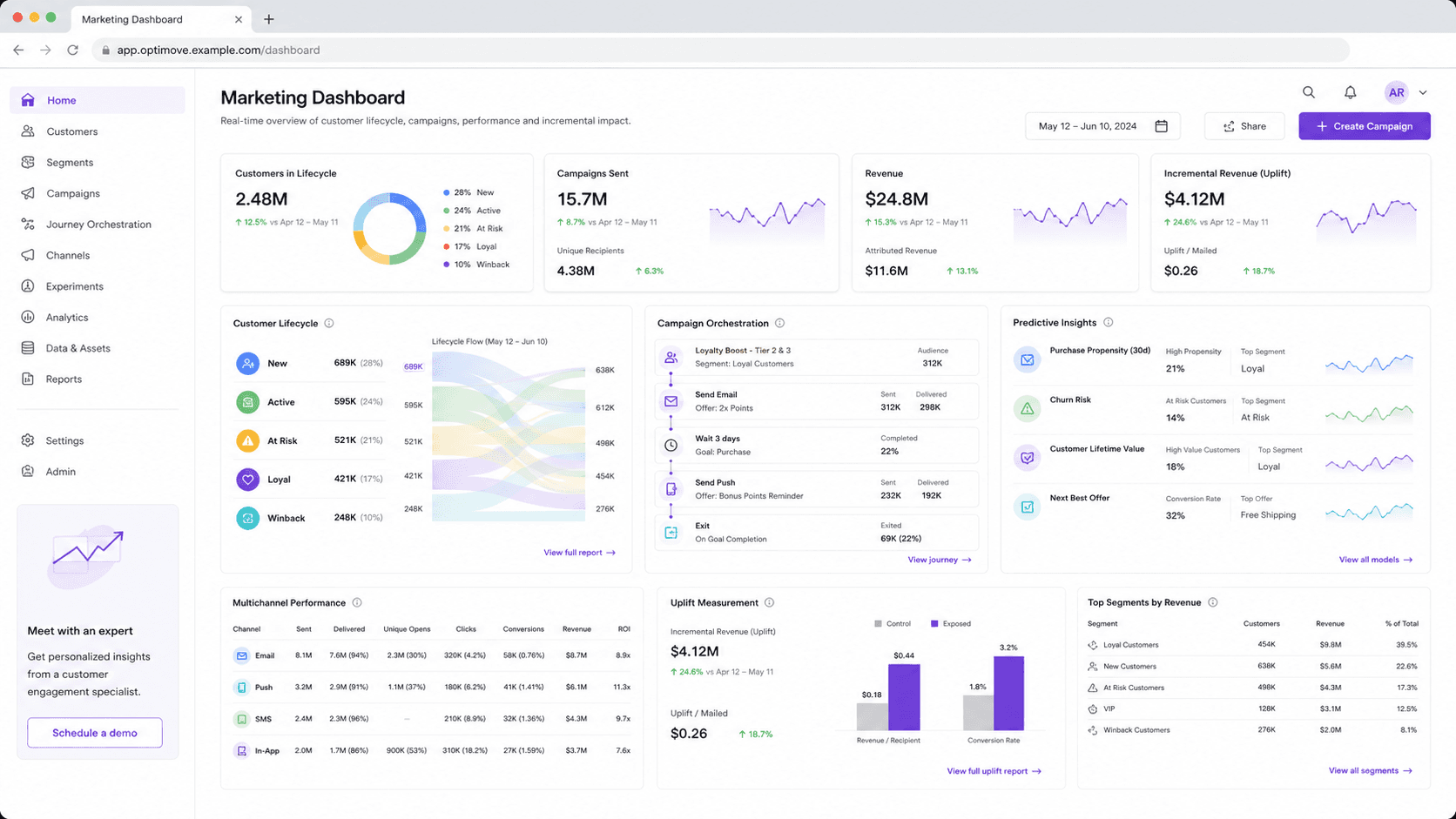
Optimove is customer-led: predictive segments, lifecycle states, campaign priority, and retention analytics. Customer.io is event-led: custom events, attributes, APIs, and messaging logic that technical growth teams can shape around their product or store data.
The decision is whether the team needs built-in retention intelligence or a flexible event messaging canvas.
Use-case table
| Use case | Better starting point | Implementation implication |
|---|---|---|
| Predictive segments and customer lifecycle prioritization | Optimove | Expect customer modeling, segment governance, and retention reporting work. |
| Custom event-triggered messages across product or commerce events | Customer.io | Expect event design, API work, attribute management, and data QA. |
| Retention team wants a customer strategy layer | Optimove | Optimove is stronger when customer states drive decisions. |
| Technical lifecycle team wants flexible journey logic | Customer.io | Customer.io fits when the team can instrument and maintain its own event model. |
| Email-first storefront and subscription lifecycle | Sequenzy | Sequenzy fits when custom event infrastructure and predictive orchestration are unnecessary. |
Where Optimove is stronger
Optimove is stronger when the marketing team needs customer intelligence out of the platform: lifecycle states, predictive groups, campaign priority, and retention measurement. It is useful when the decision logic is more important than raw event flexibility.
It may be too structured if the business wants to build every journey from custom product events.
Where Customer.io is stronger
Customer.io is stronger when the team has a clear event model and wants flexible messaging rules. It fits SaaS, marketplaces, apps, and technical ecommerce teams that want to trigger campaigns from custom data.
Before replacing Optimove, confirm whether customer scoring and campaign arbitration are still needed or can be rebuilt externally.
Pricing reality
Optimove pricing should be justified by customer intelligence and retention orchestration. Customer.io pricing should be modeled around profiles, message volume, data pipelines, event instrumentation, and technical ownership.
Review signals
The cited Optimove review themes point to predictive segmentation, journey orchestration, customer analytics, multichannel campaigns, setup effort, and pricing clarity. The cited Customer.io review themes point to event-driven journeys, integrations, campaign usability, and technical setup. The review split is whether customer-state decisioning or custom event flexibility matters more.
Migration checklist
- Translate Optimove customer states into events, attributes, or segments.
- Export suppressions, templates, campaign baselines, and segment definitions.
- Define event owners for storefront, app, billing, backend, and warehouse data.
- Rebuild high-value lifecycle journeys before migrating advanced retention logic.
- Compare retention outcomes by segment after migration.
Buying questions to ask
- Does the team want built-in customer intelligence or custom event flexibility?
- Who owns event instrumentation and data quality?
- Can Customer.io represent required customer scores and lifecycle states?
- How will campaign priority be resolved?
- What reporting proves retention impact?
Use-case matchups
| Need | Better fit | Why |
|---|---|---|
| Built-in retention intelligence and customer decisioning | Optimove | Optimove gives marketers more opinionated customer strategy and prioritization. |
| Flexible event-based lifecycle messaging | Customer.io | Customer.io is stronger when the team wants to model custom product events and build journeys around them. |
| SaaS and ecommerce email without event-infrastructure overhead | Sequenzy | Sequenzy fits teams that want lifecycle and transactional email with a narrower setup. |
Best Fit by Event Model
Best retention platform for built-in customer decisioning
Optimove fits teams that want the platform to guide customer treatment, campaign priority, and retention strategy from customer analytics.
Best lifecycle messaging platform for custom product events
Customer.io is the better fit when the team has a custom event model and wants to build detailed product-led journeys around those events.
Best email platform for SaaS and ecommerce lifecycle without heavy setup
Sequenzy fits when the useful work is lifecycle and transactional email around store or subscription events, not maintaining a broader event infrastructure.
Decision checklist
- Choose Optimove if the team wants customer analytics and campaign prioritization built into the platform.
- Choose Customer.io if custom events and flexible lifecycle execution are more important.
- Avoid Optimove if the team prefers owning the event model and journey logic directly.
- Avoid Customer.io if marketers need more built-in retention strategy and customer scoring.
- Consider Sequenzy if Stripe, store events, newsletters, and transactionals cover the need.
Where Sequenzy fits
Sequenzy is the simpler email-first option for Shopify/WooCommerce automations, newsletters, transactionals, and Stripe lifecycle messages without Customer.io event infrastructure or Optimove-level predictive orchestration.
How to make the Optimove vs Customer.io decision
Optimove is the better fit when you need CRM marketing orchestration. Customer.io is the better fit when your team prefers its approach to email marketing and automation.
| Decision area | Pick Optimove when... | Pick Customer.io when... |
|---|---|---|
| Primary workflow | Its core strength matches the campaign you need next. | Its core strength matches the campaign you need next. |
| Data model | Your customer data already fits its segments and triggers. | Your customer data already fits its segments and triggers. |
| Team ownership | Someone can own setup, testing, and reporting inside the tool. | Someone can own setup, testing, and reporting inside the tool. |
| Budget | The price is justified by workflows you will use now. | The price is justified by workflows you will use now. |