
Overview
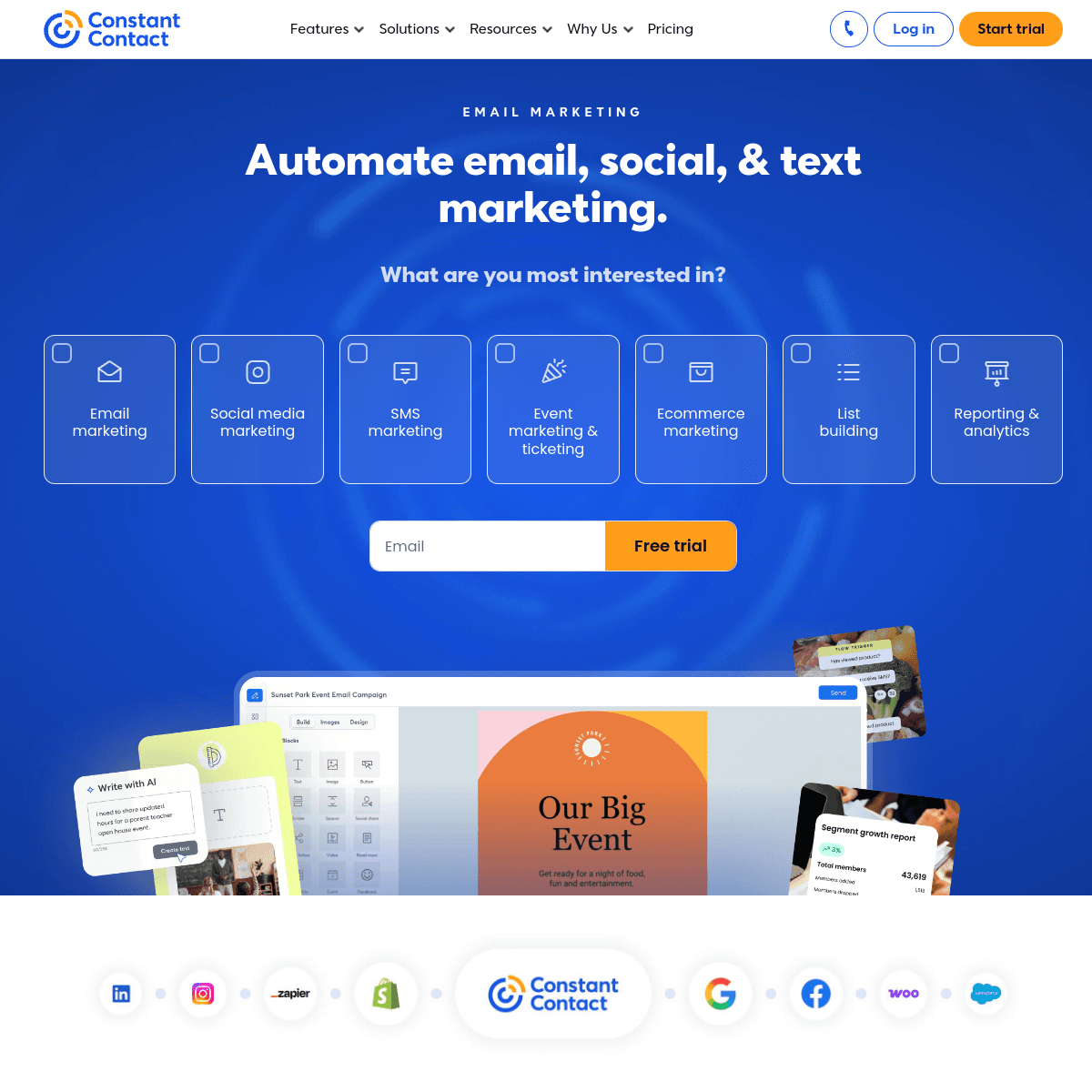
Constant Contact and HubSpot serve different markets entirely. Constant Contact is an established small business email platform with event marketing. HubSpot is an enterprise suite with CRM, sales, marketing, and service capabilities. The comparison is really about scale and needs.
Use-case matchups
| Need | Better fit | Why |
|---|---|---|
| Affordable newsletters and small-business email | Constant Contact | It is simpler and much cheaper when email and events are the main work. |
| Full CRM, sales, marketing, and service platform | HubSpot | HubSpot consolidates more business functions into one system. |
| Event marketing and local organization outreach | Constant Contact | Event registration, support, and simple campaign tools are a better small-business fit. |
| Sales-marketing alignment and attribution | HubSpot | CRM records, lifecycle stages, deals, and reporting can live together. |
| SaaS subscription lifecycle email | Sequenzy | Stripe-aware lifecycle email is not the same as small-business event email or a full CRM suite. |
Best Fit by Company Scale
Best email marketing tool for small-business newsletters and events
Constant Contact is the better fit when the team mainly needs email campaigns, event registration, simple lists, and approachable support. It avoids the cost and administration of a full CRM suite when sales, service, and marketing operations are still lightweight.
Best marketing platform for sales-led teams
HubSpot is the better fit when marketing emails need to connect directly to contacts, deals, lifecycle stages, attribution, sales tasks, and service workflows. Its price makes sense when the company is buying a shared revenue operating system, not just an email sender.
Best email marketing tool for SaaS subscription lifecycle email
Sequenzy is the better fit when the main lifecycle is product and billing state rather than CRM deals. It is more focused than HubSpot for teams that need Stripe-triggered onboarding, retention, and transactional email without adopting a full sales suite.
Pricing reality
Constant Contact costs $80/month for 10k contacts. HubSpot Marketing Hub Professional is $800+/month. That's 10x the price. The difference reflects HubSpot's comprehensive platform beyond email.
Platform Scope
Constant Contact focuses on email marketing with some social tools and event management. HubSpot includes full CRM, sales tools, marketing automation, SEO, content management, and more. If you need the full suite, HubSpot delivers.
Event Marketing
Constant Contact has built-in event management with registration, ticketing, and follow-ups. HubSpot doesn't include event features in standard plans. For event-focused organizations, Constant Contact provides native tools.
CRM and Sales
HubSpot's free CRM integrates with marketing for complete customer lifecycle management. Constant Contact has no CRM. For sales-marketing alignment, HubSpot is the comprehensive choice.
Ease of Use
Constant Contact is simpler - focused on email with straightforward features. HubSpot has a massive learning curve matching its massive feature set. For simplicity, Constant Contact wins.
For SaaS Companies
Neither offers native Stripe integration for subscription automation. HubSpot is expensive and broad. Constant Contact is affordable but lacks SaaS features. For SaaS companies, consider Sequenzy which offers purpose-built SaaS automation at the right price.
Making the Choice
Choose Constant Contact for affordable email marketing with events. Choose HubSpot when you need a complete marketing, sales, and CRM platform. For SaaS, consider Sequenzy.
The Hidden Cost of HubSpot
HubSpot's $800+/month sticker price is just the beginning. Onboarding for Marketing Hub Professional starts at $3,000, and most companies need implementation help that can run $5,000-$15,000 with a HubSpot partner. Add premium features like custom reporting, additional users, and API limits, and your actual annual spend can easily triple the base price.
Constant Contact's pricing is what you see - $80/month with phone support included. No onboarding fees, no hidden charges, no surprise overages. For a local business sending weekly newsletters and managing quarterly events, the total cost of ownership over three years with Constant Contact is a fraction of what HubSpot would cost for similar email functionality.
When HubSpot's Investment Pays Off
HubSpot earns its premium when your business needs marketing-to-sales alignment. If you have a sales team that needs to know which prospects opened emails, visited pricing pages, and downloaded whitepapers, HubSpot's unified CRM makes this seamless. The lead scoring automatically prioritizes hot prospects, and the attribution reporting shows which marketing channels drive actual revenue.
Constant Contact cannot provide this. It sends emails and tracks opens, but it has no concept of a sales pipeline, deal stages, or multi-touch attribution. If your business growth depends on connecting marketing efforts to sales outcomes, HubSpot's comprehensive platform justifies the investment in ways that simple email metrics never could.
Scalability and Growth Path
One advantage of starting with Constant Contact is simplicity - you can be up and running in an afternoon. But many businesses outgrow it within a year or two as their marketing needs become more sophisticated. The migration to a more capable platform then involves rebuilding everything from scratch.
HubSpot's growth path is smoother. Start with the free CRM, add Marketing Hub Starter for basic email, and upgrade to Professional when you need automation and reporting. Everything builds on the same foundation. The downside is that this growth path locks you into HubSpot's ecosystem, and the pricing jumps between tiers are significant - from free to $20/month to $800/month with little middle ground.
Enterprise Security and Compliance
Enterprise email platforms must meet strict security and compliance requirements. Constant Contact and HubSpot offer different levels of SOC 2 compliance, GDPR support, SSO, and role-based access control.
Data residency, encryption standards, and audit logging requirements vary by industry. Compare how each platform addresses healthcare (HIPAA), financial services, and European data protection regulations. These compliance features often determine which platforms enterprises can even consider.
Multi-Team and Multi-Brand Management
Large organizations need email platforms that support multiple teams, brands, and business units. Constant Contact and HubSpot handle multi-tenant scenarios differently, from shared templates to separate reporting.
Role-based access, approval workflows, and brand guidelines enforcement help enterprises maintain consistency while giving teams autonomy. Compare how each platform balances centralized control with team-level flexibility for email campaigns.
Integration Ecosystem and Data Architecture
Enterprise email marketing requires deep integration with existing tech stacks. Constant Contact and HubSpot connect differently with CRMs, data warehouses, CDPs, and analytics platforms.
Evaluate webhook reliability, API rate limits, and native integrations with tools your organization already uses. The ability to sync data bidirectionally with your data warehouse and trigger emails from any data source creates the most flexible automation possibilities.
Review signals
The reviews on this page match the positioning. Constant Contact reviewers highlight newsletters, events, fundraising, phone support, and simple campaign execution, while warning that automation can feel dated. HubSpot reviewers highlight CRM-connected marketing and sales alignment, while warning that cost and unused feature breadth can be painful.
Use those reviews to frame the demo. Constant Contact should prove simple campaign and event operations. HubSpot should prove that CRM, attribution, automation, and sales handoff will be used enough to justify the higher total cost.
Migration checklist
| Step | What to confirm |
|---|---|
| Export contacts and consent | Preserve lists, tags, segments, custom fields, opt-in source, unsubscribes, bounces, and spam complaints. |
| Map CRM records | If moving from HubSpot, decide how companies, deals, tasks, notes, lifecycle stages, owners, and sales activity will move or be archived. |
| Rebuild campaigns and workflows | Recreate newsletters, automations, HubSpot workflows, Constant Contact campaigns, and event follow-ups manually. |
| Replace forms and events | Move website forms, popups, landing pages, event registrations, ticketing, surveys, and confirmation pages. |
| Recreate templates | Check brand templates, personalization tokens, unsubscribe links, event modules, and mobile rendering. |
| Reconnect integrations | Verify CRM, ecommerce, payments, webinar, event, analytics, and data warehouse connections. |
| Preserve reporting | Export historical campaign, event, CRM, attribution, and revenue reports before cancelling the old platform. |
| Phase the rollout | Start with a newsletter or low-risk workflow, then move event campaigns, sales handoff, and revenue-critical automation after validation. |
Decision checklist
- Choose Constant Contact if newsletters, events, support, and small-business simplicity are the main needs.
- Choose HubSpot if CRM, sales, service, attribution, and marketing automation need to operate in one system.
- Avoid Constant Contact if lead scoring, CRM ownership, and multi-touch attribution are required.
- Avoid HubSpot if the team only needs email and event campaigns.
- Consider Sequenzy if subscription billing events and SaaS lifecycle email are the core workflow.








