
Overview
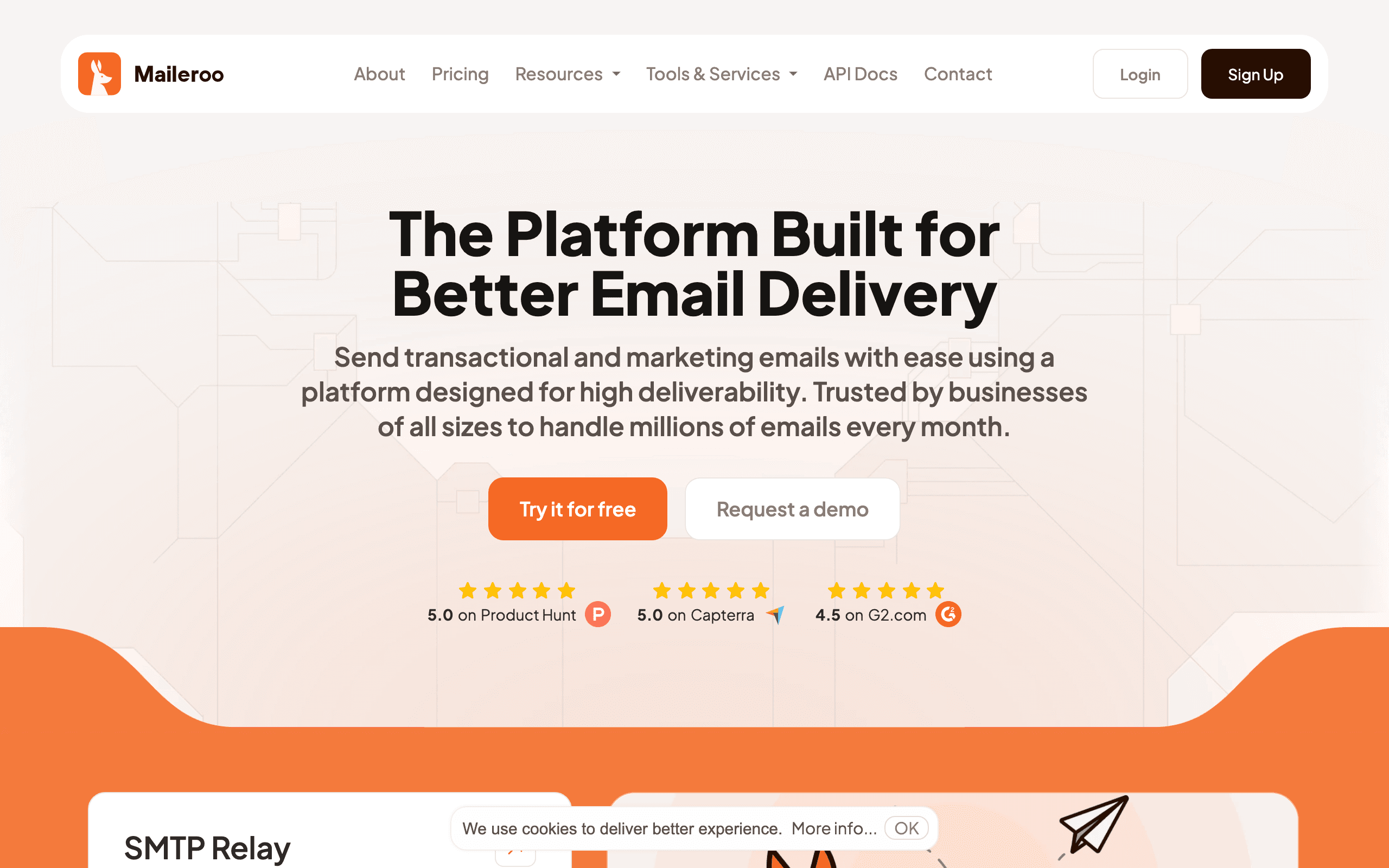
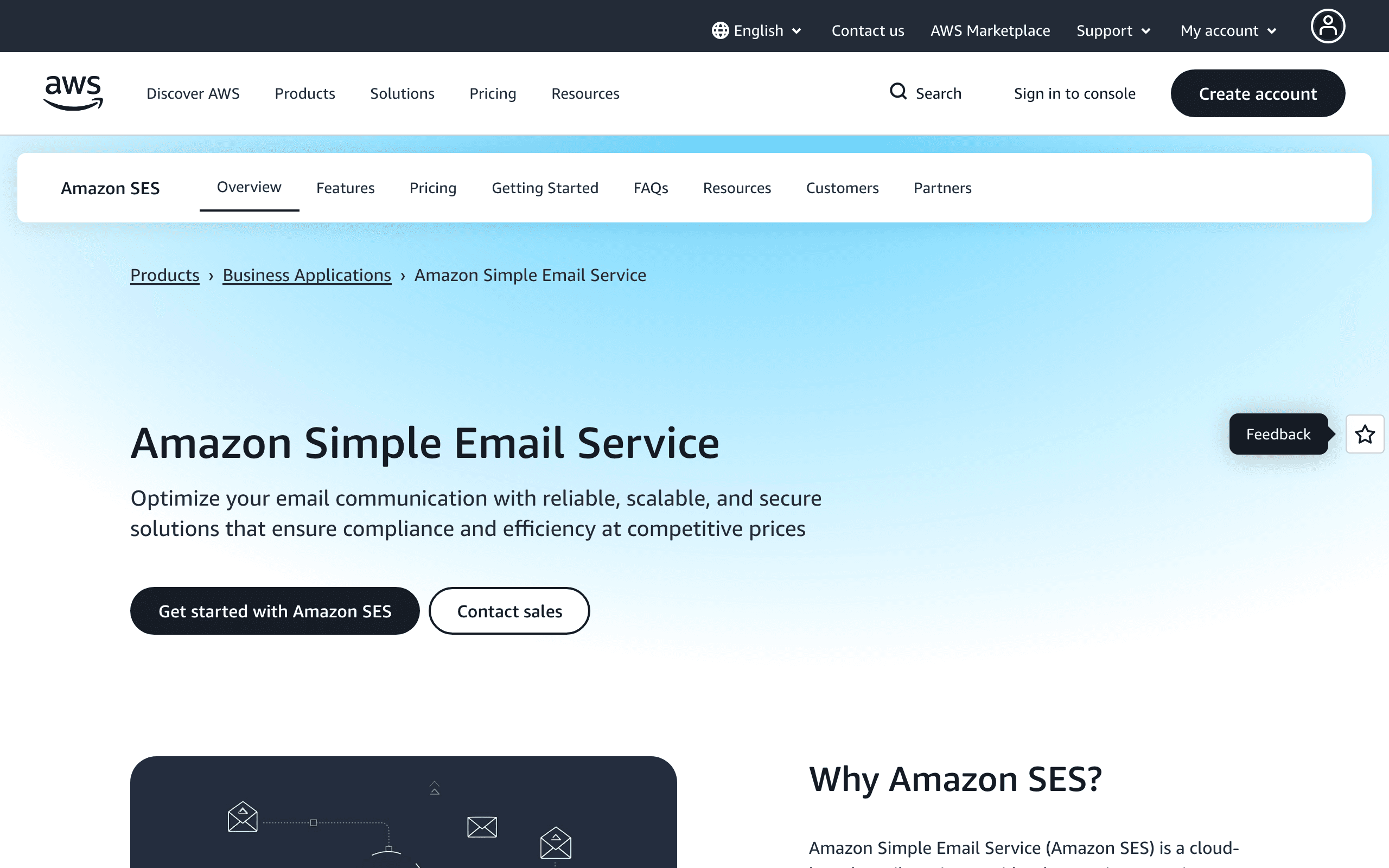
Maileroo and Amazon SES both handle email delivery but approach it differently. Maileroo is a email delivery service with SMTP relay, REST API, and free email verification. Amazon SES is a the cheapest email sending via AWS.
Delivery Approach
Maileroo pairs SMTP relay and a REST API with a feature most competitors charge extra for: email verification, included free on every plan. Pricing starts at $8 a month after a 5,000-email free tier, positioning it as a budget-friendly alternative to bigger providers. Amazon SES, by contrast, is pure sending infrastructure with none of that built in, so the two appeal to different priorities: bundled convenience versus rock-bottom per-email cost.
Amazon SES is the cheapest option at $0.10 per 1,000 emails, but it requires an AWS account and significant DIY setup. You get raw sending power without any frills.
Pricing
Maileroo starts free (5,000 emails/mo) with paid plans from $8/month. Amazon SES $0.10/1k emails. Cheapest sending. AWS required. Complex setup.. Maileroo's free email verification API is a genuine differentiator that can save you money on a separate verification service.
Making the Choice
Choose Maileroo for affordable delivery with free email verification. Choose Amazon SES for cheapest per-email cost. For unified SaaS email, consider Sequenzy.
Email Verification Advantage
Because Maileroo's verification API is free on every plan, you can check addresses before sending without paying a separate vendor for that step. Catching invalid addresses upfront reduces bounce rates and protects sender reputation, the core of good deliverability, which matters more the more user-submitted addresses you process, think signup forms or lead gen. Amazon SES has no equivalent built in, so teams relying on SES for delivery typically add a third-party verification service if they need this at all.
SES ships with no email verification feature, so cleaning a list before sending means bringing in a separate third-party tool and paying for it on top of your SES sending costs. Maileroo folds that verification directly into its $8-and-up plans, which removes a vendor and a line item from your stack. For teams that would otherwise need to stitch verification onto SES themselves, Maileroo's bundled approach is the simpler, though not necessarily cheaper, path.
Pricing and Value
At $8 a month with 5,000 free emails to start, Maileroo sits toward the affordable end of email delivery services. Once volume passes 250,000 emails, dedicated IPs come free, a feature many competitors bill separately for. There is also a 50% nonprofit discount for qualifying organizations. Compared to Amazon SES's raw $0.10 per 1,000 emails, Maileroo costs more per email but bundles verification, IPs, and support that SES leaves entirely up to you.
SES's $0.10-per-1,000 rate has no included features beyond sending itself, so what looks like a bargain rate needs to be weighed against everything Maileroo bundles for its $8 monthly floor: verification, dashboard, templates, and support. Whether SES's lower unit cost wins out depends on your volume and how much of that extra tooling you would otherwise have to build or buy separately. At low to moderate volumes, Maileroo's all-in price can end up cheaper once you count what you are not paying for elsewhere.
Infrastructure and Reliability
Amazon SES runs on AWS's infrastructure and has years of production use across companies sending at massive scale, which counts for something when uptime and delivery reliability are non-negotiable. Maileroo is newer and has not built that same track record yet, even though its feature set and pricing are competitive. For workloads where you cannot afford surprises, SES's history is a real advantage that Maileroo has not had time to match.
Maileroo is still earning its reputation, but its included verification API, dedicated IPs on higher-volume plans, and straightforward pricing make it a reasonable bet for teams willing to try a less established provider. If reliability at any cost matters most, SES's longer history is hard to beat. If you would rather pay a bit more for built-in tooling and are comfortable with a newer vendor, Maileroo's feature set closes a lot of the practical gap.
Use-case matchups
| Use case | Better fit | Why |
|---|---|---|
| Budget delivery with bundled verification | Maileroo | Maileroo includes verification and easier SMTP/API setup. |
| Cheapest raw sending at scale | Amazon SES | SES has extremely low per-email pricing for teams comfortable with AWS. |
| Minimal setup for transactional delivery | Maileroo | Maileroo hides more delivery operations behind a simpler product. |
| Engineering-owned AWS infrastructure | Amazon SES | SES fits teams already managing AWS, SNS, IAM, and deliverability workflows. |
| SaaS lifecycle email with Stripe | Sequenzy | Sequenzy is better when campaigns, transactional email, and billing automation should be unified. |
Pricing reality
Amazon SES is cheaper for raw sending, but it requires AWS setup, production access, bounce/complaint handling, monitoring, and usually separate verification tooling. Maileroo costs more per unit but bundles verification and simplifies delivery operations. Include engineering time in the comparison.
Review signals
The reviews on this page show Maileroo being valued for verification, pricing, and basic delivery. SES feedback should be read through an infrastructure lens: teams value the low cost and AWS scale, but the work shifts to engineering and deliverability operations.
Best Fit by Verification and AWS Control
Best transactional email service for bundled verification
Maileroo is the better fit when user-submitted addresses, signup forms, and list hygiene create real bounce risk. Built-in verification and easier SMTP/API setup are more valuable when the team wants managed delivery operations without building separate validation and suppression workflows.
Best low-cost email infrastructure for AWS-owned sending
Amazon SES is the better fit when the team wants the cheapest sending path and can own the operational work around it. SES is strongest for AWS-native teams that can manage identities, regions, quotas, SNS events, bounces, complaints, and deliverability monitoring.
Best SaaS email platform for lifecycle workflows beyond delivery
Sequenzy fits teams that need customer messaging tied to product and billing state. It is relevant when campaigns, transactional email, Stripe events, subscriber profiles, and lifecycle automation matter more than choosing the cheapest or verification-heavy delivery provider.
Migration checklist
| Step | Moving to Maileroo | Moving to Amazon SES | Moving to Sequenzy |
|---|---|---|---|
| Scope | Confirm SMTP/API sending, verification needs, domain auth, and monthly volume. | Confirm AWS setup, sending region, production access, SNS, bounces, complaints, and monitoring. | Confirm SaaS lifecycle, campaigns, transactional templates, and Stripe events. |
| Data export | Export templates, suppression records, domains, API mappings, and verification logic. | Export templates, suppression records, domains, API mappings, and event-processing requirements. | Export contacts, lifecycle fields, billing IDs, and suppression records. |
| Rebuild workflows | Update SMTP/API calls, verification checks, webhooks, and sender authentication. | Build SES sending, SNS bounce/complaint handling, suppression logic, monitoring, and sender authentication. | Rebuild campaign, transactional, and billing-triggered workflows together. |
| QA | Test verification, bounces, complaints, webhooks, and deliverability. | Test sandbox exit, domain auth, bounces, complaints, monitoring, rate limits, and deliverability. | Test campaign, transactional, and Stripe-triggered paths end to end. |
Decision checklist
- Choose Maileroo if bundled verification and easier delivery operations matter more than the lowest raw sending cost.
- Choose Amazon SES if engineering owns AWS email infrastructure and needs the cheapest high-volume sending.
- Choose Sequenzy if the team wants SaaS campaigns, transactional email, and Stripe-aware automation in one product.









