
Overview
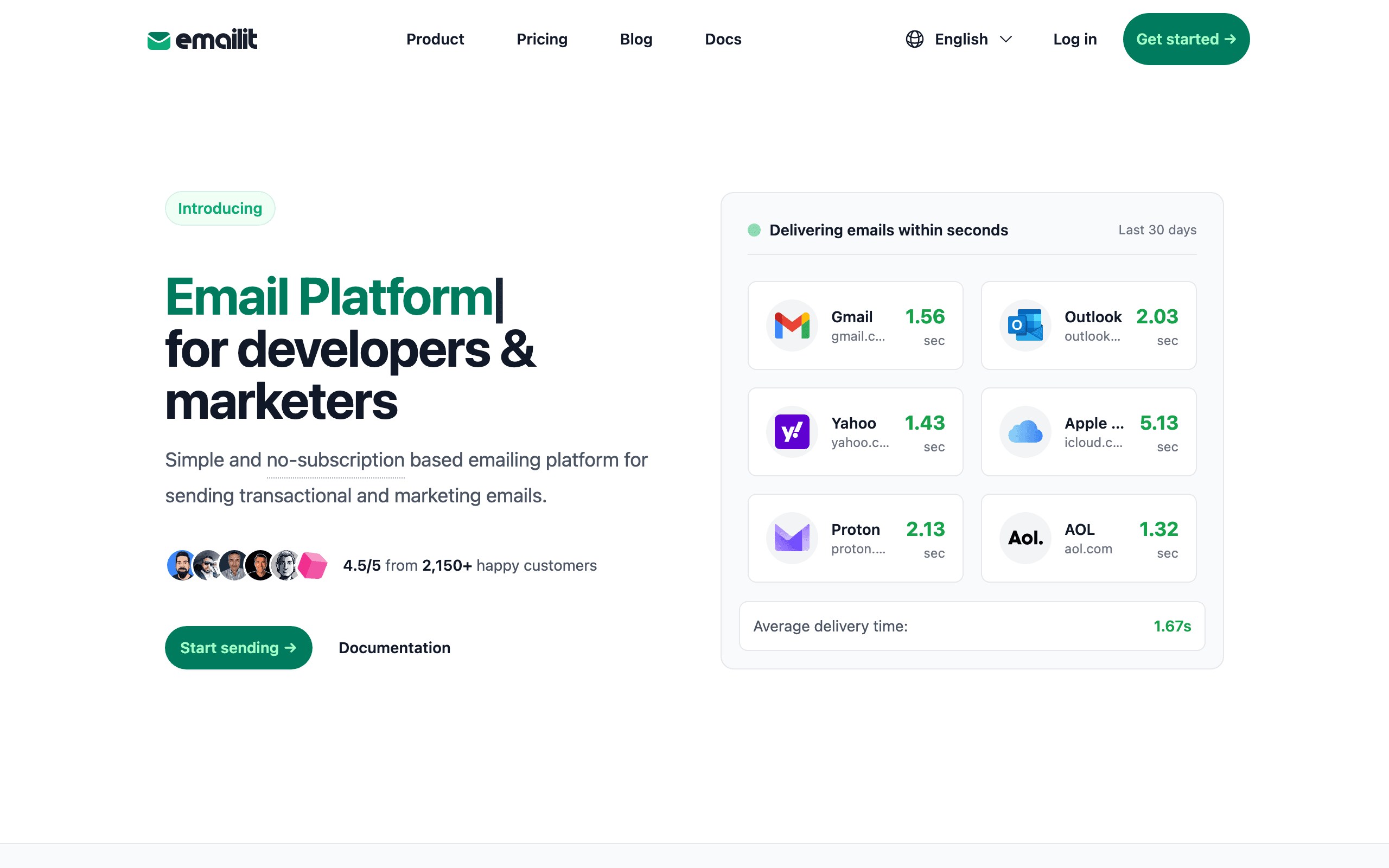
EmailIt and Amazon SES serve different needs in the email space. EmailIt is a budget pay-per-email delivery service. Amazon SES is a cheapest email sending via AWS.
The choice depends on what you need: cheapest per-email pricing (EmailIt) or cheapest per-email (Amazon SES). For SaaS businesses specifically, Sequenzy offers purpose-built features that neither tool provides.
Pricing reality
- EmailIt: ~$1-2 per 10k emails, billed per email with no subscription.
- Amazon SES: $1 - $0.10 per 1,000 emails. AWS required.
- Sequenzy: $99/month for 120,000 emails on a fully managed service, so the infrastructure is handled for you. Compare the tiers on pricing.
Review signals
The EmailIt reviews on this page support the simplicity argument. One reviewer says the team abandoned SES setup after fighting IAM policies for two days, then had EmailIt sending password reset emails in 20 minutes.
The caution signal is scale and monitoring. Another EmailIt reviewer says it worked for basic transactional email but was outgrown at 50k monthly emails when delivery analytics and reputation tracking became important.
Amazon SES reviews reinforce the opposite profile: unbeatable raw cost and deep AWS automation for teams that can handle the setup. The negative SES review flags the real operational burden: sandbox approval, IAM, and the AWS console can slow teams that are not already AWS-native.
Where EmailIt Wins
Cheapest per-email pricing
EmailIt's rate of roughly $1-2 per 10,000 emails is the number to weigh against SES at high volume, where the two sit in similar territory.
No monthly subscription
Nothing is billed monthly with EmailIt, so a slow month costs you only what you actually sent.
Simple SMTP/API
EmailIt exposes SMTP and a REST API without requiring the AWS SDK, so an app can start sending through a standard SMTP relay or a direct API call.
Fast delivery
Speed is a strength for EmailIt, both in sending and setup. One reviewer on this page went from abandoned SES setup to password reset emails in 20 minutes.
Where Amazon SES Wins
Cheapest per-email
Amazon SES offers cheapest per-email, which matters for teams that prioritize this.
Massive scale
Amazon SES offers massive scale, which matters for teams that prioritize this.
AWS integration
Amazon SES offers aws integration, which matters for teams that prioritize this.
EU region
Amazon SES offers eu region, which matters for teams that prioritize this.
Delivery Speed and Reliability
EmailIt sends through a simple SMTP relay and REST API without requiring an AWS account, which gets you sending in minutes but leaves you without deliverability monitoring or reputation tools. Amazon SES runs on AWS infrastructure with a Virtual Deliverability Manager for reputation tracking and built-in DKIM, SPF and DMARC configuration, though new accounts start in sandbox mode limited to verified addresses until AWS approves higher sending volume.
API Design and Developer Experience
EmailIt keeps things minimal: a clean REST API and SMTP relay without the complexity of an SDK, aimed at developers who just want to send email without cloud expertise. Amazon SES integrates deeply with Lambda, SNS and S3 for teams already building on AWS, but that power comes with a more complex console and support that requires a separate AWS support plan if you need help.
Scaling and Cost at Volume
EmailIt charges roughly $1-2 per 10,000 emails with no monthly subscription, so costs scale directly with what you send. Amazon SES charges about $0.10 per 1,000 emails, similar territory, but that low per-email rate assumes you're comfortable configuring AWS billing, IAM roles and sending limits yourself rather than paying for a service that handles that setup for you.
The AWS Complexity Tax
Amazon SES offers the lowest per-email cost in the industry, but that price tag comes with a hidden complexity tax. Setting up SES requires an AWS account, IAM policy configuration, sandbox escape approval, domain verification through Route 53 or manual DNS changes, and integration via the AWS SDK. For teams already running infrastructure on AWS, this complexity is absorbed into existing workflows. For everyone else, it represents a significant barrier.
EmailIt eliminates this complexity entirely. Sign up, get an API key or SMTP credentials, and start sending. There is no sandbox mode to escape, no IAM policies to configure, no AWS console to navigate. The trade-off is fewer features and less infrastructure control, but for teams that just need to send transactional emails reliably, the simplicity has genuine value.
The decision often comes down to team composition. If you have DevOps engineers comfortable with AWS, SES is the obvious choice for cost efficiency. If your team is focused on building product rather than managing email infrastructure, EmailIt or a managed alternative removes a meaningful operational burden.
Deliverability Management Differences
Amazon SES provides the Virtual Deliverability Manager, which monitors sender reputation, tracks email deliverability metrics, and provides recommendations for improving inbox placement. This tooling is powerful but requires active management -- SES gives you the data and tools, but you are responsible for acting on them.
EmailIt offers minimal deliverability tooling. You send emails and can track basic delivery status, but there are no reputation monitoring dashboards, no bounce management automation, and no proactive deliverability insights. For low-volume senders, this is rarely a problem. For anyone sending at meaningful scale, the lack of deliverability management becomes a risk.
For SaaS businesses where email deliverability directly impacts user experience -- password resets, verification codes, billing notifications -- the deliverability tooling gap between SES and EmailIt is significant. Consider whether your team has the expertise to leverage SES's tools or whether a managed service with built-in deliverability optimization would serve you better.
When Both Fall Short for SaaS
Neither EmailIt nor Amazon SES understands your SaaS business. They send emails, but they do not know about trial expirations, subscription upgrades, payment failures, or user onboarding milestones. Building email automation around these events requires custom integration work regardless of which sending platform you choose.
Sequenzy addresses this gap with native Stripe integration that automatically triggers emails based on billing events. Combined with AI-powered sequences for onboarding and retention, and unified transactional plus marketing email, Sequenzy provides the SaaS-specific layer that generic sending platforms lack. At $49/month, it costs more than either EmailIt or SES but eliminates the custom integration work.
Use-case matchups
| Use case | Better fit | Why |
|---|---|---|
| Lowest raw sending cost at scale | Amazon SES | SES is best when the team already knows AWS and can manage setup, bounces, complaints, monitoring, and deliverability. |
| Simple transactional sending without AWS | EmailIt | EmailIt is better when the team wants API/SMTP credentials quickly and does not want IAM, sandbox, or AWS console work. |
| AWS-native application email | Amazon SES | SES fits teams already using Lambda, SNS, S3, CloudWatch, Route 53, and IAM. |
| MVP or side-project notifications | EmailIt | EmailIt is easier when email volume is modest and operational simplicity matters more than infrastructure control. |
| SaaS lifecycle automation | Sequenzy | Sequenzy is better when Stripe events, transactional email, and lifecycle campaigns need one SaaS-focused workspace. |
| Deliverability monitoring and dedicated IP control | Amazon SES | SES provides more infrastructure controls if the team has the expertise to use them. |
Best Fit by Cost and Operational Ownership
Best simple transactional email service without AWS setup
EmailIt is the better fit when the team wants SMTP or API sending quickly and does not want to manage IAM, SES sandbox approval, configuration sets, SNS topics, or CloudWatch. It works best for modest transactional volume where simplicity beats infrastructure control.
Best low-cost AWS email infrastructure for technical teams
Amazon SES is the better fit when raw cost, high-volume scale, and AWS-native operations matter most. It is strongest for teams that already know AWS and can build the missing layers around bounce handling, complaint suppression, monitoring, templates, and deliverability.
Best SaaS email platform for billing-aware lifecycle automation
Sequenzy fits SaaS teams that need more than a sending API. If trial expiry, payment failure, upgrade, onboarding, and retention messages should be triggered from customer state, Sequenzy is more relevant than choosing between two generic delivery pipes.
Migration checklist
- Decide whether the destination should optimize for raw AWS cost, simple managed sending, or SaaS lifecycle automation.
- Export verified domains, sender identities, SMTP/API keys, templates, SNS/webhook routes, suppression data, bounce rules, complaint handling, and delivery reports.
- If moving to Amazon SES, design the missing operational layer: template rendering, bounce processing, complaint suppression, sending quotas, dashboards, and monitoring.
- If moving to EmailIt, identify which SES configuration sets, SNS events, reputation dashboards, dedicated IPs, and AWS automation need replacement elsewhere.
- Begin the move with the transactional templates that break product flows when they fail, such as verification, password reset, invite, receipt, invoice, billing, alert, and notification emails.
- Reconnect API/SMTP calls, AWS or app webhooks, bounce handling, complaint handling, alerts, analytics, and suppression syncing.
- Authenticate SPF, DKIM, and DMARC, then test a small production cohort before moving all traffic.
- Preserve historical delivery, bounce, complaint, latency, quota, reputation, cost, and support reports so the team can compare raw infrastructure savings against implementation overhead.
Decision checklist
- Is the team already comfortable with AWS, IAM, SES sandbox approval, SNS, and CloudWatch?
- Does the monthly send volume justify Amazon SES setup complexity for the lower per-email cost?
- Are delivery analytics and reputation monitoring required now, or only later at higher scale?
- Would a simpler SMTP/API provider reduce implementation time enough to justify EmailIt?
- Would SaaS billing events, lifecycle campaigns, and transactional email in one workspace justify Sequenzy instead?









