
Overview
Mailjet and Amazon SES represent opposite ends of the email spectrum. Mailjet is a complete platform with marketing, transactional, and visual tools. Amazon SES is raw infrastructure at rock-bottom prices. The choice comes down to ease of use vs cost at scale.
The Price Difference
Amazon SES costs $0.10 per 1,000 emails. That's it. No platform fees, no markup.
At 100,000 emails/month:
- Amazon SES: ~$10
- Mailjet: ~$85-100
At 1 million emails/month, SES costs roughly $100 while Mailjet would cost significantly more. For pure volume, SES is unbeatable on price.
The Complexity Cost
SES's low price comes with hidden costs: engineering time.
Setting up SES requires:
- AWS account configuration
- DNS verification (SPF, DKIM, DMARC)
- IAM policies for API access
- SNS queues for bounce/complaint handling
- IP warmup for new accounts
- Ongoing deliverability management
Mailjet handles all this automatically. For non-technical teams, Mailjet is the only realistic option.
Marketing vs Infrastructure
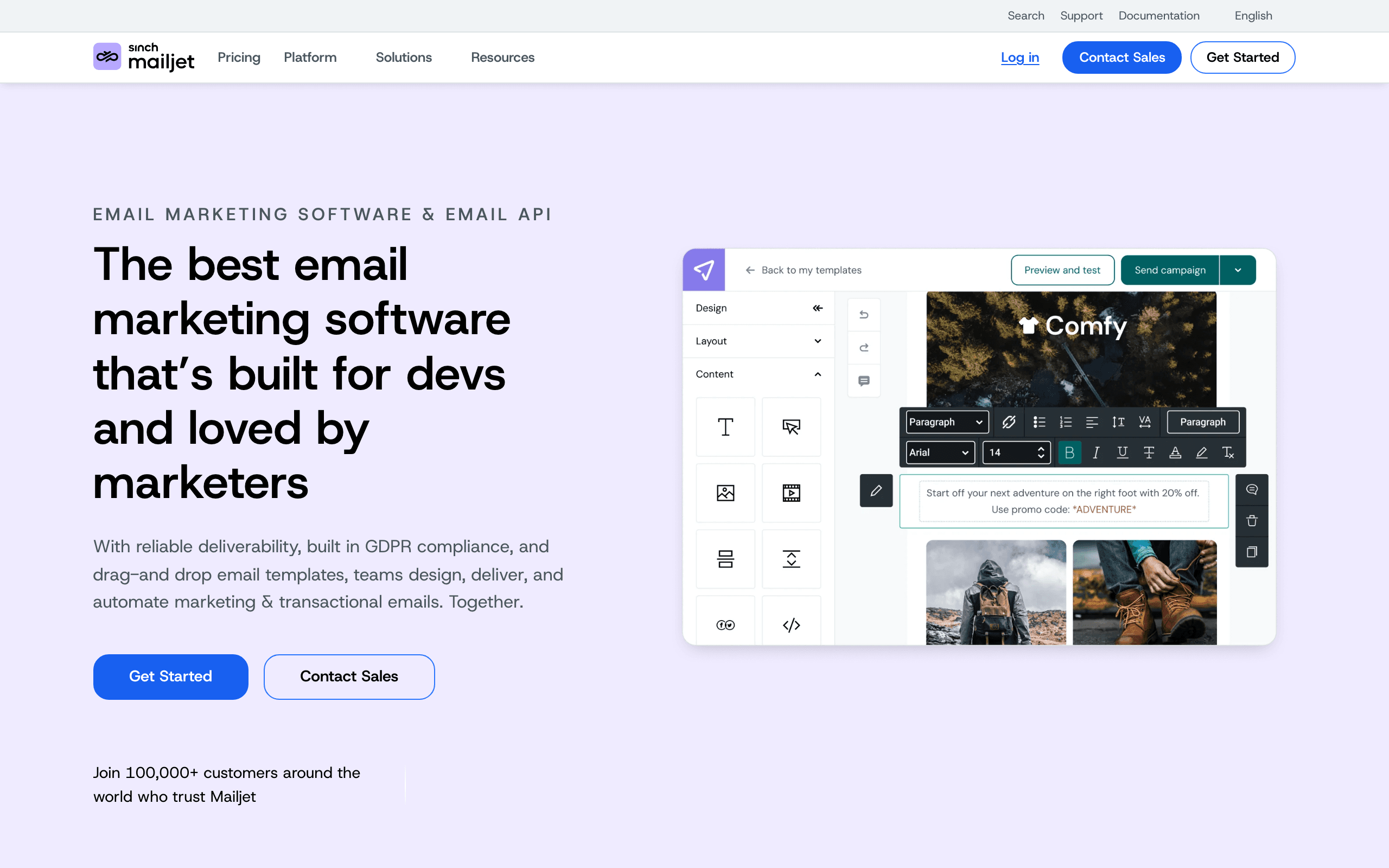
Mailjet has marketing features: campaigns, automation, Passport editor, A/B testing.
SES has zero marketing features. It sends emails. That's all. If you need marketing capabilities, SES requires pairing with another tool.
When SES Makes Sense
SES is right when:
- You send millions of emails monthly
- You have engineering resources for email infrastructure
- You're already on AWS
- Cost is the primary concern
- You only need transactional email
For most companies, especially those without dedicated email engineers, managed platforms like Mailjet save more in time than they cost in price.
For SaaS Companies
Mailjet offers more than SES but is still general-purpose. SES is pure infrastructure.
If you're SaaS with Stripe billing, consider Sequenzy. We offer managed email infrastructure with native Stripe integration and SaaS-specific automation. No AWS complexity, no building marketing features yourself.
Making the Choice
Choose Mailjet for a complete, user-friendly email platform. Choose Amazon SES for maximum volume at minimum cost if you have engineering resources. For SaaS with Stripe, consider Sequenzy.
Use-case matchups
| Need | Better fit | Why |
|---|---|---|
| Managed marketing plus transactional platform | Mailjet | Mailjet includes campaigns, visual building, contacts, and transactional email. |
| Cheapest raw email infrastructure | Amazon SES | SES is listed at $0.10 per 1,000 emails and requires technical ownership. |
| Non-technical campaign operations | Mailjet | Mailjet provides a visual UI, builder, support, and managed deliverability. |
| AWS-native high-volume sending | Amazon SES | SES fits teams already comfortable with AWS, IAM, SNS, and deliverability operations. |
| SaaS lifecycle and transactional email | Sequenzy | Sequenzy adds SaaS campaigns, transactionals, and Stripe-triggered automation. |
Best Fit by Technical Ownership
Best email platform for non-technical campaign teams
Mailjet fits teams that want visual campaign tools, contact management, templates, support, and transactional sending without owning raw infrastructure. It is strongest when marketers need to edit campaigns and collaborate without waiting for engineering to build every email workflow.
Best email infrastructure for AWS-native high-volume sending
Amazon SES is the better fit when engineering owns deliverability, templates, IAM, SNS, bounce handling, and high-volume email operations inside AWS.
Best SaaS email platform for lifecycle and transactional workflows
Sequenzy fits software teams that need campaigns, transactional email, and Stripe-triggered automation without building lifecycle logic on raw infrastructure. It matters when billing and product events should drive messaging directly.
Pricing reality
Mailjet is listed at roughly $85-100/month for 100,000 emails with marketing features. Amazon SES is listed at $10/month for 100,000 emails as pure sending cost. Sequenzy is listed at $49-99/month for 60k-120k emails, with unlimited contacts.
SES is much cheaper on raw send cost, but the page repeatedly notes the hidden work: AWS setup, bounce/complaint handling, reputation monitoring, missing marketing features, and engineering time.
Review signals
The cited Mailjet reviews praise real-time collaboration, EU/GDPR positioning, and combined marketing plus transactional email, while noting daily limits and basic automation. The cited Amazon SES reviews praise low cost, AWS integration, and scale, while warning about technical setup and lack of marketing features.
Migration checklist
| Workstream | Moving toward Mailjet | Moving toward Amazon SES |
|---|---|---|
| Domains | Recreate SPF, DKIM, DMARC, tracking, bounces, and suppressions. | Verify SES identities, SPF, DKIM, DMARC, SNS feedback, and production access. |
| Sending code | Move API/SMTP calls and templates into Mailjet. | Move send calls to AWS SDK or SMTP and configure IAM permissions. |
| Marketing | Rebuild campaigns, contacts, lists, segments, and automations. | Choose or build a separate marketing layer if campaigns are still needed. |
| Deliverability | Use Mailjet's managed reporting and deliverability tools. | Own reputation monitoring, warmup, bounce handling, and alerts. |
| Cutover | Test transactional and campaign sends before switching. | Test sandbox exit, throughput, bounces, complaints, and CloudWatch/SNS reporting. |
Decision checklist
- Choose Mailjet if the team needs managed campaigns, transactional email, and a visual workflow.
- Choose Amazon SES if raw sending cost matters most and engineering can own the infrastructure.
- Choose Sequenzy if SaaS email should combine campaigns, transactionals, and Stripe lifecycle automation.
The True Cost Equation
Amazon SES at $10 for 100,000 emails versus Mailjet at $85-100 looks like a clear winner. But that comparison ignores engineering time. Setting up SNS for bounces, Lambda for webhooks, CloudWatch for monitoring, and managing IP warmup and reputation takes 40-80 hours of engineering time initially, plus ongoing maintenance.
At typical engineering rates, the initial SES setup costs more than a year of Mailjet. The question is whether your team has that expertise already or needs to acquire it. For teams already deep in AWS, the marginal cost is low. For everyone else, Mailjet's managed approach saves real money.
Marketing Features as a Differentiator
SES has exactly zero marketing features. No campaign builder, no automation, no contact management, no templates. If you need to send a newsletter alongside transactional emails, SES requires a completely separate marketing platform.
Mailjet bundles marketing campaigns, visual builder with collaboration, automation workflows, and contact management with transactional email. For businesses needing both email types, Mailjet eliminates the need for a second platform entirely.
When SES Becomes the Right Choice
SES makes financial sense when three conditions are met: your team has AWS expertise, your monthly volume exceeds 500,000 emails, and you only need transactional delivery. Below those thresholds, the engineering investment rarely pays for itself.
For SaaS companies at moderate volume, the managed approach of Mailjet or Sequenzy is almost always more cost-effective when accounting for total cost of ownership including developer time and opportunity cost.
Delivery Speed and Reliability
Mailjet gives you a visual dashboard, drag-and-drop builder, and both marketing and transactional sending in one place, at roughly $85 to $100 a month for 100,000 emails. Amazon SES is pure infrastructure with none of that, but the same 100,000 emails cost about $10 through SES's raw $0.10-per-1,000 rate. The gap in price reflects the gap in what's included: Mailjet hands you a finished product, SES hands you the cheapest possible pipe and expects you to build around it.
API Design and Developer Experience
Mailjet's REST API is solid and its documentation is approachable, matched with a full visual interface for people who would rather not write integration code at all. SES requires AWS-specific setup, IAM policies and DNS records among them, and its only interface is the AWS Console, which is not built for marketers. Developers on either platform can get transactional email working, but only Mailjet gives non-developers a usable way in.
Scaling and Cost at Volume
At 100,000 emails a month, SES costs around $10 against Mailjet's roughly $85 to $100, a gap that widens further at higher volumes since SES's rate stays flat while Mailjet's plans scale with features and volume together. That difference is the cost of Mailjet's marketing tools, contact management, and deliverability handling, which SES leaves entirely to you. Whether the extra cost is worth it depends on how much you would otherwise spend building and maintaining those features yourself around SES.









