Overview
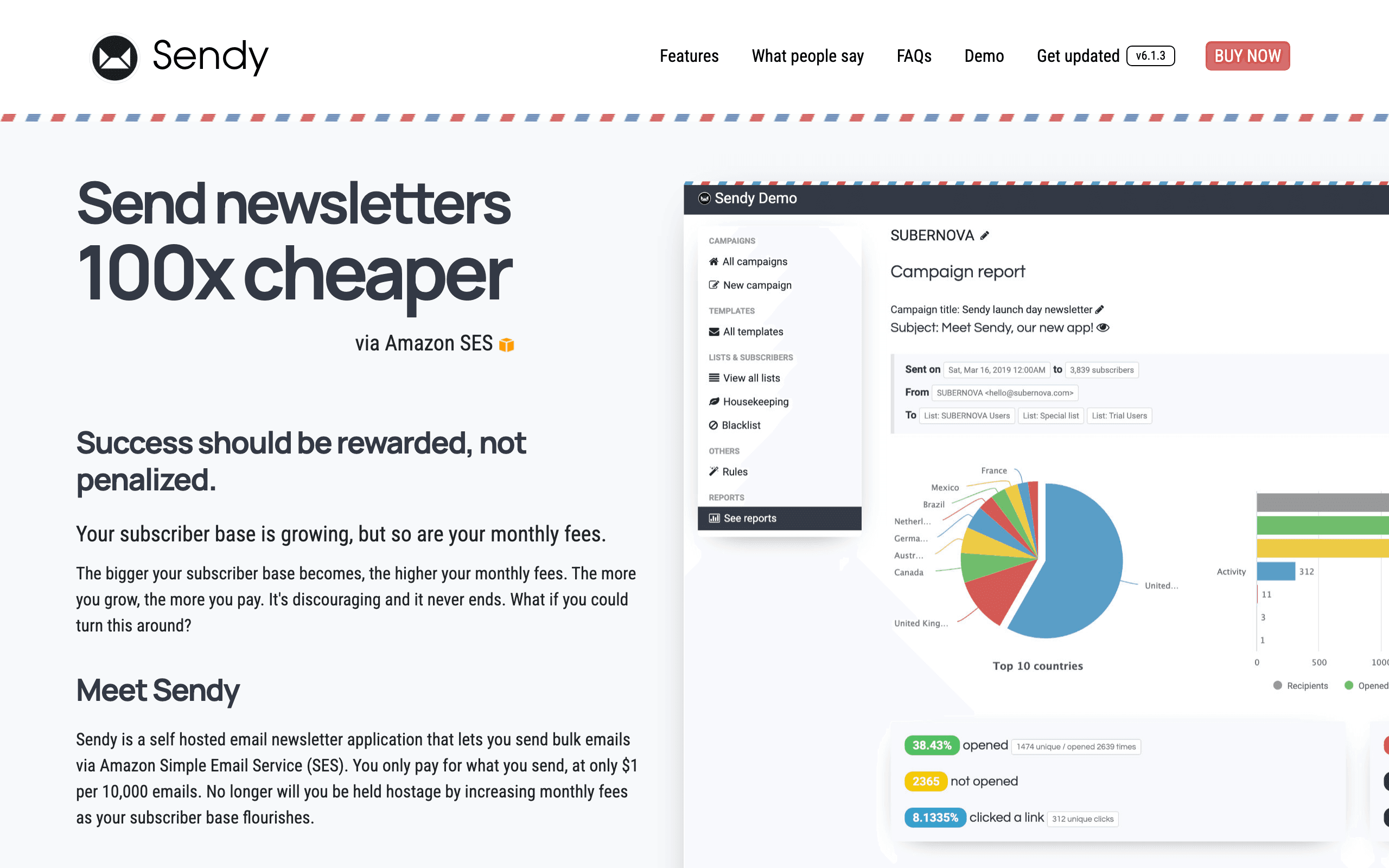
Sendy and Amazon SES aren't direct competitors. They're different layers of the email stack. Sendy is a marketing application that uses SES for sending. SES is the underlying email infrastructure. Understanding this relationship helps you make the right choice.
How They Relate
Think of it like WordPress and a web server. SES is the infrastructure (like Apache/Nginx). Sendy is the application (like WordPress). You need infrastructure to run, but the application is what you interact with. Sendy specifically requires SES. It's not optional.
When to Use Sendy
Use Sendy when you need marketing email features but want the cost efficiency of SES. Sendy gives you list management, campaign builders, autoresponders, and tracking. Without something like Sendy, you'd have to build all of this yourself on top of raw SES.
When to Use SES Directly
Use SES directly for transactional email. Password resets, receipts, notifications. These are triggered by your application code and don't need marketing features. Many businesses use both: Sendy for marketing, SES API for transactional.
The Cost Equation
SES alone costs ~$0.10 per 1,000 emails. Sendy adds a $69 one-time license plus hosting costs. If you need marketing features, $69 is far cheaper than building them yourself. If you only need transactional email, skip Sendy and use SES directly.
For SaaS Companies
Most SaaS companies need both marketing and transactional email. Managing Sendy for marketing plus raw SES for transactional is operationally complex. Sequenzy unifies both in one platform with Stripe integration, no self-hosting required.
Making the Choice
This isn't really either/or. Use Sendy if you need marketing features on top of SES. Use SES directly if you're building custom solutions or sending transactional email. Or consider a managed platform like Sequenzy that handles both without infrastructure management.
Understanding the Email Stack: Where Each Fits
The relationship between Sendy and Amazon SES is architectural, not competitive. Amazon SES sits at the infrastructure layer, handling the actual delivery of emails through AWS data centers. Sendy sits at the application layer, providing list management, campaign building, and subscriber tracking. Every email Sendy sends goes through SES -- Sendy is a client of the SES service.
This layered architecture is common in software. Just as WordPress sits on top of a web server and database, Sendy sits on top of SES and MySQL. Choosing between them is less about which is better and more about which layer you need to interact with directly. Marketing teams need the application layer (Sendy). Developers building custom solutions need the infrastructure layer (SES).
Many businesses use both simultaneously. Sendy handles newsletters, drip campaigns, and marketing emails through its web interface. The SES API handles transactional emails -- password resets, order confirmations, system notifications -- triggered directly from application code. This dual approach leverages each tool's strengths without forcing either into an unsuitable role.
The Build vs Buy Decision for Email Marketing
Using Amazon SES directly for marketing email means building everything Sendy provides: subscriber management, list segmentation, campaign scheduling, template rendering, open/click tracking, bounce handling, and unsubscribe processing. This development work easily exceeds 200 hours for a basic implementation.
Sendy's $69 license encapsulates years of development focused on these exact problems. For businesses considering building a custom marketing layer on SES, comparing the build cost against $69 makes the economics obvious. Even imperfect, Sendy delivers more value than most custom solutions built by teams with other priorities.
The exception is when your marketing needs are highly specialized. If you need real-time personalization, complex segmentation logic, or deep integration with your product data model, a custom SES integration may serve you better. But for standard newsletter and campaign use cases, Sendy's pre-built features save significant development time.
Transactional Email: Where SES Shines Alone
For transactional emails -- password resets, purchase receipts, shipping notifications -- using SES directly through its API is the right approach. These emails are triggered by application events, not marketing decisions. They need programmatic control, not a web UI.
SES provides the reliability and speed transactional emails require. Sub-second delivery, automatic retry logic, and bounce handling through SNS notifications give developers fine-grained control. Sendy adds unnecessary overhead for these use cases since transactional emails do not need list management or campaign tracking.
The gap in most self-hosted setups is unifying marketing and transactional email analytics. Sendy tracks marketing opens and clicks. SES tracks delivery metrics for transactional email. But there is no single dashboard showing both. Sequenzy addresses this by combining marketing campaigns and transactional email in one platform with unified analytics and deliverability monitoring.
Cost Optimization Strategies for SES Users
Whether using SES through Sendy or directly, several strategies reduce costs further. Dedicated IPs ($24.95/month each) improve deliverability for high-volume senders by isolating your sending reputation. Configuration sets enable granular tracking without external analytics tools. Suppression lists automatically prevent sending to addresses that have bounced or complained, reducing wasted sends.
SES also offers a free tier of 3,000 messages per month when sending from an EC2 instance. For very small senders, this means Sendy campaigns can be sent at zero marginal cost beyond hosting. This free tier does not apply to direct API calls from outside AWS, so architecture decisions affect pricing.
For SaaS companies using SES for both product emails and marketing, the total monthly cost rarely exceeds $50 even at significant volume. The challenge is not cost but operational complexity -- managing two email systems, monitoring deliverability across both, and maintaining consistent branding. A unified platform like Sequenzy simplifies this at the cost of slightly higher per-email pricing.
Use-case matchups
| Situation | Best first look | Why |
|---|---|---|
| Team wants the lowest visible email sending cost and can self-host | Sendy | Sendy is the baseline here for teams comfortable operating their own app layer on top of a sending service. |
| Engineering team wants raw infrastructure without a newsletter UI | Amazon SES | Amazon SES is the underlying infrastructure choice when the team wants to own even more of the stack. |
| SaaS or subscription team wants lifecycle and transactional email | Sequenzy | Sequenzy is stronger when Stripe events, transactional messages, and campaigns need a hosted lifecycle workflow. |
| Technical team already owns servers and AWS email operations | Sendy | Sendy can make sense when maintenance, updates, deliverability setup, and backup ownership are acceptable. |
| Team needs the specialist capability | Amazon SES | Amazon SES deserves the first demo when the main requirement is raw AWS sending infrastructure. |
| Team wants hosted workflows without self-hosting | Sequenzy | Sequenzy removes Sendy-style app maintenance while staying focused on email automation and transactional messages. |
Pricing reality
The pricing signals on this page list Sendy at ~$10 + $69 license/month or equivalent operating cost, Amazon SES at ~$10/month, and Sequenzy at $99/month. Sendy's number should never be read as the whole cost.
Sendy usually shifts cost from the vendor invoice to operations: hosting, updates, backups, SES or SMTP setup, bounce handling, deliverability monitoring, and internal troubleshooting. Amazon SES's real cost depends on whether the team needs raw AWS sending infrastructure.
Review signals
For Sendy, validate reviews around setup, updates, SES integration, bounce handling, deliverability, and the amount of technical maintenance required. For Amazon SES, focus review research on whether users praise the reason you would choose it: raw AWS sending infrastructure.
Best Fit by Self-Hosting and Infrastructure Ownership
Best low-cost newsletter tool for teams willing to self-host
Sendy is the better fit when the team wants a simple campaign UI, can host and maintain the app, and is comfortable pairing it with SES or another sending service. The appeal is low visible cost, but the buyer must accept updates, backups, cron jobs, and troubleshooting.
Best raw AWS sending infrastructure for engineering-owned email
Amazon SES is the better fit when there is no need for Sendy's app layer and engineering wants direct control over sending. It makes sense when the team can build templates, suppression handling, bounce and complaint processing, reporting, monitoring, and any campaign workflow itself.
Best hosted SaaS email platform for lifecycle and transactionals
Sequenzy fits teams that want hosted workflows without Sendy maintenance or raw SES buildout. It is most relevant when campaigns, transactional emails, Stripe events, onboarding, and retention sequences should be managed in one product.
Migration checklist
| Workstream | Moving toward Sendy | Moving toward Amazon SES | Simplifying to Sequenzy |
|---|---|---|---|
| Hosting and ownership | Provision hosting, backups, updates, SSL, cron jobs, sending service credentials, and admin access. | Configure domains, production access, SNS bounce and complaint handling, suppression storage, templates, and CloudWatch reporting. | Import subscribers, attributes, tags, suppressions, and lifecycle events into a hosted workflow. |
| Sending setup | Configure SES or SMTP, SPF, DKIM, DMARC, bounce processing, complaint handling, and suppression logic. | Confirm sender authentication, deliverability tooling, and plan limits. | Configure sending domains and transactional paths without self-hosting. |
| Contacts and consent | Import lists, custom fields, segments, unsubscribes, bounces, and suppression records. | Import the data model Amazon SES needs for raw AWS sending infrastructure. | Import subscriber data and lifecycle attributes. |
| Automations | Rebuild simple autoresponders and campaigns; custom lifecycle logic may need outside code. | Rebuild the workflows that prove Amazon SES's advantage. | Rebuild campaign, lifecycle, and transactional email flows. |
| Reporting | Decide which analytics are built in and which require outside tooling. | Validate reporting for raw AWS sending infrastructure before committing. | Validate campaign, automation, transactional, and subscription lifecycle reporting. |
Decision checklist
- Is the team honestly willing to own Sendy's hosting, updates, backups, and deliverability operations?
- Does Amazon SES's strength in raw AWS sending infrastructure matter more than Sendy's low visible cost?
- Who owns bounce handling, complaint processing, and suppression hygiene after migration?
- Are the listed prices still realistic after adding hosting, support, and engineering time?
- Would hosted lifecycle and transactional email be more useful than a self-hosted newsletter layer?
- SES is cheaper only if the team is ready to build and maintain the missing product layer.