Start with how you make money
Most comparison pages start with features. This one should start with your business model, because PostHog Workflows and Klaviyo are each shaped around one.
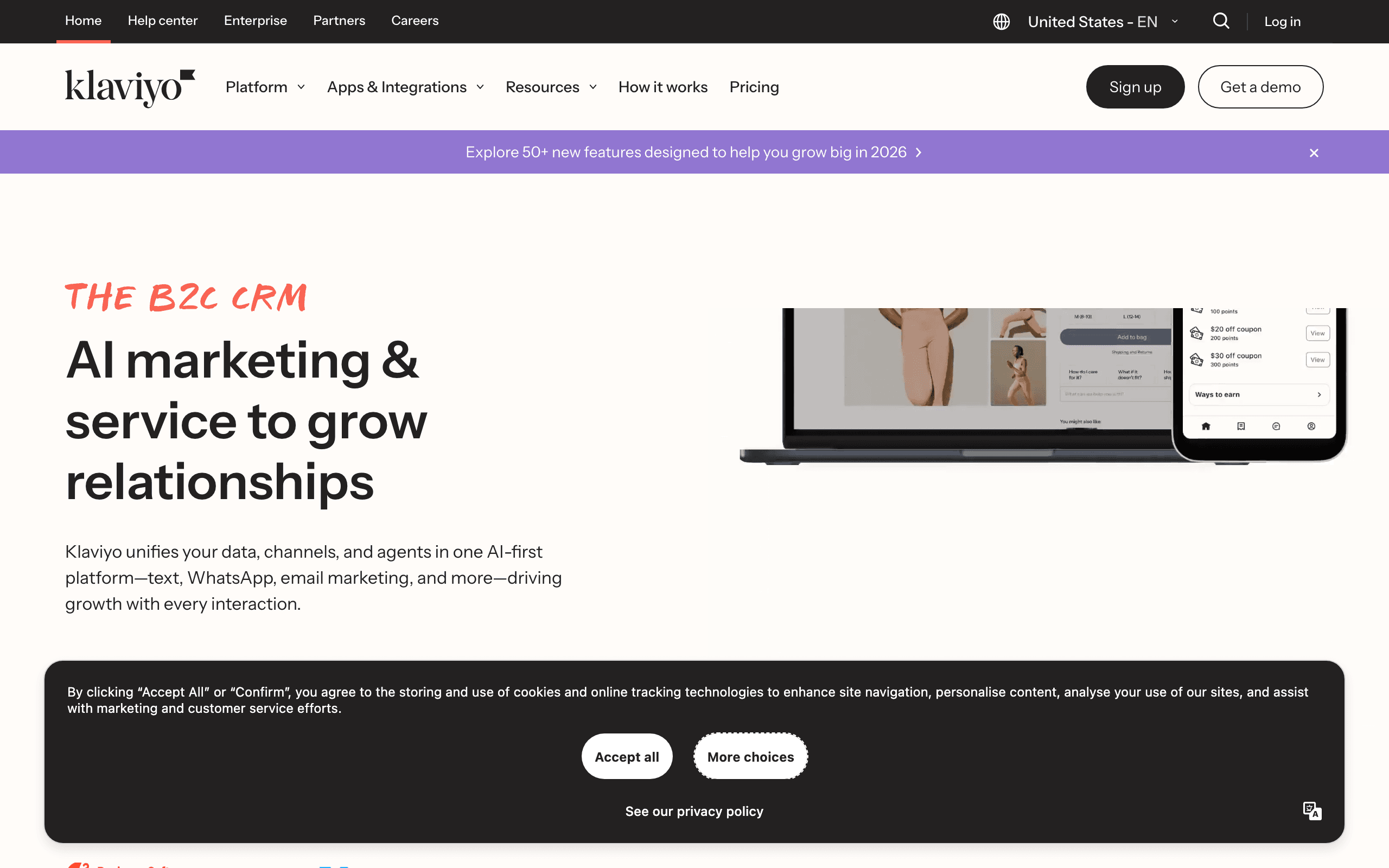
Klaviyo was built for online stores. Its customer profile is a purchase history: products viewed, carts started, orders placed, discounts used, predicted next order date and lifetime value. Its flows, templates and reports assume the goal of a message is an order.
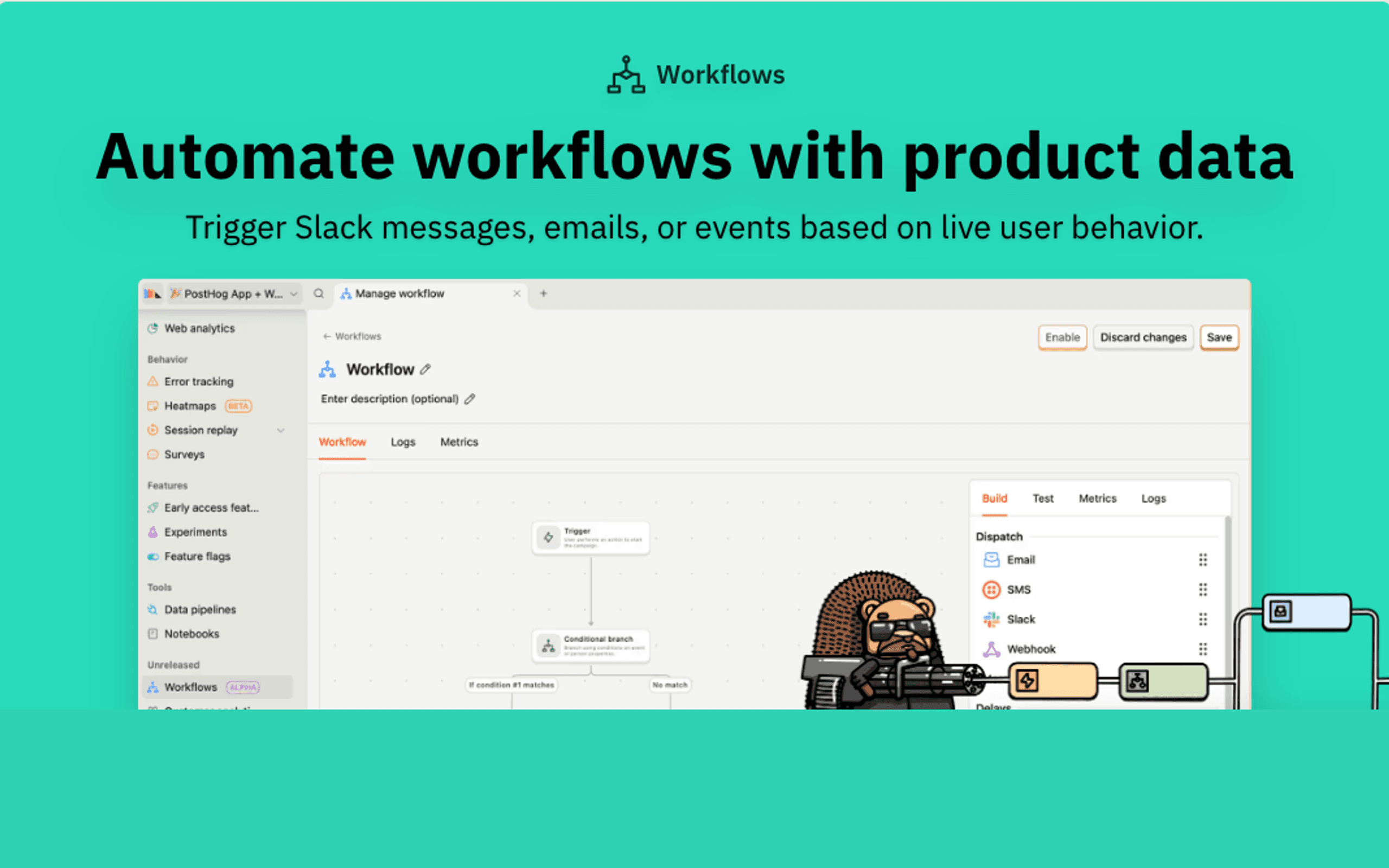
PostHog Workflows was built into a product analytics suite. Its customer is a person with events and properties: signed up, invited a teammate, used a feature, hit an error, entered a cohort. Its actions assume the goal of a message is a behavior change inside a product.
If you sell physical products, Klaviyo's model fits. If you sell software, PostHog's model fits, and Klaviyo's store features mostly go unused.
A week of work in each tool
In PostHog Workflows, a product manager sees in a funnel that many new signups never connect their first data source. They create a workflow triggered by the signup event, wait two days, check whether the "source connected" event fired, and send a short email with a setup link if not. A second branch posts to the success team's Slack channel when a paying account stalls at the same step.
In Klaviyo, an ecommerce marketer plans a spring promotion. They schedule a campaign to customers who bought in the last 180 days, drop in a product block that pulls live catalog images and prices, and add an SMS follow-up for subscribers who opted in. Meanwhile, abandoned cart, browse abandonment and post-purchase flows keep running, and the dashboard shows revenue attributed to each.
Neither workflow feels natural in the other tool. PostHog has no catalog to pull products from. Klaviyo has no funnel view of in-app setup steps.
The profile meter
This is the pricing tension specific to this pair. Klaviyo bills on active profiles: the free plan covers up to 250, the email plan starts around $20 a month for small lists and reaches about $150 a month at 10,000 profiles. The Email and SMS plan starts at $35 a month with 1,250 SMS credits included. Your bill follows the size of your emailable audience, whether you send to everyone weekly or rarely.
PostHog Workflows bills per message. Each month includes 10,000 emails and 10,000 other dispatches for free, then $0.003 per email up to 50,000, $0.0018 up to 100,000 and $0.001 up to 1 million. Your bill follows what you send.
A store with a highly engaged list that it emails often gets good value from Klaviyo's model. A software product with a large, mostly quiet user base would pay Klaviyo for every profile and PostHog only for the handful of lifecycle emails it sends.
Pricing reality for a 10,000-contact SaaS
Take a SaaS product with 10,000 users that sends 40,000 lifecycle emails a month.
| Line item | PostHog Workflows | Klaviyo (email plan) | Sequenzy |
|---|---|---|---|
| Contacts | Not billed | 10,000 active profiles | Unlimited |
| First 10,000 emails | Free | Covered by plan | Covered by plan |
| Remaining 30,000 emails | 30,000 x $0.003 = $90 | Covered by plan | Covered by plan |
| Monthly total | About $90, plus PostHog analytics | About $150 | $49 plan covers 60,000 emails |
| SMS | Your Twilio account | Email and SMS plan from $35 | Paid add-on |
The Klaviyo price is for the email plan only; SMS is budgeted separately. For a store, Klaviyo's price buys catalog sync, recommendations and revenue attribution that the other columns do not match.
Identity: distinct IDs versus email profiles
PostHog keys people on distinct IDs, which can be anonymous until a user identifies. Klaviyo keys profiles on email address or phone number. If you forward PostHog events to Klaviyo, anonymous visitors will not map, and a user who changes their email can split into two Klaviyo profiles. Make sure identified PostHog persons carry an email property before events reach Klaviyo, and decide which system is the source of truth for consent.
SMS consent is a product in itself
Klaviyo treats SMS as a first-class channel, with consent capture in signup forms, compliance tooling and SMS-specific flow steps. PostHog Workflows can send SMS through a Twilio account you connect, but consent collection and opt-out handling for SMS are yours to build. If text messages are part of your retention strategy, this difference alone often settles the decision.
Where each tool clearly wins
Klaviyo wins on anything store-shaped: cart recovery, browse abandonment, back-in-stock, replenishment, product recommendations, SMS with consent handling and flow-level revenue reporting. It is also the more complete marketing workspace, with campaign scheduling, template management and segmentation for marketers.
PostHog Workflows wins on product-shaped automation: activation nudges from funnel data, alerts to internal teams, webhooks into other systems and updating person properties. It is also lighter to adopt if PostHog is already your analytics tool.
Review signals
Klaviyo is rated 4.6 out of 5 on G2 across more than 1,300 reviews and 4.6 on Capterra. Reviewers consistently praise segmentation, automation and the Shopify integration. Pricing that grows faster than expected as lists grow is the most common complaint, followed by mixed experiences with support. Its Trustpilot score is far lower, driven largely by billing and support complaints. Independent reviews of PostHog Workflows specifically are still limited, since it is a newer product.
Use-case matchups
| Need | Better fit | Why |
|---|---|---|
| Abandoned cart with product images | Klaviyo | Catalog sync and cart events are native |
| Nudge users who skip onboarding | PostHog Workflows | The funnel and cohort already exist |
| Promotional SMS with consent capture | Klaviyo | SMS compliance is built in |
| Slack alert on a high-intent account | PostHog Workflows | Internal dispatches are included |
| Failed payment emails for a subscription | Sequenzy | Stripe events are native triggers |
Where Sequenzy fits
Sequenzy started as an email platform for SaaS and now also covers core ecommerce flows.
For subscription businesses, it connects to Stripe so trial ending, payment failed, upgrade and cancellation trigger sequences directly. Its native PostHog integration receives events through a PostHog destination and can import recent history from PostHog Cloud, so PostHog stays your analytics source while Sequenzy owns customer email, including transactional messages.
For smaller stores, Sequenzy integrates with Shopify and WooCommerce (beta) for cart recovery, browse abandonment and post-purchase flows, with rule-based product blocks and statistical CLV and churn predictions. It is honestly less deep than Klaviyo: no AI product recommendations, simpler popups and a newer SMS add-on. What changes is the pricing unit: emails sent with unlimited contacts, from free for 2,500 emails a month to $49 for 60,000.
Migration checklist
| Workstream | Klaviyo to PostHog plus an email tool | PostHog Workflows to Klaviyo |
|---|---|---|
| Profiles and consent | Export profiles with email and SMS consent status as CSV | Send identified persons with email and consent flags |
| Events | Instrument store events in PostHog if you still need them | Forward selected events as Klaviyo metrics |
| Flows | Rebuild; store flows need an ecommerce-capable tool | Rebuild each workflow as a Klaviyo flow |
| Templates | Export HTML; product blocks will not carry over | Recreate templates in Klaviyo's editor |
| Store connection | Reconnect Shopify in the new tool | Connect Shopify to Klaviyo |
| Domain | Verify the domain in the new sender | Add Klaviyo's DNS records before cutover |
Decision checklist
- Choose Klaviyo if your revenue comes from orders and you need SMS and catalog-driven email.
- Choose PostHog Workflows if your automations react to product usage you already track in PostHog.
- Avoid Klaviyo if you are a SaaS with a large, quiet user base; the profile meter will charge for all of it.
- Avoid PostHog Workflows for store retention; it has no catalog, cart or attribution model.
- Consider Sequenzy if you sell subscriptions and want lifecycle and billing email beside PostHog, or run a smaller store that prefers send-based pricing.