Different weight classes
If you are comparing PostHog Workflows and Braze, you are probably at one of two points. Either you are a product team using PostHog and wondering whether "real" engagement tooling means Braze, or you are at a larger company evaluating whether PostHog Workflows could cover some of what Braze does.
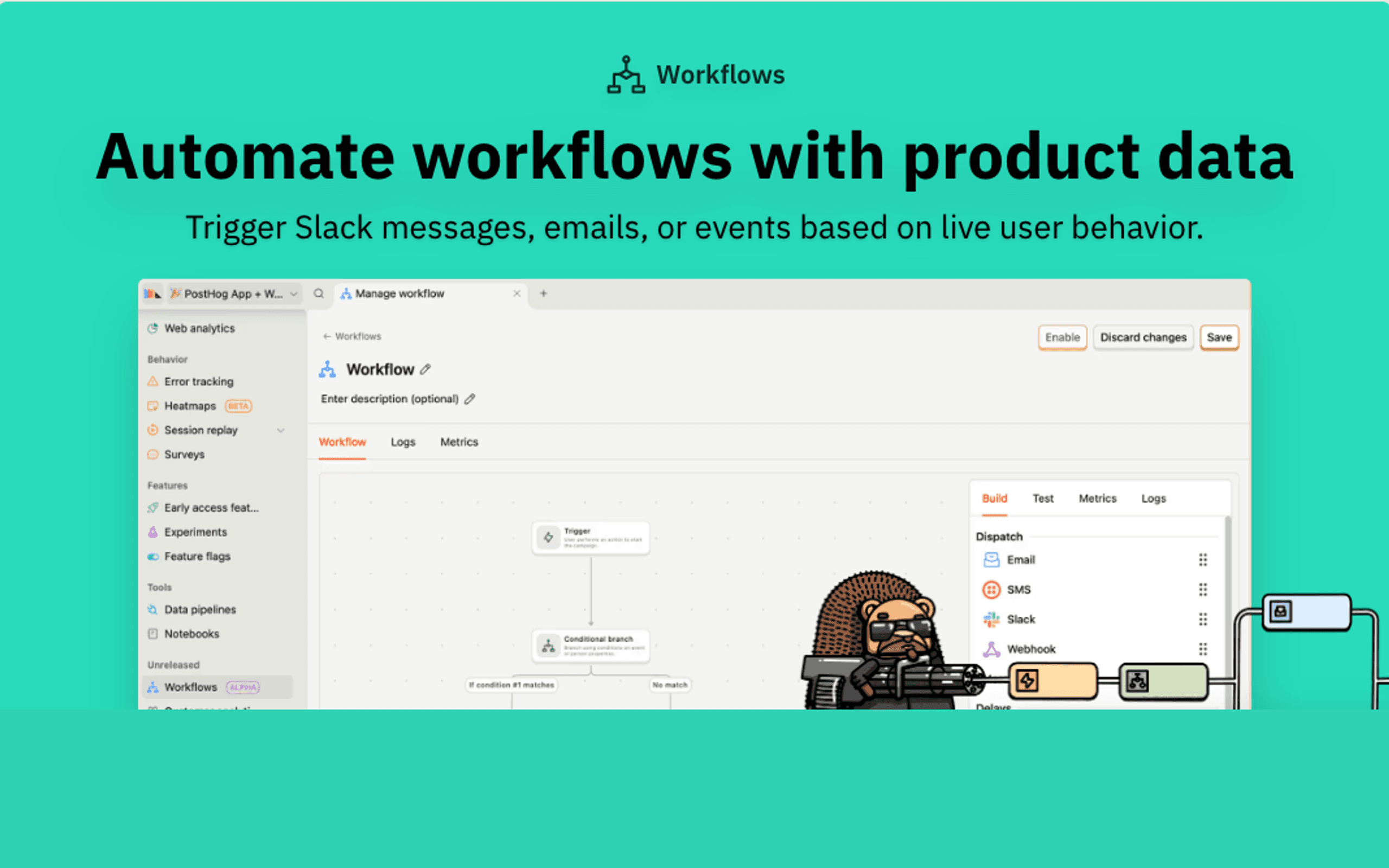
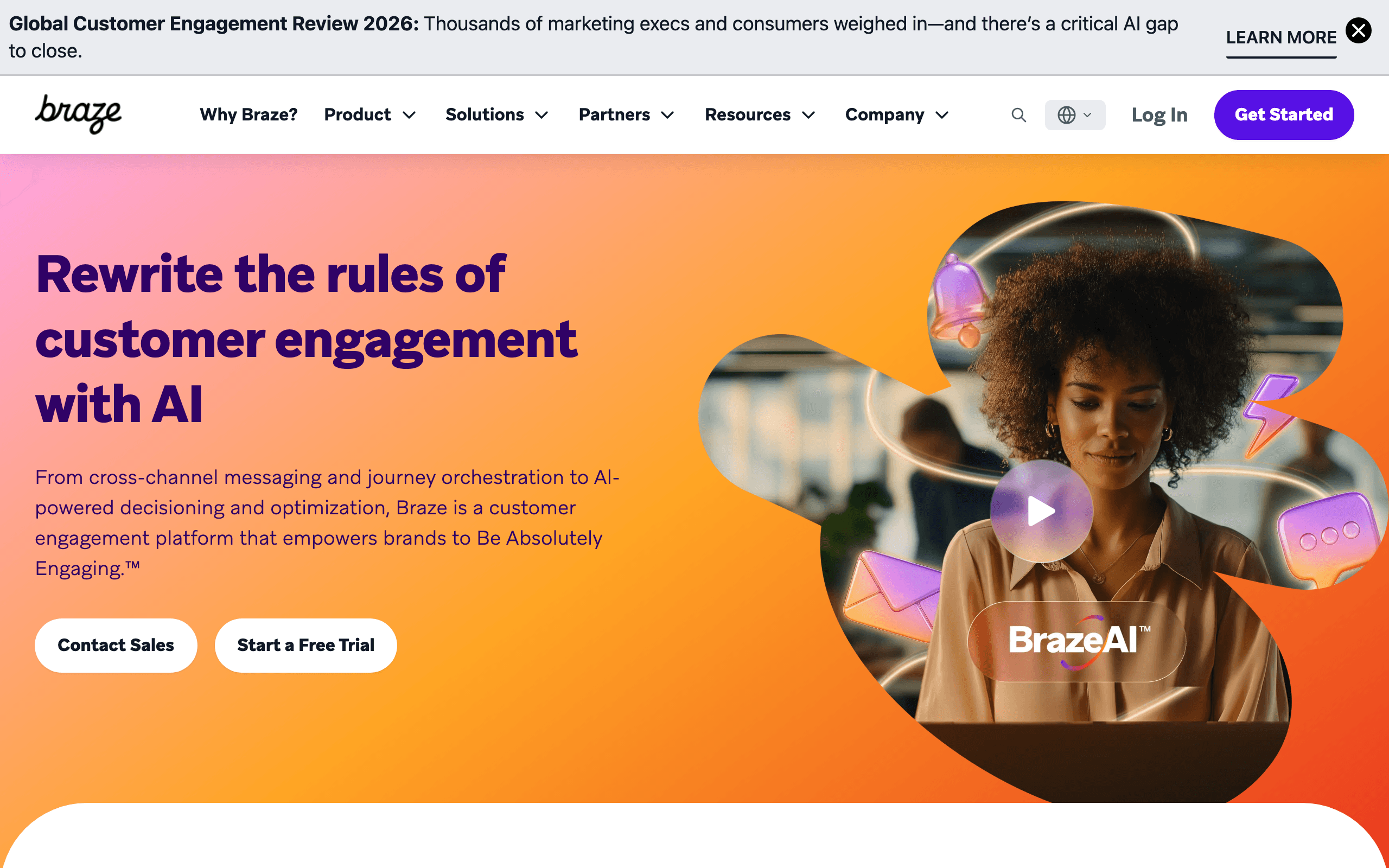
The honest framing is that these tools serve different organizations. Braze is a customer engagement platform for consumer brands: think streaming apps, retailers, food delivery, fintech, and mobile games. It is designed for audiences in the millions, teams of CRM specialists, and programs that coordinate push, in-app, email, and SMS. PostHog Workflows is an automation feature inside a product analytics suite, designed so a product team can act on what users do without leaving PostHog.
Channels are the real divide
Braze earns its place with channels that PostHog Workflows does not try to own:
- Mobile push and web push, delivered through Braze SDKs with delivery and engagement tracking.
- In-app messages and content cards, rendered inside your app and targeted by the same segments as email.
- Cross-channel rules, such as frequency capping, so one user does not get a push, an email, and an SMS about the same thing.
PostHog Workflows covers email, SMS, Slack, webhooks, and real-time destinations. That is a strong set for product operations: tell the team in Slack when a large account churns, send a follow-up email when a user finishes onboarding, update a property, call your own backend. It is not a mobile engagement stack.
If your product is a consumer mobile app and push is your main lifecycle channel, this comparison ends here in Braze's favor.
How buying and pricing work
PostHog Workflows is self-serve. It is available in your PostHog project, includes 10,000 messages per channel free each month, and charges per message after that.
Braze does not publish self-serve prices. Its pricing page describes four editions, Go, Select, Pro, and Enterprise, and says pricing scales with Monthly Active Users and uses Action Credits consumed across email, SMS, in-product messaging, and BrazeAI features. Expect a sales process, an annual contract, and an implementation project.
That difference in buying model matters as much as the invoice. A product manager can ship a PostHog workflow this afternoon. A Braze rollout typically involves SDK integration, data pipelines, and onboarding with the vendor.
When PostHog Workflows is the smarter choice even at scale
Large companies sometimes keep PostHog Workflows alongside Braze. Braze runs the customer-facing CRM program, and PostHog Workflows handles internal and operational jobs:
- Alerting a customer success channel when an enterprise account's usage drops.
- Calling a webhook to provision something when a feature flag rollout reaches a user.
- Sending a quick beta feedback email to a cohort that tried a new feature.
These are close to product data and do not justify Braze Action Credits or a CRM team's time.
Pricing reality: comparing different units
You cannot line up these prices directly, because the units differ and Braze does not publish rates. What you can compare is what drives each bill.
| Cost driver | PostHog Workflows | Braze |
|---|---|---|
| Main unit | Messages per channel | Monthly Active Users |
| Consumption | Per message after 10,000 free per channel | Action Credits across email, SMS, in-product messaging, and AI features |
| Plan structure | No tiers for Workflows | Go, Select, Pro, and Enterprise editions |
| How you buy | Self-serve in PostHog | Sales process and contract |
| Hidden cost | Your time building flows | SDK work, data pipelines, and program staff |
A worked example makes the gap concrete. A B2B SaaS sending 6,000 onboarding and activation emails a month stays inside PostHog's free email allowance. The same team talking to Braze would enter an edition negotiation sized around active users and credits, for a program that is email only. For a consumer app with a million monthly actives and push as the main channel, the calculation flips, because PostHog Workflows cannot deliver the program at all.
Identity and data flow
Most Braze and PostHog problems are identity problems. PostHog identifies people by a distinct ID, merged with anonymous activity when you call identify. Braze identifies users by an external ID, with its own handling for anonymous users on its SDK.
Before connecting them, decide which ID is canonical, usually your own database user ID, and set it in both tools at login. Then use PostHog's Braze destination, your CDP, or your warehouse to forward events and attributes. If the IDs disagree, you get duplicate Braze profiles, which inflates active user counts and splits message history. Test with a handful of internal accounts before enabling the destination for everyone.
Running both without chaos
If you use Braze for customer engagement and PostHog for analytics, decide clearly:
- Braze owns customer-facing lifecycle messages. Onboarding, re-engagement, promotions, and push.
- PostHog owns analytics and internal automation. Funnels, experiments, and Slack or webhook workflows.
- Events flow one direction by default. Send product events to Braze through a PostHog destination, your CDP, or your warehouse, and bring Braze engagement data back to your warehouse for joined analysis.
The main risk is two tools emailing the same user. Pick one owner for customer email.
Migration realities
From PostHog Workflows to Braze: plan for SDK work if you want push and in-app, a user identity mapping between PostHog distinct IDs and Braze external IDs, rebuilt journeys on Braze's canvas, and new sending domain and IP setup. Cohorts become Braze segments, but the definitions need to be rebuilt from attributes and events that exist in Braze.
From Braze to PostHog Workflows: this usually happens when a company realizes its program was mostly email and Slack alerts. You can move those flows, but push, in-app messaging, content cards, and cross-channel frequency rules have no PostHog equivalent. Be sure the program you are moving really is that simple.
Use-case matchups
| Need | Better fit | Why |
|---|---|---|
| Push reminder for a lapsed mobile user | Braze | Native push with delivery tracking |
| Email when a B2B trial stalls in setup | PostHog Workflows | Trigger is an existing cohort |
| In-app promotion shown on app open | Braze | In-app messages and content cards |
| Slack alert when an enterprise account's usage drops | PostHog Workflows | Native Slack step on product data |
| Frequency cap across push, email, and SMS | Braze | Cross-channel rules on one profile |
| Failed payment email with Stripe context | Sequenzy | Billing state drives the sequence |
Who runs it day to day
Staffing is an underrated part of this decision. A Braze program usually has a CRM or lifecycle manager planning campaigns, someone handling data and SDK integration, and designers producing message content for several channels. The platform is built to reward that investment with experiments, personalization, and orchestration across millions of users. Without those people, much of what you pay for sits unused.
PostHog Workflows is usually run by whoever already works in PostHog: a product manager, an engineer, or a founder. Workflows are short, tied to a specific product question, and measured in the same funnels. That is a very different operating model. If your company has no plans to hire a lifecycle team in the next year, that alone tells you which tool matches your reality today.
If you're replacing Braze with something closer to your product data, the Braze alternatives guide also covers Customer.io and Knock, which trigger messages from product events.
Decision checklist
- Is push or in-app your main lifecycle channel? Yes points to Braze.
- How many monthly active users do you have? Braze is built for large audiences. Small ones rarely justify the contract.
- Do you have a CRM or lifecycle team? Without one, Braze is hard to operate well.
- Is the program mostly email? Then PostHog Workflows or an email-focused tool is enough.
- Can you commit engineering time to SDK and data work? Braze needs it. PostHog Workflows mostly does not.
Where Sequenzy fits
Sequenzy does not compete with Braze for consumer mobile engagement. It has no in-app messaging or native mobile SDKs, and its web and mobile push runs alongside email rather than as a mobile engagement suite. It competes when a B2B SaaS company evaluates Braze because it wants "serious lifecycle messaging" but its channel is mostly email.
In that case, Sequenzy gives you onboarding, trial conversion, dunning, and product update email with Stripe context and transactional email in the same product, on published plans. Pricing is by emails sent per month with unlimited contacts, and the comparison plan is $49/month for 60k emails (unlimited subscribers). PostHog stays your analytics layer, and you avoid a platform built for channels you do not need.
The decision in one line
Consumer app with push and a CRM team: Braze. Product team reacting to analytics: PostHog Workflows. SaaS lifecycle that lives in the inbox: Sequenzy.