Overview
Mailjet and Elastic Email are both budget-friendly email platforms offering transactional and marketing in one product. Both launched around 2010, but they have evolved differently. Mailjet emphasizes collaboration and European presence. Elastic Email competes on aggressive pricing for high-volume senders. See our Mailjet alternatives for more options.
Budget Leaders with Different Strengths
Both are positioned as budget options, but their strengths differ. Mailjet wins on collaboration features, visual builder quality, and enterprise backing from Sinch. Elastic Email wins on pure cost efficiency, especially at high volumes. Choose based on what matters more to your team.
Real-time Collaboration
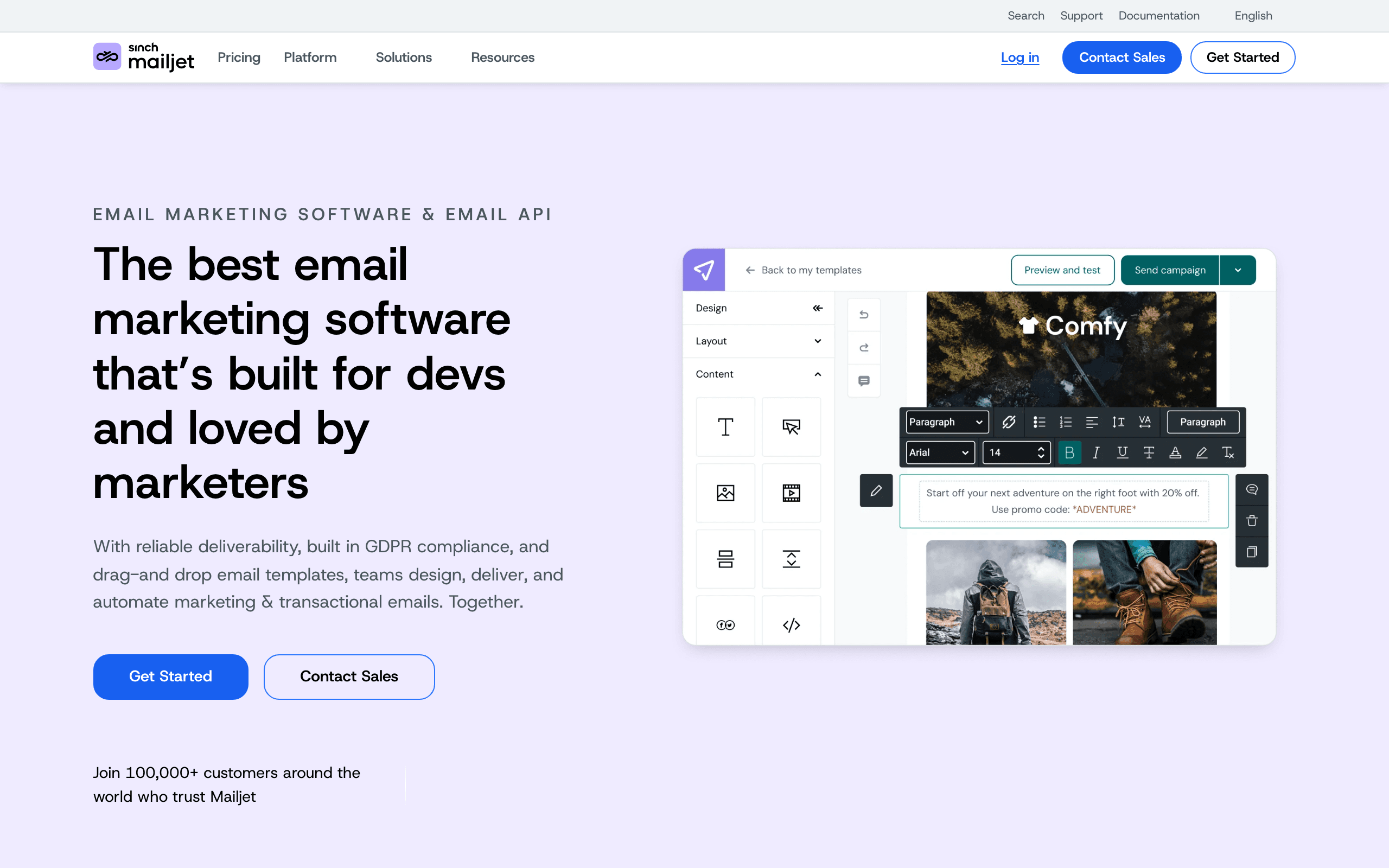
Mailjet Passport is unique in the budget email space. Multiple team members can edit the same email simultaneously, like Google Docs. For marketing teams with designers and copywriters collaborating on campaigns, this feature alone might justify choosing Mailjet. Elastic Email offers no equivalent.
Pricing at Scale
At entry level, Mailjet ($15/mo) is slightly cheaper than Elastic Email ($19/mo). The story changes at high volumes. Elastic Email's aggressive volume pricing can be 30-50% cheaper at scale. If cost is your primary concern and you send high volume, Elastic Email wins.
Enterprise Stability
Mailjet is owned by Sinch, a major communications company. This provides enterprise stability, ongoing development, and resources. Elastic Email is independent. For companies valuing vendor stability and long-term platform viability, Mailjet has the edge.
European Presence
Mailjet is headquartered in Paris with EU data processing options. This matters for GDPR compliance and European data residency requirements. Elastic Email is US-based. European companies with data sovereignty concerns should favor Mailjet.
The SaaS Alternative
Both platforms are general-purpose email tools. SaaS companies often need more focused features. Sequenzy offers unified marketing and transactional built for SaaS, with native Stripe integration and unlimited contacts.
Making the Choice
Choose Mailjet for real-time collaboration, European presence, and enterprise backing. Choose Elastic Email for maximum cost savings at high volumes. For SaaS with marketing automation and transactional emails with Stripe integration, consider Sequenzy.
Collaboration as a Competitive Advantage
Mailjet's Passport collaborative editor is genuinely unique among email platforms in this price range. Multiple team members editing the same email simultaneously eliminates the version control problems and back-and-forth that plague most email teams. For organizations with separate design, copy, and marketing roles, this feature alone can justify choosing Mailjet over Elastic Email.
Elastic Email has no equivalent feature. Email creation is a solo activity. For solo marketers or small teams where one person handles emails, this gap does not matter. For collaborative teams, it matters a lot.
Volume Pricing Economics
Elastic Email's aggressive pricing makes the biggest impact at high volumes. At 500,000 emails monthly, Elastic Email can cost 30-50% less than Mailjet. For agencies managing multiple clients or businesses with large subscriber bases sending frequent campaigns, these savings are significant.
At moderate volumes under 100,000 emails monthly, the price difference narrows. The decision at moderate volume should be based on feature needs rather than cost since the monthly savings are modest.
Data Sovereignty for European Businesses
Mailjet's Paris headquarters and EU data processing infrastructure provide compliance advantages for European businesses. Data stays within the EU, simplifying GDPR compliance documentation and satisfying data residency requirements. Elastic Email is US-based without EU data processing options.
For companies in regulated European industries or those with customers who require EU data processing guarantees, Mailjet's European presence is not just a feature but a compliance requirement.
Delivery Speed and Reliability
Mailjet and Elastic Email both move transactional email quickly, so the choice comes down to what surrounds delivery rather than speed itself. Mailjet, owned by Sinch and based in Paris, adds real-time collaborative editing so teams can build emails together, plus EU data options for GDPR compliance. Elastic Email skips collaboration but consistently undercuts on price at high volumes. Pick Mailjet if your team edits templates together and needs EU hosting, and Elastic Email if volume pricing matters more.
API Design and Developer Experience
Both platforms offer REST APIs, SMTP relay, and SDKs in multiple languages, but Mailjet's documentation and visual email builder are generally considered more polished. Elastic Email's API is functional and gets the job done, though it feels less refined than Mailjet's. Neither is as developer-focused as dedicated transactional specialists, but between the two, Mailjet's tooling, including its real-time Passport editor, gives teams building templates collaboratively a smoother experience than Elastic Email currently offers.
Scaling and Cost at Volume
At 50,000 emails a month, Mailjet runs roughly $35 on its Premium automation plan while Elastic Email lands between $25 and $35 depending on the tier. Elastic Email's advantage grows at higher volumes, where its aggressive pricing can undercut competitors by 30 to 50 percent. Mailjet's Essential plan starts cheaper at $15 for basic sending if you do not need automation yet. Compare both against your actual monthly volume, since the cheaper option flips depending on scale.
Use-case matchups
| Use case | Better fit | Why |
|---|---|---|
| Collaborative email production | Mailjet | Mailjet's Passport editor supports real-time team collaboration. |
| Lowest high-volume sending cost | Elastic Email | Elastic Email is positioned around aggressive volume pricing. |
| European data residency concerns | Mailjet | Mailjet's European presence can matter for GDPR and data residency requirements. |
| Budget transactional and marketing email | Depends | Both are budget-friendly; choose based on collaboration, deliverability, and volume pricing. |
| SaaS lifecycle email with billing triggers | Sequenzy | Sequenzy is built around SaaS campaigns, transactional email, and Stripe integration. |
Best Fit by Budget Email Priority
Best email platform for EU collaboration and template workflows
Mailjet fits teams that value European presence, real-time campaign collaboration, transactional email, and marketer-friendly template production.
Best email platform for high-volume budget sending
Elastic Email is the better fit when the primary decision is aggressive volume pricing and the team can validate deliverability and workflow fit.
Best SaaS email platform for billing-triggered lifecycle email
Sequenzy fits SaaS teams that need lifecycle campaigns and transactionals tied to subscription events rather than volume sending alone.
Pricing reality
Both tools are budget options, but the cheaper choice depends on volume and requirements. Mailjet can be competitive at entry level and adds collaboration value. Elastic Email tends to become more attractive as volume rises. Include dedicated IPs, validation, support level, and automation requirements in the real comparison.
Review signals
The reviews on this page point to Mailjet's collaboration, EU positioning, and unified marketing plus transactional email as positives, with cautions around plan limits and basic automation. Elastic Email reviews emphasize low cost, API usefulness, and verification, with cautions around editor quality, support depth, and deliverability monitoring.
Migration checklist
| Step | Moving to Mailjet | Moving to Elastic Email | Moving to Sequenzy |
|---|---|---|---|
| Scope | Confirm collaboration, EU data, templates, and automation needs. | Confirm send volume, validation, SMTP/API use, and support requirements. | Confirm SaaS lifecycle, Stripe, transactional, and campaign needs. |
| Data export | Export contacts, templates, lists, suppression data, and sender domains. | Export contacts, templates, lists, suppression data, and sender domains. | Export contacts, lifecycle fields, billing IDs, and suppression records. |
| Integration rebuild | Rebuild templates, API/SMTP calls, webhooks, and collaborative approval flow. | Rebuild templates, API/SMTP calls, webhooks, and validation flow. | Rebuild campaigns, transactional templates, and billing-triggered journeys. |
| QA | Test collaboration, sending, bounces, unsubscribes, and deliverability. | Test volume sending, bounces, validation, unsubscribes, and deliverability. | Test marketing, transactional, and Stripe-triggered paths together. |
Decision checklist
- Choose Mailjet if collaboration, EU presence, and an enterprise-backed budget platform matter.
- Choose Elastic Email if high-volume cost efficiency is the strongest requirement.
- Choose Sequenzy if the buying reason is SaaS lifecycle automation rather than generic budget email delivery.