Elastic Email's pricing page
Captured from elasticemail.com. Pricing changes often, so confirm the current numbers on the live page.
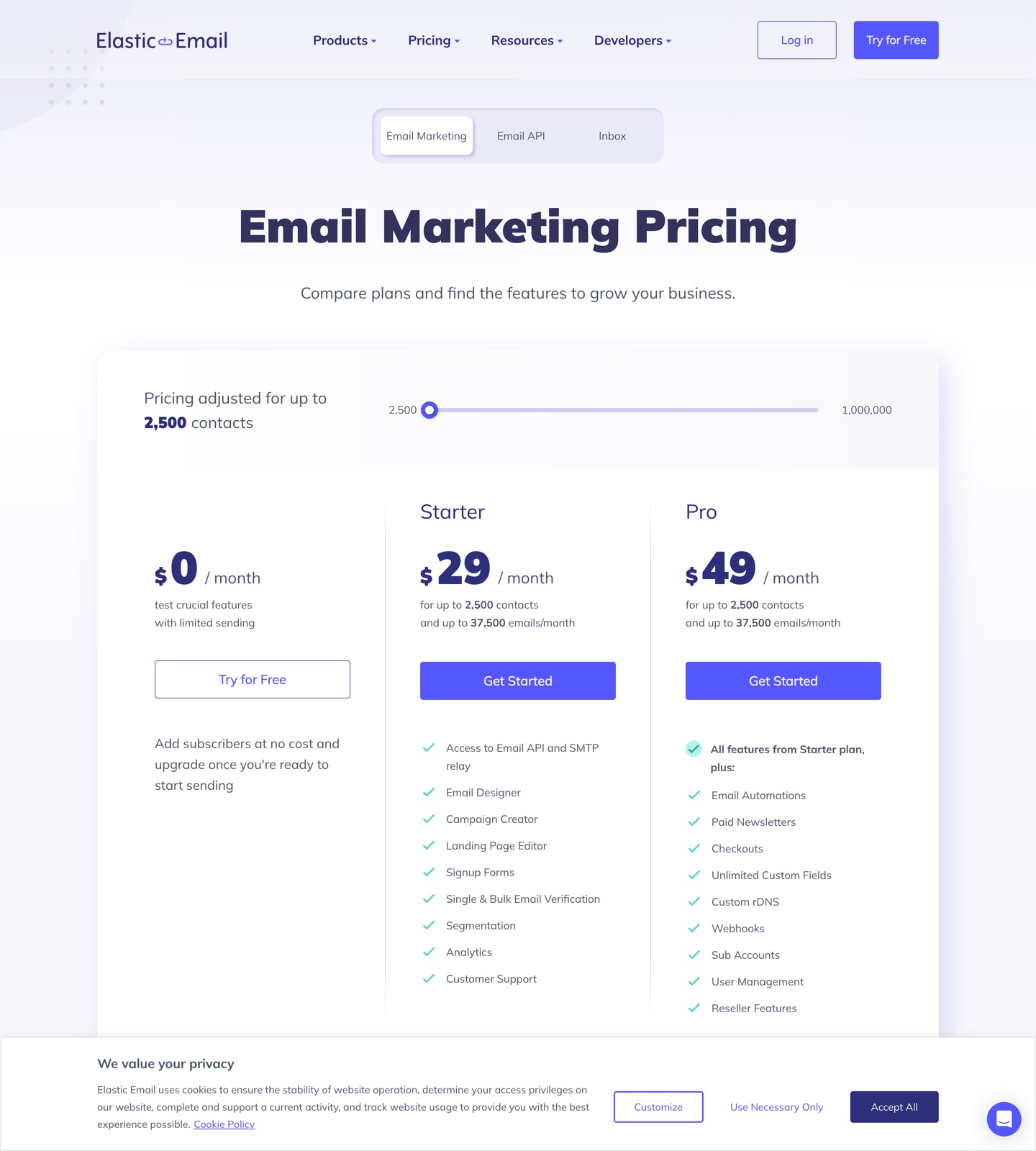
Buying shortcut
Which Elastic Email plan should you choose?
Start here
Free testing
Teams evaluating Elastic Email before upgrading. It is the first tier to check when you only need the core Elastic Email workflow. Watch for: Limited sending
Public price
$0
Limited sending for testing core features.
Main upgrade
Starter
Small teams running campaigns and forms. Inspect this tier when the lower tier starts blocking reporting, automation, collaboration, or support needs. Watch for: Pro required for advanced automation and reseller features
Public price
$29/mo+
$29/month for up to 2,500 contacts and 37,500 emails/month.
High-volume or advanced
Pro
Teams needing automation, commerce, webhooks, and subaccounts. Treat this as the serious-operations tier, especially if the first two plans leave key limits or add-ons unresolved. Watch for: Private IPs cost extra
Public price
$49/mo+
$49/month for up to 2,500 contacts and 37,500 emails/month.
Cost scenarios
Pricing pages show the entry point. These scenarios show what the plan means in real buying situations.
Small list with campaigns and forms
Elastic Email: Starter at the visible $29/month tier.. Sequenzy: Better if SaaS lifecycle sequence strategy is the real need.. Elastic Email is broad; Sequenzy is more lifecycle-specific.
Team needing automation and webhooks
Elastic Email: Pro is the practical plan.. Sequenzy: Built around SaaS email workflows rather than reseller features.. Pro is where Elastic Email becomes more automation-capable.
High-deliverability sender
Elastic Email: Base plan plus private IP add-ons.. Sequenzy: Compare based on lifecycle needs and sending volume.. Add-ons can change the real cost.
What to watch for
Paid pricing is based on active contacts and send allowance.
Private IPs are paid add-ons.
Pro is needed for automations, paid newsletters, checkouts, webhooks, and subaccounts.
Elastic Email pricing combines marketing and sending
Elastic Email is useful when you want campaigns, forms, landing pages, SMTP/API access, analytics, and verification in one place. Starter is enough for basic campaigns; Pro is the automation and advanced-account threshold.
The cost model should be split by job. A marketing team cares about contacts, campaign sends, automation, landing pages, and forms. A developer team cares about SMTP/API sending, verification, logs, and deliverability. If both teams use Elastic Email, the platform can consolidate spend. If the SaaS team mainly wants lifecycle sequence work, the broad feature set may not be the deciding factor.
Use Elastic Email alternatives to compare broad email platforms and delivery tools. Use Sequenzy vs Elastic Email when the decision is campaign infrastructure versus SaaS lifecycle strategy.
Elastic Email vs Sequenzy
Elastic Email is a broad email platform. Sequenzy is more focused on SaaS lifecycle workflows and sequence strategy.
Elastic Email vs Sequenzy
How Elastic Email compares with Sequenzy, which bills on emails sent rather than contact count.
How Sequenzy prices the same volume
Sequenzy price per 1k emails
$0.82 / 1k at $49/mo for 60k emails
Verdict
Elastic Email is a flexible marketing and sending platform with low entry pricing. Sequenzy is better when the core problem is SaaS lifecycle email, not general email marketing plus SMTP.
FAQ
Sources checked · Jun 16, 2026