
Overview
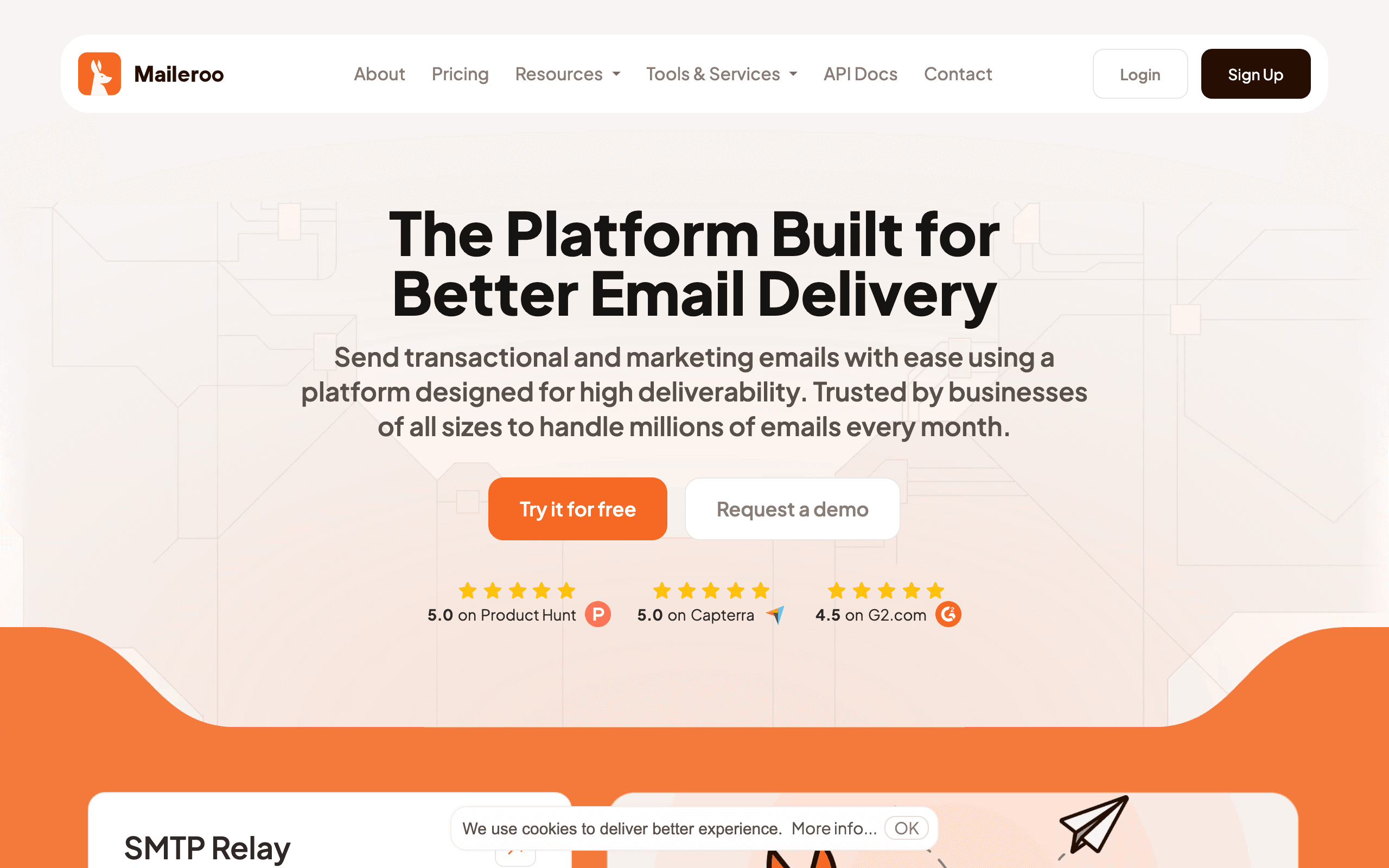
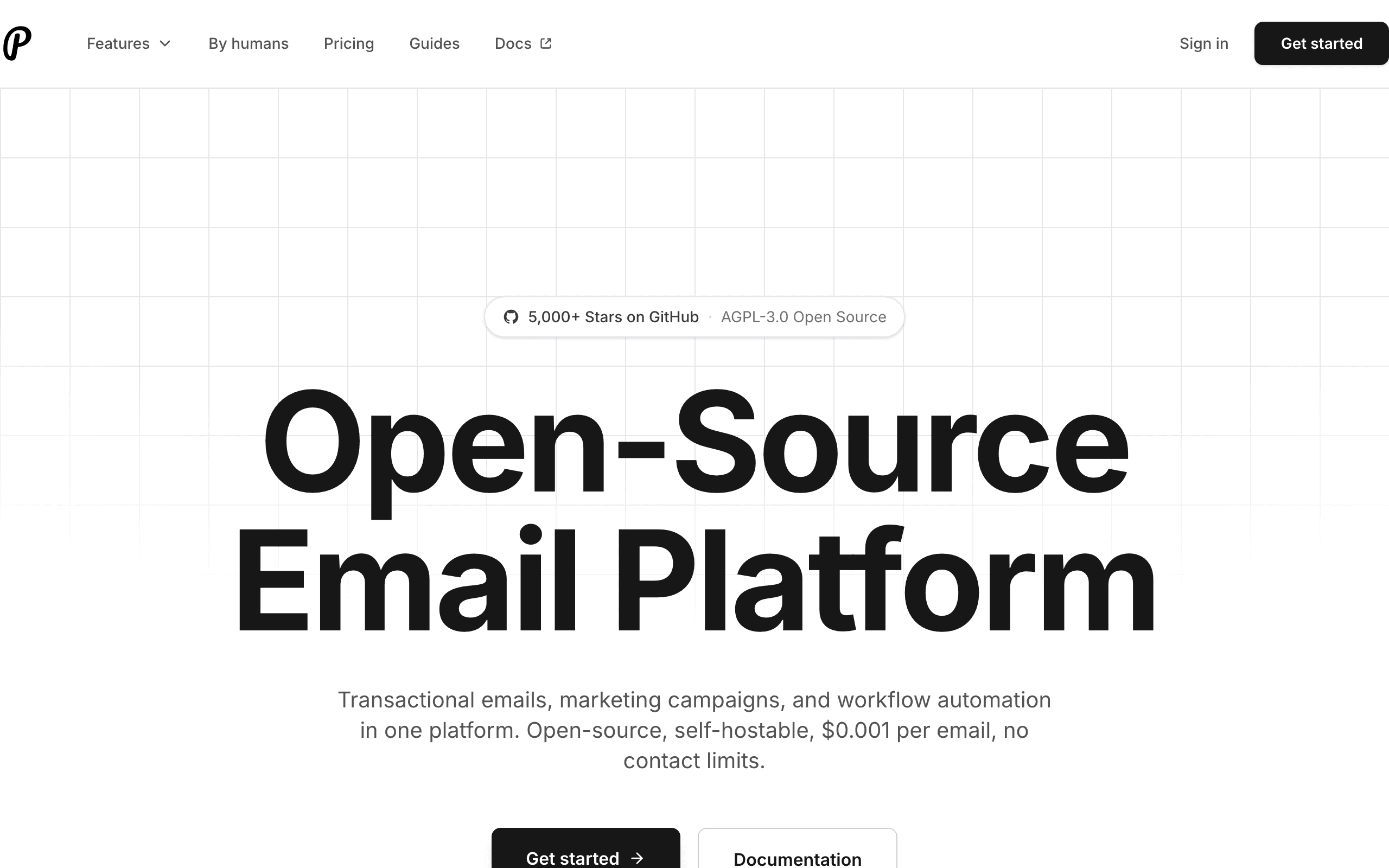
Maileroo and Plunk both handle email delivery but approach it differently. Maileroo is a email delivery service with SMTP relay, REST API, and free email verification. Plunk is a open-source modern email platform for developers.
Delivery Approach
Maileroo combines SMTP relay and a REST API with free email verification built into every plan, an unusual bundle at its $8-a-month starting price with 5,000 free emails included. Plunk takes a different angle entirely: it's open source, self-hostable, and free to start, aimed at developers who want to own their email stack rather than rent verification tools. Neither is chasing the same buyer, since Plunk's appeal is control and cost, while Maileroo's is convenience and cleaner lists.
Plunk offers open source and modern stack, providing a developer-friendly alternative in the email delivery space.
Pricing
Maileroo starts free (5,000 emails/mo) with paid plans from $8/month. Plunk Free tier. Open-source. Modern. Transactional + marketing. Developer-friendly.. Maileroo's free email verification API is a genuine differentiator that can save you money on a separate verification service.
Making the Choice
Choose Maileroo for affordable delivery with free email verification. Choose Plunk for open source. For unified SaaS email, consider Sequenzy.
Email Verification Advantage
Checking addresses before sending typically costs extra, but Maileroo folds that verification into its plans starting at $8 a month. Plunk has no equivalent feature, which fits its open-source, developer-first philosophy: you're expected to bring your own tools or write your own checks. For teams that would rather not build that layer themselves, Maileroo's included verification removes a step; for teams comfortable self-hosting and wiring up their own stack, Plunk's flexibility matters more than a bundled extra.
Plunk's free tier and open-source code make it attractive if you want to run your own email infrastructure without licensing fees, but list cleaning isn't part of the package. Maileroo answers that gap directly with a free verification API on every plan, including its $8 entry tier. If reducing bounces without adding another vendor matters to you, Maileroo's bundled approach is simpler than pairing Plunk with a separate checker.
Pricing and Value
Maileroo's $8-a-month plan includes 5,000 free emails and, once you pass 250,000 sent, free dedicated IPs that many providers charge for separately. Plunk starts free entirely, reflecting its open-source model, though free doesn't mean feature-equivalent: Plunk's automation and campaign tools stay limited compared with what a paid transactional plan typically covers. Which one costs less depends on whether you value Maileroo's included extras or Plunk's zero starting price and source-code access.
Plunk's pricing starts at free, which is hard to beat on paper, but its consB list notes limited features and sparse documentation next to more established tools. Maileroo charges from $8 a month yet returns verification, dedicated IPs at scale, and SDKs across seven-plus languages for that price. Compare what each actually delivers at your expected volume rather than just the sticker price before deciding which is the better deal.
Infrastructure and Reliability
Neither Maileroo nor Plunk has the long track record of legacy providers; both are younger platforms still building their reputations. Plunk's consB flags a smaller community and sparse documentation, while Maileroo's own weak points include limited documentation and a shorter history too. If proven infrastructure at scale is your top priority, weigh that both are still relatively new, and look at your own testing results rather than brand age alone.
Maileroo makes sense for teams that want verification and dedicated-IP perks bundled into a low-cost transactional plan, even from a newer provider. Plunk appeals more to developers who want open-source control and are willing to self-host or accept a leaner feature set for that freedom. If your priority is turnkey delivery with less setup, Maileroo fits; if it's owning the code, Plunk's free, open approach wins out.
Use-case matchups
| Situation | Better fit | Why |
|---|---|---|
| You want a low-cost hosted delivery API with SMTP fallback | Maileroo | Maileroo provides SMTP relay, REST API, a 5,000-email free tier, and paid plans from the cited $8/month level. |
| You need built-in email verification | Maileroo | Verification is a specific Maileroo advantage in the page data; Plunk does not list it. |
| You want open-source control or self-hosting flexibility | Plunk | Plunk's main differentiator is its open-source, developer-first model. |
| You need a lightweight combined transactional and marketing developer tool | Plunk | Plunk is positioned here as transactional plus marketing, while Maileroo is more delivery-service oriented. |
| You need SaaS lifecycle campaigns, not just delivery | Sequenzy | Sequenzy adds Stripe-aware marketing and transactional workflows on top of email sending. |
Best Fit by Hosted Verification and Open-Source Control
Best hosted delivery service with verification
Choose Maileroo when the team wants a managed SMTP/API provider, bundled email verification, and predictable setup without owning the mail infrastructure. It is the better fit for apps that need production sending quickly and want to reduce bounce risk from signups, invites, and customer-entered addresses.
Best open-source transactional email tool for developers
Choose Plunk when developer control, source availability, and self-hosting flexibility matter more than bundled verification. It is stronger for teams comfortable evaluating a younger ecosystem and owning more of the operational burden in exchange for customization and transparency.
Best SaaS lifecycle system beyond developer mail tools
Choose Sequenzy when the product needs lifecycle campaigns, billing-aware automation, newsletters, and transactional email together. Plunk and Maileroo can both help deliver messages, but SaaS growth workflows need subscriber context and Stripe-triggered journeys around those sends.
Pricing reality
Maileroo is easier to price from the data on this page: free for 5,000 emails/month and paid from $8/month, with email verification included. Plunk's value depends more on whether you use the hosted product, self-host, or treat open source as a control and customization advantage.
The cheapest option is not automatically the lowest-effort option. If you self-host or customize Plunk, include maintenance, deliverability monitoring, uptime, backups, and engineering time in the evaluation. If you choose Maileroo, include whether a separate marketing platform will still be needed.
Review signals
The Maileroo reviews emphasize free email verification, competitive pricing, and reliable basic delivery. The caution is that it is a newer, smaller platform with less ecosystem depth than older providers.
The Plunk reviews emphasize open-source confidence and developer control. The trade-off is that teams choosing Plunk should be comfortable with a younger ecosystem and with validating whether the hosted or self-hosted path fits their reliability expectations.
Migration checklist
- Inventory transactional templates, SMTP credentials, API calls, webhooks, bounce handling, and suppression logic.
- Decide whether the target setup is hosted Plunk, self-hosted Plunk, or Maileroo's hosted delivery service.
- Recreate domain authentication records and verify SPF, DKIM, DMARC, return-path, and tracking settings.
- Port templates and test all critical flows: signup verification, password reset, receipts, invites, and alerts.
- Confirm bounce, complaint, unsubscribe, and suppression handling before routing production traffic.
- Shift traffic gradually and monitor delivery latency, error rates, bounces, and spam placement.
Decision checklist
- Choose Maileroo if you want hosted low-cost delivery plus bundled verification.
- Choose Plunk if open-source control matters more than bundled verification and vendor maturity.
- Choose Sequenzy if your real need includes SaaS campaigns, Stripe events, and transactional email in one product.









