Emailit's pricing page
Captured from emailit.com. Pricing changes often, so confirm the current numbers on the live page.
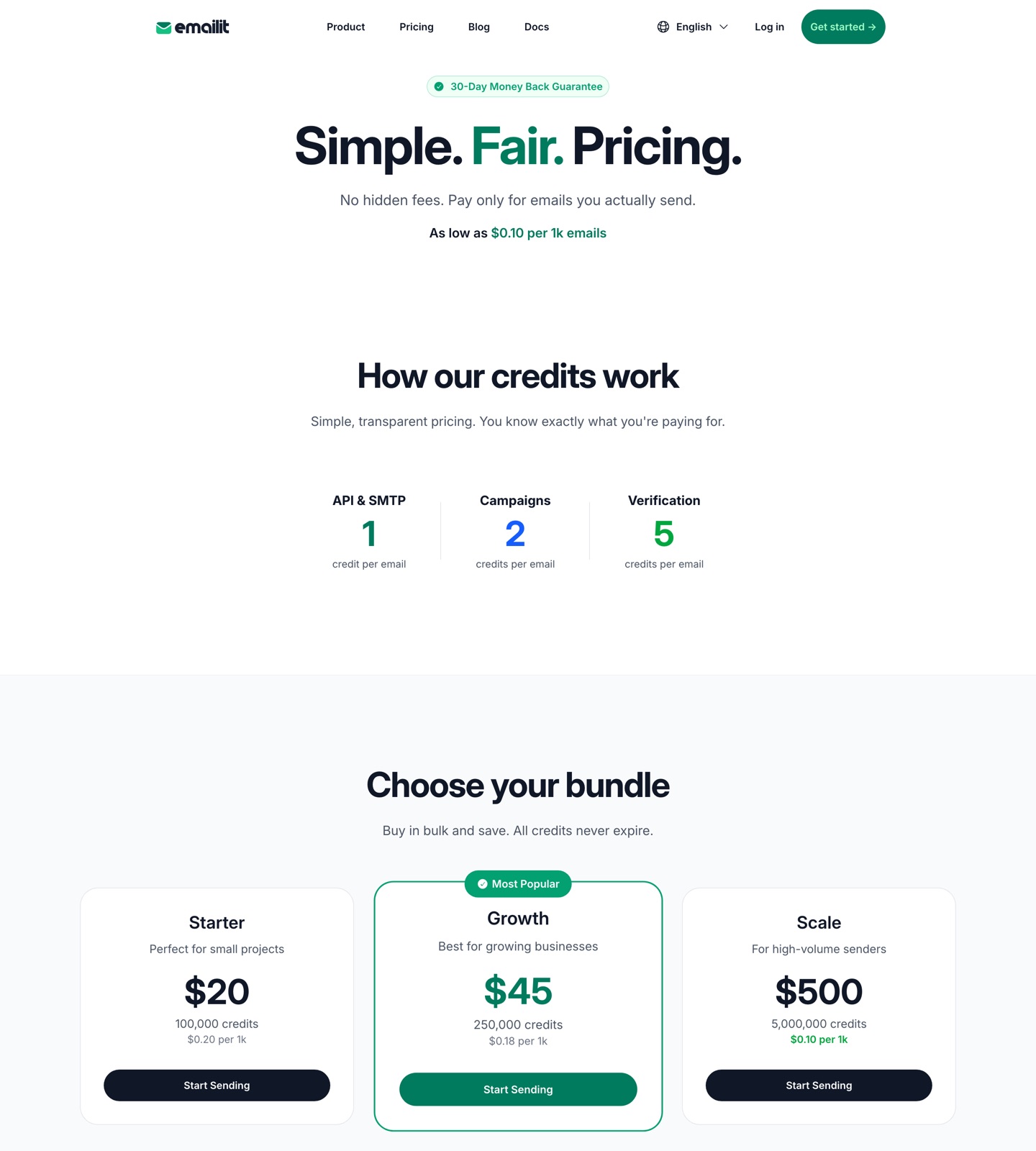
Buying shortcut
Which Emailit plan should you choose?
Start here
Pay as you go
Starters and low-volume senders. It is the first tier to check when you only need the core Emailit workflow. Watch for: 100 emails per day limit
Public price
$0/mo
Free with 3,000 credits per month; extra credits $2 per 10,000.
Main upgrade
Pro
Professional projects that are not business-critical. Inspect this tier when the lower tier starts blocking reporting, automation, collaboration, or support needs. Watch for: No uptime SLA
Public price
$25/mo
$25 per month billed monthly or $20 per month billed yearly; 100,000 credits per month included; extra credits $1 per 10,000.
High-volume or advanced
Contract
High-volume senders with custom scaling needs. Treat this as the serious-operations tier, especially if the first two plans leave key limits or add-ons unresolved. Watch for: Requires talking to sales
Public price
Custom
Flexible credits and volume pricing with invoicing.
What Emailit costs at your size
The cheapest plan that covers each size, from Emailit's published pricing. Check the sources below for the date it was verified.
Cost scenarios
Pricing pages show the entry point. These scenarios show what the plan means in real buying situations.
Transactional API sending
Emailit: 1 credit per API or SMTP email, starting with a $20 credit bundle.. Sequenzy: Sequenzy is not raw delivery infrastructure.. Emailit is better for prepaid delivery credits.
Newsletter campaign sends
Emailit: Campaigns cost 2 credits per email.. Sequenzy: Sequenzy is built around marketing campaign workflows.. Compare effective campaign cost, not only API send cost.
No monthly subscription preference
Emailit: Credits do not expire and there is no base subscription.. Sequenzy: Sequenzy is better when ongoing lifecycle tooling matters more than prepaid delivery.. Emailit wins for occasional pay-as-you-go sending.
What to watch for
Campaign emails use 2 credits per email, not 1.
Email verification uses 5 credits per email.
Data retention and dedicated IP are paid add-ons.
Costs beyond the headline price
- Extra credits cost $2 per 10,000 on Pay as you go but only $1 per 10,000 on Pro and Business.
- Campaign emails use 2 credits each, automation runs use 3 credits each, and email verifications use 5 credits each, so these workloads consume monthly credits faster than API sending.
- A dedicated IP costs $30 per month per IP.
- The data retention add-on costs $50 per month.
- A deliverability optimization session costs $299 as a one-time fee.
- Monthly billing costs more than yearly billing: Pro is $25 versus $20 per month and Business is $250 versus $200 per month.
Emailit pricing is credit-based
Emailit is easiest to evaluate by converting your expected API sends, campaign sends, verification checks, and automation runs into credits.
That conversion is the whole buying exercise. API sends, campaign sends, verification, automations, retention, and dedicated IP needs do not have the same cost shape, so a cheap credit bundle can look different once real workflows are mapped. Emailit is strongest when developers want prepaid sending flexibility and do not need a full marketing operating system.
Use Emailit alternatives for email API and delivery-credit comparisons. Use Sequenzy vs Emailit if you are deciding whether the project needs infrastructure credits or lifecycle campaign software.
Emailit vs Sequenzy
Emailit is delivery-credit infrastructure. Sequenzy is the better comparison when the buying decision is about marketing workflows rather than raw credits.
Emailit vs Sequenzy
How Emailit compares with Sequenzy, which bills on emails sent rather than contact count.
How Sequenzy prices the same volume
Sequenzy price per 1k emails
$0.82 / 1k at $49/mo for 60k emails
Verdict
Emailit is a strong fit when you want prepaid credits and no subscription. Sequenzy is a better fit when the job includes SaaS lifecycle strategy, campaign workflows, and audience operations.
FAQ
Sources checked · Oct 8, 2026
Written by Nic Polotnianko, co-founder of Sequenzy, which appears in this comparison. How we compare tools