
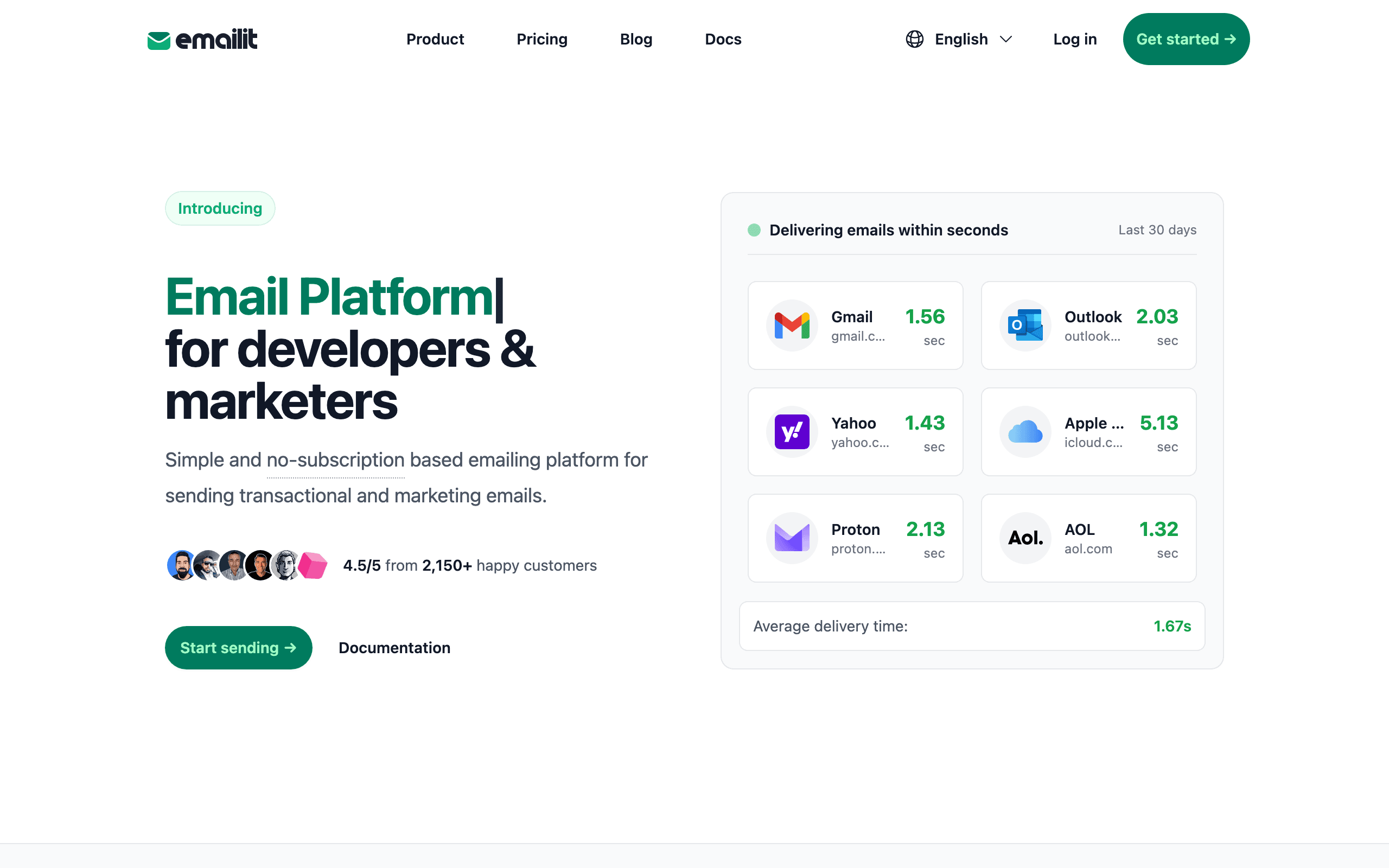

Overview
EmailIt and SendGrid serve different needs in the email space. EmailIt is a budget pay-per-email delivery service. SendGrid is a enterprise email delivery platform by Twilio.
The choice depends on what you need: cheapest per-email pricing (EmailIt) or proven at massive scale (SendGrid). For SaaS businesses specifically, Sequenzy offers purpose-built features that neither tool provides.
Pricing reality
- EmailIt: ~$1-2 per 10k emails, billed per email with no subscription, over SMTP or API.
- SendGrid: $19.95/month - Twilio-owned. Both transactional API and marketing.
- Sequenzy: $99/month for 120,000 emails, priced by volume, with SMS as a paid add-on. See pricing.
Review signals
The EmailIt reviews on this page support the small-scale cost argument. One reviewer says SendGrid is overkill for 3,000 monthly password reset emails and that EmailIt handles the same job for pennies.
The negative EmailIt review shows the scaling point: once the team passed 50,000 monthly emails, SendGrid's deliverability tools, validation API, and analytics justified the higher cost.
SendGrid's reviews validate the enterprise-production case, especially for millions of daily sends and strong documentation. The caution signal is support, with one reviewer saying response quality declined after Twilio acquired SendGrid.
Where EmailIt Wins
Cheapest per-email pricing
EmailIt's per-email rate, about $1-2 per 10k emails, is the cheapest of the two for low volume.
No monthly subscription
Because EmailIt charges no monthly fee, a quiet month costs you nothing, unlike SendGrid's $19.95 base price.
Simple SMTP/API
EmailIt's SMTP and API setup avoids SendGrid's configuration complexity, so there is less to set up.
Fast delivery
EmailIt is the pick for teams that prioritize fast delivery on time-sensitive messages.
Where SendGrid Wins
Proven at massive scale
SendGrid offers proven at massive scale, which matters for teams that prioritize this.
Both transactional and marketing
SendGrid offers both transactional and marketing, which matters for teams that prioritize this.
Extensive documentation
SendGrid offers extensive documentation, which matters for teams that prioritize this.
Strong deliverability
SendGrid offers strong deliverability, which matters for teams that prioritize this.
Delivery Speed and Reliability
EmailIt keeps things simple: pay roughly $1 to $2 per 10,000 emails sent, with no subscription and no dashboard to configure. SendGrid, now part of Twilio, runs at enterprise scale, processing over 100 billion emails a month, and starts at $19.95 a month with dynamic templates and dedicated IPs on higher tiers. For a small app sending occasionally, EmailIt's pay-per-email model is cheaper and faster to set up; for anything approaching serious volume, SendGrid's proven infrastructure and tooling justify the higher price.
API Design and Developer Experience
SendGrid ships SDKs in seven or more languages, an email validation API, and Handlebars-based dynamic templates, backed by extensive documentation built over more than a decade. EmailIt has none of that; it is a clean API and little else, which also means less to learn and fewer moving parts to break. Teams that want a mature toolkit with validation and templating reach for SendGrid; teams that just need to fire an email from code without extra configuration reach for EmailIt.
Scaling and Cost at Volume
SendGrid's pricing splits between its API product and its separate Marketing Campaigns product, which some users find confusing to navigate, and support quality has drawn complaints since the Twilio acquisition. EmailIt avoids that entirely with one flat per-email rate and no split billing to untangle. At comparable low volumes, EmailIt tends to cost less; at high volumes needing dedicated IPs and enterprise support, SendGrid's infrastructure is harder to match regardless of price.
The Twilio Ecosystem Effect
SendGrid's acquisition by Twilio in 2019 brought email into a broader communications platform that includes SMS, voice, and video. For companies already using Twilio's products, SendGrid offers natural integration points and unified billing. EmailIt exists as an independent company with no ecosystem to leverage.
The Twilio connection cuts both ways. Enterprise teams benefit from a single vendor relationship and consolidated support. But Twilio's influence has also introduced enterprise-style pricing complexity and, according to many users, degraded support quality. Tickets that once received same-day responses now sometimes take days. EmailIt's smaller scale means more personal support but fewer resources overall.
For SaaS companies specifically, the Twilio ecosystem provides communication tools but not subscription-aware email automation. Neither platform connects natively to Stripe billing events to trigger emails based on upgrades, downgrades, or payment failures.
The Documentation and SDK Gap
SendGrid's documentation is among the most comprehensive in the email industry. Official SDKs in Python, Ruby, Go, Java, C#, PHP, and Node.js mean your team can integrate using their preferred language with type-safe, well-maintained libraries. EmailIt's documentation is minimal by comparison, with basic API reference and limited examples.
This documentation gap matters most during initial integration and troubleshooting. When something goes wrong with SendGrid, you can usually find the answer in their docs, community forums, or Stack Overflow. EmailIt's smaller user base means fewer community resources and less institutional knowledge available online.
However, SendGrid's extensive documentation also reflects its complexity. There are separate products for transactional API and marketing campaigns, different pricing for each, and configuration options that can overwhelm teams just trying to send a password reset. EmailIt's sparse docs mirror its sparse feature set -- there is simply less to document.
The Email Validation Advantage
SendGrid offers an email validation API that verifies addresses before you send, reducing bounces and protecting your sender reputation. This feature alone can save significant money by preventing sends to invalid addresses. EmailIt has no validation capability, meaning you need a third-party service like ZeroBounce or NeverBounce.
Email validation becomes critical at scale. A 5% bounce rate on 100,000 emails means 5,000 bounces that damage your domain reputation. SendGrid's built-in validation catches most of these before they become problems. The cost of a separate validation service often exceeds what you save by using EmailIt over SendGrid.
For SaaS companies managing subscriber lifecycles, validation is just one piece of the deliverability puzzle. Connecting email engagement data to user segments, tracking which subscribers convert to paying customers, and automating responses to billing events requires capabilities that go beyond what either pure delivery platform provides.
Use-case matchups
| Situation | Best first look | Why |
|---|---|---|
| Small app with low-volume transactional sending | EmailIt | EmailIt is attractive when the team wants cheap SMTP/API delivery without enterprise overhead. |
| Production app sending high-volume transactional email | SendGrid | SendGrid brings scale, documentation, SDKs, validation, analytics, and more mature sender tools. |
| Team already using Twilio for messaging | SendGrid | SendGrid can fit into a broader Twilio communications stack. |
| SaaS team needing lifecycle marketing plus transactional email | Sequenzy | Sequenzy is more useful when transactional messages and subscription-aware campaigns must share customer state. |
| Developer team that only needs password resets and receipts | EmailIt | Paying for SendGrid's broader infrastructure may be unnecessary at very low volume. |
Pricing reality details
EmailIt wins the raw per-email price comparison for small or simple sending needs. That advantage narrows if the team later needs validation, advanced analytics, dedicated IP planning, or enterprise-grade support.
SendGrid's higher base cost buys maturity: documentation, SDKs, event webhooks, validation, templates, scale, and a large ecosystem. It is often easier to justify when email delivery is mission-critical and volume is growing.
Sequenzy's price is relevant when email is not just delivery infrastructure. If the team also needs campaigns, lifecycle automation, transactional email, and Stripe events, a pure delivery comparison misses the real workload.
Best Fit by Delivery Maturity
Best low-cost SMTP API sender for small apps
EmailIt fits small teams that need affordable SMTP or API delivery for basic app messages, password resets, receipts, and low-volume transactional paths. It should be tested first when the team values simplicity and price more than enterprise tooling.
Best email infrastructure platform for growing production volume
SendGrid fits teams that expect volume growth, need mature SDKs, event webhooks, validation, templates, analytics, and a larger operational ecosystem. Choose it when email delivery is mission-critical and infrastructure depth matters more than the lowest entry price.
Best SaaS email platform for lifecycle plus transactionals
Sequenzy fits when delivery is only part of the job and the team also needs campaigns, lifecycle automation, transactional email, and Stripe events. It is the better comparison when subscriber state and billing context should drive messages.
Migration checklist
| Workstream | Moving toward EmailIt | Moving toward SendGrid | Simplifying to Sequenzy |
|---|---|---|---|
| Sending domains | Configure SPF, DKIM, DMARC, return-path, and sender identity. | Configure authenticated domains, link branding, suppression handling, and optional dedicated IPs. | Configure domains for both campaign and transactional sending. |
| Templates | Move simple SMTP/API templates and test dynamic variables. | Rebuild dynamic templates, Handlebars variables, categories, and transactional layouts. | Rebuild transactional, lifecycle, and campaign templates together. |
| Events | Capture delivery, bounce, complaint, and unsubscribe webhooks if available. | Map SendGrid event webhooks, categories, unsubscribe groups, and validation responses. | Map transactional events, campaign engagement, Stripe events, and subscriber state. |
| Application code | Swap SMTP/API credentials and test retry/error handling. | Update SDK/API calls, error handling, rate limits, sandbox tests, and webhook signatures. | Connect product events and billing events to email automations. |
| Deliverability | Monitor bounces, spam complaints, reputation, and warm-up needs manually. | Use validation, analytics, suppression tools, and dedicated sender controls as volume grows. | Track deliverability alongside lifecycle and campaign outcomes. |
Decision checklist
- Is the current problem cheap delivery or mature delivery operations?
- How much SDK, documentation, and webhook support does the team need?
- Will email validation reduce enough bounces to matter?
- Are marketing campaigns and lifecycle emails part of the same roadmap?
- Is Twilio ecosystem fit valuable, or would it add unnecessary complexity?









