
Overview
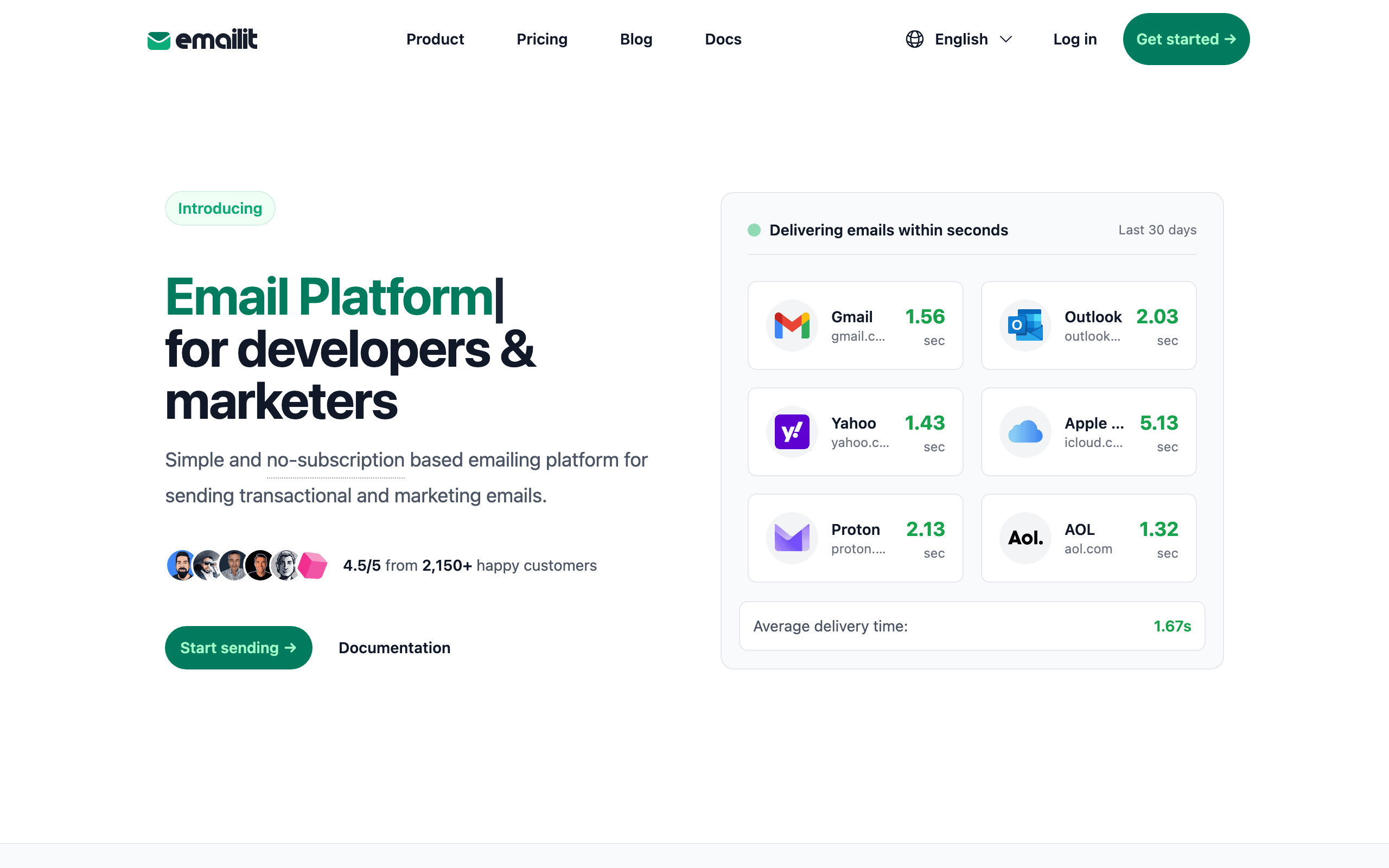
EmailIt and SMTP2GO serve different needs in the email space. EmailIt is a budget pay-per-email delivery service. SMTP2GO is a simple SMTP relay with good support.
The choice depends on what you need: cheapest per-email pricing (EmailIt) or simple setup (SMTP2GO). For SaaS businesses specifically, Sequenzy offers purpose-built features that neither tool provides.
Pricing reality
- EmailIt: About $1-2 per 10,000 emails, billed per message with no subscription, and you connect through SMTP or the API.
- SMTP2GO: $10/month - SMTP relay focus. Good support. Detailed analytics.
- Sequenzy: $99/month covers 120,000 emails and is fully managed, so you run no sending infrastructure. See pricing.
Review signals
The EmailIt reviews on this page support tiny-volume sending. One reviewer says SMTP2GO's $10/month minimum does not make sense for 500 monthly emails.
The negative EmailIt review shows the support and diagnostics gap: when a batch bounced, the team lacked the tools to diagnose the problem and moved to SMTP2GO for reporting and suppression management.
SMTP2GO's reviews reinforce the operational value: responsive support, detailed reporting, reliable setup, and automatic suppression management. That makes the $10/month minimum easier to justify when delivery problems would be costly.
Where EmailIt Wins
Cheapest per-email pricing
EmailIt's per-email rate is the lowest here, and it is most valuable when monthly volume is tiny.
No monthly subscription
Without a monthly plan, EmailIt costs nothing in months you send nothing, which SMTP2GO's $10 minimum does not allow.
Simple SMTP/API
EmailIt keeps the integration small, with plain SMTP and an API as the two ways in, which suits a developer who wants a minimal sending layer.
Fast delivery
Fast delivery is EmailIt's edge when sending speed matters more than reporting, since SMTP2GO's strengths lie in analytics and support.
Where SMTP2GO Wins
Simple setup
SMTP2GO offers simple setup, which matters for teams that prioritize this.
Good support
SMTP2GO offers good support, which matters for teams that prioritize this.
Detailed analytics
SMTP2GO offers detailed analytics, which matters for teams that prioritize this.
Affordable
SMTP2GO offers affordable, which matters for teams that prioritize this.
Delivery Speed and Reliability
EmailIt's pay-per-email pricing, about $1-2 per 10,000 emails, and simple SMTP/API setup get a message out with minimal configuration and no subscription. SMTP2GO charges $10 a month but adds dedicated IP options and automatic suppression management for bounces, which matters more once inbox reputation, not just raw send speed, becomes the priority.
API Design and Developer Experience
SMTP2GO leans on SMTP more than a modern REST API, but it pairs that with responsive customer support and detailed delivery analytics you can check without digging through logs. EmailIt offers both SMTP and a developer-first REST API, though it has no built-in testing or preview tools, so validating what you send is left to you rather than the platform.
Scaling and Cost at Volume
SMTP2GO's $10-a-month plan includes a 1,000-email free tier plus dedicated IPs and suppression handling as volume grows, features aimed at protecting deliverability rather than just cutting cost. EmailIt's pay-per-email model, at roughly $1-2 per 10,000 emails with no subscription, scales more cheaply for pure volume but leaves reputation management and suppression handling for you to build yourself.
Use-case matchups
| Use case | Better fit | Why |
|---|---|---|
| Lowest-cost low-volume sending | EmailIt | EmailIt's pay-per-email model is best when monthly volume is tiny and support needs are low. |
| Reliable SMTP relay with support | SMTP2GO | SMTP2GO is stronger when the team values setup help, diagnostics, suppression management, and delivery reporting. |
| Simple app notifications | Tie | Both can send basic transactional emails through SMTP/API when the team handles template and workflow logic elsewhere. |
| Deliverability troubleshooting | SMTP2GO | SMTP2GO provides better support and analytics for diagnosing bounces, deferrals, and reputation issues. |
| SaaS marketing plus transactional email | Sequenzy | Sequenzy is better when campaigns, transactional messages, and Stripe-triggered lifecycle automation need one workspace. |
| Developer-controlled minimal stack | EmailIt | EmailIt is the lighter option when developers want delivery only and do not need operations tooling. |
Best Fit by Relay Operations
Best SMTP relay for developer-controlled low-volume sending
EmailIt is the better fit when developers want a minimal sending layer and can own bounce handling, alerts, logs, and escalation themselves. It suits small apps, internal products, side projects, and low-volume transactional workloads where a monthly relay subscription would be disproportionate. The tradeoff is fewer operational guardrails when deliverability issues appear.
Best SMTP relay for support and deliverability troubleshooting
SMTP2GO is stronger when the team wants practical delivery operations: setup help, diagnostics, suppression management, bounce visibility, and support that can help with authentication or reputation problems. It is a better fit for businesses without dedicated email operations expertise, or for workloads where a single deliverability incident would cost more than the subscription.
Best SaaS email platform for campaigns plus transactionals
Sequenzy is the better fit when SMTP relay is not enough because customer state should drive email. SaaS teams need Stripe lifecycle triggers, onboarding, campaign segments, receipts, renewal reminders, and transactional messages tied to product or billing activity. That requires a lifecycle layer above either EmailIt's minimal relay or SMTP2GO's delivery operations.
The Support Quality Difference
SMTP2GO has built a genuine reputation for responsive, knowledgeable customer support. Their team understands email delivery at a technical level and provides actionable help with authentication issues, deliverability problems, and configuration questions. EmailIt, as a smaller operation, cannot match this level of support infrastructure.
For teams without dedicated email operations expertise, good support is worth more than the price difference suggests. A single deliverability issue that takes days to diagnose without help can cost far more in lost emails than SMTP2GO's $10 monthly subscription. EmailIt's lower cost assumes you can troubleshoot problems independently.
That said, both platforms focus on SMTP relay and delivery -- neither offers marketing email support, subscriber strategy guidance, or automation help. SaaS companies needing guidance on onboarding sequences, retention campaigns, or lifecycle email architecture need a platform built for that purpose.
The Bounce Management Factor
SMTP2GO's automatic suppression management handles bounced addresses without manual intervention. When an email bounces, SMTP2GO suppresses future sends to that address, protecting your sender reputation. EmailIt provides minimal bounce handling, leaving reputation management largely to you.
Bounce management matters more than most teams realize until they hit problems. Repeatedly sending to bounced addresses damages your domain reputation with ISPs, which can cause deliverable emails to start landing in spam. SMTP2GO's automated approach prevents this spiral. EmailIt users need to build their own suppression logic or risk reputation damage.
For SaaS businesses, bounces often correlate with business events -- employees leaving companies, free trial users using throwaway addresses, or churned customers abandoning email accounts. Connecting bounce data to subscriber segments and Stripe subscription status provides context that pure SMTP relay services cannot offer.
The Analytics Visibility Gap
SMTP2GO provides detailed delivery analytics showing what happened to every email -- delivered, bounced, deferred, opened, clicked. This visibility helps identify problems before they become critical. EmailIt's reporting is minimal, giving you basic send confirmation without the granular tracking that informs optimization.
Detailed analytics become essential as sending volume grows. A subtle deliverability decline might show up as a gradual drop in open rates across certain ISPs. SMTP2GO's reporting can surface this trend. EmailIt users might not notice until delivery rates have significantly degraded.
However, both platforms limit analytics to delivery metrics. Neither tracks downstream business impact -- which emails drive signups, which campaigns generate revenue, or which transactional emails correlate with user retention. SaaS companies that need to connect email performance to business outcomes through subscriber activity tracking require a more complete platform.
Migration checklist
| Workstream | What to verify |
|---|---|
| Relay configuration | Move SMTP/API credentials, sending domains, sender identities, suppression rules, and webhook endpoints. |
| Deliverability operations | If moving to SMTP2GO, recreate diagnostics, bounce handling, deferral tracking, reporting, and support escalation paths. |
| Minimal stack | If moving to EmailIt, confirm the app owns logging, retries, bounces, complaints, and reputation monitoring. |
| Lifecycle layer | If moving to Sequenzy, map campaigns, transactionals, Stripe events, and subscriber segments into one customer view. |
| Cutover | Reverify SPF, DKIM, DMARC, return-path, tracking links, and one production notification before ramping volume. |
Decision checklist
Is monthly volume small enough that EmailIt's pay-per-email model clearly beats SMTP2GO's minimum?
Does the team need support help for authentication, bounces, deferrals, or reputation issues?
Is automatic suppression management required to protect sender reputation?
Would SMTP2GO's reporting reduce operational risk enough to justify the subscription?
Would SaaS lifecycle automation and unified marketing plus transactional email justify Sequenzy instead?
Decide whether support, reporting, and suppression management justify a monthly SMTP relay subscription.
Export verified domains, sender identities, SMTP/API credentials, templates, suppression lists, webhook endpoints, bounce logs, delivery reports, and dedicated IP settings.
If moving to SMTP2GO, map EmailIt API/SMTP calls, bounce handling, reporting needs, suppression behavior, and alerting into SMTP2GO's relay setup.
If moving to EmailIt, identify which SMTP2GO analytics, suppression rules, email tests, dedicated IP settings, and support workflows must be replaced.
Start the move with password resets, receipts, and invoices, since templates must be recreated on the new platform and those are the messages customers notice first.
Reconnect SMTP/API calls, SDKs, webhooks, bounce handling, complaint handling, alerts, analytics exports, and monitoring.
Authenticate SPF, DKIM, and DMARC, then run seed tests plus a small production cohort before moving all transactional volume.
Preserve historical delivery, latency, bounce, complaint, cost, and support reports so the team can compare low cost against operational visibility.