
Overview
EmailIt and Mailgun serve different needs in the email space. EmailIt is a budget pay-per-email delivery service. Mailgun is a developer-focused email API with validation tools.
The choice depends on what you need: cheapest per-email pricing (EmailIt) or powerful api (Mailgun). For SaaS businesses specifically, Sequenzy offers purpose-built features that neither tool provides.
Pricing reality
- EmailIt: roughly $1 to $2 per 10,000 emails, billed per email with no subscription, and sent over SMTP or the API.
- Mailgun: $35/month (50k) - Developer-focused API. Email validation included.
- Sequenzy: pricing is based on emails sent each month rather than list size, so the $99 plan covers 120,000 emails with unlimited contacts. See pricing.
Review signals
The EmailIt reviews on this page support low-volume, low-complexity sending. One reviewer says Mailgun was overkill for 5,000 monthly notification emails and EmailIt handled the same job for a fraction of the cost.
The caution signal is production tooling. Another reviewer says EmailIt is refreshing but misses Mailgun's delivery logs and email validation for serious production email.
Mailgun's reviews support the mature developer-platform argument: validation, inbound routing, and a strong API are valued. The negative review points to post-acquisition price increases and a reduced free tier as reasons teams evaluate simpler alternatives.
Where EmailIt Wins
Cheapest per-email pricing
EmailIt offers the cheapest per-email pricing, at roughly $1 to $2 per 10,000 emails, which is a real advantage for light senders. The edge narrows at high volume, where Mailgun's per-email cost falls as sending grows.
No monthly subscription
EmailIt has no monthly subscription, so a quiet month costs nothing in fixed fees. That matters for senders who would otherwise pay Mailgun's $35 minimum while sending very little.
Simple SMTP/API
EmailIt's SMTP and API are simpler to set up than Mailgun's, with less configuration to manage. Teams that only need basic sending will find fewer settings to learn.
Fast delivery
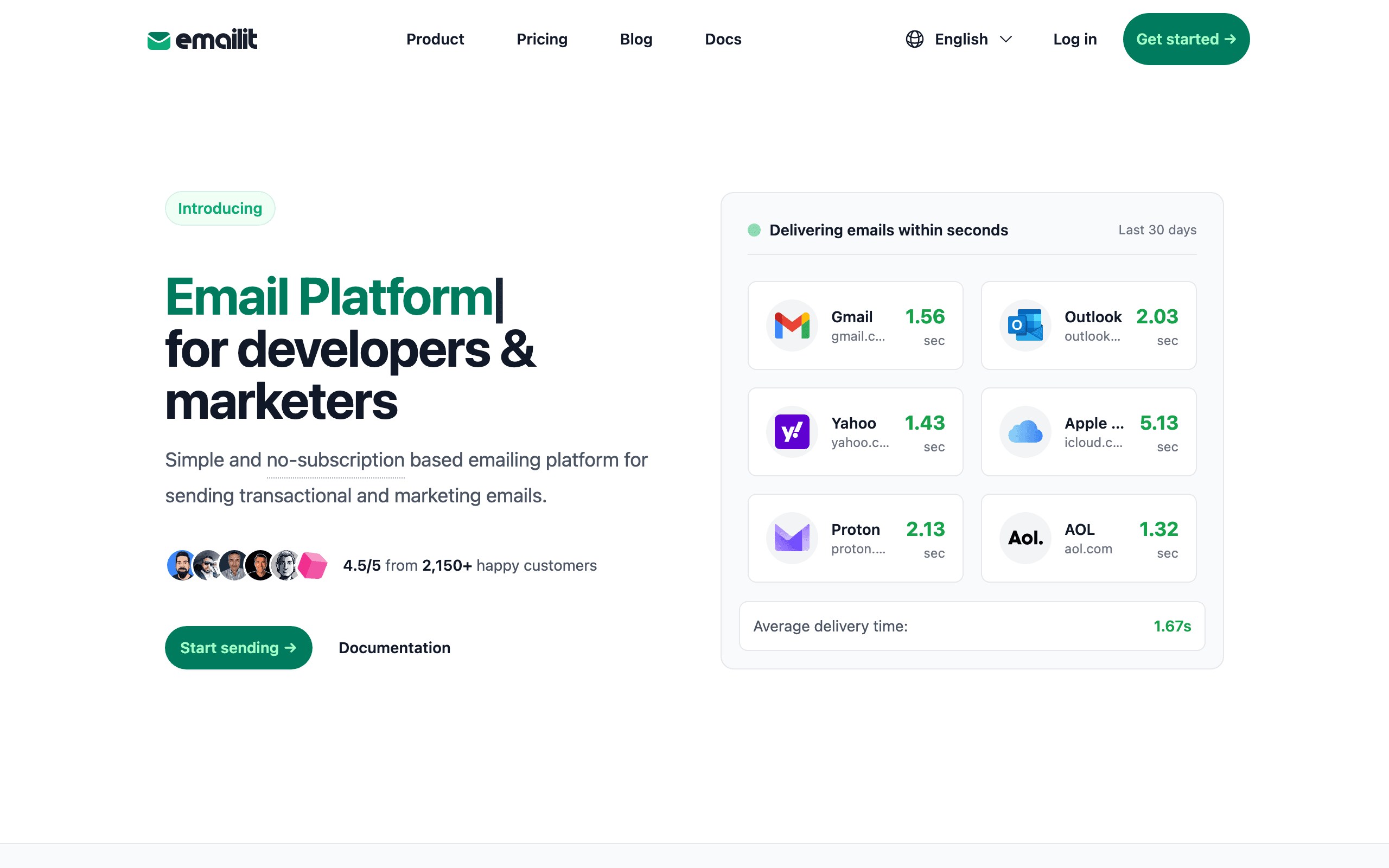
EmailIt's speed advantage comes mostly from setup, since it skips the domain verification step that Mailgun requires. Neither company publishes a delivery-speed benchmark, so that is the clearest difference.
Where Mailgun Wins
Powerful API
Mailgun offers powerful api, which matters for teams that prioritize this.
Email validation
Mailgun offers email validation, which matters for teams that prioritize this.
EU region
Mailgun offers eu region, which matters for teams that prioritize this.
Inbound email
Mailgun offers inbound email, which matters for teams that prioritize this.
Delivery Speed and Reliability
EmailIt charges purely per email sent, around $1 to $2 per 10,000, with no monthly floor, which keeps costs predictable for low-volume transactional sending like password resets and receipts. Mailgun bundles delivery into a $35-a-month plan covering 50,000 emails, plus validation and routing tools that add setup overhead but reduce bounces before you send. Neither company publishes a delivery-speed benchmark the way some transactional specialists do, so your infrastructure choice here is really about pricing shape, not raw speed.
API Design and Developer Experience
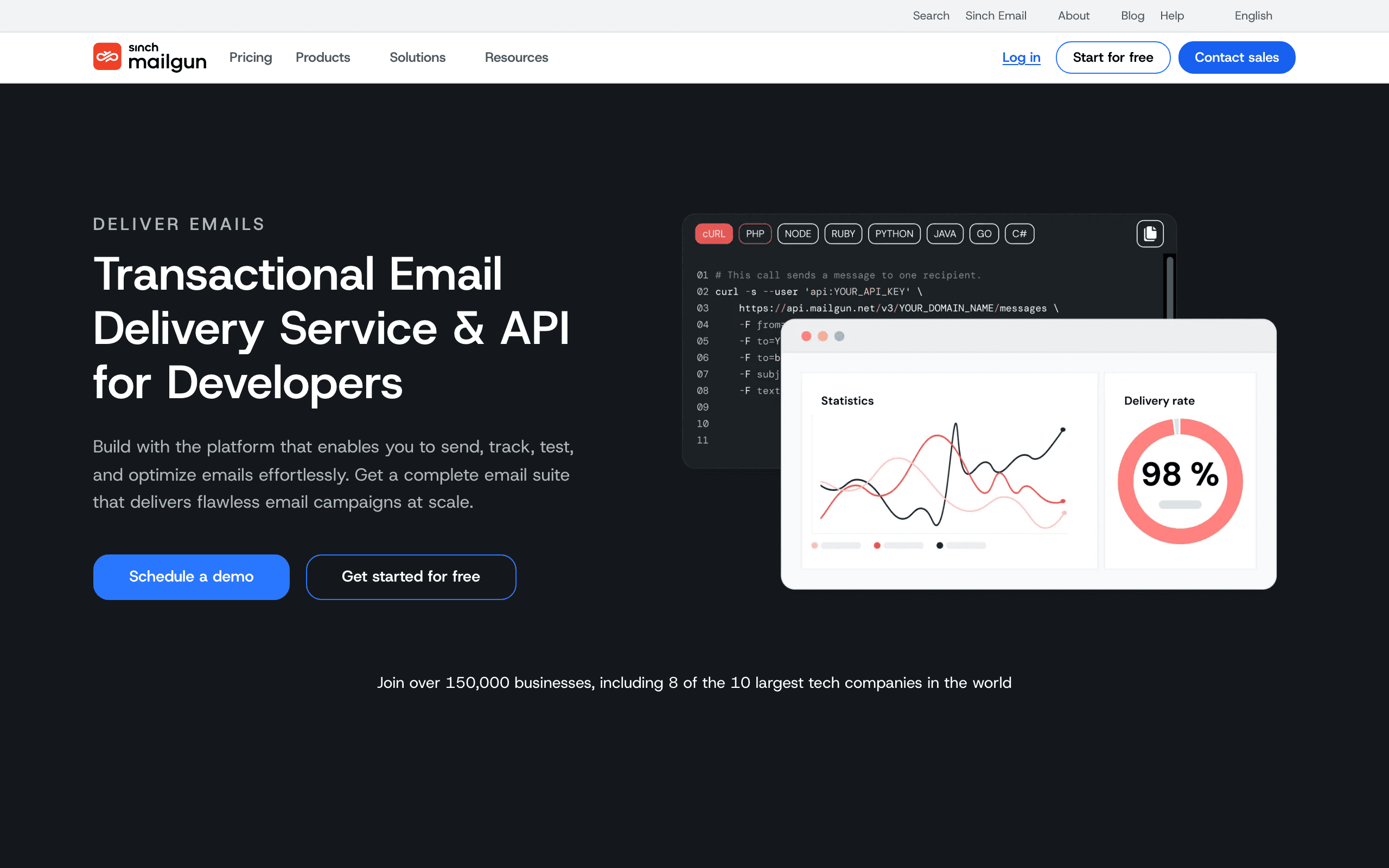
Mailgun documents its REST API and SMTP relay extensively, with SDKs in many languages, inbound routing rules, and an EU hosting option for GDPR-sensitive teams. EmailIt keeps its API and documentation deliberately simple, skipping validation, inbound routing, and EU hosting in favor of a smaller surface area that is quicker to integrate. Teams that want more building blocks lean toward Mailgun; teams that want to plug in fast and pay only for what they send lean toward EmailIt.
Scaling and Cost at Volume
Mailgun's $35-a-month minimum applies whether you send 500 emails or 50,000, and that price rose after Sinch's acquisition of the company. EmailIt has no subscription at all, so a low-volume sender pays only for the roughly $1 to $2 per 10,000 emails actually sent. At high volume the calculation flips, since Mailgun's per-email cost drops with scale while EmailIt's pay-per-email model keeps climbing linearly.
The Sinch Acquisition Impact
Mailgun was acquired by Sinch in 2021, and the impact on pricing has been significant. The previously generous free tier (10,000 emails/month for three months) was reduced, and paid plan prices increased. Long-time Mailgun users frequently cite the acquisition as the moment they started evaluating alternatives.
EmailIt benefits from this market shift by offering a simpler, cheaper alternative for teams that do not need Mailgun's full feature set. If you used Mailgun primarily for basic SMTP relay and REST API sending, EmailIt provides the same core functionality at lower cost without the corporate acquisition concerns.
However, Sinch also brought resources that improved Mailgun in some areas. Infrastructure investment, expanded global presence, and multi-channel capabilities through the broader Sinch platform. For teams that value organizational stability and investment, Sinch's backing provides more confidence than EmailIt's smaller independent operation. The question is whether you are paying for features and stability you actually use.
The Email Validation Divide
Mailgun includes email validation as a core feature, allowing you to verify email addresses before sending. This protects your sender reputation by preventing bounces from invalid addresses. Email validation is particularly important for applications that accept user-submitted email addresses -- registration forms, contact forms, and user invitations.
EmailIt has no email validation capability. If an address bounces, you discover it after the fact through delivery failure notifications. For applications where email addresses come from trusted sources (internal systems, authenticated users), this is rarely a problem. For applications accepting public input, the lack of validation creates deliverability risk.
The validation gap matters most at scale. A few bounces from bad addresses are manageable. Hundreds or thousands of bounces can damage your sender reputation and affect delivery to legitimate addresses. If your application processes user-submitted emails at volume, Mailgun's validation provides meaningful protection that EmailIt simply cannot offer.
The SaaS Integration Question
Both EmailIt and Mailgun are general-purpose email APIs without SaaS-specific features. Mailgun's inbound routing is useful for processing replies, but neither platform understands subscription billing, trial periods, or customer lifecycle stages. Building SaaS email automation on either requires custom webhook processing and workflow logic in your application code.
Sequenzy eliminates this custom work with native Stripe integration that triggers emails from billing events automatically. Combined with AI-powered sequences for onboarding and retention, and unified transactional plus marketing email at $49/month, it provides the SaaS-specific automation that neither EmailIt's simplicity nor Mailgun's developer tools can match.
Use-case matchups
| Use case | Better fit | Why |
|---|---|---|
| Lowest-cost simple transactional email | EmailIt | EmailIt is better when the team only needs basic API/SMTP sending and wants to avoid a monthly platform minimum. |
| Mature developer email API | Mailgun | Mailgun is stronger when validation, inbound routing, EU region support, logs, SDKs, and dedicated IPs matter. |
| MVP or side-project notifications | EmailIt | EmailIt is easier when volume is low and advanced troubleshooting tools would sit unused. |
| User-submitted email addresses at scale | Mailgun | Mailgun's email validation helps protect sender reputation before bad addresses cause bounces. |
| SaaS lifecycle automation | Sequenzy | Sequenzy is better when Stripe events, transactional email, and lifecycle campaigns need one SaaS-focused workspace. |
| Reply processing and inbound workflows | Mailgun | Mailgun is the better fit when inbound routing is part of the product experience. |
Best Fit by Developer Email Depth
Best cheap email API for basic transactional sending
EmailIt is the better fit when the product needs simple notification, password-reset, receipt, or alert emails without validation, inbound routing, dedicated IPs, or advanced logs. It suits teams that can keep templates and monitoring in their own application and want a lightweight pay-per-email sender. The value is minimal platform overhead, not a full developer email toolkit.
Best developer email API for validation and inbound routes
Mailgun is stronger when email is part of the product workflow, not just outbound delivery. Choose it for inbound route processing, reply handling, email validation, EU-region needs, dedicated IPs, SDKs, and more mature troubleshooting tools. It is the better fit when user-submitted addresses, webhook logic, and deliverability operations carry meaningful product or revenue risk.
Best SaaS email platform for Stripe-triggered lifecycle
Sequenzy is the better fit when the team is building subscription lifecycle email rather than raw sending infrastructure. SaaS products need trial onboarding, billing reminders, receipts, failed-payment recovery, upgrade prompts, and lifecycle campaigns connected to customer state. That business logic is not native to either EmailIt or Mailgun, so Sequenzy removes custom workflow code.
Migration checklist
| Workstream | What to verify |
|---|---|
| Sending setup | Move domains, sender identities, SMTP/API credentials, webhooks, suppression lists, and template references. |
| Inbound and validation | If moving to Mailgun, rebuild routes, reply processing, validation calls, and region-specific settings. |
| Monitoring | Recreate logs, event webhooks, bounce handling, complaint processing, and reputation alerts. |
| SaaS lifecycle | If moving to Sequenzy, map Stripe events, subscribers, transactional templates, and marketing campaigns into one flow. |
| Production cutover | Test password resets, receipts, inbound replies if used, bounces, unsubscribes, and DNS before raising traffic. |
Decision checklist
Does the application need email validation before sending to user-submitted addresses?
Are inbound routes, EU region support, logs, SDKs, or dedicated IPs required?
Is Mailgun's $35/month floor justified by operational tooling, or is EmailIt enough?
How much does the Sinch-era pricing/support change affect the buying decision?
Would SaaS billing events and lifecycle campaigns make Sequenzy a better fit than either API?
Decide whether the destination should optimize for raw cost, mature developer tooling, or SaaS lifecycle automation.
Export verified domains, sender identities, SMTP/API keys, templates, routes, inbound parsing rules, validation data, suppressions, webhooks, and delivery logs.
If moving to Mailgun, configure domains, routes, validation, EU/US region needs, webhooks, logs, and dedicated IP requirements before switching traffic.
If moving to EmailIt, identify which Mailgun validation, inbound routes, logs, SDKs, EU region, and dedicated IP workflows need replacement elsewhere.
Recreate the verification, password reset, invite, receipt, invoice, billing, alert, and notification templates first, since users notice quickly when these fail.
Reconnect API/SMTP calls, webhooks, bounce handling, complaint handling, inbound routes, alerts, analytics, and suppression syncing.
Authenticate SPF, DKIM, and DMARC, then test one API send, one SMTP send, one webhook event, and one inbound route if used before full migration.
Preserve historical validation, delivery, inbound, bounce, complaint, cost, and support reports so the team can compare low-cost simplicity against mature API tooling.









