Mailgun's pricing page
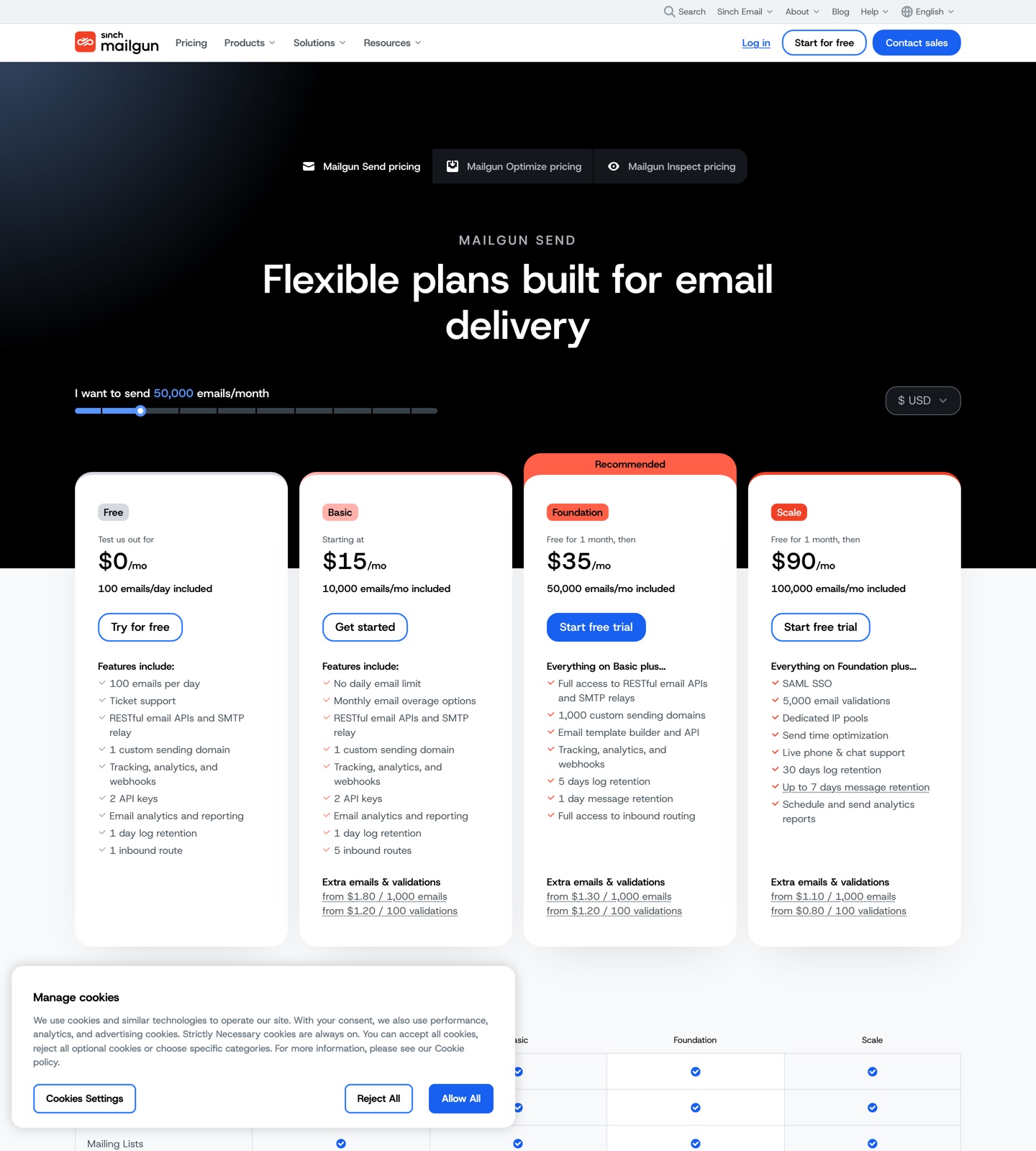
Captured from mailgun.com. Pricing changes often, so confirm the current numbers on the live page.
Buying shortcut
Which Mailgun plan should you choose?
Start here
Free
Testing Mailgun and low-volume projects. It is the first tier to check when you only need the core Mailgun workflow. Watch for: Daily cap
Public price
$0/mo
100 emails/day included.
Main upgrade
Basic
Small teams that need production sending without daily limits. Inspect this tier when the lower tier starts blocking reporting, automation, collaboration, or support needs. Watch for: 1 custom sending domain
Public price
$15/mo
10,000 emails/month; extra emails from $1.80 per 1,000.
High-volume or advanced
Scale
Larger senders needing deliverability and support. Treat this as the serious-operations tier, especially if the first two plans leave key limits or add-ons unresolved. Watch for: More infrastructure than lifecycle marketing product
Public price
$90/mo after first month
100,000 emails/month; extra emails from $1.10 per 1,000.
Cost scenarios
Pricing pages show the entry point. These scenarios show what the plan means in real buying situations.
Developer app needing API and SMTP
Mailgun: Basic or Foundation depending on volume. Sequenzy: Better if lifecycle workflows are the main need. Mailgun is strong infrastructure. Sequenzy adds SaaS workflow and content generation.
High-volume sender with deliverability controls
Mailgun: Scale or Enterprise services. Sequenzy: Depends on lifecycle needs and email volume. Mailgun is better when dedicated IPs, validations, and infrastructure controls matter most.
Founder building onboarding and churn sequences
Mailgun: Delivery only, plus your own workflow tooling. Sequenzy: Built-in SaaS lifecycle sequence workflow. Sequenzy is simpler for lifecycle marketing.
What to watch for
Log retention is short on Free and Basic.
Email validations may be an add-on or included only on higher tiers.
Mailgun is delivery infrastructure, not a lifecycle campaign generator.
Mailgun pricing is delivery-first
Mailgun is priced around sending volume, retention, deliverability controls, support, and add-ons like validations. That makes sense for engineering teams that want control over email infrastructure.
The product is not primarily about deciding what lifecycle messages should exist or writing those campaigns. That is the gap Sequenzy targets.
The plan ladder maps to operational maturity. Free and Basic are useful when you are proving integration or sending modest production mail. Foundation becomes more realistic when you need many domains, templates, and a normal monthly allowance. Scale is where deliverability support, validations, IP controls, and higher-volume operations start to shape the buying decision. Those details matter more than the starting price if email is critical infrastructure for your app.
Mailgun is often compared with lifecycle platforms because both send email, but they solve different problems. Mailgun gives developers the pipes, logs, APIs, and controls. It does not decide the onboarding path, retention cadence, churn-risk messaging, or billing communication strategy. If you are weighing those two jobs, the Mailgun alternatives guide and Mailgun comparison make the tradeoff clearer.
Mailgun vs Sequenzy
Mailgun is better for infrastructure control. Sequenzy is better for SaaS teams that want a practical lifecycle email system without assembling API, automation, content, and billing logic separately.
Choose Mailgun when engineering owns the email stack and wants granular delivery controls. Choose Sequenzy when the business problem is getting more useful SaaS lifecycle emails live without building the campaign layer from scratch.
Mailgun vs Sequenzy
How Mailgun compares with Sequenzy, which bills on emails sent rather than contact count.
How Sequenzy prices the same volume
Sequenzy price per 1k emails
$0.82 / 1k at $49/mo for 60k emails
Verdict
Mailgun is a serious email infrastructure product with clear volume tiers and deliverability controls. Sequenzy is better when the job is SaaS lifecycle email strategy, content, and automation rather than raw delivery infrastructure.
FAQ
Sources checked · Jun 16, 2026