

Overview
EmailIt and Resend serve different needs in the email space. EmailIt is a budget pay-per-email delivery service. Resend is a modern developer-first transactional email API.
The choice depends on what you need: cheapest per-email pricing (EmailIt) or best developer experience (Resend). For SaaS businesses specifically, Sequenzy offers purpose-built features that neither tool provides.
Pricing reality
- EmailIt: ~$1-2/10k emails - Pay-per-email, no subscription. SMTP and API.
- Resend: Free (3k/mo), then $20/mo - Developer-first. React Email support. Modern API.
- Sequenzy: $99/month for 120,000 emails, unlimited subscribers, fully managed. See pricing.
Review signals
The EmailIt reviews on this page support simple, stack-agnostic sending. One reviewer says EmailIt's SMTP relay lets them keep an existing setup without code changes and that Resend's developer-experience advantage does not matter for non-React projects.
The negative EmailIt review points to developer productivity: Resend's API and docs were strong enough to justify paying more.
Resend's reviews reinforce the React Email and TypeScript workflow advantage. Reviewers value templates as version-controlled React components, while also noting that Audiences is still not mature enough to replace a full marketing platform.
Where EmailIt Wins
Cheapest per-email pricing
EmailIt offers cheapest per-email pricing, which is a genuine advantage for teams that need it.
No monthly subscription
EmailIt offers no monthly subscription, which is a genuine advantage for teams that need it.
Simple SMTP/API
EmailIt offers simple smtp/api, which is a genuine advantage for teams that need it.
Fast delivery
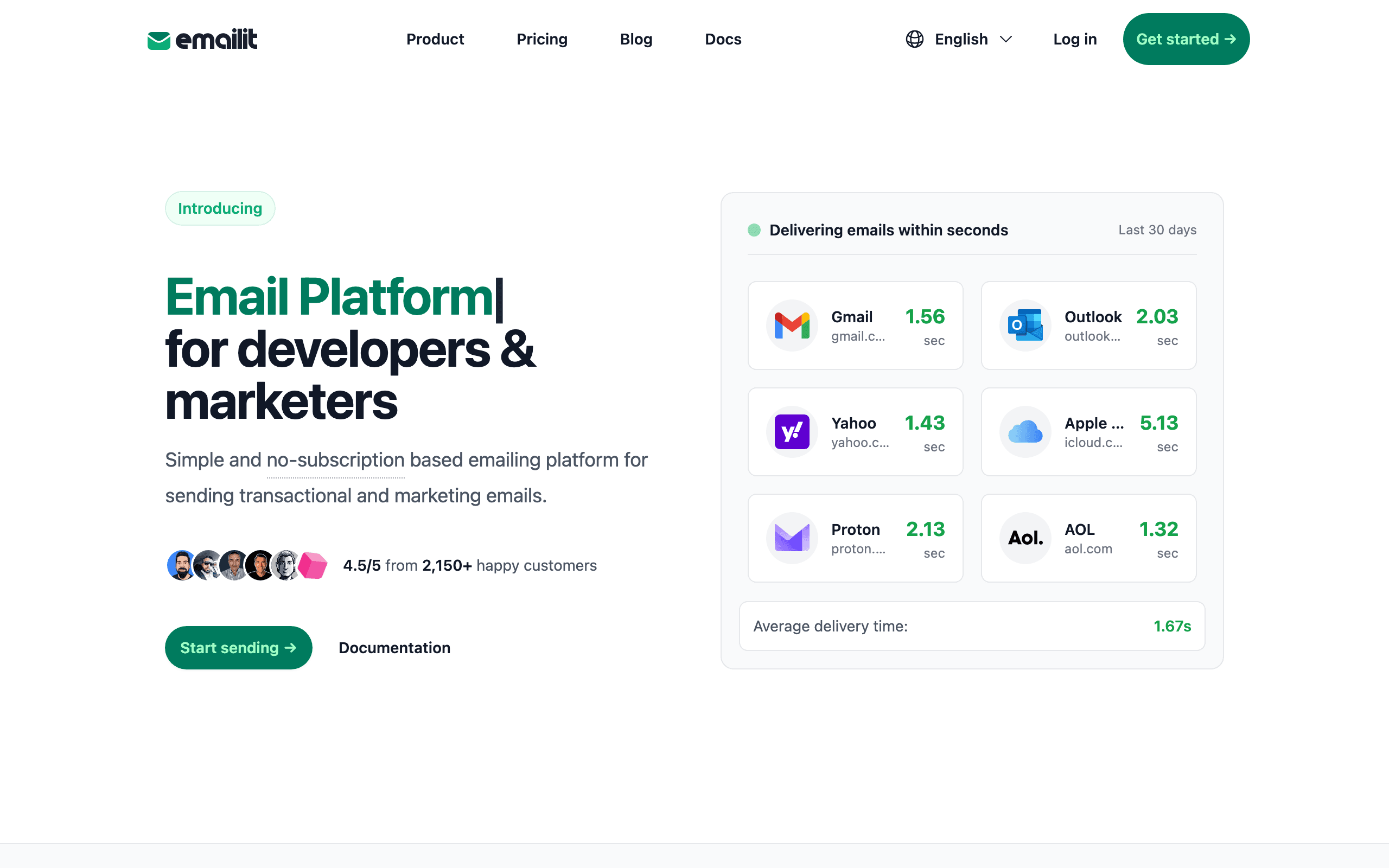
EmailIt offers fast delivery, which is a genuine advantage for teams that need it.
Where Resend Wins
Best developer experience
Resend offers best developer experience, which matters for teams that prioritize this.
React Email integration
Resend offers react email integration, which matters for teams that prioritize this.
Clean API
Resend offers clean api, which matters for teams that prioritize this.
Generous free tier
Resend offers generous free tier, which matters for teams that prioritize this.
Delivery Speed and Reliability
EmailIt's pay-per-email model with no monthly subscription makes it cheaper for very low-volume transactional sending, delivered through a straightforward SMTP relay or REST API. Resend is built around a modern TypeScript-first SDK and native React Email support, so component-based templates render consistently, and its free tier covers 3,000 emails a month before the $20/month plan kicks in.
API Design and Developer Experience
Resend's API design and documentation are built specifically for developers working with React Email, offering component-based templates and fast, responsive support. EmailIt's API and SMTP setup work fine for non-React applications and skip the subscription entirely, but its documentation is sparser and there's no free tier to test before you commit to paying per email sent.
Scaling and Cost at Volume
At low volume, EmailIt's roughly $1-2 per 10,000 emails with no subscription can beat Resend's free tier once you're sending more than 3,000 emails a month. Past that point, Resend's $20/month plan may cost more per email at certain volumes than EmailIt's pay-as-you-go pricing, so which one is cheaper depends heavily on exactly how many emails you send each month.
The React Email Revolution
Resend's integration with React Email fundamentally changed how developers think about email templates. Instead of wrestling with inline styles and table layouts, React developers write email templates as typed components that live in version control alongside application code. This is a genuine paradigm shift that EmailIt cannot match.
For teams already using React or Next.js, the developer experience difference is substantial. Templates become testable, composable, and type-safe. Changes go through code review like any other code. EmailIt's SMTP relay approach means you handle templating entirely on your own, which offers flexibility but none of the tooling benefits.
That said, React Email only matters if your team uses React. For Python, Go, or Ruby backends, Resend's DX advantage shrinks considerably. The REST API is clean regardless, but the template magic disappears. EmailIt's language-agnostic SMTP relay works identically across every stack.
The Free Tier Calculus
Resend's free tier of 3,000 emails per month is genuinely generous for early-stage projects. You can build, test, and launch without spending anything. EmailIt has no free tier but charges fractions of a cent per email, meaning very low-volume senders might spend less than a dollar monthly.
The economic crossover point matters. Below 3,000 monthly emails, Resend is free while EmailIt costs pennies. Between 3,000 and roughly 50,000 emails, both platforms cost relatively little. Above 50,000 emails monthly, EmailIt's pay-per-email model without a subscription base can become more economical depending on exact volumes.
Neither platform's pricing model accounts for subscriber management, marketing automation, or lifecycle email -- they charge purely for delivery. For SaaS companies that need to connect email to subscription billing and user behavior, a purpose-built platform eliminates the need to cobble together multiple services.
Beyond Transactional Email
Both EmailIt and Resend started as transactional email services, but Resend is expanding into marketing territory with its Audiences feature. This beta product lets Resend users manage contacts and send broadcast emails, potentially eliminating the need for a separate marketing tool.
EmailIt shows no signs of expanding beyond delivery. This simplicity is either a strength or limitation depending on your perspective. If you only need to send password resets and order confirmations, EmailIt's focused approach means less complexity. If you eventually need campaigns and subscriber management, you will need a second platform.
The gap between transactional and marketing email is where many SaaS companies struggle. Running separate tools for each creates data silos -- your marketing platform does not know about transactional engagement, and your transactional service does not know about subscriber segments. Unified platforms that handle both under one roof simplify this considerably.
Use-case matchups
| Use case | Better fit | Why |
|---|---|---|
| Lowest-cost simple transactional email | EmailIt | EmailIt is better when the team needs basic SMTP/API sending and wants to avoid a recurring subscription. |
| React or Next.js transactional templates | Resend | Resend is stronger when React Email, TypeScript SDKs, and code-reviewed email components matter. |
| Existing SMTP-based application | EmailIt | EmailIt is easy to drop into legacy stacks that already send through SMTP. |
| Developer-first new product email | Resend | Resend's API, docs, free tier, and React Email workflow reduce implementation friction for modern teams. |
| SaaS lifecycle automation | Sequenzy | Sequenzy is better when Stripe events, transactional email, and marketing sequences need one workspace. |
| Early-stage testing below 3k emails/month | Resend | Resend's free tier is attractive when a new app needs to test sending before paying. |
Best Fit by Sending Budget and Developer Workflow
Best low-cost transactional email service for simple SMTP apps
EmailIt is the better fit when the product already sends through SMTP or a basic API and the team mostly wants the lowest possible delivery bill. It makes sense for straightforward password resets, receipts, and alerts where template tooling is not the deciding factor.
Best transactional email API for React and Next.js products
Resend fits teams that want email templates in code, reviewed like application changes, and maintained by engineers. Its value is not only delivery price; it is the React Email workflow, TypeScript-friendly API surface, documentation, and free tier for early production testing.
Best SaaS email tool for billing-aware lifecycle messages
Sequenzy becomes relevant when transactional delivery is only one part of the job. If the team also needs campaigns, subscriber segments, Stripe-triggered sequences, and lifecycle reporting, Sequenzy removes the need to bolt a marketing platform onto a low-cost sending API.
Migration checklist
- Decide whether the destination should optimize for raw cost, developer experience, or SaaS lifecycle automation.
- Export verified domains, sender identities, SMTP/API keys, templates, React Email components, webhooks, audiences, suppressions, and delivery reports.
- If moving to Resend, convert key templates into React Email components or map existing templates into Resend's preferred sending workflow.
- If moving to EmailIt, identify which Resend SDKs, React Email setup, free-tier testing, audience data, and developer tooling need replacement.
- Rebuild critical transactional templates first: verification, password reset, invite, receipt, invoice, billing, alert, and notification emails.
- Reconnect API/SMTP calls, webhooks, bounce handling, complaint handling, alerts, analytics, and suppression syncing.
- Authenticate SPF, DKIM, and DMARC, then test one code-rendered template and one plain SMTP/API send before moving all production traffic.
- Preserve historical delivery, template, webhook, audience, cost, and support reports so the team can compare raw sending cost against developer productivity.
Decision checklist
- Is the product built around React or Next.js enough for React Email to matter?
- Would EmailIt's SMTP relay avoid code changes in an existing application?
- Is Resend's free 3,000-email tier enough for the current stage?
- Will Audiences cover future marketing needs, or will another tool still be required?
- Would SaaS lifecycle automation and unified campaign plus transactional email justify Sequenzy instead?









