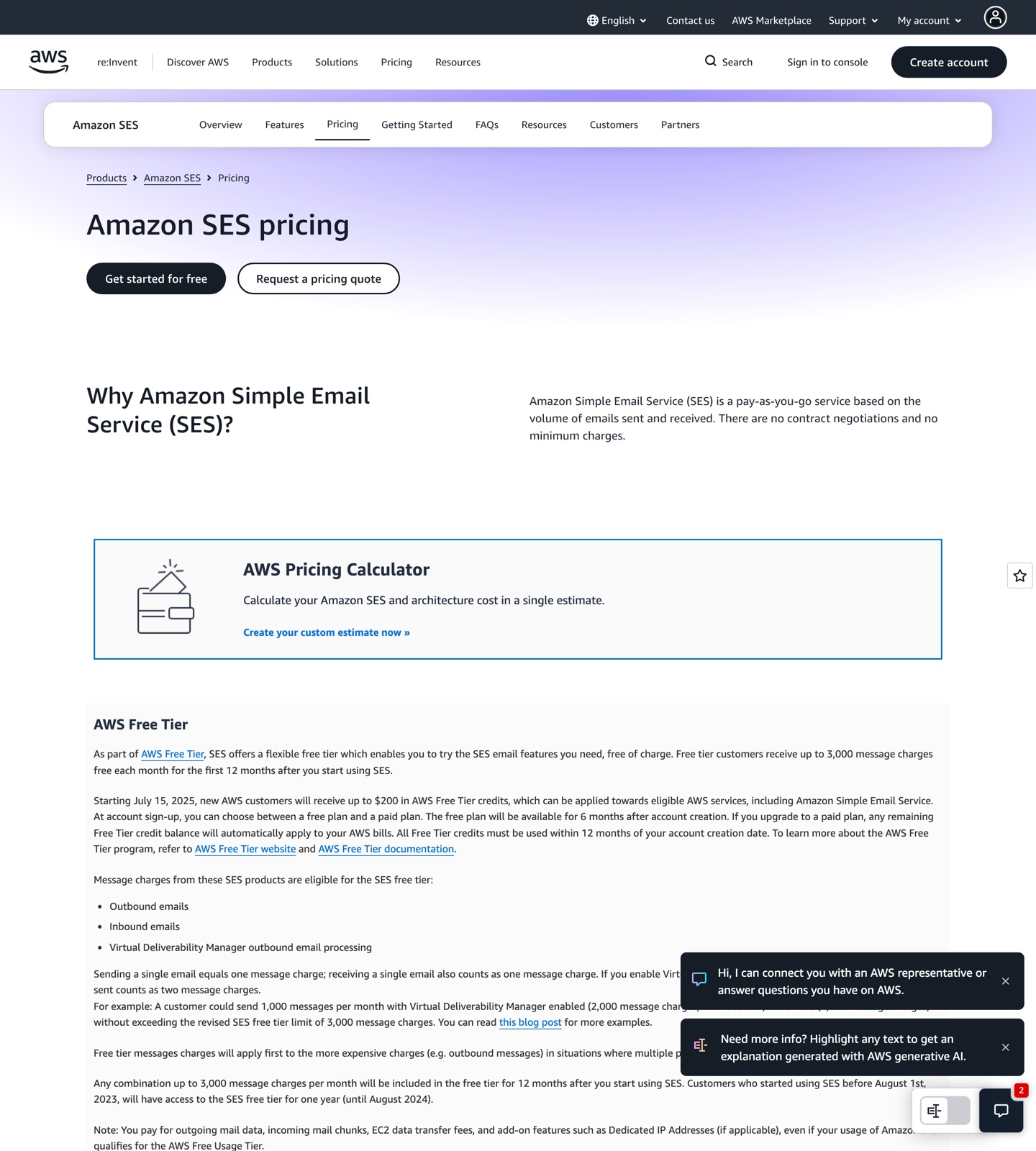
Amazon SES's pricing page
Captured from aws.amazon.com. Pricing changes often, so confirm the current numbers on the live page.
Buying shortcut
Which Amazon SES plan should you choose?
Start here
Outbound Email
Developers sending transactional or application email. It is the first tier to check when you only need the core Amazon SES workflow. Watch for: Requires technical setup and monitoring
Public price
$0.10 / 1,000 emails
Pay-as-you-go for email sent ($0.0001 per email), metered by AWS.
Main upgrade
Inbound Email
Apps that need to receive and route email. Inspect this tier when the lower tier starts blocking reporting, automation, collaboration, or support needs. Watch for: Engineering-owned workflow
Public price
$0.10 / 1,000 received
Pay per inbound message; first 1,000 emails received each month are free.
High-volume or advanced
Dedicated IPs and Add-ons
High-volume senders needing reputation control. Treat this as the serious-operations tier, especially if the first two plans leave key limits or add-ons unresolved. Watch for: Adds operational complexity and recurring cost
Public price
From $24.95/mo per IP
Standard dedicated IP is $24.95/mo each; managed dedicated IP is $15/mo + $0.08 per 1,000 emails.
Cost scenarios
Pricing pages show the entry point. These scenarios show what the plan means in real buying situations.
Developer sending 50,000 transactional emails/mo
Amazon SES: About $5/mo in SES sending fees ($0.10 per 1,000), plus AWS data costs. Sequenzy: Higher-level lifecycle platform rather than raw infrastructure. SES wins on raw infrastructure cost for pure transactional sending.
SaaS team needing onboarding and retention flows
Amazon SES: SES sending is cheap, but you build the entire workflow layer. Sequenzy: Built-in SaaS lifecycle emails, sequences, and analytics. Sequenzy reduces product and marketing implementation burden.
High-volume sender (5M emails/mo) with a dedicated IP
Amazon SES: About $500/mo sending plus $24.95/mo per dedicated IP and data fees. Sequenzy: Compare only if lifecycle workflow is part of the need. SES is cheapest when engineering can own the stack.
What to watch for
SES is not a marketer-friendly campaign platform out of the box.
Deliverability, templates, analytics, preferences, and lifecycle logic require more setup.
Dedicated IP ($24.95/mo) and data-transfer ($0.12/GB) costs add to the headline $0.10 per 1,000 rate.
Amazon SES pricing is cheap because it is infrastructure
SES can look dramatically cheaper than email marketing platforms because you are mostly buying sending infrastructure. That is useful for technical teams, but it also means more implementation responsibility.
If you need templates, lifecycle campaigns, analytics, unsubscribe logic, preference management, and sequence strategy, SES is only one part of the system.
A realistic SES budget includes the surrounding application work: event tracking, template rendering, unsubscribe pages, preference center, suppression handling, bounce/complaint monitoring, deliverability tooling, and reporting. SES can still be the cheapest sending layer, but the team pays in engineering ownership.
Use Amazon SES alternatives to compare delivery infrastructure. Use Sequenzy vs Amazon SES when deciding whether raw AWS sending is enough or whether the team needs a managed lifecycle email product.
Amazon SES vs Sequenzy
Amazon SES is a sending service. Sequenzy is a SaaS lifecycle email platform.
Amazon SES vs Sequenzy
How Amazon SES compares with Sequenzy, which bills on emails sent rather than contact count.
How Sequenzy prices the same volume
Sequenzy price per 1k emails
$0.82 / 1k at $49/mo for 60k emails
Verdict
Amazon SES is excellent low-cost email infrastructure for technical teams. Sequenzy is better when you want a SaaS lifecycle email product rather than a raw AWS sending service.
FAQ
Sources checked · Jun 17, 2026