Updated 2026-01-28
tinyEmail
Mailchimp

tinyEmail vs Mailchimp

E-commerce specialist vs all-purpose platform

19
Features Compared
4
Key Differences
4
User Reviews
8
FAQs Answered
TL;DR

tinyEmail ($65/mo for 15k emails) specializes in e-commerce with AI tools and a free Shopify plan. Mailchimp ($100/mo at 10k contacts) is an all-purpose platform with 300+ integrations. Choose tinyEmail for e-commerce value; choose Mailchimp for versatility and ecosystem.

Platform Overview

See how each platform looks

Mailchimp

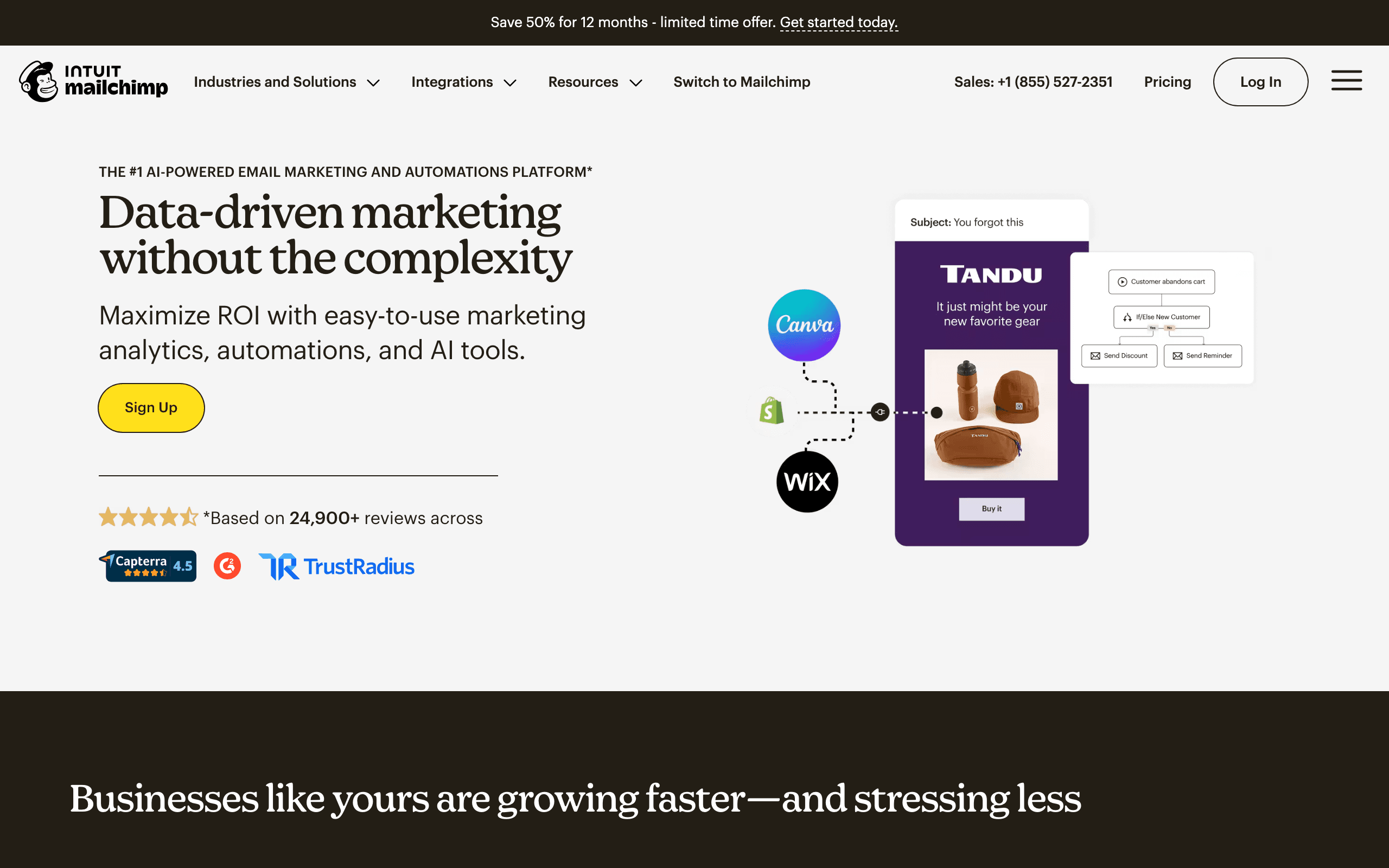
Mailchimp dashboard screenshot

Popular all-in-one marketing platform with email, automation, and CRM features.

Key Differences

The main things that set these tools apart

E-commerce Focus
tinyEmail wins

tinyEmail is built for e-commerce with Shopify-specific features and AI tools. Mailchimp is general-purpose, serving everything from newsletters to agencies. For e-commerce, tinyEmail's focus is an advantage.

Integration Ecosystem
Mailchimp wins

Mailchimp has 300+ native integrations covering almost every tool. tinyEmail has fewer integrations but focuses on e-commerce platforms. If you need broad integration support, Mailchimp wins.

Beyond Email
Mailchimp wins

Mailchimp offers landing pages, websites, social posting, and ads. tinyEmail focuses primarily on email marketing. For all-in-one marketing, Mailchimp is more complete.

Free Tier Value
tinyEmail wins

tinyEmail offers more generous free plans, especially the completely free plan for Shopify stores. Mailchimp's free plan is more limited at 1,000 emails/month.

Pricing Comparison

At 10,000 contacts

tinyEmail
$65/month

Pro plan for ~15k emails. Volume-based pricing, e-commerce focus.

Visit tinyEmail
Mailchimp
$100/month

Standard plan. Contact-based pricing with email limits.

Visit Mailchimp
Best for SaaS
Sequenzy
$49/month

For 120k emails/month with unlimited subscribers. SaaS-focused.

Start Free Trial

Feature Comparison

19 features compared side-by-side

Feature
tinyEmail
Mailchimp
Sequenzy
Core Features
Email builder
Drag-and-drop
Drag-and-drop
Visual builder
Templates
600+ e-commerce focused
100+ general purpose
AI-generated
AI content tools
tinyAlbert AI
Basic AI
Full AI sequences
Landing pages
Limited
Full builder
Websites
Website builder
E-commerce Features
Shopify integration
Deep, FREE plan
Good integration
WooCommerce
Abandoned cart
Product recommendations
Basic
Basic
E-commerce reports
Detailed
Good
Stripe-based
Integrations & Ecosystem
Native integrations
50+ (e-commerce focused)
300+ (broad ecosystem)
Stripe + essentials
CRM integrations
HubSpot, Salesforce, etc.
Extensive CRM support
Limited
Social media
Limited
Social posting, ads
Zapier
API quality
Good
Comprehensive
Modern
Pricing & Value
Free plan
500 subscribers, 15k emails
500 contacts, 1k emails
14-day trial
Shopify free plan
Completely FREE
Not available
Not applicable
Pricing model
Email volume
Contact count + limits
Subscriber count
Dedicated IP
Included in Pro
Premium plans only
Add-on

Pros & Cons

Honest strengths and weaknesses of each platform

tinyEmail

Pros
  • AI subject line and content generation
  • 600+ templates
  • Cheaper than Mailchimp
  • Shopify integration
  • AI writing help
  • Simple interface
Cons
  • Fewer integrations
  • Basic automation
  • No landing pages
  • No social posting
  • Limited analytics
  • Primarily Shopify-focused
  • Less brand recognition

Mailchimp

Pros
  • Massive integration ecosystem
  • Landing pages and social posting
  • Advanced analytics
  • A/B testing
  • Audience management
  • Strong brand recognition
  • Customer journey builder
Cons
  • Expensive at $100/month for 10k contacts
  • No AI content generation
  • Indirect Shopify integration
  • Transactional requires Mandrill
  • Complex interface
  • Free plan very limited
  • No Shopify-specific AI

What Users Say

Real reviews from tinyEmail and Mailchimp users

tinyEmail Reviews

G2

Switched from Mailchimp to tinyEmail and saving $35/month with better AI features. The subject line generator alone improved our open rates.

Whitney C.2025-10-15
Capterra

Good budget alternative to Mailchimp with nice AI features. Missing the landing pages and integrations though.

Heidi S.2025-08-20

Mailchimp Reviews

G2

Mailchimp integrates with everything. The analytics depth is excellent. Gets expensive but the ecosystem is unmatched.

John M.2025-11-10
Trustpilot

Mailchimp keeps raising prices. The value is not what it used to be. Considering switching to cheaper alternatives.

Larry H.2025-09-25

Best For

When to choose each tool

Choose tinyEmail if you...
  • Shopify stores wanting free or cheap email
  • E-commerce businesses focused on email
  • Stores wanting AI content assistance
  • Budget-conscious merchants
  • Businesses not needing landing pages or social
Choose Mailchimp if you...
  • Businesses needing broad integrations
  • Teams wanting landing pages and websites
  • Companies with diverse marketing needs
  • Agencies managing multiple client types
  • Brands wanting social media tools

Consider Sequenzy as an Alternative

Different Market

Sequenzy is built for SaaS companies stores. If you sell products through Shopify, tinyEmail or Mailchimp are better choices.

Stripe vs Shopify

Where tinyEmail focuses on e-commerce and Mailchimp serves everyone, Sequenzy integrates with Stripe for subscription businesses.

SaaS-Specific Automation

Sequenzy offers automation based on trials, subscriptions, and MRR - concepts that matter to SaaS but not to e-commerce or general marketing.

Overview

tinyEmail and Mailchimp serve different markets. tinyEmail specializes in e-commerce with AI tools and Shopify integration. Mailchimp is the all-purpose email marketing giant with broad capabilities and massive integration ecosystem.

The core question is whether you need e-commerce specialization or broad versatility. See our platform comparison guide for more options.

Focus vs Versatility

tinyEmail is built specifically for e-commerce. Their templates, AI, and features are optimized for online stores. Mailchimp serves everyone from bloggers to enterprises, which means more features but less e-commerce focus.

For Shopify stores, tinyEmail's specialized approach and free plan make it compelling. For businesses with diverse needs, Mailchimp's versatility is valuable.

Integration Ecosystem

Mailchimp's 300+ integrations cover almost every business tool. CRMs, social media, e-commerce platforms, accounting software - Mailchimp connects to most things.

tinyEmail has fewer integrations but focuses on e-commerce platforms and CRMs. If you need connections to obscure tools, Mailchimp is safer.

Beyond Email

Mailchimp offers landing pages, websites, social posting, and ads. It tries to be an all-in-one marketing platform. tinyEmail focuses primarily on email marketing.

If you want everything in one place, Mailchimp is more complete. If you just need excellent e-commerce email, tinyEmail's focus is an advantage.

Pricing Comparison

tinyEmail at $65/month for 15,000 emails is cheaper than Mailchimp at $100/month for 10,000 contacts. tinyEmail also offers free plans for Shopify stores, while Mailchimp's free tier is limited to 1,000 emails/month.

For e-commerce businesses, tinyEmail typically offers better value. Compare with Sequenzy pricing for SaaS alternatives.

When Each Platform Wins

Choose tinyEmail when: You run an e-commerce store, want AI content assistance, prefer budget-friendly pricing, or need a free Shopify starting point. Explore our email marketing alternatives.

Choose Mailchimp when: You need broad integrations, want landing pages and social tools, have diverse marketing needs, or work with clients across industries.

For SaaS Companies

If you run a software business rather than e-commerce or general marketing, neither platform is ideal. SaaS companies should consider Sequenzy, which offers Stripe integration and subscription-focused automation.

Integration Ecosystem Gap

Mailchimp integrates with nearly every business tool available. tinyEmail has limited integrations focused on Shopify. For businesses with complex multi-tool workflows, Mailchimp's integration breadth is a genuine operational advantage that tinyEmail cannot match.

AI Content: tinyEmail's Edge

tinyEmail's AI subject line and content generation is an advantage Mailchimp does not have. For small teams that struggle with email copywriting, AI assistance saves time and often improves engagement metrics. This feature alone can justify tinyEmail's price for content-challenged marketers.

Analytics and Optimization

Mailchimp provides deeper analytics including audience insights, engagement patterns, and comparative reporting. tinyEmail's analytics cover basics. For data-driven marketers who optimize based on performance data, Mailchimp's reporting depth enables better decision-making.

Use-case matchups

Situation Best first look Why
Shopify store wants AI-assisted email creation and templates tinyEmail tinyEmail is the baseline here when faster campaign creation and Shopify-friendly templates matter.
Team wants a familiar all-purpose platform Mailchimp Mailchimp is stronger when brand familiarity and general campaigns matter more than AI-specific tooling.
Store or SaaS team wants lifecycle and transactional email Sequenzy Sequenzy is stronger when transactional messages and lifecycle automation matter more than AI campaign generation.
Small ecommerce team wants help producing campaigns quickly tinyEmail tinyEmail should be tested first when content speed is the bottleneck.
Team needs the specialist capability Mailchimp Mailchimp deserves the first demo when the main requirement is broad all-purpose email marketing.
Team wants event-driven email workflows instead of content tooling Sequenzy Sequenzy is more relevant when app, Stripe, store, and transactional events drive the email program.

Best Fit by General Email Scope

Best Shopify email tool for AI-assisted ecommerce campaigns

tinyEmail fits stores that want fast campaign creation and Shopify-friendly templates without paying for a broad all-purpose platform. It is strongest when the team needs help producing more campaigns from product and store context.

Best general email marketing platform for small-business campaigns

Mailchimp is the better fit when the team wants familiar templates, integrations, landing pages, segmentation, and broad campaign tooling. It works better when the store also needs general small-business marketing features beyond ecommerce campaign generation.

Best lifecycle email platform for event-driven customer messages

Sequenzy fits teams that need transactional and lifecycle email tied to app, Stripe, or store events rather than general campaign creation. It is a better fit when automation timing and customer state matter more than quickly drafting promotional emails.

Pricing reality

The pricing signals on this page list tinyEmail at $65/month, Mailchimp at $100/month, and Sequenzy at $49/month. Compare them by workflow, not only by monthly cost.

tinyEmail's value depends on whether AI-assisted content, templates, and Shopify-friendly campaign creation save meaningful time. Mailchimp's real cost depends on whether the team needs broad all-purpose email marketing.

Sequenzy is not an AI campaign-content tool. It should be evaluated when lifecycle automation, transactional email, and subscriber events matter more than template generation.

Review signals

This page has existing review data from G2, Capterra, Trustpilot. Keep those sources in the decision because AI email tools and established platforms differ in editor quality, support, deliverability, ecommerce sync, pricing, and automation depth.

For tinyEmail, validate review themes around AI content quality, Shopify app reliability, template workflow, support, and reporting. For Mailchimp, focus review research on whether users praise the reason you would choose it: broad all-purpose email marketing.

Use reviews to shape demo tasks: generate a campaign, sync Shopify products, import a segment, build an automation, test unsubscribe behavior, and compare reporting.

Migration checklist

Workstream Moving toward tinyEmail Moving toward Mailchimp Simplifying to Sequenzy
Store and subscriber data Sync Shopify customers, products, segments, consent, tags, and suppressions. Map audiences, tags, groups, journeys, templates, forms, ecommerce sync, and suppressions. Import subscribers, attributes, tags, suppressions, and lifecycle events.
AI and templates Validate AI generation, brand voice, product blocks, template quality, and fallback editing. Confirm whether Mailchimp needs separate content or design tooling. Move lifecycle and transactional templates; keep AI content elsewhere if needed.
Automations Rebuild welcome, campaign, product, cart, and simple ecommerce automations. Rebuild the workflows that prove Mailchimp's advantage in broad all-purpose email marketing. Rebuild lifecycle and transactional email flows.
Forms and capture Move popups, forms, landing pages, coupons, and embedded signup paths. Move forms, brand assets, and workflow-specific content. Move subscriber capture only where it feeds lifecycle email.
Reporting Validate campaign reporting, ecommerce revenue, generated-content performance, and exports. Validate reporting for broad all-purpose email marketing before committing. Validate campaign, automation, transactional, and lifecycle reporting.

Decision checklist

  • Is AI-assisted campaign creation the main bottleneck, or is automation depth the real issue?
  • Does Mailchimp's strength in broad all-purpose email marketing matter more than tinyEmail's content and template workflow?
  • Which platform handles Shopify sync, consent, and suppressions most cleanly?
  • Are the listed prices still realistic at actual subscriber count, send volume, and add-ons?
  • Would lifecycle and transactional email create more value than faster campaign generation?
  • Mailchimp can become expensive if broader features are not used.

Frequently Asked Questions

8 questions answered about tinyEmail vs Mailchimp

Testimonials

Sequenzy Testimonials

Not sure which to pick?

If you're a SaaS founder who needs Stripe integration and unified email, try Sequenzy free. No credit card required.

Related Comparisons

Sequenzy pricing reference

Sequenzy - Complete Pricing Guide

Pricing Model

Sequenzy uses email-volume-based pricing. You only pay for emails you send. Unlimited contacts on all plans — storing subscribers is always free.

All Pricing Tiers

  • 2.5k emails/month: Free (Free annually)
  • 15k emails/month: $19/month ($205/year annually)
  • 30k emails/month: $29/month ($313/year annually)
  • 60k emails/month: $49/month ($529/year annually)
  • 120k emails/month: $99/month ($1069/year annually)
  • 300k emails/month: $199/month ($2149/year annually)
  • 600k emails/month: $399/month ($4309/year annually)
  • 900k emails/month: $599/month ($6469/year annually)
  • 1.2M emails/month: $799/month ($8629/year annually)
  • 2M emails/month: $1299/month ($14029/year annually)
  • 3M emails/month: $1999/month ($21589/year annually)
  • 4M emails/month: $2499/month ($26989/year annually)
  • 5M emails/month: $2999/month ($32389/year annually)
  • Unlimited emails/month: Custom pricing (Custom annually)

Yearly billing: All plans offer a 10% discount when billed annually.

Free Plan Features (2,500 emails/month)

  • Visual automation builder
  • Transactional email API
  • Reply tracking & team inbox
  • Landing pages
  • Unlimited team members
  • Goal tracking & revenue attribution
  • Unlimited lists and segments
  • Payment integrations
  • API, MCP, and CLI access
  • Unlimited sending domains
  • SPF, DKIM, and DMARC
  • Deliverability monitoring
  • Send time optimization
  • A/B testing

Paid Plan Features (15k - 5M emails/month)

  • Visual automation builder
  • Transactional email API
  • Reply tracking & team inbox
  • Landing pages (Create hosted signup pages and attach a custom domain.)
  • Unlimited team members
  • Goal tracking & revenue attribution
  • Unlimited lists and segments
  • Payment integrations (Stripe, Paddle, Lemon Squeezy)
  • API, MCP, and CLI access
  • Unlimited sending domains
  • SPF, DKIM, and DMARC
  • Deliverability monitoring
  • Send time optimization
  • A/B testing

Enterprise Plan Features (Unlimited emails)

  • Visual automation builder
  • Transactional email API
  • Reply tracking & team inbox
  • Landing pages
  • Unlimited team members
  • Goal tracking & revenue attribution
  • Unlimited lists and segments
  • Payment integrations
  • API, MCP, and CLI access
  • Unlimited sending domains
  • SPF, DKIM, and DMARC
  • Deliverability monitoring
  • Send time optimization
  • A/B testing

Important Pricing Notes

  • You only pay for emails you send — unlimited contacts on all plans
  • No hidden fees - all features included in the price
  • No credit card required for free tier

Contact

  • Pricing Page: https://sequenzy.com/pricing
  • Sales: hello@sequenzy.com



