
Overview
tinyEmail and MailerLite are both budget-friendly email marketing platforms but serve different audiences. tinyEmail specializes in e-commerce with AI tools. MailerLite is a clean, general-purpose platform popular with creators and small businesses.
The choice depends on your business type: e-commerce or general marketing. See our platform comparison guide for more options.
E-commerce vs General Purpose
tinyEmail is built for online stores. Deep Shopify and WooCommerce integration, abandoned cart, product recommendations - these are core features, not afterthoughts.
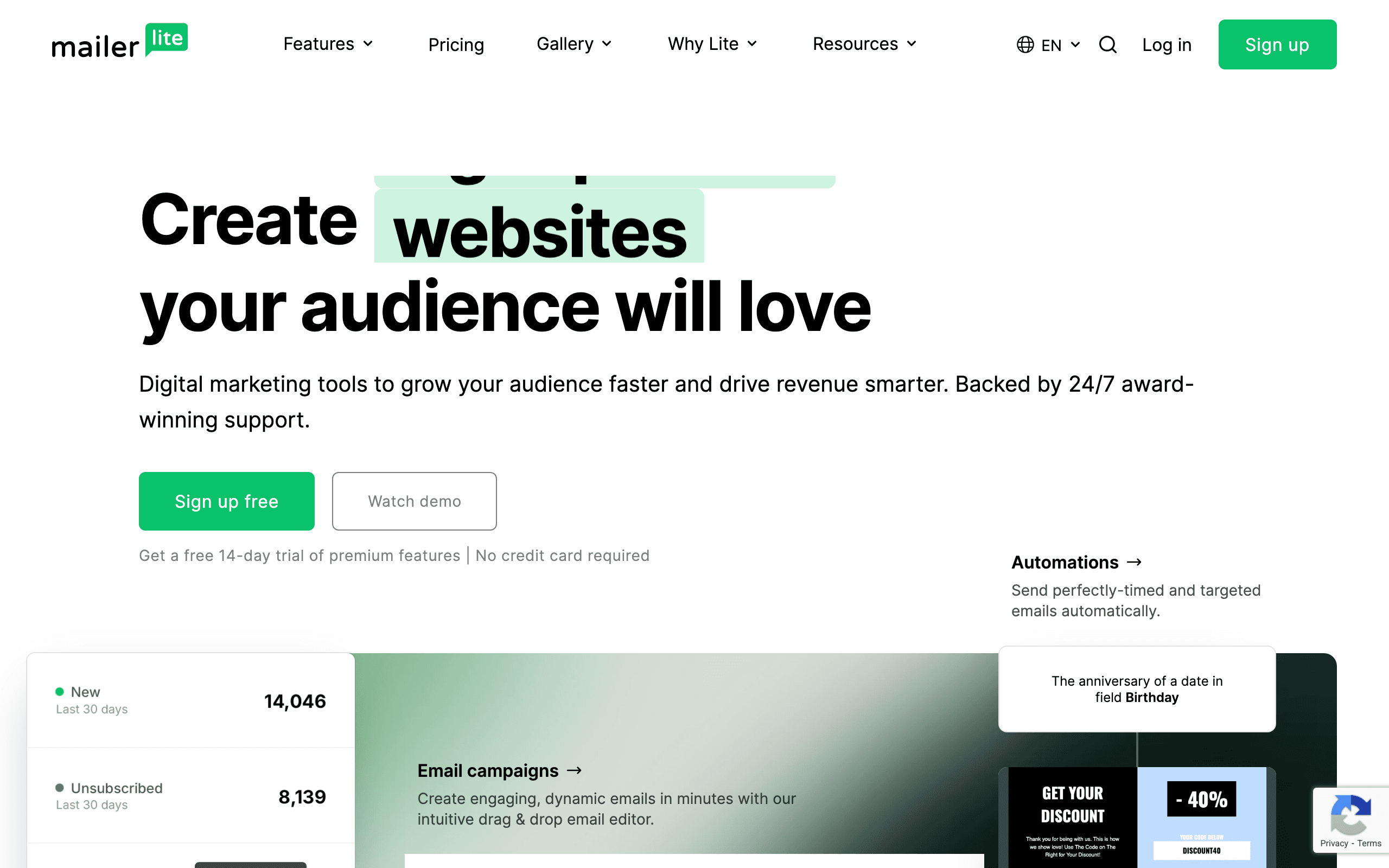
MailerLite serves everyone: bloggers, creators, small businesses, nonprofits. It is a versatile platform that does email marketing well without specializing in any vertical.
If you run an e-commerce store, tinyEmail's focus is an advantage. For other business types, MailerLite's versatility makes more sense.
Landing Pages and Websites
MailerLite includes a full landing page builder with 30+ templates and a website builder. These are genuinely useful features for growing businesses.
tinyEmail focuses on email marketing. Landing page capabilities are limited. If you need landing pages, MailerLite is the clear winner.
AI and Content Creation
tinyEmail's tinyAlbert AI is prominent for generating e-commerce content and subject lines. MailerLite has an AI writing assistant but does not emphasize it as much.
For AI-assisted content creation, especially for e-commerce, tinyEmail has invested more. Both can help with email campaigns.
Pricing Comparison
MailerLite at $39/month for 10,000 subscribers is cheaper than tinyEmail at $65/month for 15,000 emails. MailerLite also has a more generous free tier (1,000 subscribers vs 500).
However, tinyEmail offers a completely free plan for Shopify stores. For Shopify specifically, tinyEmail may be more cost-effective. Compare with Sequenzy pricing for SaaS alternatives.
User Experience
MailerLite is known for its clean, modern interface and excellent documentation. It is consistently praised as one of the easiest email platforms to use.
tinyEmail is functional and has good e-commerce workflows, but MailerLite has the better reputation for overall user experience.
When Each Platform Wins
Choose tinyEmail when: You run an e-commerce store, need deep Shopify/WooCommerce integration, want AI content for products, or need a free Shopify starting point. Explore our email marketing alternatives.
Choose MailerLite when: You are a blogger, creator, or small business wanting clean design, landing pages, and excellent user experience at a budget price.
For SaaS Companies
If you run a software business rather than e-commerce or content, neither platform is ideal. SaaS companies should consider Sequenzy, which offers Stripe integration and subscription-focused automation.
Value Comparison
MailerLite at $10/month for 500 subscribers with a beautiful editor and website builder is objectively better value than tinyEmail at $65/month for similar subscriber counts. tinyEmail's AI features need to justify a significant price premium over MailerLite's polished experience.
Email Design Quality
MailerLite's drag-and-drop editor produces more polished emails than tinyEmail despite having fewer templates. Quality of individual templates matters more than quantity. For brands where email design impacts engagement, MailerLite's editor provides a better creative experience.
Free Plan Generosity
MailerLite's free plan with 1,000 subscribers and 12,000 emails is more generous and includes the full email editor. tinyEmail's free tier is more limited. For businesses starting with email marketing on no budget, MailerLite provides a better foundation.
Use-case matchups
| Situation | Best first look | Why |
|---|---|---|
| Shopify store wants AI-assisted email creation and templates | tinyEmail | tinyEmail is the baseline here when faster campaign creation and Shopify-friendly templates matter. |
| Team wants simple affordable email | MailerLite | MailerLite is stronger when clean UX, forms, landing pages, and budget matter. |
| Store or SaaS team wants lifecycle and transactional email | Sequenzy | Sequenzy is stronger when transactional messages and lifecycle automation matter more than AI campaign generation. |
| Small ecommerce team wants help producing campaigns quickly | tinyEmail | tinyEmail should be tested first when content speed is the bottleneck. |
| Team needs the specialist capability | MailerLite | MailerLite deserves the first demo when the main requirement is clean affordable newsletters and automations. |
| Team wants event-driven email workflows instead of content tooling | Sequenzy | Sequenzy is more relevant when app, Stripe, store, and transactional events drive the email program. |
Best Fit by Budget Email Stack
Best Shopify email tool for AI content and templates
tinyEmail fits ecommerce teams that want quick product campaigns and Shopify-friendly templates more than landing pages or website tools.
Best affordable email platform for newsletters forms and landing pages
MailerLite is the better fit when clean UX, newsletters, forms, landing pages, and simple automations matter more than Shopify-specific AI.
Best lifecycle email platform for subscription and transactional automation
Sequenzy fits teams that need event-triggered lifecycle email and transactionals rather than a budget newsletter and landing-page stack.
Pricing reality
The pricing signals on this page list tinyEmail at $65/month, MailerLite at $39/month, and Sequenzy at $49/month. Compare them by workflow, not only by monthly cost.
tinyEmail's value depends on whether AI-assisted content, templates, and Shopify-friendly campaign creation save meaningful time. MailerLite's real cost depends on whether the team needs clean affordable newsletters and automations.
Review signals
For tinyEmail, validate review themes around AI content quality, Shopify app reliability, template workflow, support, and reporting. For MailerLite, focus review research on whether users praise the reason you would choose it: clean affordable newsletters and automations.
Migration checklist
| Workstream | Moving toward tinyEmail | Moving toward MailerLite | Simplifying to Sequenzy |
|---|---|---|---|
| Store and subscriber data | Sync Shopify customers, products, segments, consent, tags, and suppressions. | Map subscribers, groups, fields, automations, forms, landing pages, templates, and unsubscribes. | Import subscribers, attributes, tags, suppressions, and lifecycle events. |
| AI and templates | Validate AI generation, brand voice, product blocks, template quality, and fallback editing. | Confirm whether MailerLite needs separate content or design tooling. | Move lifecycle and transactional templates; keep AI content elsewhere if needed. |
| Automations | Rebuild welcome, campaign, product, cart, and simple ecommerce automations. | Rebuild the workflows that prove MailerLite's advantage in clean affordable newsletters and automations. | Rebuild lifecycle and transactional email flows. |
| Forms and capture | Move popups, forms, landing pages, coupons, and embedded signup paths. | Move forms, brand assets, and workflow-specific content. | Move subscriber capture only where it feeds lifecycle email. |
| Reporting | Validate campaign reporting, ecommerce revenue, generated-content performance, and exports. | Validate reporting for clean affordable newsletters and automations before committing. | Validate campaign, automation, transactional, and lifecycle reporting. |
Decision checklist
- Does tinyAlbert's content speed justify tinyEmail's fewer automation features, or is automation depth the bigger gap?
- Does MailerLite's strength in clean affordable newsletters and automations matter more than tinyEmail's content and template workflow?
- Does tinyEmail's deep Shopify integration beat MailerLite's basic one for syncing consent and suppressions?
- Do $65/mo for 15k emails on tinyEmail or $39/mo for 10k subscribers on MailerLite still hold at your real send volume?
- Would Sequenzy's Stripe-triggered billing emails and transactional messages matter more than either platform's campaign drafting?
- MailerLite should be tested for Shopify and automation depth.









