
Same buyers, different instincts
Constant Contact and Mailchimp are the two names most small businesses hear first. Both price by contacts, both cover newsletters and basic automation, and both have been around for decades. They lean toward different customers.
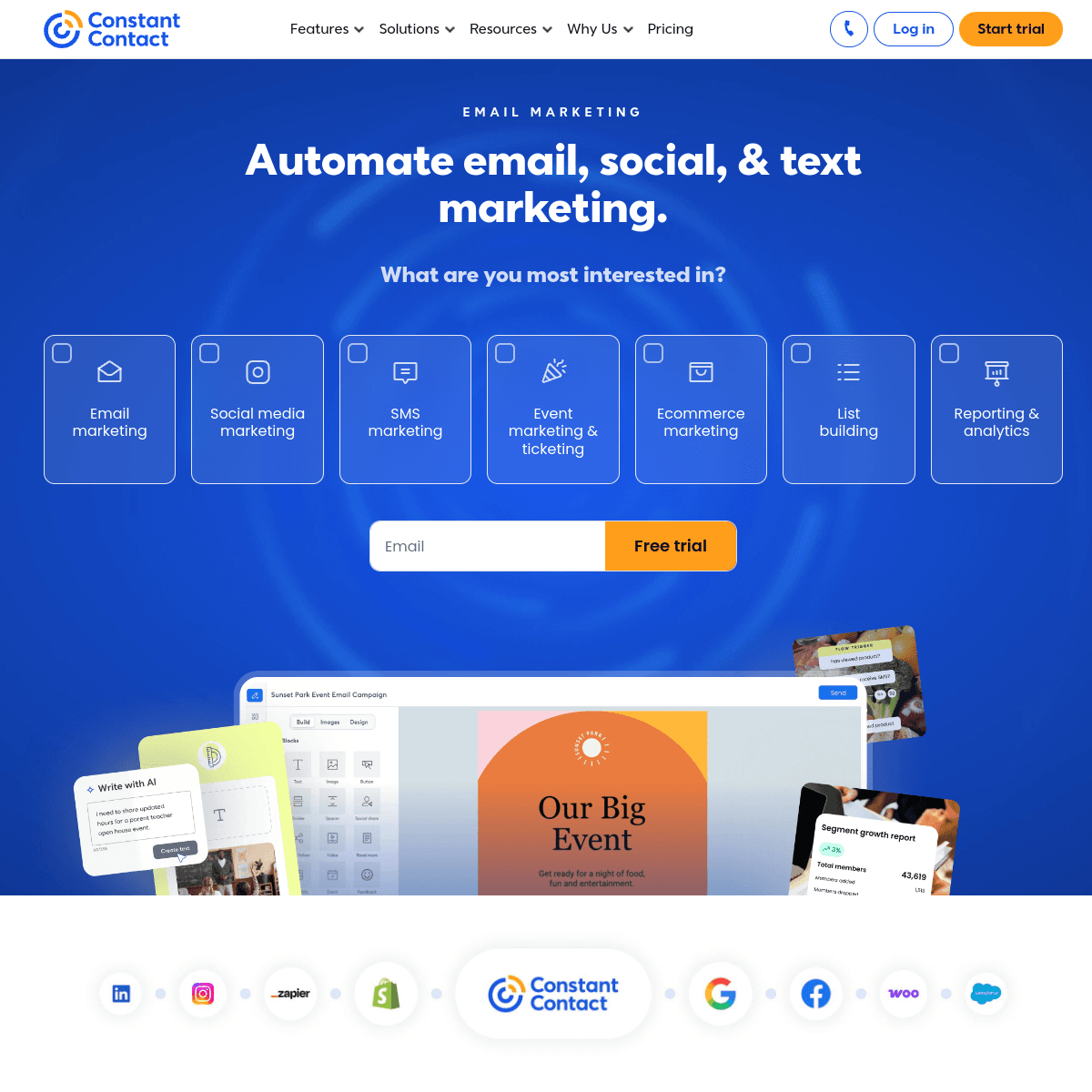
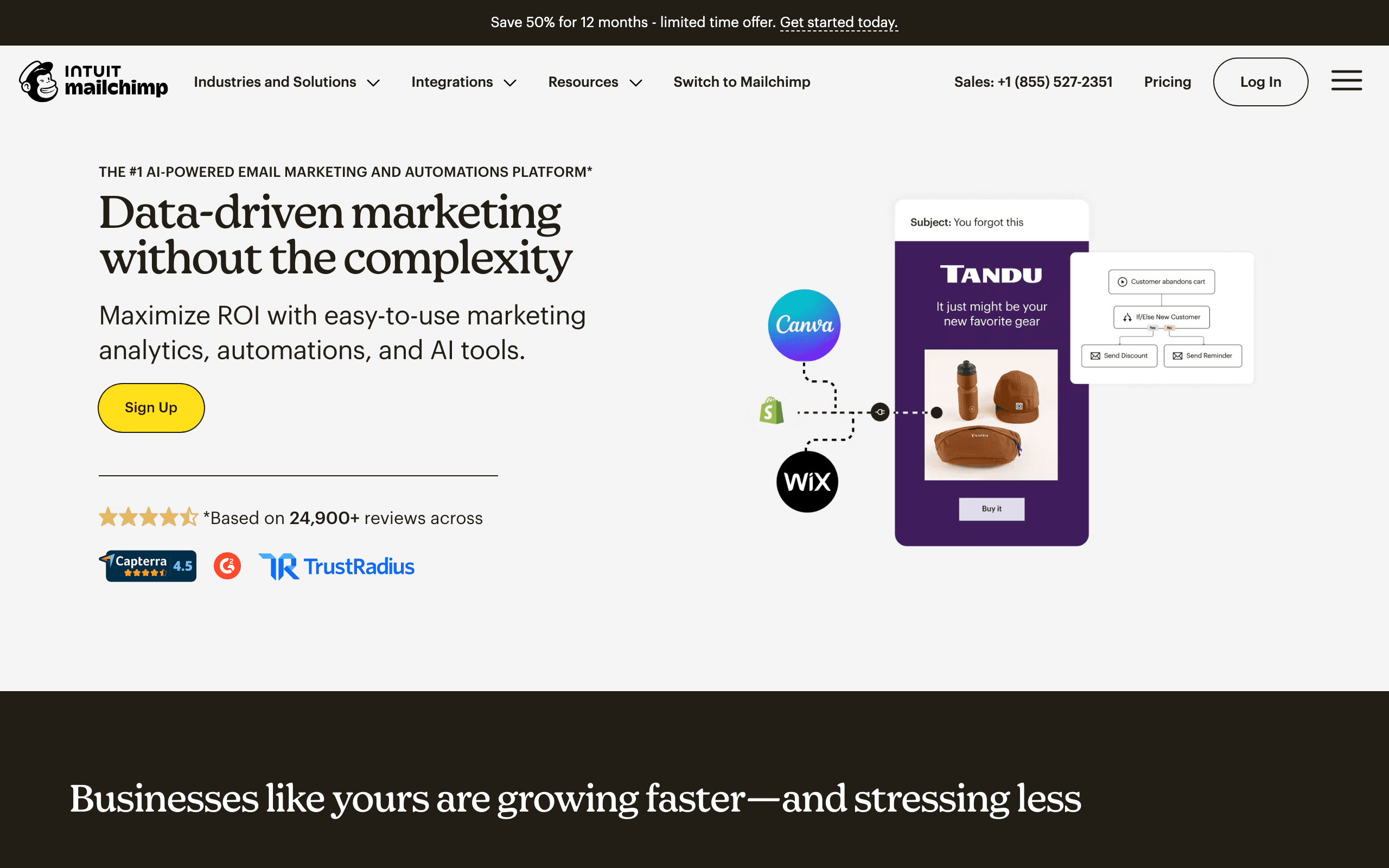
Constant Contact leans toward the owner of a local business, a nonprofit director or an association manager: someone who sends a monthly newsletter, promotes events, posts to social media and wants to pick up the phone when something is confusing. Mailchimp leans toward online businesses: stores that want purchase data in their emails, marketers who connect many apps, and anyone who wants to start without paying.
Plan gates you will hit
The biggest practical difference is where each tool puts its limits.
Constant Contact:
| Plan | Starting price | Automation | Segments | Users | Monthly sends |
|---|---|---|---|---|---|
| Lite | $12 | 1 automation template | 1 custom segment | 1 | 10x contacts |
| Standard | $35 | 3 automation templates, resend to non-openers | 10 custom segments | 3 | 12x contacts |
| Premium | $80 | Custom automations | Unlimited | Unlimited | 24x contacts |
Starting prices are for the smallest list. At 10,000 contacts, Standard is about $160 a month on monthly billing.
Mailchimp has a free plan for 250 contacts, then Essentials (about $110 at 10,000 contacts, 10x sends), Standard (about $135, 12x sends, 5 users, branching journeys) and Premium ($350, advanced segmentation, phone support).
In short: on Constant Contact you can outgrow automation on Standard; on Mailchimp, Standard covers most small-business automation, and Premium is about advanced segmentation, users and support.
Beyond the newsletter
Constant Contact bundles tools a community-facing organization uses: event pages with registration, reminders and ticketing; social posting; surveys; and SMS from $10 a month on Lite and Standard, with 500 messages included on Premium.
Mailchimp bundles tools an online business uses: a website builder, landing pages, store integrations with product blocks and purchase-based journeys, SMS credits in supported countries, and ad tools.
Pick the tool whose extras you will actually use. It also helps to count what you would otherwise pay for. A nonprofit that uses Constant Contact's event registration may avoid a separate ticketing subscription, while a store that relies on Mailchimp's store sync and product blocks avoids a separate ecommerce email tool. Those savings often matter more than the $25 difference between the two Standard plans at 10,000 contacts. Events and phone support are hard to replace cheaply; so are store-connected journeys.
Who pays for unsubscribed contacts
This is the billing difference most comparisons miss. Constant Contact bills on active contacts: people you can actually email. Unsubscribed contacts, people awaiting confirmation and contacts on temporary hold are inactive and not billed. You can keep your full history without paying for it.
Mailchimp's current plans count unsubscribed and unconfirmed contacts toward your billable total. To keep the bill down you archive contacts you no longer email, which removes them from your audience but keeps their data retrievable.
For an organization with years of history, this can decide the price. A list of 10,000 active and 4,000 unsubscribed contacts is billed as 10,000 on Constant Contact and 14,000 on Mailchimp unless you archive.
Pricing reality over a year
A nonprofit with 10,000 active contacts on the mid-tier plan of each tool, with no SMS:
| Constant Contact Standard | Mailchimp Standard | |
|---|---|---|
| Monthly billing | About $160 x 12 = $1,920 | About $135 x 12 = $1,620 |
| With the available discount | About 15% off with annual prepay, roughly $1,630 | 15% first-year discount, roughly $1,380 |
| If 4,000 unsubscribed contacts stay on file | Unchanged | Higher tier unless archived |
| Events and ticketing | Included | Separate tool |
| Phone support | Included | Premium only |
On sticker price Mailchimp is cheaper. Add an event ticketing tool and the time spent archiving contacts, and the gap can close. Check nonprofit discounts with both vendors before deciding.
Support
Constant Contact is known for phone and chat support available to small plans, which matters to owners who manage email themselves. Mailchimp offers email and chat support on paid plans and reserves phone support for Premium.
The difference shows up at awkward moments: a campaign stuck in review, an import flagged for compliance, or a form that stopped collecting signups the day before an event. Owners who manage email alongside everything else often value a phone call over a help article. Teams with a dedicated marketer who is comfortable with documentation and community forums will miss phone support less, and may prefer Mailchimp's larger library of guides and third-party tutorials.
Two example setups
A community theater with 6,000 contacts. It sends a monthly newsletter, promotes six productions a year, sells tickets for fundraising events, and posts every show to Facebook and Instagram. A volunteer manages it and sometimes needs help. Constant Contact fits: event registration and ticketing, social posting and phone support are all in the account, and the Standard plan's three automation templates cover a welcome series and event reminders.
An online tea shop with 6,000 contacts. It sends two promotions a week, wants abandoned cart and post-purchase emails, shows recommended products based on past orders, and connects a review app and a loyalty app. Mailchimp fits: store-connected journeys and product blocks on Standard, a large integration directory, and a send allowance that covers twice-weekly campaigns.
Swap the tools between these two and each owner would be paying for features they never use while missing the ones they need.
Switching between them
Constant Contact to Mailchimp:
- Export contacts with list memberships, custom fields and email permission status.
- Import into a single Mailchimp audience. Turn each Constant Contact list into a tag, since multiple Mailchimp audiences are billed separately.
- Import unsubscribed contacts as unsubscribed so they stay suppressed.
- Recreate your newsletter template in Mailchimp's editor, and rebuild automations as Customer Journeys.
- Move events to a separate registration tool.
Mailchimp to Constant Contact:
- Export the audience with tags and merge fields, plus unsubscribed and cleaned contacts.
- Recreate tags as Constant Contact lists or tags, and check how many custom segments your plan allows.
- Rebuild journeys using the automation templates your plan includes; complex branching may require Premium.
- Authenticate your sending domain before the first campaign.
Use-case matchups
| Situation | Better fit | Why |
|---|---|---|
| Association sending newsletters and event invites | Constant Contact | Events, surveys and phone support |
| Online store with cart and product emails | Mailchimp | Store journeys and product blocks |
| Organization with a long unsubscribe history | Constant Contact | Unsubscribed contacts are not billed |
| Startup testing email with a tiny list | Mailchimp | Free plan |
| Marketer who wants branching automation mid-tier | Mailchimp | Journeys on Standard |
| SaaS product with trial and billing email | Sequenzy | Billing-event triggers and pricing by emails sent |
Migration checklist
| Workstream | Constant Contact to Mailchimp | Mailchimp to Constant Contact |
|---|---|---|
| Contacts | Export with list memberships and permission status | Export with tags, merge fields and status |
| Structure | One audience, lists become tags | Tags become lists or tags; check segment limits |
| Suppressions | Import unsubscribed contacts, then archive them to avoid billing | Import unsubscribed contacts; they are not billed |
| Automations | Rebuild as Customer Journeys | Use included automation templates; custom flows need Premium |
| Events | Move to a separate ticketing tool | Rebuild events in Constant Contact |
| Sending | Authenticate your domain | Authenticate your domain |
Where Sequenzy fits
Sequenzy has no event registration, social posting or phone support, so it is not a fit for a nonprofit or local business that relies on those. It fits software companies that started on one of these tools and found that their key emails are not newsletters: onboarding after signup, trial reminders, failed payment notices, upgrade prompts and receipts. Sequenzy connects natively to Stripe, Paddle and Polar, triggers sequences from product events, sends transactional and marketing email from one account, and charges by emails sent with unlimited contacts ($49/month for 60k emails (unlimited subscribers)). See the Constant Contact alternatives and Mailchimp alternatives.
Making the call
- Events, surveys, social posting and phone support matter most: Constant Contact.
- A free start, ecommerce journeys and integrations matter most: Mailchimp.
- You keep a long unsubscribe history and do not want to archive: Constant Contact.
- You need branching automation without paying for a top tier: Mailchimp.
- You run a SaaS product and need lifecycle and billing email: Sequenzy.









