Overview
tinyEmail and ConvertKit serve completely different markets. This is not about which has better features. It is about which fits your business model.
- tinyEmail: E-commerce email marketing with AI tools and Shopify integration
- ConvertKit: Creator platform with paid newsletters, digital products, and monetization tools
Comparing them is like comparing a forklift to a passenger car. Both are vehicles, but they solve different problems.
The Business Model Question
Before comparing features, ask yourself:
- Do you sell physical products through an online store? tinyEmail
- Do you create content and want to monetize your audience? ConvertKit
- Do you run a SaaS business? Neither (see Sequenzy)
E-commerce: tinyEmail Wins
tinyEmail is built for e-commerce:
- Shopify integration with free plan for Shopify stores
- 600+ templates designed for product marketing
- tinyAlbert AI for e-commerce email creation
- Abandoned cart automation
- Product recommendations
- CRM integrations (Salesforce, HubSpot, Zoho)
- Dedicated IP for sending reputation
ConvertKit has none of these features. It is not designed for selling products.
Creator Economy: ConvertKit Wins
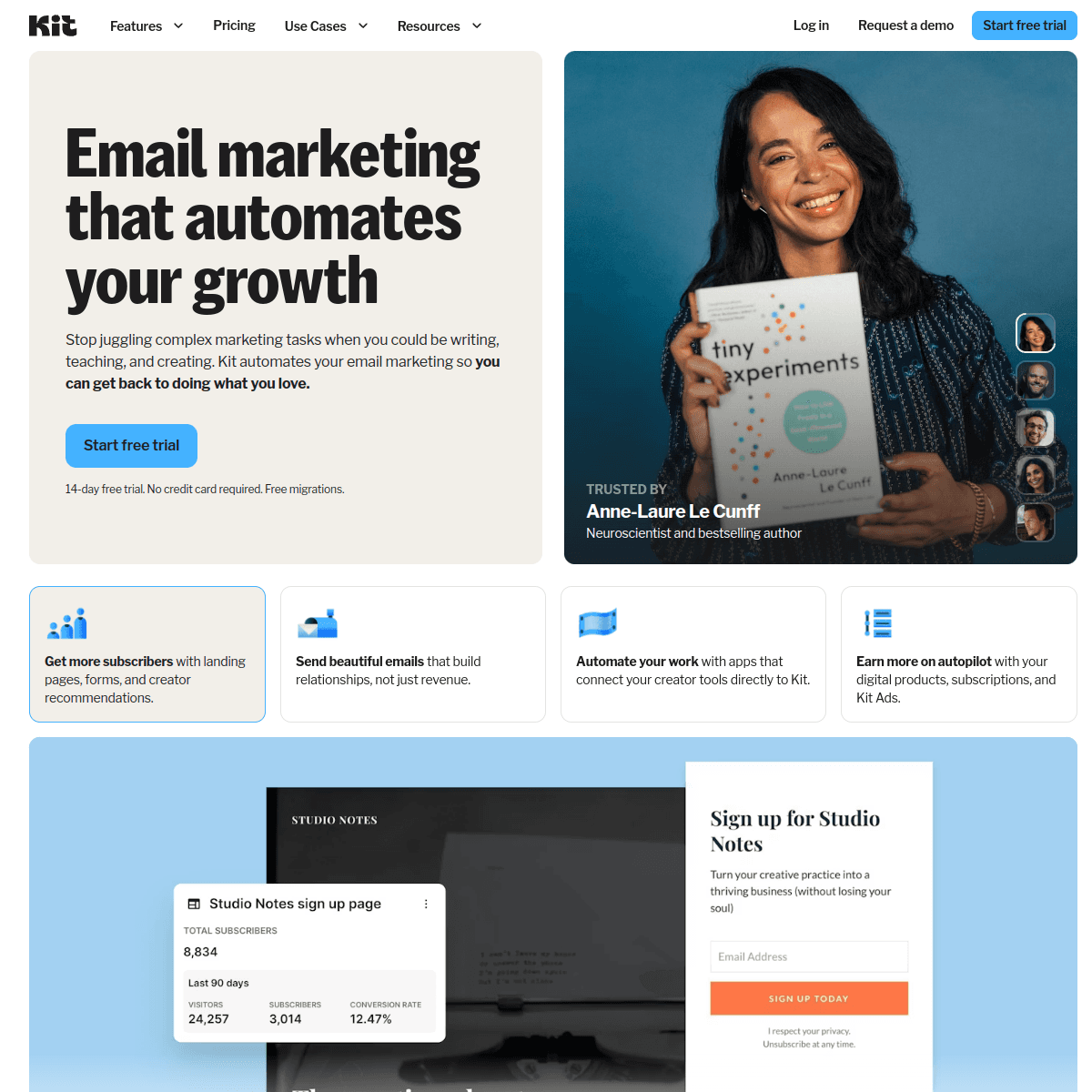
ConvertKit is built for creators:
- Paid newsletters: Charge subscribers for premium content
- Tip jar: Accept support from your audience
- Commerce hub: Sell digital products and courses
- Creator network: Cross-promote with other creators
- Sponsor network: Connect with advertisers through ConvertKit Ads
- Advanced tagging: Segment by interests and engagement
tinyEmail has none of these features. It is not designed for content monetization.
Price Comparison
tinyEmail Pro: $65/month for 15,000 emails with all features including AI and dedicated IP.
ConvertKit Creator Pro: $119/month for 10,000 subscribers with all monetization features.
tinyEmail is cheaper, but they include different things. tinyEmail gives you e-commerce tools. ConvertKit gives you creator monetization infrastructure.
Free Tier Difference
ConvertKit's free plan supports up to 10,000 subscribers but with limited features (no automation).
tinyEmail's free plan supports only 500 subscribers and 15,000 emails but includes more features.
For starting out, ConvertKit's free tier is more generous for list size.
Template Philosophy
tinyEmail has 600+ templates designed for product marketing. Professional, designed emails with product showcases and promotional layouts.
ConvertKit intentionally keeps emails minimal and text-focused. The philosophy is that personal, plain text emails feel more authentic from a creator and have better deliverability.
Neither is wrong. It depends on your brand and audience expectations.
Automation Differences
Both have automation, but for different purposes:
- tinyEmail: Abandoned cart, post-purchase sequences, product recommendations
- ConvertKit: Welcome sequences, course delivery, paid content access, creator workflows
The automations match their target markets.
For SaaS Companies
Neither platform is designed for SaaS. tinyEmail is for e-commerce. ConvertKit is for creators.
Sequenzy offers Stripe integration for subscription-aware automation. At $49/month, it is cheaper than both and includes features actually relevant to software businesses: MRR tracking, trial expiry emails, and churn prevention.
Making the Choice
Choose tinyEmail when: You run an e-commerce store, sell physical products, use Shopify, or want designed templates and AI for product emails.
Choose ConvertKit when: You are a creator, want to charge for newsletters, sell digital products, or want to monetize your audience through content.
Choose Sequenzy when: You run a SaaS business and need Stripe subscription integration.
Creator Economy Focus
ConvertKit was built from the ground up for creators: bloggers, podcasters, YouTubers, and course creators. Every feature supports the creator workflow from audience building to monetization. tinyEmail is a general e-commerce email tool with AI features that happens to work well with Shopify.
For professional creators, ConvertKit's focused approach results in a better experience. For Shopify store owners, tinyEmail's e-commerce integration and AI content tools are more relevant.
Deliverability Reputation
ConvertKit is known for exceptional deliverability. The platform enforces strict list hygiene and maintains a strong sender reputation. tinyEmail's deliverability is adequate but does not have the same reputation for inbox placement. For businesses where every email reaching the inbox directly impacts revenue, ConvertKit's deliverability advantage matters.
The Generous Free Plan
ConvertKit's free plan covers 10,000 subscribers, which is among the most generous in the industry. tinyEmail's free tier is more limited. For creators starting out, ConvertKit lets you build a substantial audience before paying anything.
Use-case matchups
| Situation | Best first look | Why |
|---|---|---|
| Shopify store wants AI-assisted email creation and templates | tinyEmail | tinyEmail is the baseline here when faster campaign creation and Shopify-friendly templates matter. |
| Creator wants audience-first email workflows | ConvertKit | ConvertKit is stronger when creator sequences, forms, products, and monetization matter. |
| Store or SaaS team wants lifecycle and transactional email | Sequenzy | Sequenzy is stronger when transactional messages and lifecycle automation matter more than AI campaign generation. |
| Small ecommerce team wants help producing campaigns quickly | tinyEmail | tinyEmail should be tested first when content speed is the bottleneck. |
| Team needs the specialist capability | ConvertKit | ConvertKit deserves the first demo when the main requirement is creator-focused newsletters, products, forms, and sequences. |
| Team wants event-driven email workflows instead of content tooling | Sequenzy | Sequenzy is more relevant when app, Stripe, store, and transactional events drive the email program. |
Best Fit by Audience and Store Model
Best Shopify email tool for AI-assisted ecommerce campaigns
tinyEmail fits stores that need product-friendly templates and faster campaign creation more than creator audience monetization.
Best creator email platform for paid newsletters and digital products
Kit is the better fit when the business is built around creators, subscribers, forms, sequences, digital products, and audience monetization.
Best lifecycle email platform for product-led customer journeys
Sequenzy fits teams that need email triggered by subscription, app, store, or transactional events rather than creator sequences or Shopify campaign drafting.
Pricing reality
The pricing signals on this page list tinyEmail at $65/month, ConvertKit at $119/month, and Sequenzy at $49/month. Compare them by workflow, not only by monthly cost.
tinyEmail's value depends on whether AI-assisted content, templates, and Shopify-friendly campaign creation save meaningful time. ConvertKit's real cost depends on whether the team needs creator-focused newsletters, products, forms, and sequences.
Review signals
For tinyEmail, validate review themes around AI content quality, Shopify app reliability, template workflow, support, and reporting. For ConvertKit, focus review research on whether users praise the reason you would choose it: creator-focused newsletters, products, forms, and sequences.
Migration checklist
| Workstream | Moving toward tinyEmail | Moving toward ConvertKit | Simplifying to Sequenzy |
|---|---|---|---|
| Store and subscriber data | Sync Shopify customers, products, segments, consent, tags, and suppressions. | Map subscribers, tags, segments, forms, landing pages, broadcasts, sequences, and products. | Import subscribers, attributes, tags, suppressions, and lifecycle events. |
| AI and templates | Validate AI generation, brand voice, product blocks, template quality, and fallback editing. | Confirm whether ConvertKit needs separate content or design tooling. | Move lifecycle and transactional templates; keep AI content elsewhere if needed. |
| Automations | Rebuild welcome, campaign, product, cart, and simple ecommerce automations. | Rebuild the workflows that prove ConvertKit's advantage in creator-focused newsletters, products, forms, and sequences. | Rebuild lifecycle and transactional email flows. |
| Forms and capture | Move popups, forms, landing pages, coupons, and embedded signup paths. | Move forms, brand assets, and workflow-specific content. | Move subscriber capture only where it feeds lifecycle email. |
| Reporting | Validate campaign reporting, ecommerce revenue, generated-content performance, and exports. | Validate reporting for creator-focused newsletters, products, forms, and sequences before committing. | Validate campaign, automation, transactional, and lifecycle reporting. |
Decision checklist
- Is AI-assisted campaign creation the main bottleneck, or is automation depth the real issue?
- Does ConvertKit's strength in creator-focused newsletters, products, forms, and sequences matter more than tinyEmail's content and template workflow?
- Which platform handles Shopify sync, consent, and suppressions most cleanly?
- Are the listed prices still realistic at actual subscriber count, send volume, and add-ons?
- Would lifecycle and transactional email create more value than faster campaign generation?
- ConvertKit should win only if creator workflows matter more than Shopify AI templates.