
Overview
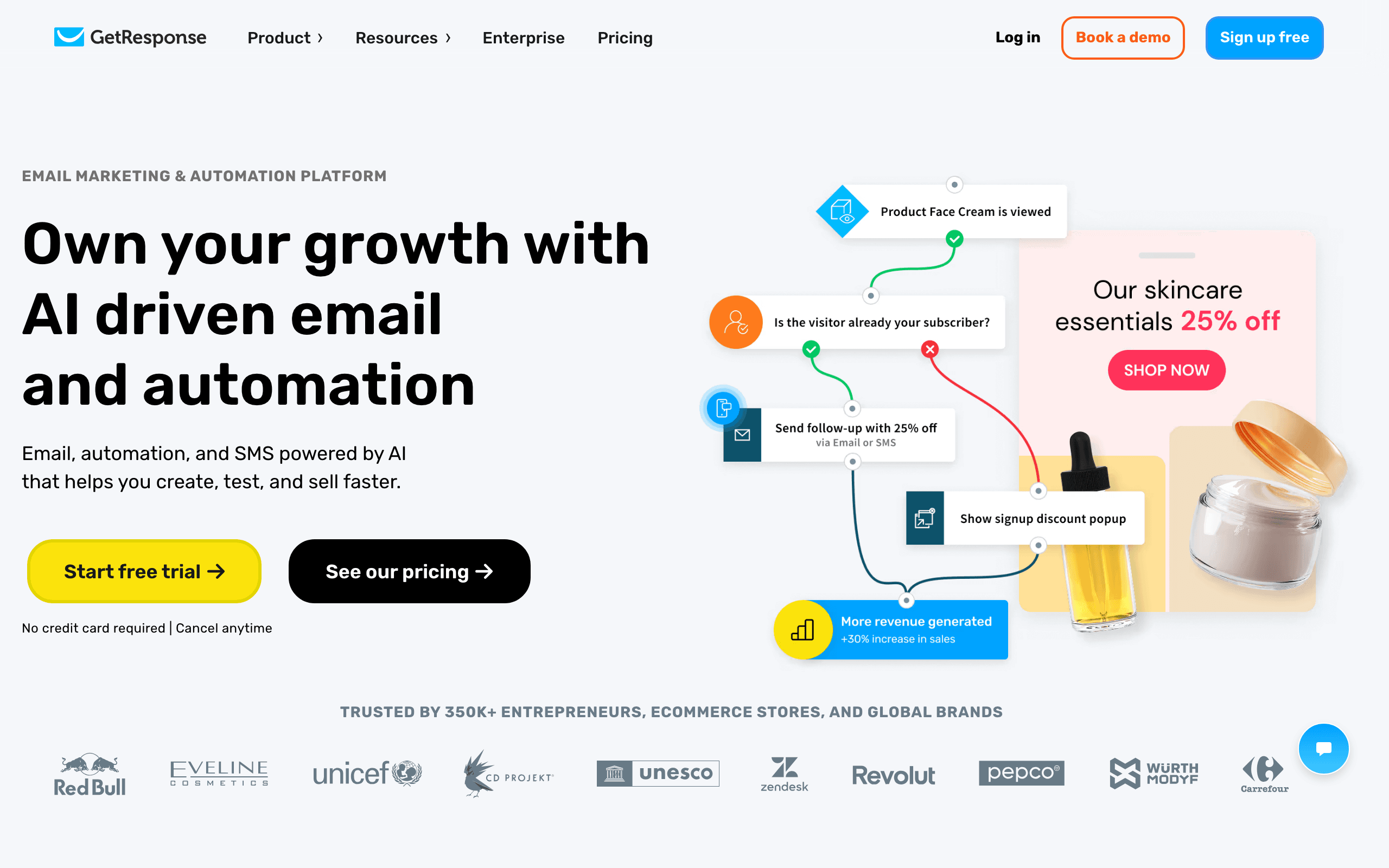
tinyEmail and GetResponse take different approaches to marketing. tinyEmail is a focused e-commerce email platform with AI tools. GetResponse is an all-in-one marketing platform including email, webinars, landing pages, and website builder.
The question is whether you need specialized e-commerce email or a comprehensive marketing suite.
Platform Scope
GetResponse includes:
- Email marketing
- Webinar hosting
- Landing page builder
- Website builder
- Conversion funnels
- Marketing automation
- Web push notifications
tinyEmail focuses on:
- Email marketing
- AI content creation
- E-commerce integrations
- 600+ templates
If you are using multiple tools for these functions, GetResponse can consolidate them into one platform.
Webinars
GetResponse has built-in webinar hosting starting on the Plus plan. You can host live webinars, automated webinars, and on-demand content for 100 to 1000 attendees depending on your plan.
tinyEmail has no webinar functionality. If webinars are part of your marketing strategy, this alone makes GetResponse the choice.
Landing Pages and Website
GetResponse includes a landing page builder on all plans with unlimited pages and A/B testing. Their AI website builder can create complete websites.
tinyEmail does not have landing pages or website building. You would need separate tools for these functions.
E-commerce Features
tinyEmail is built for e-commerce with:
- Free Shopify plan
- 600+ templates (many e-commerce focused)
- tinyAlbert AI for product emails
- Abandoned cart automation
GetResponse has e-commerce features but is more generalist:
- E-commerce integrations
- AI product recommendations
- Abandoned cart
- General templates
For dedicated e-commerce email marketing, tinyEmail is more specialized.
Templates
tinyEmail offers 600+ templates with heavy e-commerce focus. GetResponse has 100+ professionally designed templates covering various industries and use cases.
tinyEmail wins on quantity. GetResponse offers more variety across business types.
Pricing Structure
tinyEmail uses email volume pricing:
- Free: 500 subscribers, 15,000 emails
- Pro: $65/month for 15,000 emails (all features)
GetResponse uses subscriber-based pricing:
- Email Marketing: $59/month for 10,000 subscribers
- Marketing Automation: $119/month for advanced automation
- E-commerce Marketing: $139/month for e-commerce features
GetResponse's feature tiering means you may need higher plans for specific features. tinyEmail's Pro includes almost everything.
Automation
GetResponse has more advanced marketing automation with complex workflows, lead scoring, and multi-channel triggers. Their automation builder handles sophisticated marketing journeys.
tinyEmail's automation is good for e-commerce flows (abandoned cart, post-purchase) but less sophisticated for complex multi-touch campaigns.
AI Features
Both have AI:
- tinyEmail: tinyAlbert AI assistant for e-commerce emails
- GetResponse: AI email creation, AI website builder, AI product recommendations
tinyEmail's AI is more e-commerce focused. GetResponse's AI covers more marketing functions.
For SaaS Companies
Neither platform is built for SaaS. tinyEmail focuses on e-commerce. GetResponse is a general marketing platform.
Sequenzy offers Stripe integration for subscription-aware automation at $49/month, making it a better fit for software businesses.
Making the Choice
Choose tinyEmail when: You need focused e-commerce email marketing, want AI-powered content creation, need lots of templates, or run a Shopify store.
Choose GetResponse when: You want an all-in-one marketing platform, need webinar hosting, want landing pages included, or need sophisticated marketing automation across multiple channels.
Feature Breadth
GetResponse bundles webinars, funnels, website building, and email into one platform. tinyEmail focuses on email marketing with AI content assistance. For businesses that need webinar marketing or sales funnels, GetResponse provides capabilities tinyEmail cannot match.
AI Features Comparison
Both platforms have AI features but different ones. tinyEmail offers AI subject lines and content writing. GetResponse offers an AI email generator. Both save time on content creation but approach it differently. GetResponse's AI generates complete email drafts while tinyEmail's AI assists more incrementally.
Simplicity vs Completeness
tinyEmail is simpler and faster to learn. GetResponse packs more features but takes longer to master. For stores wanting basic email with AI help, tinyEmail's simplicity is an advantage. For businesses wanting a complete marketing toolkit, GetResponse's breadth provides more value per dollar.
Use-case matchups
| Situation | Best first look | Why |
|---|---|---|
| Shopify store wants AI-assisted email creation and templates | tinyEmail | tinyEmail is the baseline here when faster campaign creation and Shopify-friendly templates matter. |
| Team wants a broader marketing suite | GetResponse | GetResponse is stronger when funnels, landing pages, and webinars matter. |
| Store or SaaS team wants lifecycle and transactional email | Sequenzy | Sequenzy is stronger when transactional messages and lifecycle automation matter more than AI campaign generation. |
| Small ecommerce team wants help producing campaigns quickly | tinyEmail | tinyEmail should be tested first when content speed is the bottleneck. |
| Team needs the specialist capability | GetResponse | GetResponse deserves the first demo when the main requirement is all-in-one marketing with funnels, webinars, and landing pages. |
| Team wants event-driven email workflows instead of content tooling | Sequenzy | Sequenzy is more relevant when app, Stripe, store, and transactional events drive the email program. |
Best Fit by Marketing Suite Scope
Best Shopify email tool for AI-assisted product campaigns
tinyEmail fits ecommerce teams that want fast campaign creation and Shopify-aware templates without a full funnel and webinar suite. It is most relevant when content speed and store campaign production are the bottlenecks.
Best marketing platform for funnels webinars and landing pages
GetResponse is the better fit when the team needs email plus funnels, landing pages, webinars, broader automation, and campaign suite depth.
Best lifecycle email platform for product and billing triggers
Sequenzy fits teams that need event-driven lifecycle and transactional email rather than an all-in-one marketing suite. It is useful when product, Stripe, store, and transactional events define the workflow.
Pricing reality
The pricing signals on this page list tinyEmail at $65/month, GetResponse at $59/month, and Sequenzy at $49/month. Compare them by workflow, not only by monthly cost.
tinyEmail's value depends on whether AI-assisted content, templates, and Shopify-friendly campaign creation save meaningful time. GetResponse's real cost depends on whether the team needs all-in-one marketing with funnels, webinars, and landing pages.
Review signals
For tinyEmail, validate review themes around AI content quality, Shopify app reliability, template workflow, support, and reporting. For GetResponse, focus review research on whether users praise the reason you would choose it: all-in-one marketing with funnels, webinars, and landing pages.
Migration checklist
| Workstream | Moving toward tinyEmail | Moving toward GetResponse | Simplifying to Sequenzy |
|---|---|---|---|
| Store and subscriber data | Sync Shopify customers, products, segments, consent, tags, and suppressions. | Map contacts, lists, funnels, landing pages, webinars, automations, templates, and suppressions. | Import subscribers, attributes, tags, suppressions, and lifecycle events. |
| AI and templates | Validate AI generation, brand voice, product blocks, template quality, and fallback editing. | Confirm whether GetResponse needs separate content or design tooling. | Move lifecycle and transactional templates; keep AI content elsewhere if needed. |
| Automations | Rebuild welcome, campaign, product, cart, and simple ecommerce automations. | Rebuild the workflows that prove GetResponse's advantage in all-in-one marketing with funnels, webinars, and landing pages. | Rebuild lifecycle and transactional email flows. |
| Forms and capture | Move popups, forms, landing pages, coupons, and embedded signup paths. | Move forms, brand assets, and workflow-specific content. | Move subscriber capture only where it feeds lifecycle email. |
| Reporting | Validate campaign reporting, ecommerce revenue, generated-content performance, and exports. | Validate reporting for all-in-one marketing with funnels, webinars, and landing pages before committing. | Validate campaign, automation, transactional, and lifecycle reporting. |
Decision checklist
- Is tinyAlbert's drafting on the Pro plan the bottleneck, or does GetResponse's scoring and multi-channel automation matter more?
- Does GetResponse's strength in all-in-one marketing with funnels, webinars, and landing pages matter more than tinyEmail's content and template workflow?
- Can tinyEmail's free Shopify plan cover your sync needs, with consent and suppression handling tested on both platforms?
- Do the $65 Pro and $59 Email Marketing prices hold at your send volume, or will you need GetResponse's $119 or $139 tiers?
- Would Sequenzy's transactional email and Stripe-triggered flows, such as failed payments, matter more than campaign speed?
- GetResponse should be evaluated on suite features the team will actually use.









