Two different starting points
Mailchimp and ActiveCampaign are both contact-priced email platforms, and both have visual automation builders. The difference is where each one starts. Mailchimp starts from the campaign: you build an email, choose an audience or segment, and send. ActiveCampaign starts from the automation: a contact does something, and a journey reacts, branches, updates a deal, or alerts a salesperson.
That difference shows up in almost every workflow. For our deeper take on each tool, see the Mailchimp comparison and the ActiveCampaign comparison.
Who each tool is really for
Mailchimp suits small businesses, local shops, nonprofits, and marketing generalists who send a regular newsletter plus a handful of automated emails. You get a free plan for very small lists, a large template library, landing pages, a website builder, social posting, and postcards. The Customer Journey Builder covers welcome series, abandoned cart, and date-based messages.
ActiveCampaign suits teams whose email is a system rather than a schedule: B2B companies with a sales handoff, course and coaching businesses with long nurture paths, and agencies building programs for clients. It combines email marketing, behavior-based automation, a sales CRM with deals and lead scoring, reporting, and cross-channel messaging.
How a real workflow differs
Take a common B2B nurture: someone downloads a guide, reads three blog posts over two weeks, and visits the pricing page.
In ActiveCampaign, site tracking records the visits, a lead score climbs with each action, and when the score passes your threshold, the automation creates a deal in the pipeline, assigns an owner, and sends a personal-looking email from that rep. A goal step pulls the contact out of the nurture as soon as they book a call.
In Mailchimp, you can tag the download and send a sequence, and you can branch on opens, clicks, and purchases. The pricing-page visit and the deal creation would need a separate CRM and an integration to sync fields back. It works, but you assemble it.
For a retail newsletter, the comparison flips. Mailchimp's campaign editor, product blocks, and ready-made templates get a weekly promotion out faster, and you do not need a CRM at all.
Active Intelligence 3.0: Wavelength
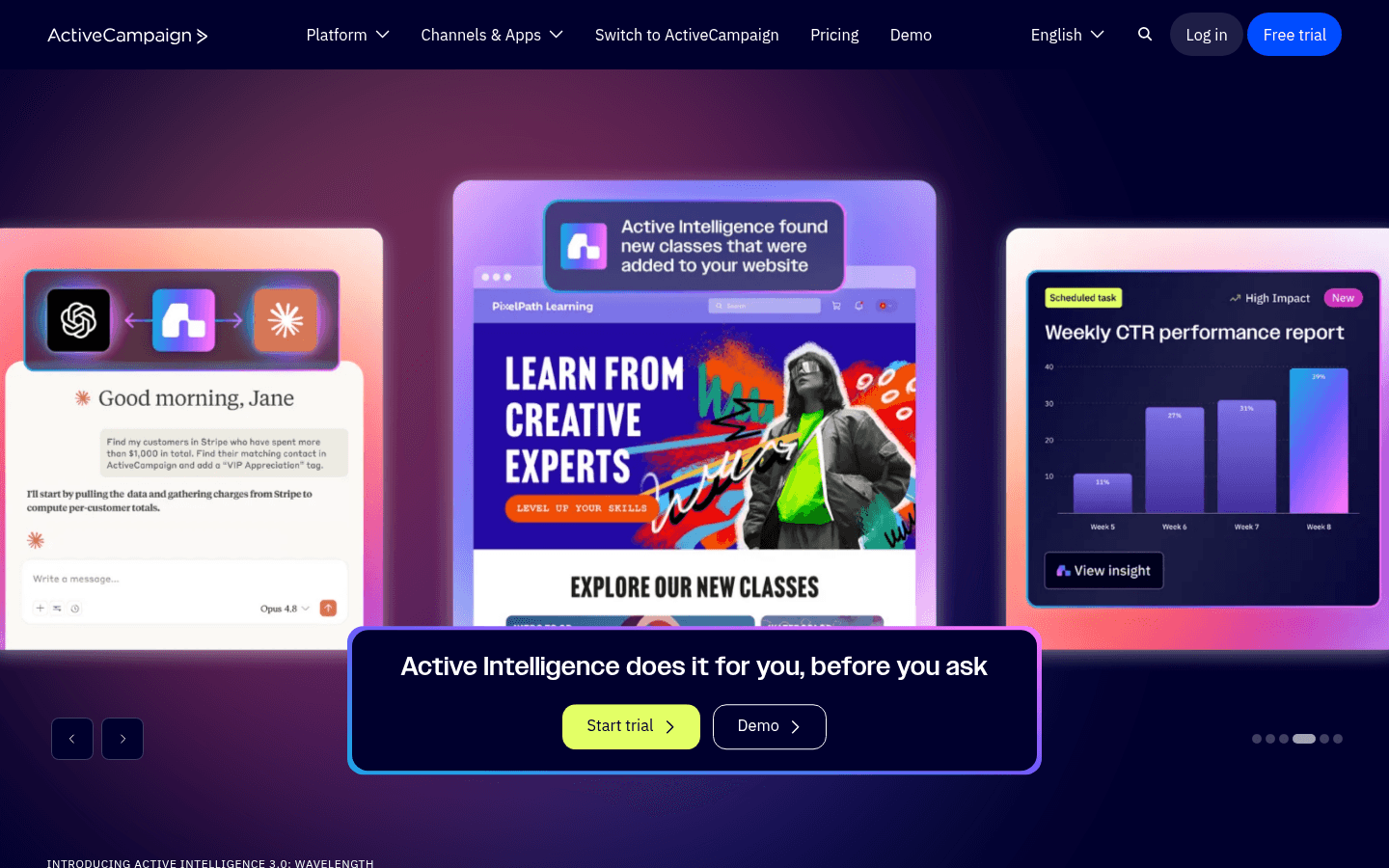
ActiveCampaign's current AI layer is Active Intelligence 3.0: Wavelength. It is designed to know your business well enough to surface the right move before you ask: proactive drafts and ideas, scheduled tasks and actions, monitoring and performance recaps, adaptive memory, content performance, industry benchmarks, automation patterns, cross-account intelligence, multi-asset analysis, external intelligence and brand monitoring, AI image generation, and AI email translations.
The practical difference from Mailchimp's AI is scope. Mailchimp's assistants help you write and tune a single email or campaign. Wavelength works at the account level, with enough context to propose the next campaign or flag an automation that is underperforming. Plus plans include Active Intelligence with usage limits.
What you actually pay
Both tools bill by contacts, so list size is the main cost driver.
| Plan level | Mailchimp at 10,000 contacts | ActiveCampaign |
|---|---|---|
| Entry | Essentials, about $110/month | Starter from $15/month at 1,000 contacts (annual), around $149 at 10,000 |
| Most teams | Standard, about $135/month | Plus from $49/month at 1,000 contacts (annual), around $189 to $239 at 10,000 |
| Advanced | Premium, about $350/month | Pro from $79, Enterprise from $145 at 1,000 contacts (annual) |
Two plan details matter more than the headline price. ActiveCampaign Starter limits each automation to 5 actions and one user, so anyone buying ActiveCampaign for its automation should budget for Plus or Pro. Mailchimp bills on audience size, and unsubscribed contacts can count until you archive them, so clean the audience before comparing quotes.
Neither plan includes transactional email. Mailchimp sells Mandrill as an add-on, and ActiveCampaign owns Postmark, which is priced separately.
A worked example
A B2B consultancy has 10,000 contacts, sends one newsletter a week, and runs a welcome series and a nurture automation. That is roughly 40,000 to 50,000 emails a month.
- On Mailchimp Standard (about $135), the send limit is 12x contacts, so 120,000 emails. Plenty of room, but no pipeline, so the team also pays for a CRM.
- On ActiveCampaign Plus (about $189 to $239 annual), the limit is 10x contacts, so 100,000 emails, and deals and lead scoring are included. If the CRM subscription it replaces costs more than the difference, ActiveCampaign is cheaper in total.
- On ActiveCampaign Starter (about $149), the nurture would hit the 5-action limit, so this plan does not fit the example.
The send-limit fine print
Both tools quietly cap how much you can send, and the caps line up closely. Mailchimp allows 10x your contact limit per month on Essentials, 12x on Standard, and 15x on Premium. ActiveCampaign allows 10x on Starter and Plus, 12x on Pro, and 15x on Enterprise. For most lists this never matters. It does matter if you send daily digests or run several overlapping automations to the whole list, because a heavy sender can outgrow a plan's send limit before its contact limit.
The Intuit factor
Intuit bought Mailchimp in 2021, and the product has since moved toward being the marketing layer of a small business suite, alongside QuickBooks. That brings tighter accounting and commerce connections and a steady stream of AI and ecommerce features. It has also brought plan and free-tier changes that long-time users notice, so check current limits rather than relying on older reviews.
ActiveCampaign is independent and focused on automation, CRM, and messaging, with Postmark as its transactional arm. If your business runs on QuickBooks and you want marketing tied to it, Mailchimp's ownership is a plus. If you want a vendor whose roadmap is automation first, ActiveCampaign fits better.
Use-case matchups
| Situation | Better fit | Why |
|---|---|---|
| Monthly newsletter for a local shop or nonprofit | Mailchimp | Campaign-first editor, templates, and a free plan for very small lists. |
| Lead nurture that ends in a sales call | ActiveCampaign | Site tracking, lead scoring, and deals live on the same contact record. |
| Shopify store with simple cart and welcome flows | Mailchimp | Prebuilt journeys and product blocks are quick to set up. |
| Course or coaching business with branching launch funnels | ActiveCampaign | If/else branches, goals, and tags handle buyers and non-buyers in one automation. |
| QuickBooks-based small business | Mailchimp | Intuit ownership brings closer ties to its accounting tools. |
| SaaS lifecycle email tied to billing | Sequenzy | Stripe, Paddle, and Polar events trigger journeys, and transactional email is included. |
Moving from Mailchimp to ActiveCampaign
What transfers cleanly:
- Contacts, tags, and merge fields. Export the audience as CSV, then map merge fields to ActiveCampaign custom fields. Tags import as tags.
- Unsubscribes and cleaned addresses. Export them separately and import them as unsubscribed so you do not re-mail anyone.
- Sending domain. Add ActiveCampaign's DKIM and SPF records alongside Mailchimp's during the overlap, then remove the old ones.
What you rebuild:
- Journeys. Rebuild each Customer Journey as an ActiveCampaign automation. This is a good moment to merge several linear journeys into one automation with if/else branches and goals.
- Templates. Mailchimp templates can be exported as HTML and pasted into ActiveCampaign's HTML editor, but most teams rebuild them in the drag-and-drop editor to keep them editable.
- Signup forms and landing pages. Recreate them and update embed codes on your site.
Moving from ActiveCampaign to Mailchimp
This direction is less common and loses more. Deals, pipelines, lead scores, and site-tracking history have no Mailchimp equivalent, so export them to whatever CRM will take over sales. Contacts, tags, and custom fields import as audience members, tags, and merge fields. Deep automations usually need to be flattened into a few simpler journeys.
Cutover checklist
| Workstream | Mailchimp to ActiveCampaign | ActiveCampaign to Mailchimp |
|---|---|---|
| Suppression | Import unsubscribed and cleaned contacts as unsubscribed first | Import unsubscribed contacts before any send |
| Domain | Add ActiveCampaign DKIM and SPF, keep DMARC, remove Mailchimp records after cutover | Authenticate the domain in Mailchimp before the first campaign |
| Automations | Rebuild journeys, then pause the Mailchimp versions the same day | Flatten branching automations; switch off originals the same day |
| Sales data | Create pipelines and stages before importing leads | Export deals and scores to your next CRM |
| Forms and site | Replace embed codes and install site tracking | Replace embed codes; remove the ActiveCampaign tracking script |
| Reporting | Export campaign history for a baseline | Export automation and deal reports before cancelling |
Where Sequenzy fits
If you run a SaaS product, both tools share the same gap: neither knows when a trial ends, a card fails, or a customer upgrades unless you pipe that data in yourself. Sequenzy connects to Stripe, Paddle, and Polar natively and starts journeys from those billing events. It also sends transactional email in the same account and bills by emails sent, not contacts.
Sequenzy does not replace ActiveCampaign's sales CRM or Mailchimp's social and postcard tools. If you need a pipeline for a sales team, ActiveCampaign is still the stronger choice.
Quick decision guide
- Choose Mailchimp if you mainly send scheduled newsletters and promotions and want the easiest start.
- Choose ActiveCampaign if behavior-triggered journeys, lead scoring, and a sales pipeline are central, and Wavelength's proactive actions would save your team time.
- Choose Sequenzy if your triggers are subscription events and you want Stripe-driven automation plus transactional email in one place.