
Overview
Shopify Email is free and built into Shopify. MailerLite is an affordable email platform with a generous free tier and landing pages. Both are budget-friendly, but neither is specialized in e-commerce email marketing.
For Shopify stores, the better question is whether to upgrade to an e-commerce-focused platform like Sequenzy ($49/mo with AI and Shopify integration) or Omnisend (email + SMS with pre-built e-commerce flows) instead of MailerLite. E-commerce-specific tools handle abandoned carts, product recommendations, and order-based automation that MailerLite does not.
When MailerLite Works
If you need landing pages, signup forms, and general email marketing at a low price, MailerLite delivers good value. The free tier is especially attractive for new businesses. Just know that the Shopify integration is basic and e-commerce features are limited.
MailerLite's Landing Pages and Website Builder Fill Gaps Shopify Does Not Have
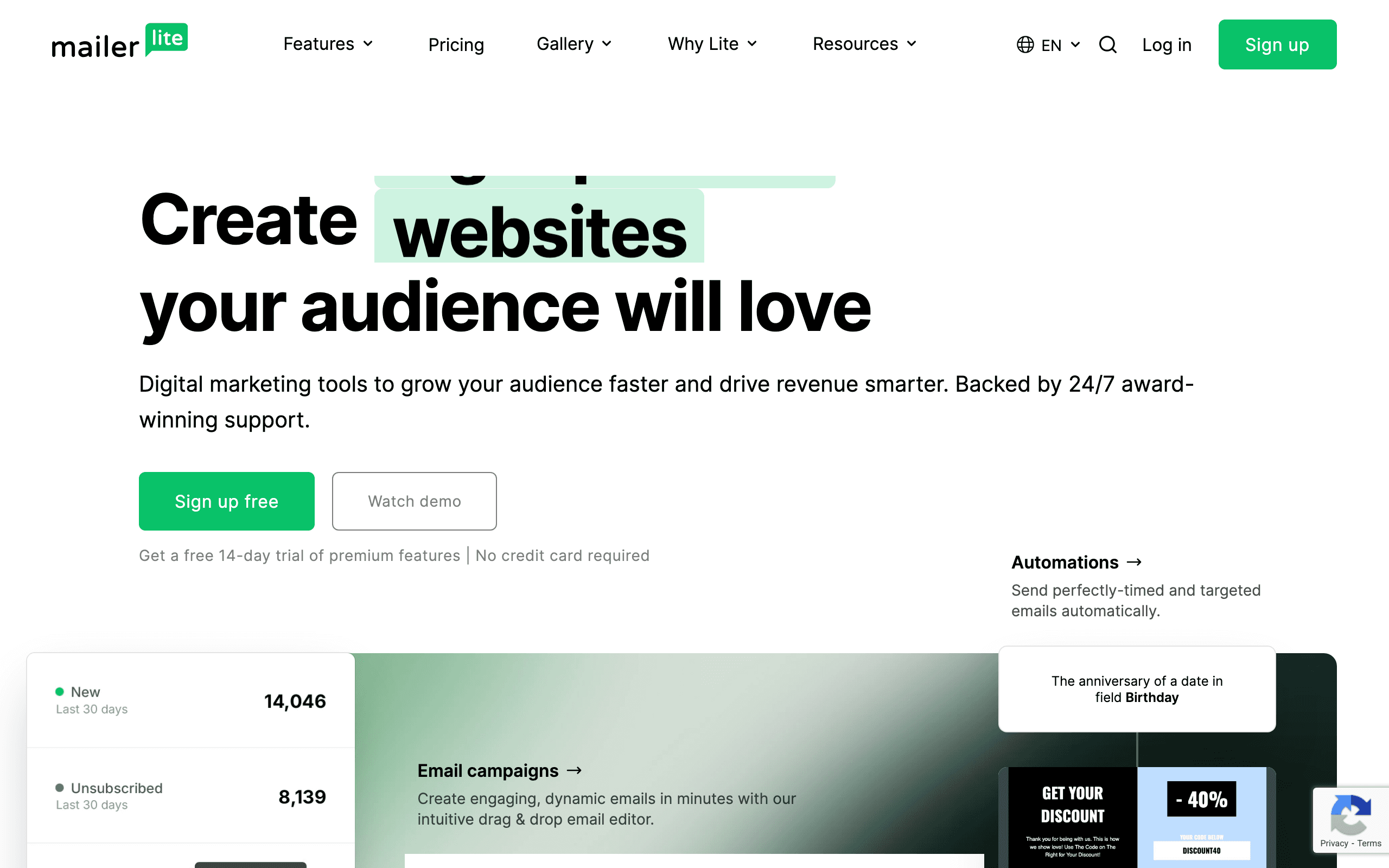
MailerLite includes a landing page builder and basic website creator alongside email marketing. For Shopify merchants who also need standalone landing pages for lead magnets, pre-launch campaigns, or content marketing, MailerLite provides these tools without requiring a separate subscription to Unbounce or Carrd. Shopify Email has no landing page capability beyond what Shopify's built-in pages offer.
However, Shopify merchants already have a website - their store. MailerLite's website builder adds marginal value when your primary web presence is your Shopify storefront. The landing page feature is more useful for collecting emails outside of your store, such as running a blog or content-driven marketing strategy. If your email list growth comes primarily from store visitors, Shopify Email's native integration handles this adequately without an external platform.
The Approval Process That Delays Your Switch
MailerLite reviews new account applications before granting sending access. This approval process protects shared IP reputation but can take 3-5 business days and sometimes results in rejection. For Shopify merchants eager to start sending campaigns immediately, this delay is frustrating - especially when Shopify Email requires zero setup and is already available in your admin panel.
If you are migrating from Shopify Email to MailerLite, account for this approval timeline. Do not cancel or reduce your Shopify Email usage until MailerLite has approved your account and you have verified that your domain authentication (SPF, DKIM) is properly configured. The transition period where both platforms are active adds temporary complexity but prevents gaps in your email marketing during the switch.
Why Shopify Stores Often Need Neither General Email Platform
Both Shopify Email and MailerLite are general-purpose email tools - one basic and free, the other affordable with more features. Neither is built specifically for e-commerce workflows. Abandoned cart recovery, product recommendation emails, browse abandonment sequences, and purchase-triggered cross-sell campaigns require e-commerce-specific platforms. For SaaS companies using Shopify for digital product sales, Sequenzy offers transactional email and marketing campaigns with Stripe integration at $49/month - purpose-built for subscription businesses rather than e-commerce or general newsletters.
Use-case matchups
| Situation | Best first look | Why |
|---|---|---|
| New Shopify store wants the simplest built-in campaign tool | Shopify Email | Shopify Email is the baseline when the team wants to send basic campaigns without adding another platform. |
| Store wants a clean affordable email platform | MailerLite | MailerLite is stronger when the team wants simple hosted email tools beyond Shopify Email. |
| Shopify or WooCommerce team wants email automation plus transactional email | Sequenzy | Sequenzy is stronger when the job includes lifecycle automation and transactional messages, not just Shopify campaigns. |
| Store only needs occasional product announcements | Shopify Email | Staying native avoids extra setup when campaigns are simple and infrequent. |
| Team needs the specialist capability | MailerLite | MailerLite deserves the first demo when the main requirement is affordable newsletters, forms, landing pages, and automations. |
| Team wants store email without SMS or a large suite | Sequenzy | Sequenzy is a focused upgrade when email workflows are deeper than Shopify Email but narrower than a full ecommerce SMS platform. |
Best Fit by Shopify Native Campaigns and Affordable Newsletter Tools
Best email tool for simple Shopify sends
Shopify Email is the better fit when the store wants native product announcements and basic campaigns without paying for a separate email platform.
Best affordable email platform for newsletters, forms, and landing pages
MailerLite is the better fit when the team needs hosted email tools, landing pages, forms, newsletters, and simple automations beyond Shopify Email.
Best email tool for Shopify lifecycle and transactional workflows
Sequenzy is the better fit when Shopify or WooCommerce teams need deeper email automation and transactional messages without SMS or a large ecommerce suite.
Pricing reality
The pricing signals on this page list Shopify Email at ~$10/month or equivalent usage cost, MailerLite at $47/month, and Sequenzy at $49/month. Shopify Email often looks cheapest because it is built into Shopify, but that does not mean it covers the same work.
Shopify Email's real value is low setup friction for basic campaigns. MailerLite's real cost depends on whether the store uses affordable newsletters, forms, landing pages, and automations.
Review signals
This page has existing review data from Shopify Community, G2, Capterra. Keep those sources visible because Shopify-native tools and external platforms differ most in day-to-day workflow, support, app reliability, billing, and ecommerce sync quality.
For Shopify Email, validate community and app-context feedback around simplicity, limits, templates, reporting, and what merchants outgrow first. For MailerLite, focus review research on whether users praise the reason you would choose it: affordable newsletters, forms, landing pages, and automations.
Migration checklist
| Workstream | Staying with Shopify Email | Moving toward MailerLite | Simplifying to Sequenzy |
|---|---|---|---|
| Shopify data | Keep customer segments, products, discounts, and campaign sending inside Shopify. | Map subscribers, groups, fields, automations, forms, landing pages, templates, Shopify sync, and unsubscribes. | Connect store events, subscribers, attributes, suppressions, and transactional paths. |
| Consent and suppression | Confirm Shopify customer consent, unsubscribes, and segmentation rules are clean. | Import consent, unsubscribes, tags, fields, and suppression status into MailerLite. | Import subscribers, tags, attributes, and suppression status. |
| Automations | Use Shopify-native basics and avoid rebuilding complex flows if they are not needed. | Rebuild the workflows that prove MailerLite's advantage in affordable newsletters, forms, landing pages, and automations. | Rebuild lifecycle and transactional email flows without SMS scope. |
| Templates and forms | Keep simple product campaigns and brand settings inside Shopify. | Move templates, forms, popups, brand assets, and Shopify-specific content. | Move email templates and lifecycle message content. |
| Reporting | Accept simpler Shopify campaign reporting if it answers the question. | Validate campaign, revenue, segment, and channel reporting before switching. | Validate campaign, automation, transactional, and lifecycle reporting. |
Decision checklist
- Has Shopify Email's basic segmentation or limited automation become a bottleneck, or is the free tier still enough for current sends?
- Does MailerLite's strength in affordable newsletters, forms, landing pages, and automations justify another vendor, bill, and integration?
- Staying on Shopify keeps consent and unsubscribe records in one place; moving to MailerLite means importing them with their suppression status.
- Does the $47/month MailerLite Growing Business plan still fit past 10,000 subscribers, and does Shopify's ~$10/month hold as sends grow?
- Shopify Email has no SMS and MailerLite includes no CRM, so decide whether you need either before you compare workflows.
- MailerLite should be checked for ecommerce automation and Shopify sync depth.








