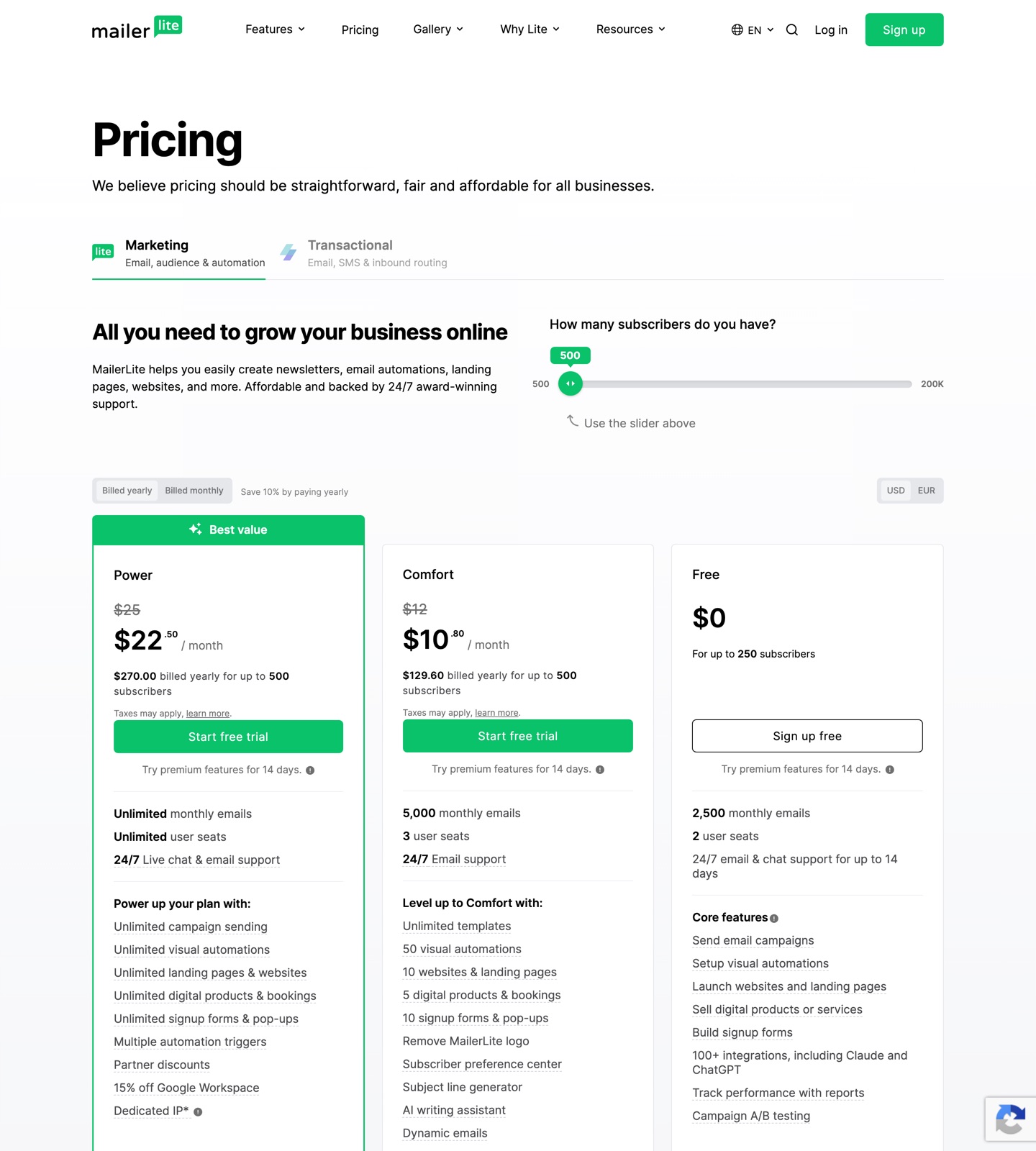
MailerLite's pricing page
Captured from mailerlite.com. Pricing changes often, so confirm the current numbers on the live page.
Buying shortcut
Which MailerLite plan should you choose?
Start here
Free
Testing MailerLite or running a very small newsletter. It is the first tier to check when you only need the core MailerLite workflow. Watch for: MailerLite logo remains
Public price
$0
Up to 250 subscribers and 2,500 monthly emails.
Main upgrade
Comfort
Solopreneurs and small teams that want the full toolkit with sensible limits. Inspect this tier when the lower tier starts blocking reporting, automation, collaboration, or support needs. Watch for: Limited automations, forms, sites, and seats compared with Power
Public price
From $12/mo
Subscriber-based paid plan.
High-volume or advanced
Enterprise
Larger senders that need dedicated support and deliverability services. Treat this as the serious-operations tier, especially if the first two plans leave key limits or add-ons unresolved. Watch for: Sales-led pricing
Public price
Custom
Custom plan for businesses with over 200,000 subscribers.
Cost scenarios
Pricing pages show the entry point. These scenarios show what the plan means in real buying situations.
Creator with a small newsletter
MailerLite: Free or low paid tier. Sequenzy: Free if send volume stays under the free email allowance. MailerLite is stronger if landing pages and creator tools matter more than SaaS events.
SaaS with 50,000 users but moderate sending
MailerLite: Subscriber count can drive cost up. Sequenzy: Email-volume pricing with unlimited contacts. Sequenzy is easier to budget when many product users receive only occasional lifecycle email.
Small business using websites, forms, and popups
MailerLite: Comfort or Power. Sequenzy: Email-focused rather than site/form suite. MailerLite is better for general small-business marketing assets.
What to watch for
The free plan was cut on 16 June 2026, from 500 subscribers and 12,000 monthly emails down to 250 subscribers and 2,500 monthly emails. Older comparison articles still quote the previous limits.
Free accounts also picked up feature-use caps from 13 August 2026 - 3 automations, 3 forms, 1 digital product, 1 landing page, and 1 website.
Paid tiers rose across every subscriber band in the same 2026 repricing, so renewal quotes may not match what you originally signed up for.
Comfort has practical limits on automations, forms, landing pages, and user seats.
MailerLite is not designed around product events, billing state, or transactional SaaS lifecycle email.
What changed in 2026
If you are comparing MailerLite against an article written before mid-2026, the free plan you are reading about no longer exists. On 16 June 2026 MailerLite cut the free tier from 500 subscribers and 12,000 monthly emails to 250 subscribers and 2,500 monthly emails, and raised paid pricing across every subscriber band at the same time. From 13 August 2026, free accounts are also capped at 3 automations, 3 forms, 1 digital product, 1 landing page, and 1 website.
Free accounts did gain some ground: the seat limit went from 1 to 2, and previously paid features such as custom campaign and landing page templates, the HTML editor, blogs, and promotional pop-ups became available. The trade is more capability on a much smaller allowance.
The practical effect is that MailerLite is no longer the most generous free plan in the category, and a list that used to sit comfortably inside the free tier may now need a paid plan. If free sending is your main criterion, compare current allowances in our guide to the best free email marketing tools rather than assuming last year's limits still apply.
What MailerLite costs as your list grows
Both paid plans are priced by subscriber count, so the headline price tells you very little on its own. These are the anchor points worth knowing:
| Plan | Entry price | Send allowance | Anchor point as you scale |
|---|---|---|---|
| Free | $0 | 2,500 emails/mo | Hard stop at 250 subscribers |
| Comfort | $12/mo at 500 subscribers | 10x your subscriber tier | $819/mo at 200,000 subscribers |
| Power | $25/mo entry | Unlimited, subject to fair use | $39/mo at 1,000 subscribers |
| Enterprise | Custom | Custom | Sales-led above 200,000 subscribers |
Two things follow from that shape. The Comfort send allowance is a multiple of your subscriber tier rather than a flat number, so a list you email frequently can hit the send ceiling well before the subscriber ceiling. And because Power is subscriber-priced despite its unlimited sending, moving to Power solves a volume problem but never a database-size problem.
Paying annually saves 10%. Prices move with MailerLite's live slider, so treat the anchors above as the shape of the curve and confirm your exact tier before you budget.
MailerLite pricing is simple until your audience grows
MailerLite is easy to understand at a small scale. You get a real free plan, then paid tiers unlock more templates, automation, support, and usage. The important detail is that pricing follows subscriber count, not just how many emails you actually send.
For newsletters and small-business marketing, that is normal. For SaaS, it can be awkward because your product database may be much larger than the group you actively email each month.
The Comfort versus Power decision should be based on operational limits, not only price. Comfort is enough when you need a friendly editor and a controlled number of assets. Power is more realistic when automations, seats, sends, forms, and support become part of daily marketing operations. For SaaS teams, neither tier changes the bigger question: should cost follow subscribers or actual lifecycle communication?
The MailerLite alternatives guide and MailerLite comparison are useful if you are deciding between approachable newsletter software and SaaS-specific email workflows. MailerLite can be the right tool for small-business marketing while still being the wrong pricing model for a large product database.
MailerLite vs Sequenzy
MailerLite is better if you need landing pages, forms, simple websites, and a friendly newsletter editor. Sequenzy is better if your email program is mostly onboarding, activation, trial conversion, dunning, reactivation, and product-event messaging.
Choose MailerLite when the email tool also needs to cover creator pages, forms, newsletter assets, and simple commerce. Choose Sequenzy when user behavior and billing state should drive the message plan.
MailerLite vs Sequenzy
How MailerLite compares with Sequenzy, which bills on emails sent rather than contact count.
How Sequenzy prices the same volume
Sequenzy price per 1k emails
$0.82 / 1k at $49/mo for 60k emails
Verdict
MailerLite is a strong budget-friendly marketing tool for small businesses and creators. Sequenzy is the better choice when your "subscribers" are really SaaS users and the cost should follow email volume rather than database size.
FAQ
Sources checked · Aug 12, 2026