
Overview
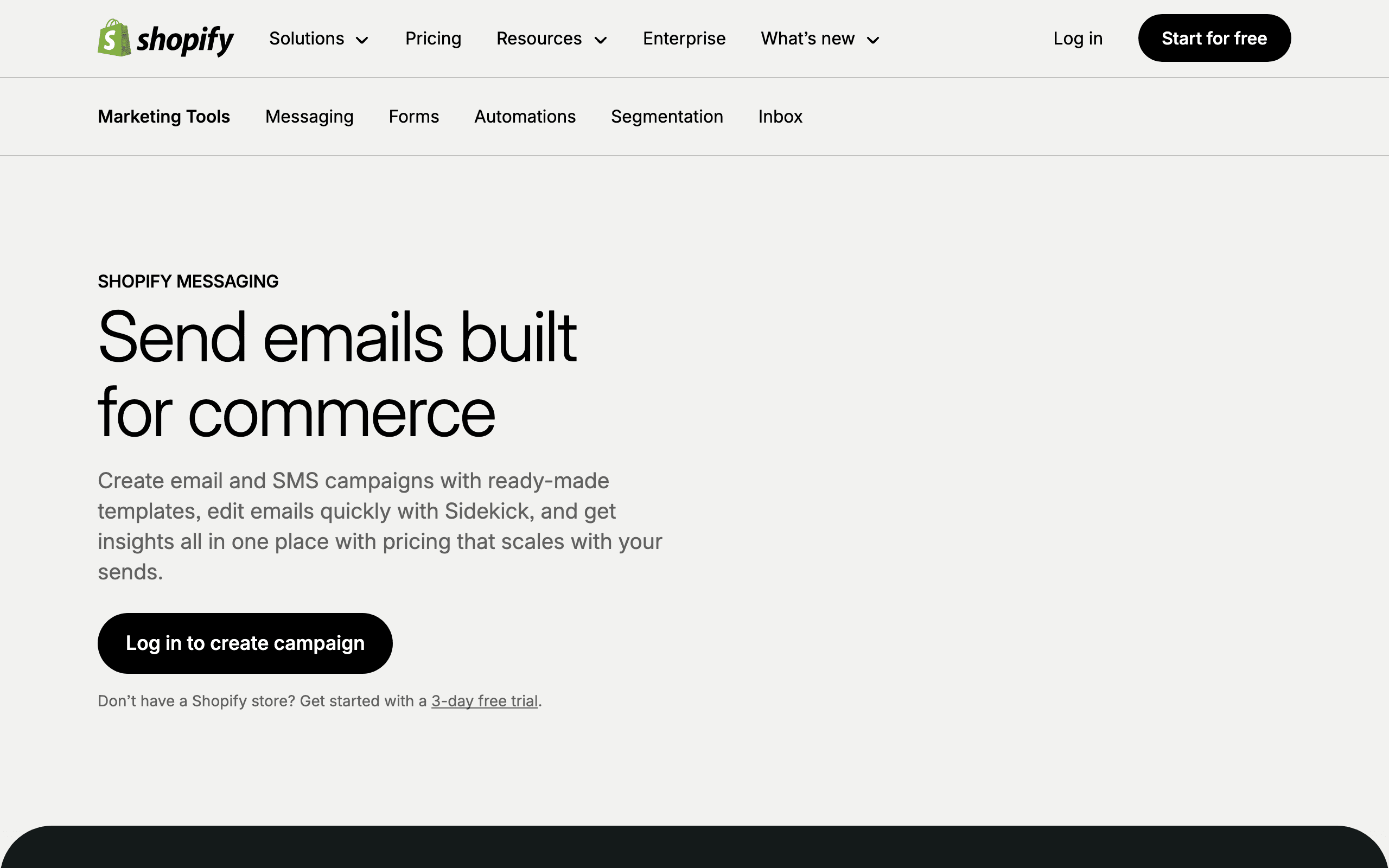
Shopify Email is already in your store. Omnisend is the platform most stores graduate to when they need real email marketing.
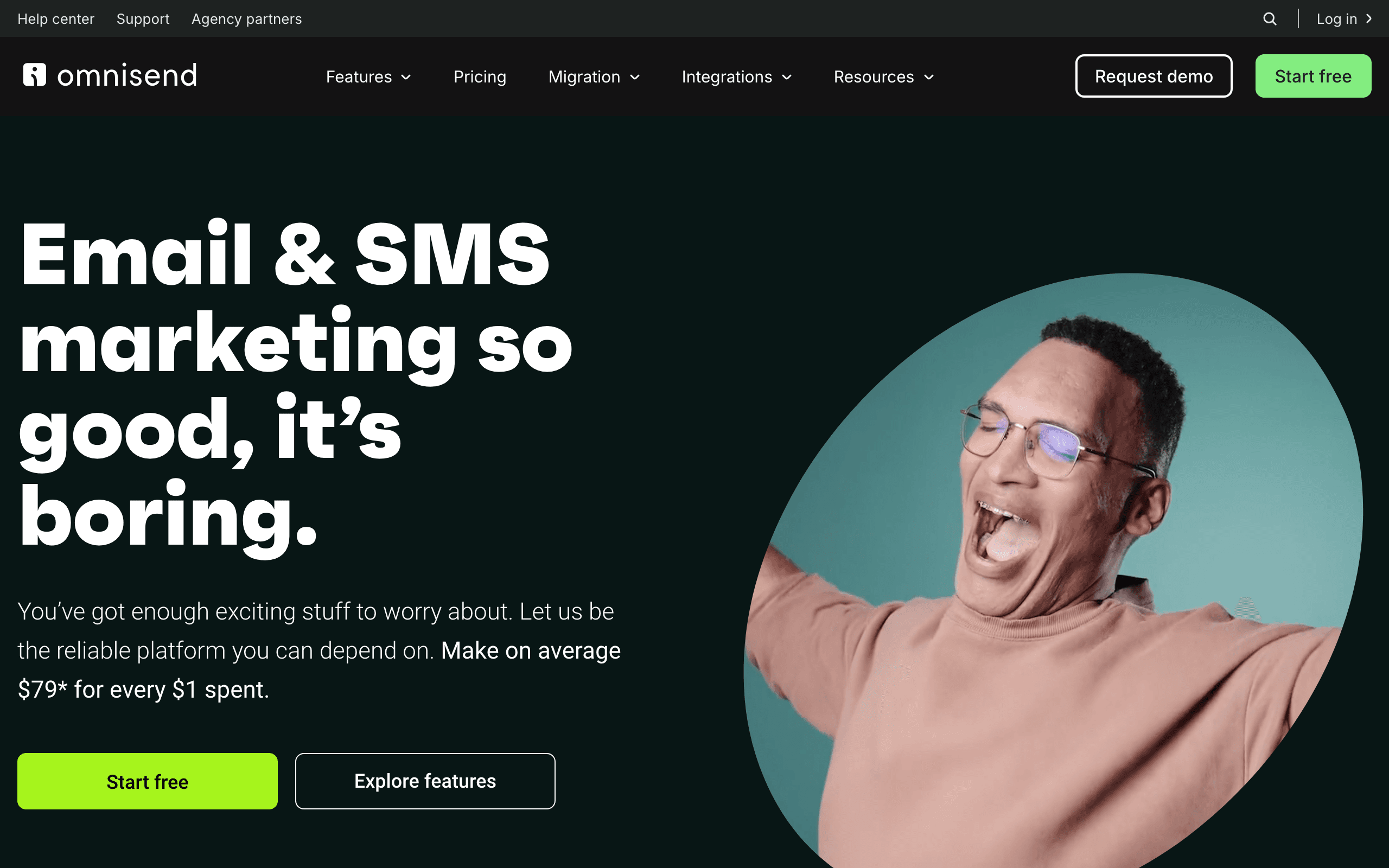
The jump from Shopify Email to Omnisend gives you SMS, pre-built automations, and segmentation that actually works. For stores where email is just a newsletter, Shopify Email is fine. For stores where email should be a revenue channel, Omnisend delivers the tools to make that happen.
Pricing Comparison
- Shopify Email: ~$10/month at 10k subscribers
- Omnisend: $115/month at 10k contacts (Standard)
- Sequenzy: $49/month for 60,000 emails
Omnisend's free tier (250 contacts, most features) lets you test the platform before committing. That is the best way to decide if the upgrade is worth it.
Where Omnisend Wins
Multi-channel marketing
Email, SMS, and push notifications from one platform. This matters because the best e-commerce marketing uses multiple channels together. An abandoned cart email followed by an SMS reminder converts better than email alone.
Pre-built automations
20+ ready-made workflows for e-commerce. Install Omnisend, turn on the abandoned cart flow, and start recovering revenue immediately. Shopify Email requires you to build everything manually with limited tools.
Where Shopify Email Wins
Price and simplicity
Free and already there. For stores sending occasional promotional emails, it is hard to argue against free.
The Middle Ground: Sequenzy
Sequenzy gives you AI-built email sequences and Shopify integration for $49/month. More automation than Shopify Email, lower cost than Omnisend, but SMS is only a lighter paid add-on. If email is your primary channel and you want AI doing the heavy lifting, it is worth a look.
The Revenue Gap Between Free Email and Real E-Commerce Marketing
Shopify Email sends newsletters and promotional campaigns. Omnisend builds revenue-generating automated workflows - abandoned cart recovery, browse abandonment, post-purchase upsell, win-back sequences - that run 24/7 without manual intervention. The difference is not just features but philosophy: Shopify Email is a communication tool, Omnisend is a revenue engine.
Stores that switch from Shopify Email to Omnisend typically see measurable revenue increases within the first month, primarily from automated abandoned cart recovery. The average cart abandonment rate is 70%, and even recovering 5-10% of those carts through automated email and SMS follow-ups can represent significant revenue. Shopify Email has no automated cart recovery flow - every sale lost to abandonment stays lost.
SMS as the Channel Multiplier Shopify Email Cannot Offer
Omnisend includes SMS alongside email in the same automation workflows. An abandoned cart email can be followed by an SMS reminder two hours later, reaching customers through their preferred channel. Shopify Email is email-only - no SMS, no push notifications, no multi-channel coordination. For stores where mobile shopping drives significant traffic, SMS follow-ups capture attention that email alone misses.
The cost of SMS is worth examining honestly. Omnisend includes SMS credits on paid plans, but high-volume SMS campaigns require additional credits at per-message pricing. The ROI calculation is straightforward: if an SMS abandoned cart reminder generates enough recovered revenue to cover the message cost plus margin, it is profitable. For most stores with average order values above $40, the math works clearly in favor of adding SMS to the marketing mix.
When the E-Commerce Focus Becomes Irrelevant
Both Shopify Email and Omnisend are built for product-based e-commerce. Neither handles subscription software, service businesses, or B2B marketing. SaaS companies selling through Shopify (digital product delivery) will find Omnisend's e-commerce automations irrelevant to their subscription billing model and Shopify Email's basic tools insufficient for lifecycle marketing.
Sequenzy addresses this gap for software businesses at $49/month with unified transactional and marketing email. Native Stripe integration connects billing events to email sequences - trial expiration, payment failure, plan changes - replacing e-commerce automation with subscription-aware workflows designed for recurring revenue businesses.
Use-case matchups
| Situation | Best first look | Why |
|---|---|---|
| New Shopify store wants the simplest built-in campaign tool | Shopify Email | Shopify Email is the baseline when the team wants to send basic campaigns without adding another platform. |
| Store wants full ecommerce retention marketing | Omnisend | Omnisend is stronger when Shopify Email is too basic for flows, SMS, segmentation, and revenue attribution. |
| Shopify or WooCommerce team wants email automation plus transactional email | Sequenzy | Sequenzy is stronger when the job includes lifecycle automation and transactional messages, not just Shopify campaigns. |
| Store only needs occasional product announcements | Shopify Email | Staying native avoids extra setup when campaigns are simple and infrequent. |
| Team needs the specialist capability | Omnisend | Omnisend deserves the first demo when the main requirement is ecommerce email and SMS automation. |
| Team wants store email without SMS or a large suite | Sequenzy | Sequenzy is a focused upgrade when email workflows are deeper than Shopify Email but narrower than a full ecommerce SMS platform. |
Best Fit by Native Shopify Simplicity and Full Ecommerce Retention
Best email tool for occasional Shopify campaigns
Shopify Email is the better fit when the store only needs product announcements, simple promos, and native Shopify admin workflow.
Best ecommerce email and SMS platform for retention automation
Omnisend is the better fit when Shopify Email is too basic for cart flows, SMS, segmentation, forms, product-triggered automation, and revenue attribution.
Best email tool for deeper store workflows without SMS
Sequenzy is the better fit when Shopify or WooCommerce email workflows need lifecycle automation and transactional messages without buying a full ecommerce SMS platform.
Pricing reality
The pricing signals on this page list Shopify Email at ~$10/month or equivalent usage cost, Omnisend at $115/month, and Sequenzy at $49/month. Shopify Email often looks cheapest because it is built into Shopify, but that does not mean it covers the same work.
Shopify Email's real value is low setup friction for basic campaigns. Omnisend's real cost depends on whether the store uses ecommerce email and SMS automation.
Review signals
This page has existing review data from Shopify Community, Capterra, Shopify App Store. Keep those sources visible because Shopify-native tools and external platforms differ most in day-to-day workflow, support, app reliability, billing, and ecommerce sync quality.
For Shopify Email, validate community and app-context feedback around simplicity, limits, templates, reporting, and what merchants outgrow first. For Omnisend, focus review research on whether users praise the reason you would choose it: ecommerce email and SMS automation.
Migration checklist
| Workstream | Staying with Shopify Email | Moving toward Omnisend | Simplifying to Sequenzy |
|---|---|---|---|
| Shopify data | Keep customer segments, products, discounts, and campaign sending inside Shopify. | Map contacts, SMS consent, products, orders, forms, popups, coupons, flows, and revenue attribution. | Connect store events, subscribers, attributes, suppressions, and transactional paths. |
| Consent and suppression | Confirm Shopify customer consent, unsubscribes, and segmentation rules are clean. | Import consent, unsubscribes, tags, fields, and suppression status into Omnisend. | Import subscribers, tags, attributes, and suppression status. |
| Automations | Use Shopify-native basics and avoid rebuilding complex flows if they are not needed. | Rebuild the workflows that prove Omnisend's advantage in ecommerce email and SMS automation. | Rebuild lifecycle and transactional email flows without SMS scope. |
| Templates and forms | Keep simple product campaigns and brand settings inside Shopify. | Move templates, forms, popups, brand assets, and Shopify-specific content. | Move email templates and lifecycle message content. |
| Reporting | Accept simpler Shopify campaign reporting if it answers the question. | Validate campaign, revenue, segment, and channel reporting before switching. | Validate campaign, automation, transactional, and lifecycle reporting. |
Decision checklist
- Does the free Shopify Email allowance cover current sends, or do the minimal automations hold the store back?
- Does Omnisend's strength in ecommerce email and SMS automation justify another vendor, bill, and integration?
- Which handles Shopify consent and unsubscribes more cleanly: native Shopify Email or an imported Omnisend list?
- Do the listed prices hold at your real subscriber count, send volume, and SMS spend, given Omnisend's $115 Standard tier?
- Does the team need SMS bundled in, or would Sequenzy's AI sequences with SMS as a paid add-on be enough?
- Omnisend should be tested with real Shopify cart, post-purchase, and SMS workflows.








