
Overview
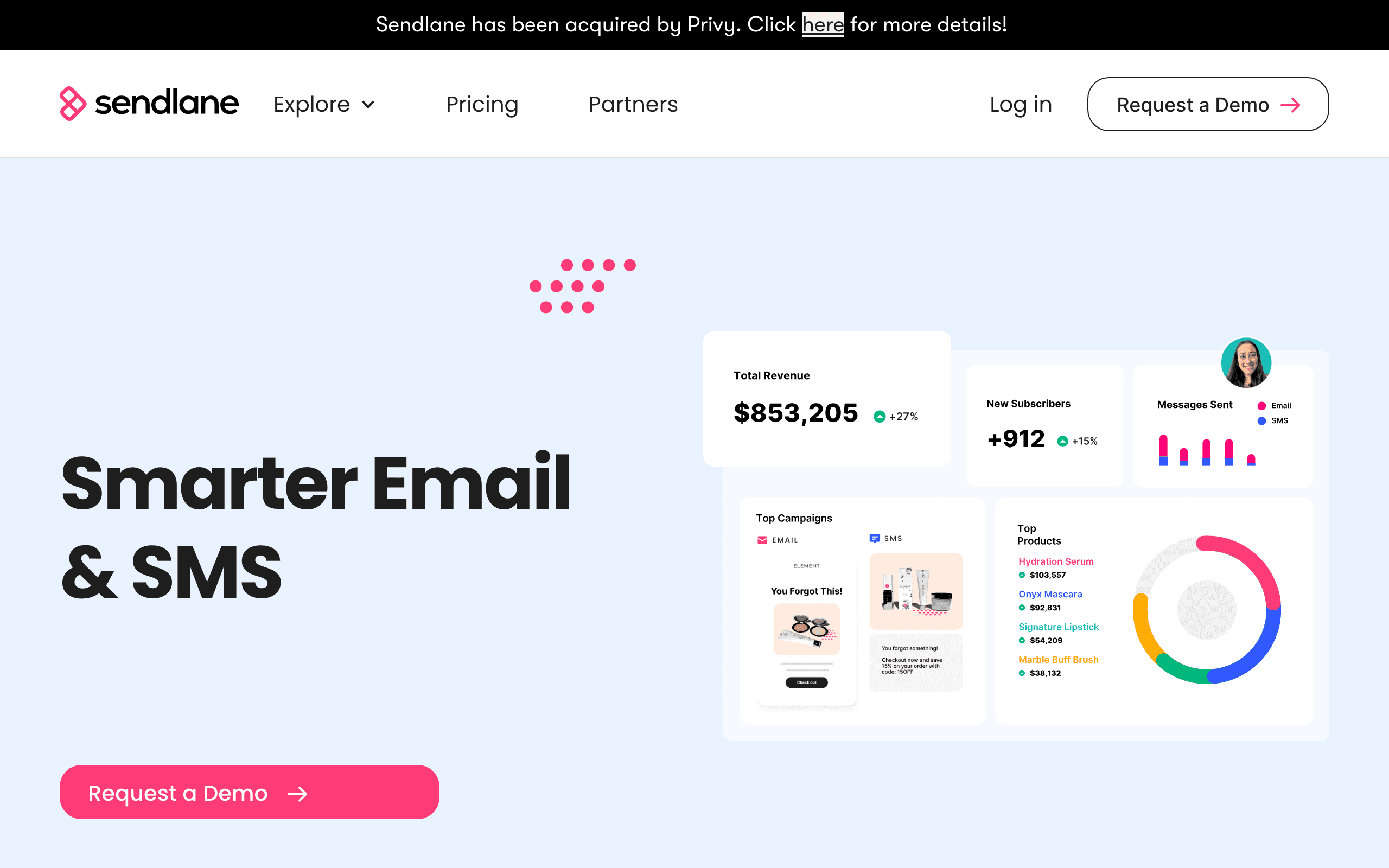
Sendlane and Shopify Email represent opposite ends of the e-commerce email spectrum. See our Sendlane comparison and Shopify Email comparison for individual breakdowns.
Shopify Email is the built-in, mostly free option that handles basic campaigns. Sendlane is the dedicated platform for stores that want advanced automation, SMS, and review collection. The question is whether your store has outgrown the free option.
Pricing Comparison
The cost difference is dramatic:
- Shopify Email: Free for 10,000 emails/month, then $1/1,000
- Sendlane: $100/month for 50,000 emails (unlimited contacts)
- Sequenzy: Free tier available, then $49/month for 60,000 emails
For a store sending 60,000 emails/month, Shopify Email costs about $40. Sendlane costs $100. Sequenzy costs $49. The question is what you get for the extra spend. See our pricing page.
When Shopify Email is Enough
Shopify Email works well for stores that:
- Send basic promotional campaigns and newsletters
- Only need simple abandoned cart reminders
- Have a small team without a dedicated email marketer
- Are still under 10,000 emails/month (free)
- Value simplicity over feature depth
The zero-setup experience is genuinely valuable. Everything lives inside your Shopify admin, product data flows into emails automatically, and you can send your first campaign in minutes.
When You Should Upgrade
Consider Sendlane (or alternatives) when:
- You want multi-step automation workflows based on customer behavior
- SMS marketing is part of your strategy
- You need built-in review collection
- Your segmentation needs go beyond basic Shopify segments
- You are doing enough revenue that email optimization has meaningful ROI
The key indicator is revenue. If your store does over $10,000/month, the revenue lift from sophisticated automation likely justifies a $100/month tool. Below that, the free option may be the smarter choice.
Why Sequenzy Is the Middle Ground
At $49/month, Sequenzy sits between Shopify Email and Sendlane:
- More automation power than Shopify Email with AI-generated sequences
- Shopify integration for customer sync and order events
- 70% cheaper than Sendlane
- Transactional email included (Sendlane does not support this)
For growing stores that need more than basic email but are not ready for $100/month, it is a good fit.
The Revenue Threshold for Upgrading
The decision to upgrade from free Shopify Email is fundamentally a revenue question. Email marketing platforms generate return on investment by driving more sales through targeted automation. The question is whether that incremental revenue exceeds the platform cost.
Industry data suggests that sophisticated email automation (behavioral triggers, multi-step sequences, advanced segmentation) can increase email-attributed revenue by 20-40% compared to basic campaigns. If your store currently generates $2,000/month from Shopify Email, upgrading to a platform like Sendlane might increase that to $2,400-$2,800/month. The $100/month cost is justified.
If Shopify Email generates $500/month in email revenue, a 40% increase brings you to $700/month. Spending $100/month on Sendlane leaves only a $100/month net gain. At that scale, Sequenzy at $49/month or Omnisend's free tier may be smarter stepping stones before committing to a premium platform.
What You Lose When You Leave Shopify Email
Switching from Shopify Email to an external platform involves trade-offs that are worth understanding upfront. The seamless Shopify admin integration disappears. You need to manage a separate dashboard, potentially deal with data sync issues, and train your team on new software.
Shopify Email's product data integration is instantaneous because it pulls directly from your catalog. External platforms sync this data through APIs, which may introduce delays. When you update a product price or image in Shopify, it updates immediately in Shopify Email but may take minutes to propagate to Sendlane.
These are minor inconveniences for most stores, but they are real. The benefit of upgrading -- advanced automation, SMS, reviews, behavioral tracking -- must outweigh the simplicity you give up. For many growing stores, the trade-off is clearly worthwhile. For very small stores, the complexity may not be.
Building an Email Strategy Before Upgrading
Before paying for a premium email platform, make sure you have maximized what Shopify Email can do. Many stores jump to expensive tools without first establishing email marketing basics. Set up a welcome email, configure the basic abandoned cart reminder, and start sending regular campaigns with Shopify Email.
Once you have baseline metrics -- open rates, click rates, revenue per email, list growth rate -- you can make an informed decision about upgrading. You will know exactly what Shopify Email generates and can project the ROI of more sophisticated automation.
Stores that skip this step often pay for features they do not use. A $100/month Sendlane subscription with basic campaigns set up is just an expensive version of free Shopify Email. The value comes from using the advanced features, which requires time and expertise to implement properly.
Use-case matchups
| Situation | Best first look | Why |
|---|---|---|
| Ecommerce brand wants email and SMS in one specialist platform | Sendlane | Sendlane is the baseline here for ecommerce teams that want campaigns, flows, segmentation, and SMS together. |
| New Shopify store needs simple built-in campaigns | Shopify Email | Shopify Email is the built-in baseline for teams that need simple campaigns before paying for a dedicated ecommerce platform. |
| SaaS or subscription team wants email without SMS complexity | Sequenzy | Sequenzy is stronger when Stripe events, transactional email, and lifecycle campaigns matter more than SMS. |
| Team is migrating from a store-first stack | Sendlane | Sendlane should be tested with real ecommerce events, revenue flows, SMS consent, and reporting needs. |
| Team is comparing against a narrower or broader specialist | Shopify Email | Shopify Email is the better first look when the main requirement is basic email directly inside Shopify. |
| Team wants one lower-cost email lifecycle workflow | Sequenzy | Sequenzy keeps the scope to marketing email, transactional email, and lifecycle events instead of ecommerce SMS. |
Pricing reality
The pricing signals on this page list Sendlane at $100/month, Shopify Email at $0/month, and Sequenzy at $49/month. Treat those as comparison anchors, not final procurement numbers.
Sendlane's real cost depends on contacts, email volume, SMS usage, plan limits, migration help, and any discounts. Shopify Email's real cost depends on whether the team uses the capabilities that make it different from Sendlane: basic email directly inside Shopify.
Review signals
For Sendlane, validate review themes around ecommerce automation, SMS, segmentation, support responsiveness, reporting, and total cost at your contact count. For Shopify Email, focus review research on whether teams praise the exact capability you are buying it for: basic email directly inside Shopify.
Best Fit by Store Maturity and Automation Depth
Best free email tool for new Shopify stores
Shopify Email is the better fit when a new store needs simple campaigns directly inside Shopify before proving email revenue. It is useful for basic newsletters, product announcements, and early list engagement without paying for advanced flows the team will not use.
Best ecommerce email and SMS platform for scaling retention
Sendlane is the better fit once email becomes a real revenue channel and the store needs segmentation, cart recovery, post-purchase flows, winbacks, SMS, and more detailed revenue attribution. Its value depends on actually using those advanced retention features.
Best lifecycle email platform beyond Shopify-only campaigns
Sequenzy fits teams that want email automation and transactional messages around customer events without ecommerce SMS. It is relevant when the store or subscription workflow needs more than Shopify Email but not a full store-first SMS platform.
Migration checklist
| Workstream | Moving toward Sendlane | Moving toward Shopify Email | Simplifying to Sequenzy |
|---|---|---|---|
| Contacts and consent | Import contacts, tags, custom fields, SMS consent, email consent, suppressions, and unsubscribes. | Map Shopify customer segments, templates, products, discounts, and consent status. | Import subscribers, tags, attributes, suppressions, and lifecycle events. |
| Ecommerce data | Sync products, orders, carts, browse events, coupons, and revenue attribution. | Confirm the ecommerce data model supports the flows you plan to keep. | Connect only the store, Stripe, and transactional events needed for email workflows. |
| Automations | Rebuild welcome, browse, cart, post-purchase, winback, replenishment, and SMS flows. | Rebuild the flows that match Shopify Email's strongest use case and retire weak duplicates. | Rebuild lifecycle and transactional email flows without SMS paths. |
| Templates and forms | Move email templates, signup forms, popups, coupons, and brand rules. | Move templates, forms, and brand assets that match the new platform's editor model. | Move email templates and lifecycle message content. |
| Reporting | Compare revenue attribution, SMS reporting, flow reporting, campaign exports, and cohort visibility. | Validate reporting for basic email directly inside Shopify before committing. | Validate campaign, automation, transactional, and subscription lifecycle reporting. |
Decision checklist
- Will SMS pay off, or add cost and consent work too early? Sendlane charges extra for SMS on top of its $100/month plan.
- Does Shopify Email's strength in basic email directly inside Shopify matter more than Sendlane's ecommerce email and SMS focus?
- Which setup needs less manual cleanup? Shopify Email reads your catalog directly, while Sendlane's sync can take minutes to update.
- Will Sendlane's $100/month hold once SMS and sends pass 50,000 emails? Sequenzy's $49 plan covers 60,000 emails, with SMS as a paid add-on.
- If lifecycle email is the main job, would Sequenzy's $49 plan with Shopify integration cover it without Sendlane's SMS layer?
- Shopify Email is cheap to start, but it may not cover advanced segmentation, SMS, or lifecycle automation.








