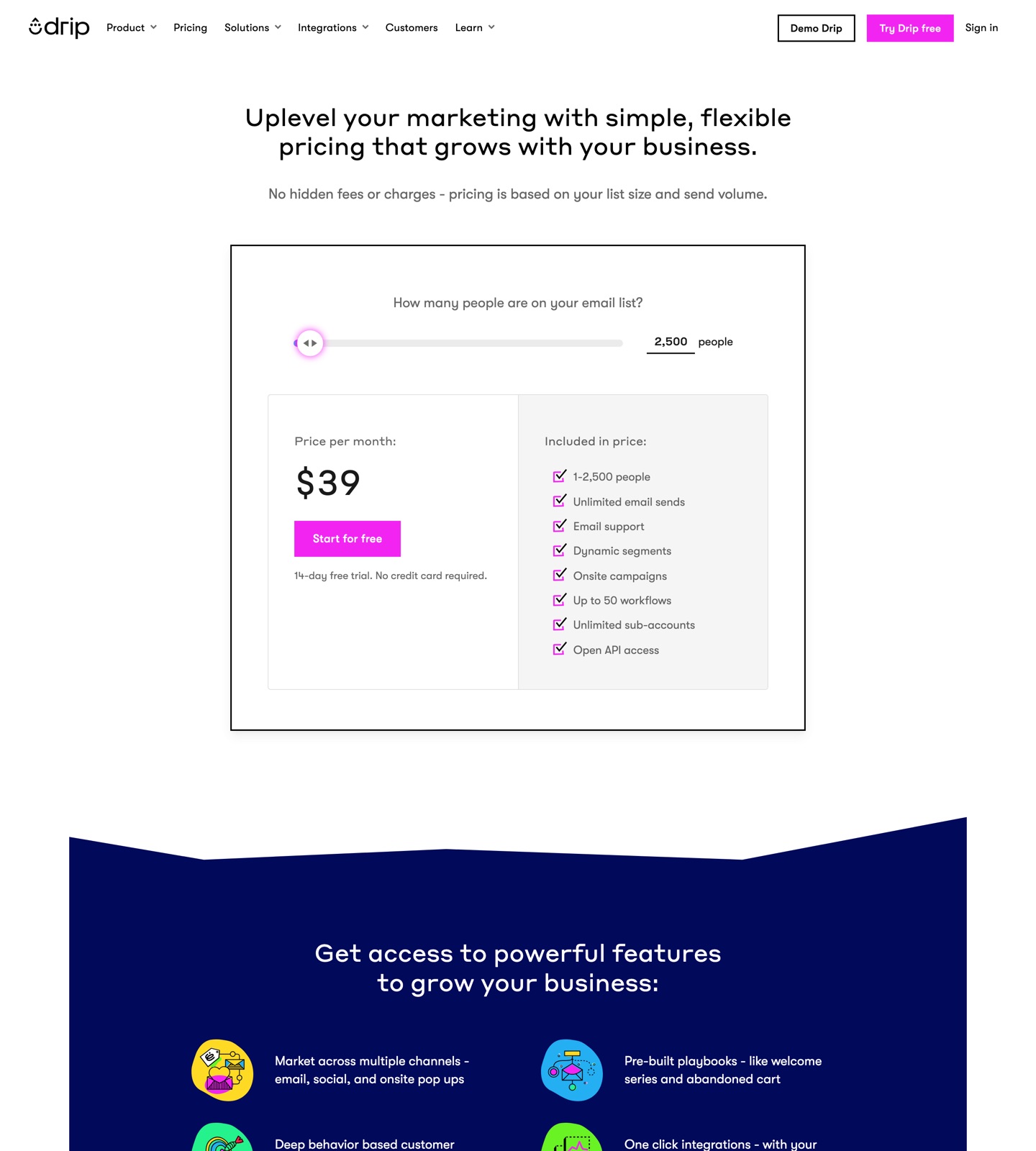
Drip's pricing page
Captured from drip.com. Pricing changes often, so confirm the current numbers on the live page.
Buying shortcut
Which Drip plan should you choose?
Start here
Drip
Ecommerce stores with customer behavior data. It is the first tier to check when you only need the core Drip workflow. Watch for: Single plan structure, not a multi-tier feature matrix
Public price
From $39/mo
Contact-based pricing - $39/mo for 2,500 contacts, $89/mo for 5,000 contacts, $154/mo for 10,000 contacts. All features included at every tier. 14-day free trial, no credit card required.
Main upgrade
Enterprise
Larger ecommerce brands with complex or high-volume needs. Inspect this tier when the lower tier starts blocking reporting, automation, collaboration, or support needs. Watch for: Not self-serve; requires sales process for exact pricing
Public price
Custom (contact sales)
Sales-led pricing for lists above 150,000 contacts. Requires a demo or sales discussion for exact pricing.
Cost scenarios
Pricing pages show the entry point. These scenarios show what the plan means in real buying situations.
Shopify brand with browsing and purchase data
Drip: Starts at $39/mo for 2,500 contacts and rises with list size ($154/mo at 10,000 contacts).. Sequenzy: Better if SaaS events matter more than ecommerce behavior.. Drip is built for ecommerce data, not general SaaS lifecycle.
SaaS startup with onboarding emails
Drip: Drip can send the emails, but the product is not SaaS-specific.. Sequenzy: Built for SaaS activation and retention flows.. Sequenzy is the cleaner fit unless ecommerce is central.
Growing ecommerce list
Drip: Monitor both contacts and sends.. Sequenzy: Compare only if you are shifting toward SaaS-style lifecycle email.. Drip is strong when revenue attribution is tied to store behavior.
What to watch for
Drip is ecommerce-first, which may be overkill for SaaS lifecycle email.
Cost scales as list size and send volume grow.
No permanent free plan for long-term low-volume use.
Drip pricing is ecommerce-oriented
Drip is easiest to understand as one ecommerce marketing platform rather than a broad stack of separate tiers. The cost scales with your list and sends, while the product value comes from behavior-based ecommerce journeys, segmentation, integrations, and revenue reporting.
If you are a SaaS team, ask whether those commerce features map to your product lifecycle. If not, you may pay for depth in the wrong domain.
Drip's price should be modeled around both list growth and send cadence. An ecommerce brand may justify the cost because every browse, cart, purchase, repeat-order, and winback flow can connect directly to revenue. A SaaS team usually has a different data model: trials, seats, workspaces, subscriptions, feature usage, invoices, and churn risk. Drip can be adapted, but the adaptation work is part of the real cost.
That is why the buyer category matters so much. If you run Shopify or ecommerce journeys, Drip belongs on the shortlist. If you run SaaS lifecycle campaigns, compare the Drip alternatives and the direct Drip comparison before paying for ecommerce-specific depth.
Drip vs Sequenzy
Drip is stronger for stores. Sequenzy is stronger for SaaS companies building onboarding, activation, feature education, churn prevention, and lifecycle emails.
Choose Drip when customer behavior is mostly store behavior and revenue attribution is tied to carts and orders. Choose Sequenzy when customer behavior is product behavior and the email program needs to follow activation, plan state, and retention signals.
Drip vs Sequenzy
How Drip compares with Sequenzy, which bills on emails sent rather than contact count.
How Sequenzy prices the same volume
Sequenzy price per 1k emails
$0.82 / 1k at $49/mo for 60k emails
Verdict
Drip is a strong ecommerce automation platform with pricing that scales by list and send volume. Sequenzy is better for SaaS lifecycle email, where product events, onboarding, activation, and retention are the main pricing and workflow questions.
FAQ
Sources checked · Jun 17, 2026