

Overview
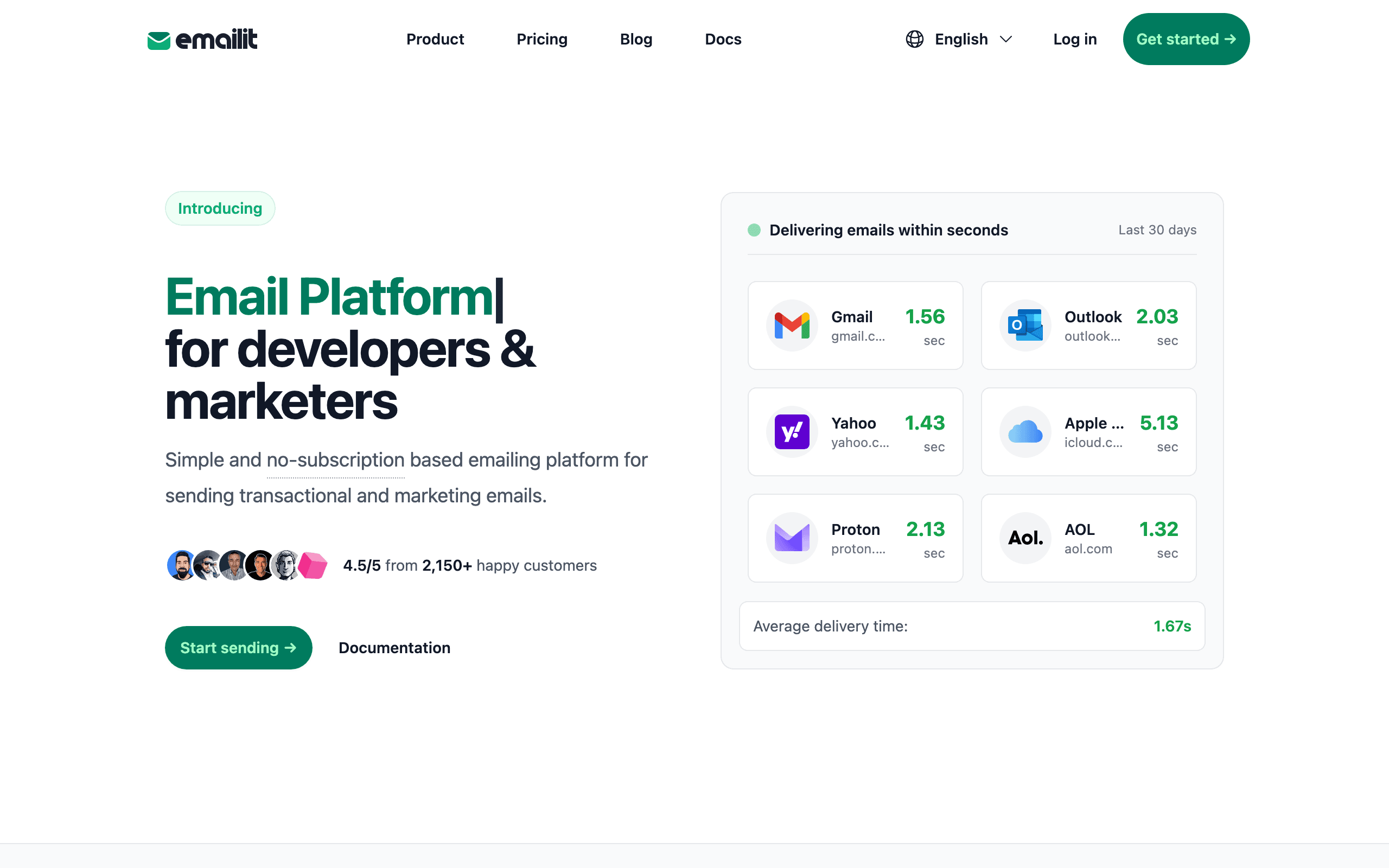
Maileroo and Emailit both handle email delivery but approach it differently. Maileroo is a email delivery service with SMTP relay, REST API, and free email verification. Emailit is a simple email sending API and SMTP relay.
Delivery Approach
Maileroo pairs SMTP relay and a REST API with something most competitors charge extra for: a free email verification service on every plan. At $8 a month with 5,000 free emails to start, it positions itself as an affordable alternative to bigger providers. EmailIt undercuts it slightly on price at $5 a month for 10,000 emails, but skips verification entirely and keeps its feature set to a simple API and SMTP relay for basic sending.
Emailit offers very affordable and simple setup, providing a smtp + api alternative in the email delivery space.
Pricing
Maileroo starts free (5,000 emails/mo) with paid plans from $8/month. Emailit $5/mo 10k. Simple API and SMTP. Affordable.. Maileroo's free email verification API is a genuine differentiator that can save you money on a separate verification service.
Making the Choice
Choose Maileroo for affordable delivery with free email verification. Choose Emailit for very affordable. For unified SaaS email, consider Sequenzy.
Email Verification Advantage
Free email verification is Maileroo's clearest edge over EmailIt, which has no equivalent feature. Checking addresses before you send reduces bounces, protects your sending reputation, and improves deliverability. For any product that collects email addresses from users directly, like signup forms, that built-in verification saves the cost of a separate service. EmailIt keeps things cheaper and simpler, but you would need to add verification elsewhere if bad addresses become a problem.
Emailit does not include free email verification. You would need a third-party service for list cleaning, adding both cost and integration complexity. Maileroo's bundled approach simplifies the email stack for teams that need verification alongside delivery.
Pricing and Value
On raw price, EmailIt is cheaper for pure volume at $5 a month for 10,000 emails versus Maileroo's $8 for a smaller free allotment of 5,000. Maileroo makes up ground once you scale past 250,000 emails a month, where it throws in dedicated IPs for free, something most providers, including EmailIt, charge extra for. For low-volume senders EmailIt wins on price alone; for growing senders who will eventually want a dedicated IP, Maileroo's structure pays off.
Emailit pricing reflects its positioning and feature set. The cost difference may or may not be justified depending on which specific capabilities your team requires. Calculate your monthly volume and feature needs to determine which offers better value. Check our pricing page for broader comparisons.
Infrastructure and Reliability
Emailit has an established infrastructure track record. For production workloads where email delivery reliability is critical, proven infrastructure provides confidence that newer platforms may need time to build.
Both Maileroo and EmailIt are newer providers still building their track record, so neither carries the history of more established transactional services. Maileroo's case rests on included verification and dedicated IPs at scale, while EmailIt's case is simply being cheap and easy to integrate. Whichever you pick, plan your sending domain's reputation carefully; the email warmup calculator can help you pace volume up before relying on either service for production traffic.
Use-case matchups
| Situation | Better fit | Why |
|---|---|---|
| You want the lowest listed monthly price for basic sending | Emailit | Emailit is listed at $5/month for 10k in the page data. |
| You need bundled email verification | Maileroo | Maileroo includes free email verification API, while Emailit does not. |
| You want a simple SMTP/API relay with minimal complexity | Emailit | Emailit is positioned around simple setup and basic sending. |
| You expect to need templates, forms, or broader delivery features | Maileroo | Maileroo has more surrounding delivery features than Emailit in this comparison. |
| You need SaaS campaigns and transactional email tied to Stripe | Sequenzy | Sequenzy adds the marketing and billing lifecycle layer neither low-cost API provides. |
Best Fit by Low-Cost Relay and Verification Needs
Best ultra-low-cost SMTP/API service
Choose Emailit when the main requirement is basic transactional sending at the lowest listed monthly price. It is the better fit for small apps that need password resets, signup confirmations, alerts, and receipts without paying for a broader delivery feature set or built-in validation workflow.
Best transactional email service with free verification
Choose Maileroo when user-entered addresses create bounce risk and email verification would otherwise become a separate line item. Maileroo is stronger when the sending workflow includes signup checks, invite validation, contact hygiene, and a broader dashboard than a bare relay provides.
Best SaaS email platform beyond delivery APIs
Choose Sequenzy when the buyer is not just choosing an SMTP pipe. SaaS teams that need transactional email, lifecycle campaigns, newsletters, and Stripe-triggered automation will usually outgrow a low-cost delivery API unless they add a separate marketing layer.
Pricing reality
Emailit is cheaper on the listed entry comparison: $5/month for 10k versus Maileroo paid plans from $8/month. That gap is small enough that bundled verification, support, analytics, dedicated IP needs, and future scale matter more than the $3 difference.
If email verification would otherwise require a separate service, Maileroo can be the cheaper effective stack. If you only need a simple SMTP/API pipe, Emailit's lower price may be enough.
Review signals
Maileroo reviews emphasize free verification, competitive pricing, and reliability for transactional email. The caution is that it is newer and less ecosystem-rich than established providers.
Emailit reviews emphasize simple delivery API and production confidence, while the page's cons call out limited analytics, documentation, verification, and integrations.
Migration checklist
- Inventory SMTP credentials, API calls, templates, bounce handling, webhook events, suppressions, and verification workflows.
- Decide whether email verification is part of the core workflow or a separate optional process.
- Recreate SPF, DKIM, DMARC, return-path, tracking domains, and webhook endpoints.
- Test password resets, signup verification, receipts, invites, alerts, and bounce/complaint handling.
- If moving away from Maileroo, replace verification workflows before accepting user-entered addresses.
- Shift traffic gradually and monitor delivery latency, errors, bounces, complaints, and inbox placement.
Decision checklist
- Choose Emailit if the job is very low-cost basic SMTP/API sending.
- Choose Maileroo if bundled verification and a broader delivery feature set matter.
- Choose Sequenzy if the real need includes SaaS lifecycle campaigns, transactional email, and Stripe events.









