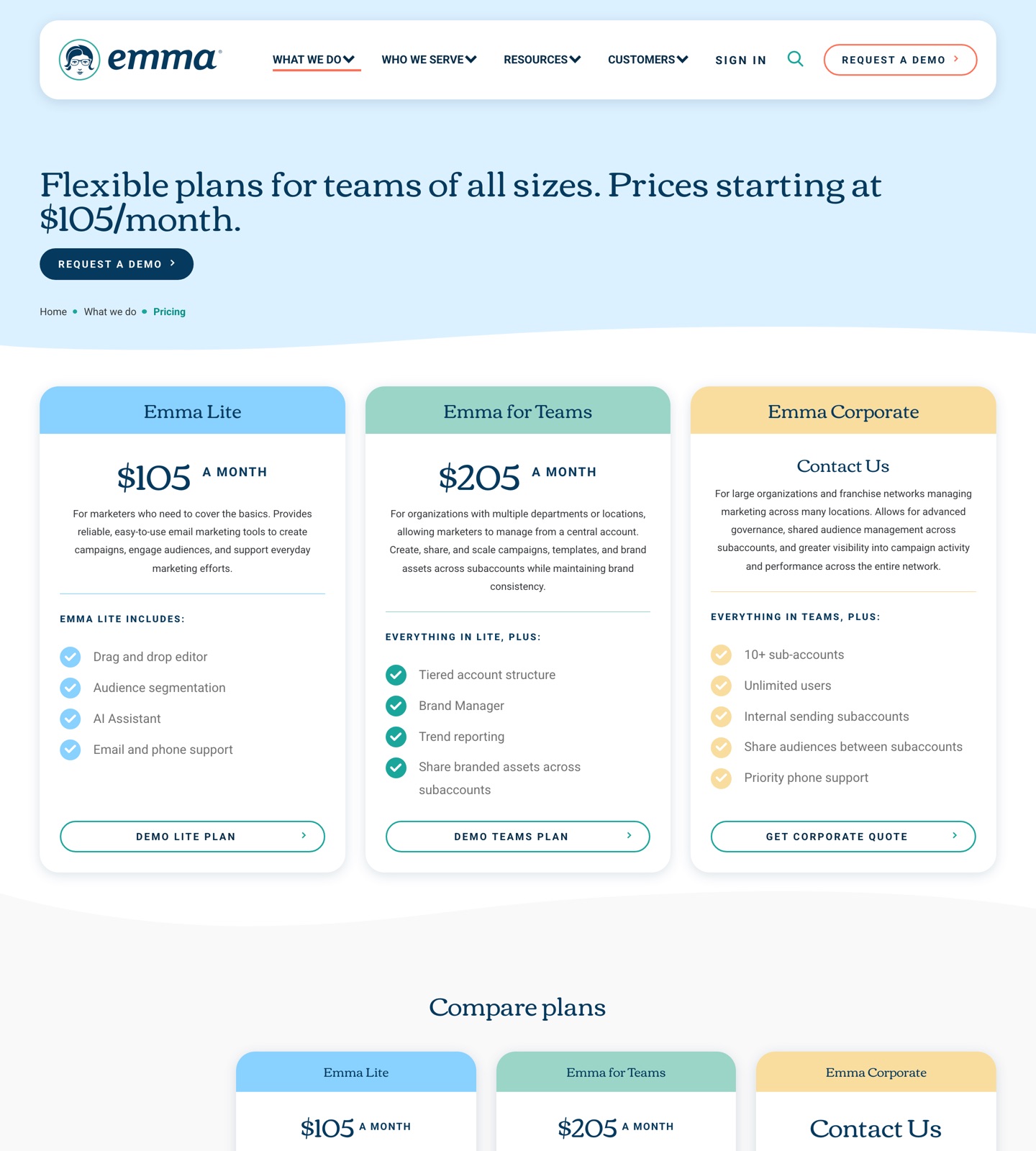
Emma's pricing page
Captured from myemma.com. Pricing changes often, so confirm the current numbers on the live page.
Buying shortcut
Which Emma plan should you choose?
Start here
Emma Lite
Marketers who need core email basics. It is the first tier to check when you only need the core Emma workflow. Watch for: 1 automation journey
Public price
$105/mo
10,000 contacts with annual contract in the public example.
Main upgrade
Emma Essentials
Growing brands that need customization and automation. Inspect this tier when the lower tier starts blocking reporting, automation, collaboration, or support needs. Watch for: Less governance than Teams
Public price
$165/mo
10,000 contacts with annual contract in the public example.
High-volume or advanced
Emma Corporate
Enterprises that need scale and control. Treat this as the serious-operations tier, especially if the first two plans leave key limits or add-ons unresolved. Watch for: Sales-led pricing
Public price
Custom
Custom plan for larger organizations.
Cost scenarios
Pricing pages show the entry point. These scenarios show what the plan means in real buying situations.
Departmental marketing team
Emma: Lite or Essentials depending on automation needs.. Sequenzy: Better if the team is a SaaS product team.. Emma is built for organizational email operations, not just sending.
Multi-location organization
Emma: Teams or Corporate is the realistic comparison.. Sequenzy: Not a subaccount governance product.. Emma wins when approvals, subaccounts, and brand control are the central need.
SaaS startup
Emma: Emma is likely expensive and organization-heavy.. Sequenzy: Focused on SaaS lifecycle email.. Sequenzy is a cleaner fit for product-led email.
What to watch for
Public examples are based on 10,000 contacts and annual contracts.
Private branding can carry additional charges.
Emma is heavier than most self-serve newsletter tools.
Emma pricing is organization-oriented
Emma’s pricing makes more sense when you view it as a team and governance platform. The plan ladder adds subaccounts, users, permissions, brand management, reporting, and priority support.
If all you need is SaaS lifecycle email, that structure may be more than you want to buy.
The platform makes sense when multiple teams, locations, or brands need guardrails and shared reporting. In that case, users, subaccounts, permissions, approvals, and brand controls are part of the value. For a focused SaaS team, those governance features can become extra cost and process around what should be a faster lifecycle workflow.
Use Emma alternatives to compare organization-oriented email platforms. Use Sequenzy vs Emma when the decision is governed multi-team email versus SaaS lifecycle execution.
Emma vs Sequenzy
Emma is best for organizations managing email across departments or locations. Sequenzy is better for SaaS teams building product-led lifecycle messaging.
Emma vs Sequenzy
How Emma compares with Sequenzy, which bills on emails sent rather than contact count.
How Sequenzy prices the same volume
Sequenzy price per 1k emails
$0.82 / 1k at $49/mo for 60k emails
Verdict
Emma is a strong organizational email platform for teams that need structure, support, and governance. Sequenzy is better for SaaS companies that need lifecycle content and automation without enterprise-style account management.
FAQ
Sources checked · Jun 16, 2026