
Overview
Emma and MailerLite serve different email marketing needs. MailerLite is beautifully simple and affordable. Emma is brand governance for distributed teams. For our take on each, see our Emma comparison and MailerLite comparison.
MailerLite's Modern Appeal
MailerLite is what modern email marketing should look like. Clean design, intuitive interface, generous free tier, and solid automation. It's a pleasure to use. Emma's interface feels dated by comparison, offering less for more.
Emma's Governance Advantage
Emma's only real advantage: centralized brand control for multi-location teams. Locked templates, approval workflows, sub-accounts. If you're a franchise with 20+ locations, this matters. For everyone else, MailerLite is the better choice.
The Value Gap
MailerLite offers 1,000 subscribers free. At 10k subscribers, it's $73/month with unlimited emails and automation. Emma starts at $99/month with no free tier. Unless brand governance is critical, the value comparison strongly favors MailerLite.
Review signals
The Emma reviews here support the governance use case, especially for a university with multiple departments, but they also flag dated editing UX as a real drawback. That means Emma is stronger as a control system than as a modern creator-friendly email tool.
The MailerLite reviews emphasize design quality, ease of use, the free-to-paid path, and value at 10,000 subscribers. The cautions are account approval delays and limited ecommerce depth, so MailerLite is strongest for newsletters, creators, and simple marketing rather than deep store automation.
Design Quality and User Experience
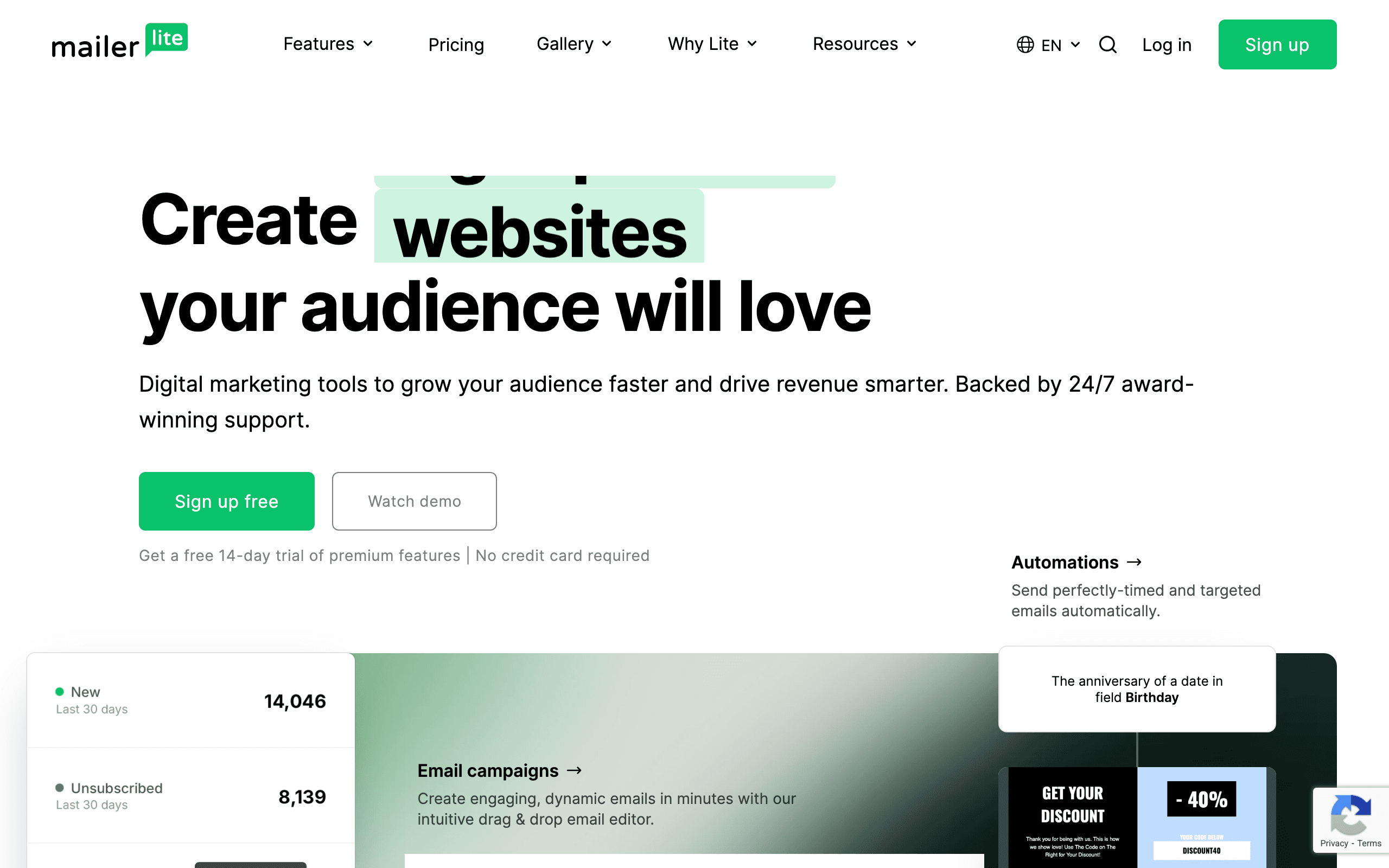
MailerLite has earned a reputation for clean, modern design that makes email marketing feel approachable. The interface is intuitive, the templates are visually appealing, and the overall experience is polished. Emma's interface feels functional but dated in comparison, reflecting its focus on governance features rather than design innovation.
For marketing teams that spend significant time in their email platform, the quality of the user experience matters. A pleasant, efficient interface improves productivity and reduces frustration. MailerLite excels here, while Emma prioritizes functionality over aesthetics.
The Free Tier Advantage
MailerLite's free plan with 1,000 subscribers and 12,000 emails per month lets businesses test the platform thoroughly before committing. Emma requires contacting sales with no self-serve trial option. This accessibility difference reflects their target markets - MailerLite welcomes individual users and small businesses, while Emma targets organizational buyers with larger budgets.
For small organizations exploring email marketing, MailerLite's free tier provides enough capacity to run a real evaluation. You can import contacts, build campaigns, test automation, and assess results before spending anything.
Paid Newsletter Monetization
MailerLite supports paid newsletters through Stripe integration, allowing publishers to charge subscribers for premium content. Emma does not offer any monetization features. For content creators and publishers looking to generate revenue from their email audience, MailerLite provides the necessary infrastructure.
This capability further widens the gap between these platforms for most use cases. Unless brand governance is your primary need, MailerLite offers more features, a better experience, and monetization capabilities that Emma simply does not have.
Use-case matchups
| Situation | Best first look | Why |
|---|---|---|
| Franchise, university, or multi-department team | Emma | Emma is built for brand controls, approvals, and distributed senders. |
| Small business or creator starting email marketing | MailerLite | MailerLite has the easier entry point, free tier, cleaner editor, and broader self-serve feature set. |
| Publisher selling paid newsletter content | MailerLite | MailerLite's Stripe-supported paid newsletter workflow is useful for creators. |
| Organization where off-brand emails create real risk | Emma | Locked templates and approval workflows solve a problem MailerLite does not address. |
| SaaS team needing transactional plus lifecycle email | Sequenzy | Sequenzy is better aligned for Stripe-triggered automation and product lifecycle messages. |
Pricing reality
MailerLite is cheaper and more accessible for most teams. Its free tier also lowers evaluation risk because a team can test campaigns, automations, and landing pages before paying.
Emma's higher price is only rational when governance is central to the workflow. If approvals, locked templates, and sub-accounts are not required, the extra cost buys little for a single marketing team.
Sequenzy's price should be evaluated only if SaaS lifecycle and transactional email are part of the requirement. It is not trying to replace MailerLite's creator monetization or Emma's distributed brand governance.
Best Fit by Governance and Simplicity
Best email platform for brand-controlled organizations
Emma fits universities, franchises, associations, and multi-location teams that need template governance, brand consistency, and coordinated campaign creation. It is strongest when many people send email under one shared brand system.
Best simple email platform for creators and small teams
MailerLite is the better fit when a creator or small business needs polished newsletters, landing pages, website building, digital products, and approachable automations. It works best when ease of execution matters more than governance workflows.
Best lifecycle email platform for product-led teams
Sequenzy fits teams whose customer emails should respond to product activity, subscriptions, invoices, and retention signals. It is more relevant when customer lifecycle state matters more than brand governance or creator tooling.
Migration checklist
| Workstream | Moving toward Emma | Moving toward MailerLite | Simplifying to Sequenzy |
|---|---|---|---|
| Contacts | Export subscribers, consent, suppressions, location ownership, and team permissions. | Export subscribers, groups, segments, forms, automations, and unsubscribes. | Export subscribers, attributes, tags, suppressions, and billing/product IDs. |
| Templates | Rebuild templates with locked brand areas and approval paths. | Rebuild newsletters, forms, landing pages, websites, and paid newsletter templates. | Rebuild campaign, lifecycle, and transactional templates. |
| Team process | Define sender roles, approvers, location access, and governance rules. | Define who owns campaigns, automations, forms, and content publishing. | Define lifecycle, product, billing, and transactional email ownership. |
| Automations | Recreate simple journeys and review-dependent campaigns. | Recreate welcome, newsletter, creator, and nurture automations. | Recreate onboarding, billing, trial, retention, and transactional flows. |
| Reporting | Track brand compliance, local sending, approvals, and campaign results. | Track campaign engagement, list growth, landing pages, and paid newsletter performance. | Track campaign, transactional, and lifecycle reporting together. |
Decision checklist
- Is brand governance required by policy, franchise rules, or compliance?
- Would MailerLite's free tier and editor speed up evaluation?
- Is paid newsletter monetization part of the business model?
- Does the team need transactional email in the same platform?
- Which workflow matters more: approvals, creator publishing, or SaaS lifecycle events?









