
Overview
Emma and Flodesk serve different users. Flodesk is beautiful email for creators at flat pricing. Emma is brand governance for organizations. For our take on Emma, see our Emma comparison.
Flodesk's Design-First Approach
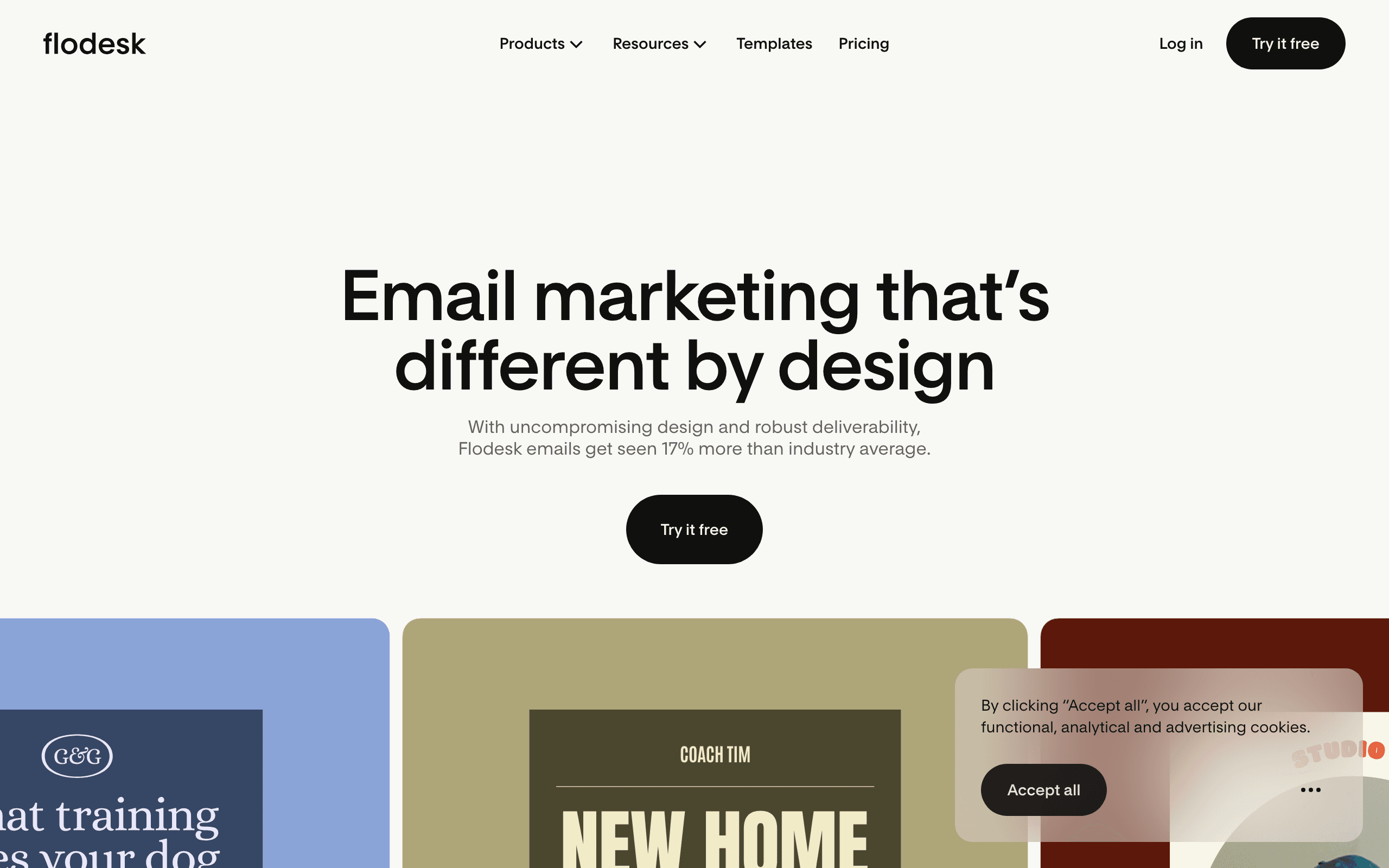
Flodesk is known for stunning email designs. Every template looks professional and modern. The editor is intuitive and focused on beauty. For creators and brands that care about visual quality, Flodesk sets the standard.
Flodesk's Flat Pricing Advantage
$38/month, unlimited subscribers. Whether you have 1,000 or 100,000 subscribers, the price stays the same. Emma's contact-based pricing scales up significantly. For growing lists, Flodesk's economics are unbeatable.
Review signals
Emma's reviews on this page support brand governance for hotel properties, while also saying the design layer feels dated compared with modern design-first platforms.
Flodesk's reviews support the visual-design and flat-pricing value proposition. Reviewers praise gorgeous templates and $38/month pricing at larger list sizes, while the main caution is limited automation and segmentation for complex sequences.
Emma's Governance Niche
For franchises and organizations with distributed teams, Emma's locked templates and approval workflows maintain brand consistency. Flodesk is designed for individual creators, not organizational governance.
The Economics of Flat vs Contact-Based Pricing
Flodesk's flat pricing model becomes increasingly attractive as your list grows. At 1,000 subscribers, both platforms cost similarly when you account for Emma's base price. At 50,000 subscribers, Flodesk is still $38/month while Emma would charge significantly more. This creates a fundamentally different growth dynamic - Flodesk users never hesitate to grow their list because there is no cost penalty.
For creators and businesses in growth mode, this pricing certainty is liberating. With Emma's contact-based model, every new subscriber represents additional cost, which can create reluctance to pursue aggressive list-building strategies.
Visual Design as a Brand Statement
Flodesk approaches email design as an art form. Every template, form, and landing page is designed to be visually stunning and worthy of social sharing. This design-first philosophy attracts creators and brands that view their emails as an extension of their visual identity. Emma's templates are designed for consistency and governance rather than visual impact.
For lifestyle brands, photographers, designers, and creative professionals, Flodesk's aesthetic quality communicates something about the brand itself. The emails look like they were crafted by a professional designer, which elevates the perceived quality of whatever you are promoting.
Automation Limitations to Consider
While Flodesk has added visual automation workflows, they remain simpler than what more sophisticated platforms offer. You can build welcome sequences and basic conditional flows, but complex multi-branch automations with detailed behavioral triggers are beyond Flodesk's current capabilities. Emma's automation is similarly basic.
If your email strategy relies heavily on sophisticated automation - for example, scoring leads, branching based on multiple criteria, or triggering sequences from external events - neither Flodesk nor Emma is the right choice. Both platforms prioritize their core strengths (design and governance, respectively) over automation depth.
Use-case matchups
| Use case | Better fit | Why |
|---|---|---|
| Multi-location brand governance | Emma | Emma is the better fit when locked templates, sub-accounts, approval workflows, and consistent brand control matter. |
| Beautiful creator newsletters | Flodesk | Flodesk is stronger when visual polish, simple editing, forms, and flat pricing matter more than governance. |
| Fast list growth without subscriber cost anxiety | Flodesk | Flodesk's flat pricing is appealing when a growing list would become expensive on contact-based tools. |
| Franchise or distributed team email | Emma | Emma is built for organizations that need local teams to customize content inside brand-safe limits. |
| SaaS lifecycle automation | Sequenzy | Sequenzy is better when Stripe events, transactional email, and lifecycle campaigns need one SaaS-focused workspace. |
| Design-led digital product sales | Flodesk | Flodesk's checkout pages and design-forward forms make more sense for creators selling simple digital products. |
Best Fit by Brand Governance and Design-Led Campaigns
Best email platform for multi-location brand governance
Choose Emma when consistency is the real business problem. Locked templates, sub-accounts, approvals, and distributed-team permissions are valuable for franchises, universities, agencies, and local teams that need room to customize without breaking the brand.
Best visual email platform for creator-style campaigns
Choose Flodesk when design quality, simple forms, landing pages, flat pricing, and easy creative workflows matter more than governance. It is the better fit for lifestyle brands, photographers, designers, and solo creators who want emails to feel like part of the brand experience.
Best SaaS email platform for lifecycle and transactional workflows
Choose Sequenzy when neither design polish nor multi-location governance is the primary requirement. Stripe-triggered lifecycle campaigns, transactional email, product onboarding, and customer automation are closer to Sequenzy's job than creator checkout pages or approval workflows.
Migration checklist
- Decide whether the destination should protect brand governance, maximize design quality, or support SaaS lifecycle automation.
- Export subscribers, custom fields, segments, templates, brand assets, forms, landing pages, automations, suppression data, checkout pages, and campaign reports.
- If moving to Emma, rebuild locked templates, approval workflows, sub-accounts, brand permissions, and location/team access before importing all users.
- If moving to Flodesk, redesign core templates and forms around Flodesk's visual system and replace Emma-specific governance workflows elsewhere.
- Rebuild priority flows first: welcome, newsletter, lead magnet delivery, product purchase follow-up, re-engagement, and win-back.
- Reconnect forms, landing pages, ecommerce or checkout links, analytics, unsubscribe handling, team permissions, and suppression syncing.
- Authenticate SPF, DKIM, and DMARC, then test one campaign, one form, one automation, and one team approval or design workflow before full migration.
- Preserve historical campaign, template, approval, design, list-growth, and cost reports so the team can compare governance value against flat-price design speed.
Pricing reality
Flodesk's flat $38/month price is materially different from Emma's contact-based governance pricing. It is strongest when the list is growing and the team values design more than compliance controls.
Emma's higher cost only makes sense when locked templates, approvals, and distributed-team permissions prevent real brand risk.
Decision checklist
- Is visual design and flat pricing more important than brand governance?
- Will list growth make contact-based pricing painful?
- Does the team need locked templates, approvals, or sub-accounts?
- Are Flodesk's simpler automation and segmentation enough?
- Would SaaS lifecycle and transactional email make Sequenzy a better fit?








