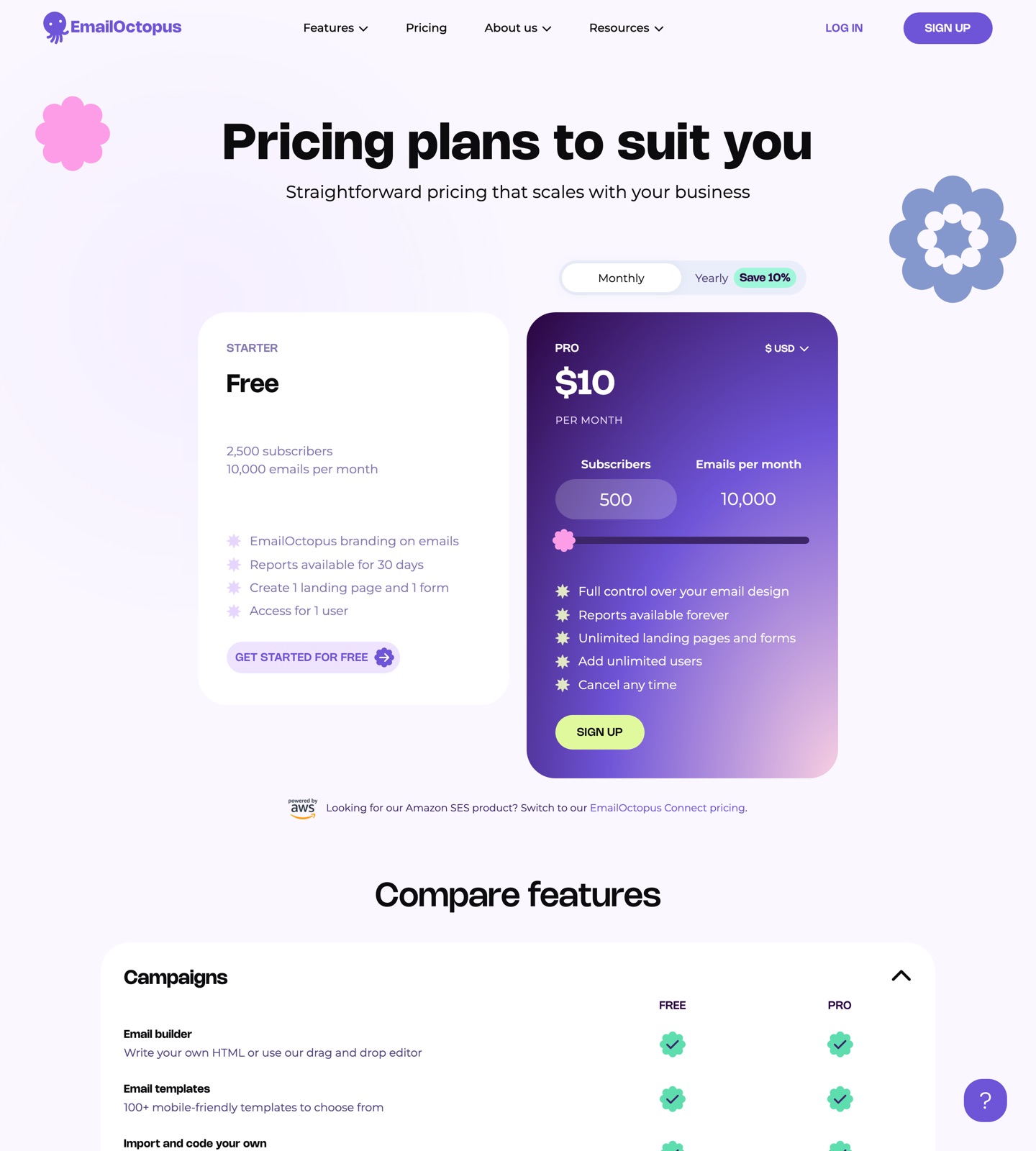
EmailOctopus's pricing page
Captured from emailoctopus.com. Pricing changes often, so confirm the current numbers on the live page.
Buying shortcut
Which EmailOctopus plan should you choose?
Start here
Free
Small lists and early newsletters. It is the first tier to check when you only need the core EmailOctopus workflow. Watch for: EmailOctopus branding
Public price
$0
2,500 subscribers and 10,000 emails per month.
Main upgrade
Pro
Budget-conscious teams that need unbranded emails. Inspect this tier when the lower tier starts blocking reporting, automation, collaboration, or support needs. Watch for: More advanced lifecycle automation is not the core positioning
Public price
From ~$18/mo
Scales with subscriber count - approximately $18/mo for 2,500 subscribers and around $24/mo for 10,000 subscribers (monthly billing). Annual billing gives a 10% discount. Unlimited email sends included at all Pro tiers.
High-volume or advanced
Custom
Very large lists. Treat this as the serious-operations tier, especially if the first two plans leave key limits or add-ons unresolved. Watch for: Not self-serve public pricing
Public price
Custom
Contact sales above 500,000 subscribers.
Cost scenarios
Pricing pages show the entry point. These scenarios show what the plan means in real buying situations.
Newsletter with fewer than 2,500 subscribers
EmailOctopus: Free if branding and reporting limits are acceptable.. Sequenzy: More appropriate once SaaS lifecycle workflows matter.. EmailOctopus is hard to beat for low-cost newsletter sending.
Small brand needing unbranded campaigns
EmailOctopus: Pro starts at approximately $18/month for 2,500 subscribers.. Sequenzy: Better for SaaS onboarding and retention automation.. Choose EmailOctopus for simple campaigns; Sequenzy for lifecycle strategy.
Nonprofit list
EmailOctopus: EmailOctopus lists a 20% lifetime nonprofit discount.. Sequenzy: Compare only if SaaS-style automation is required.. EmailOctopus is very attractive for nonprofits and simple newsletters.
What to watch for
Free emails include EmailOctopus branding.
Free reports are available for only 30 days.
Larger lists above 500,000 subscribers require a custom plan.
EmailOctopus pricing is built for simplicity
EmailOctopus stands out because the pricing page does not require a long feature matrix to understand the basics. Free is generous for small lists, while Pro removes the restrictions that matter most for serious publishing: branding, report retention, landing pages, forms, and users.
The tradeoff is depth. If you want advanced SaaS lifecycle logic, EmailOctopus is not the most purpose-built platform.
The buying decision is usually about how simple the program really is. EmailOctopus is very strong for newsletters, announcements, nonprofit lists, and budget-sensitive campaign sending. Pro is easy to justify when branding, report history, more forms, more landing pages, and multiple users matter. But if the team needs event-triggered onboarding, customer-stage targeting, upgrade nudges, failed-payment messages, and product behavior logic, the low subscription price will not include that strategy.
Use the EmailOctopus alternatives page and the EmailOctopus comparison when the choice is not just budget. A cheap campaign tool can be exactly right for a newsletter and still be the wrong tool for a SaaS lifecycle program.
EmailOctopus vs Sequenzy
EmailOctopus is best for affordable newsletters. Sequenzy is best for SaaS teams that need lifecycle emails tied to product onboarding, activation, feature discovery, and retention.
Choose EmailOctopus when you want uncomplicated email marketing at a low price. Choose Sequenzy when the email program has to react to product and billing signals rather than simply send to a list.
EmailOctopus vs Sequenzy
How EmailOctopus compares with Sequenzy, which bills on emails sent rather than contact count.
How Sequenzy prices the same volume
Sequenzy price per 1k emails
$0.82 / 1k at $49/mo for 60k emails
Verdict
EmailOctopus is one of the clearest low-cost newsletter tools. Sequenzy is not trying to win the same use case: it is a better fit when a SaaS company needs lifecycle email strategy, generated sequences, and product-aware automation.
FAQ
Sources checked · Jun 17, 2026