Moosend's pricing page
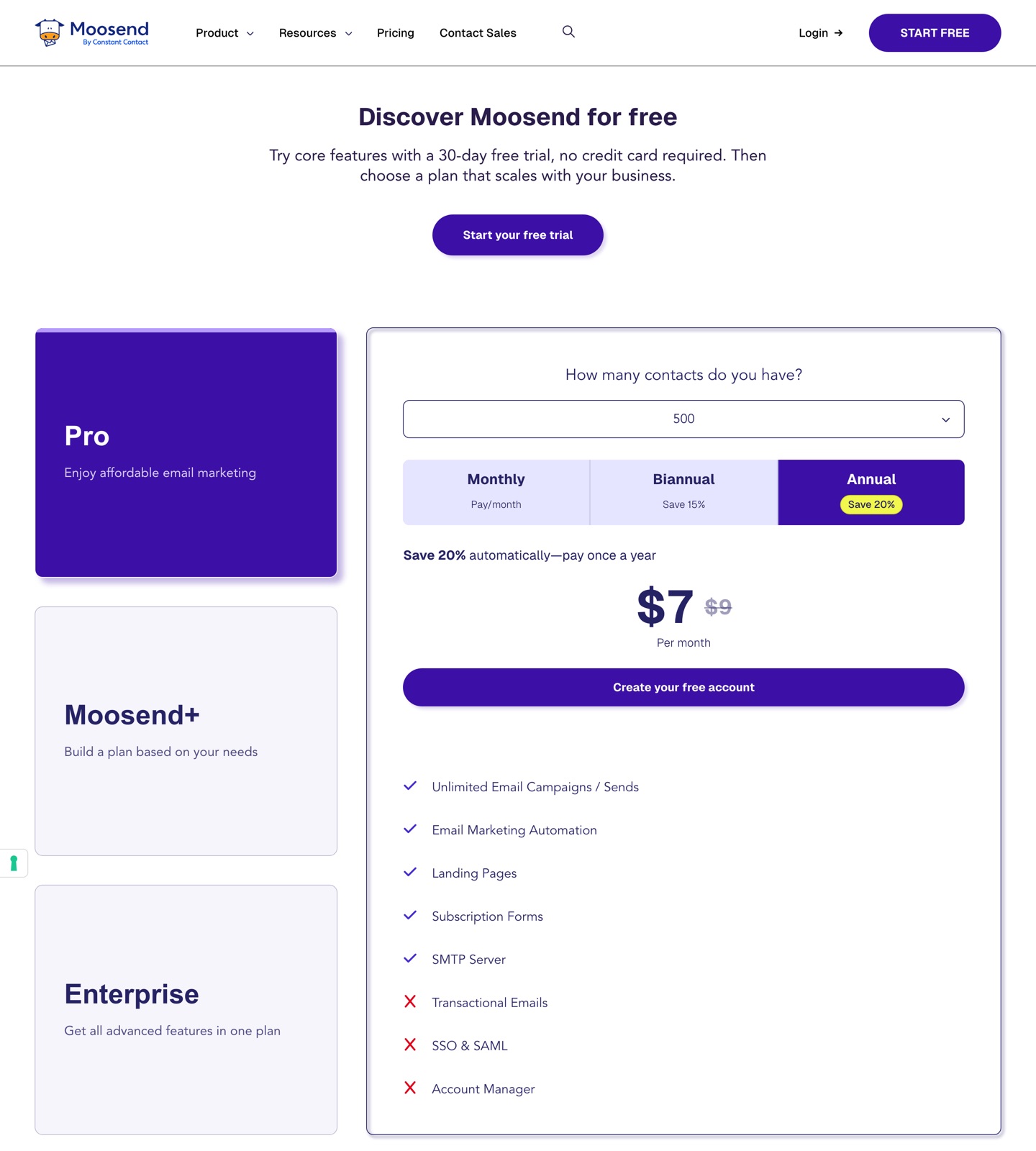
Captured from moosend.com. Pricing changes often, so confirm the current numbers on the live page.
Buying shortcut
Which Moosend plan should you choose?
Start here
Free Trial
Teams testing Moosend before choosing a plan. It is the first tier to check when you only need the core Moosend workflow. Watch for: Trial period only
Public price
$0
30 days, no credit card required.
Main upgrade
Pro
Most email marketing teams. Inspect this tier when the lower tier starts blocking reporting, automation, collaboration, or support needs. Watch for: Some advanced features are add-ons
Public price
From $9/mo
Scales by contacts - $9/mo for 500 contacts, ~$32/mo for 10,000 contacts (annual); biannual saves 15%, annual saves 20%.
High-volume or advanced
Credits
Seasonal or occasional senders. Treat this as the serious-operations tier, especially if the first two plans leave key limits or add-ons unresolved. Watch for: Credit model is less ideal for steady lifecycle programs
Public price
$350+
Pay-as-you-go credits; 350,000 credits listed at $350.
Cost scenarios
Pricing pages show the entry point. These scenarios show what the plan means in real buying situations.
Budget-conscious email marketer
Moosend: Pro may be strong value depending on contact tier.. Sequenzy: Better if SaaS lifecycle sequence content is the main need.. Moosend is broad and affordable; Sequenzy is more SaaS-specific.
Seasonal sender
Moosend: Credits can avoid monthly subscription waste.. Sequenzy: Built for recurring product lifecycle programs.. Moosend credits are useful for campaign bursts.
Team needing SSO or dedicated IPs
Moosend: Moosend+ or Enterprise.. Sequenzy: Compare based on workflow scope and email volume.. Advanced requirements move Moosend into quote/add-on territory.
What to watch for
Exact Pro price depends on contact count and billing period.
Several advanced capabilities are Moosend+ or Enterprise add-ons.
Transactional email is not simply included everywhere.
Moosend pricing has several paths
Moosend is not just one subscription ladder. It has a trial, Pro subscriptions, custom Moosend+ add-ons, Enterprise, and credit packs for seasonal sending. That flexibility is useful, but it means you should decide which buying mode matches your usage before comparing headline prices.
The best fit is a team that wants conventional email marketing capabilities with room to add more advanced features later.
The credit option is an important differentiator. Seasonal senders, events, and occasional campaign programs may prefer credits because they avoid paying every month. A steady lifecycle program usually behaves differently: messages run continuously, audiences update constantly, and automation quality matters more than burst capacity. In that case, Pro or Moosend+ is the more relevant comparison.
Moosend+ also changes the budget conversation. Transactional email, dedicated IPs, custom reports, SSO, hosted files, and extra team needs can move the account away from simple Pro pricing. If you are comparing Moosend with SaaS-focused tools, review the Moosend alternatives and the Moosend comparison so add-ons and lifecycle fit are both visible.
Moosend vs Sequenzy
Moosend is a full email marketing suite. Sequenzy is more focused on SaaS lifecycle flows and content generation, which can be more useful when the email program is tied to product adoption instead of campaigns alone.
Choose Moosend for affordable general email marketing, landing pages, forms, and flexible buying paths. Choose Sequenzy when SaaS lifecycle strategy and product-event messaging are the center of the email program.
Moosend vs Sequenzy
How Moosend compares with Sequenzy, which bills on emails sent rather than contact count.
How Sequenzy prices the same volume
Sequenzy price per 1k emails
$0.82 / 1k at $49/mo for 60k emails
Verdict
Moosend is attractive for marketers who want a full email suite with a trial, contact-based Pro plan, optional add-ons, and credits. Sequenzy is better when the core job is SaaS lifecycle sequence strategy rather than generic email marketing.
FAQ
Sources checked · Jun 17, 2026