
Overview
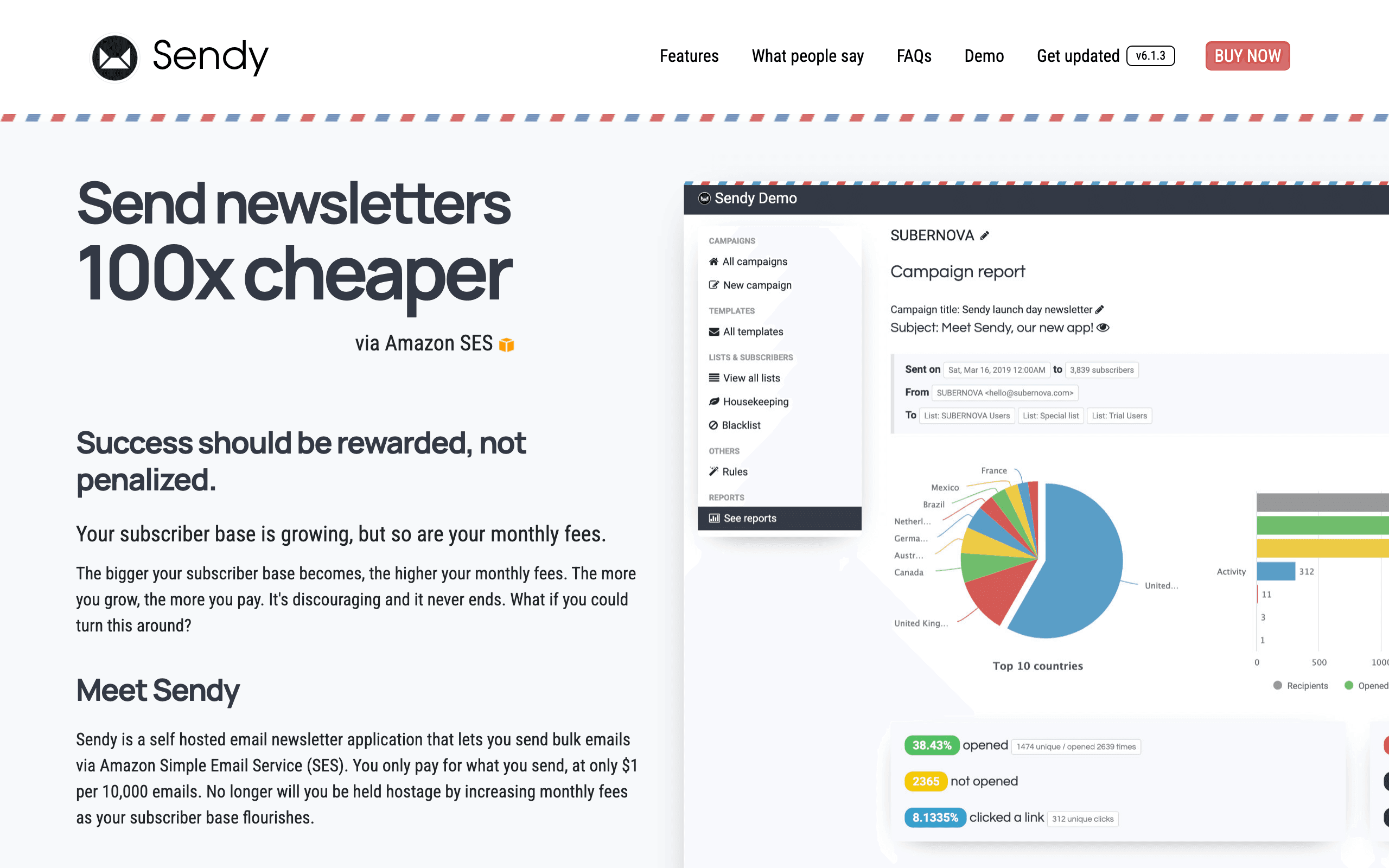
Sendy and EmailOctopus both target budget-conscious email marketers. Sendy is self-hosted for maximum savings. EmailOctopus is an affordable SaaS. Both are cheaper than mainstream platforms, but they require different trade-offs.
Budget Warriors
Both platforms appeal to those watching their email spend. Sendy achieves low cost through self-hosting and Amazon SES. EmailOctopus achieves low cost through focused features and efficient operations. Different paths to the same goal of affordable email.
The Technical Gap
EmailOctopus is designed for beginners. Sign up with email, verify your domain, start sending. Sendy requires server administration: PHP/MySQL setup, Amazon SES configuration, DNS records, security updates. For non-technical users, EmailOctopus is the only realistic option.
Cost Comparison
At 10k contacts, Sendy costs ~$5-10/month (after initial $69). EmailOctopus costs $45/month. That's ~$35/month savings with Sendy. But factor in setup time (4-8 hours) and ongoing maintenance. At typical hourly rates, the "savings" evaporate quickly unless you're at higher volumes.
Feature Comparison
EmailOctopus has landing pages, better templates, and cleaner UX. Sendy has basic campaigns and autoresponders with a dated interface. For marketing beyond simple newsletters, EmailOctopus offers more tools. Neither matches premium platforms, but EmailOctopus is more complete.
The Free Tier Advantage
EmailOctopus offers 2,500 free subscribers with 10,000 monthly emails. Sendy requires buying the $69 license and hosting before sending anything. For testing or small lists, EmailOctopus's free tier is compelling.
For SaaS Companies
Neither platform is built for SaaS. Both lack Stripe integration, event tracking, and sophisticated automation. For subscription businesses wanting Stripe integration and behavioral automation, consider Sequenzy at similar pricing.
Making the Choice
Choose Sendy if you're technical, sending high volumes, and want absolute minimum costs. Choose EmailOctopus if you want affordable email without technical hassle. For most budget-conscious users, EmailOctopus is the practical choice.
The Budget Email Showdown: Different Paths to Savings
Both Sendy and EmailOctopus are positioned as affordable alternatives to mainstream platforms, but their approaches to affordability differ fundamentally. Sendy achieves low cost by eliminating the SaaS margin entirely -- you run the software yourself and pay only infrastructure costs. EmailOctopus achieves low cost through operational efficiency -- a lean team building focused software without enterprise bloat.
The cost gap narrows at lower volumes. At 2,500 subscribers, EmailOctopus is literally free. Sendy still requires the $69 license plus hosting. At 5,000 subscribers, EmailOctopus costs $24/month. Sendy costs perhaps $3-5/month but required hours of setup. The savings only become substantial at 25,000+ subscribers where EmailOctopus charges $65/month and Sendy costs perhaps $10.
For most small businesses and startups, the practical question is whether saving $20-40 per month justifies the technical overhead of self-hosting. Factor in your hourly rate, the opportunity cost of server maintenance, and the risk of downtime. For many teams, EmailOctopus is the more economical choice despite higher nominal pricing.
Modern UX vs Functional Simplicity
EmailOctopus has invested in user experience. The dashboard is clean, the email builder is intuitive, and the workflow does not require technical knowledge. Campaign creation follows modern design patterns that any marketer can navigate. Sendy's interface has not been significantly updated since launch and shows its age in every interaction.
This UX gap affects daily productivity. Creating a campaign in EmailOctopus takes minutes with drag-and-drop templates. Creating the same campaign in Sendy takes longer with a basic editor that requires more manual formatting. Over months of regular sending, these minutes compound into hours of productivity difference.
For teams where multiple people access the email platform, the UX difference is amplified. Onboarding new team members to EmailOctopus takes minutes. Onboarding to Sendy requires explaining server access, the interface quirks, and operational procedures. For growing teams, modern UX is not a luxury -- it is an operational necessity.
The Free Tier Advantage for Startups
EmailOctopus's free tier supporting 2,500 subscribers with 10,000 monthly emails provides a genuine zero-cost starting point. Startups can validate their email strategy, build initial subscriber lists, and learn email marketing fundamentals without any financial commitment. This runway matters for bootstrapped businesses.
Sendy requires upfront investment before sending a single email: $69 for the license, hosting costs, and hours of setup time. For a startup testing whether email marketing will work for their business, this upfront commitment creates unnecessary risk. EmailOctopus eliminates this risk entirely with its free tier.
The growth path from free to paid on EmailOctopus is also smooth. When you exceed 2,500 subscribers, the $16/month Starter plan provides a gentle on-ramp. Sendy's on-ramp is steeper: buy the license, provision a server, configure SES, set up DNS, and test deliverability before sending your first email.
Nonprofit and Social Impact Considerations
EmailOctopus offers a 20% lifetime discount for nonprofits, making already affordable pricing even more accessible. At 10,000 contacts, nonprofits pay $36/month instead of $45. This discount plus the free tier makes EmailOctopus one of the most affordable options for charitable organizations.
Sendy has no nonprofit-specific programs or pricing. While its overall costs are lower for technical organizations, many nonprofits lack the in-house technical skills to self-host and maintain Sendy. The combination of EmailOctopus's nonprofit discount, ease of use, and free tier makes it the practical choice for mission-driven organizations.
For SaaS companies and subscription businesses that need more than basic email marketing, neither platform provides Stripe integration or revenue tracking. Sequenzy fills this gap with subscription-aware automation and transactional email at comparable pricing to EmailOctopus.
Use-case matchups
| Situation | Best first look | Why |
|---|---|---|
| Team wants the lowest visible email sending cost and can self-host | Sendy | Sendy is the baseline here for teams comfortable operating their own app layer on top of a sending service. |
| Team wants hosted budget email without self-hosting | EmailOctopus | EmailOctopus is the practical hosted alternative when Sendy's operations work is not worth the savings. |
| SaaS or subscription team wants lifecycle and transactional email | Sequenzy | Sequenzy is stronger when Stripe events, transactional messages, and campaigns need a hosted lifecycle workflow. |
| Technical team already owns servers and AWS email operations | Sendy | Sendy can make sense when maintenance, updates, deliverability setup, and backup ownership are acceptable. |
| Team needs the specialist capability | EmailOctopus | EmailOctopus deserves the first demo when the main requirement is simple budget SaaS email marketing. |
| Team wants hosted workflows without self-hosting | Sequenzy | Sequenzy removes Sendy-style app maintenance while staying focused on email automation and transactional messages. |
Pricing reality
The pricing signals on this page list Sendy at ~$5-10/month or equivalent operating cost, EmailOctopus at $45/month, and Sequenzy at $49/month. Sendy's number should never be read as the whole cost.
Sendy usually shifts cost from the vendor invoice to operations: hosting, updates, backups, SES or SMTP setup, bounce handling, deliverability monitoring, and internal troubleshooting. EmailOctopus's real cost depends on whether the team needs simple budget SaaS email marketing.
Review signals
For Sendy, validate reviews around setup, updates, SES integration, bounce handling, deliverability, and the amount of technical maintenance required. For EmailOctopus, focus review research on whether users praise the reason you would choose it: simple budget SaaS email marketing.
Best Fit by Budget and Operations Burden
Best low-cost newsletter tool for teams that can self-host
Sendy is the better fit when a technical team wants to minimize vendor spend and can manage PHP hosting, SES setup, DNS, bounces, complaints, suppressions, and backups. The savings only hold when infrastructure ownership is realistic.
Best hosted budget email platform without Sendy maintenance
EmailOctopus is the better fit when the team wants affordable email marketing but does not want to run servers. It is especially practical for nonprofits, small teams, and operators who need forms, templates, automations, and deliverability handled in a hosted product.
Best lifecycle email platform for SaaS and subscription teams
Sequenzy fits when simple budget email is not enough and the team needs campaigns, transactional messages, Stripe events, and subscriber lifecycle automation together. It is relevant when customer state matters more than raw newsletter cost.
Migration checklist
| Workstream | Moving toward Sendy | Moving toward EmailOctopus | Simplifying to Sequenzy |
|---|---|---|---|
| Hosting and ownership | Provision hosting, backups, updates, SSL, cron jobs, sending service credentials, and admin access. | Map lists, tags, forms, templates, automations, campaigns, and suppressions. | Import subscribers, attributes, tags, suppressions, and lifecycle events into a hosted workflow. |
| Sending setup | Configure SES or SMTP, SPF, DKIM, DMARC, bounce processing, complaint handling, and suppression logic. | Confirm sender authentication, deliverability tooling, and plan limits. | Configure sending domains and transactional paths without self-hosting. |
| Contacts and consent | Import lists, custom fields, segments, unsubscribes, bounces, and suppression records. | Import the data model EmailOctopus needs for simple budget SaaS email marketing. | Import subscriber data and lifecycle attributes. |
| Automations | Rebuild simple autoresponders and campaigns; custom lifecycle logic may need outside code. | Rebuild the workflows that prove EmailOctopus's advantage. | Rebuild campaign, lifecycle, and transactional email flows. |
| Reporting | Decide which analytics are built in and which require outside tooling. | Validate reporting for simple budget SaaS email marketing before committing. | Validate campaign, automation, transactional, and subscription lifecycle reporting. |
Decision checklist
- Is the team honestly willing to own Sendy's hosting, updates, backups, and deliverability operations?
- Does EmailOctopus's strength in simple budget SaaS email marketing matter more than Sendy's low visible cost?
- Who owns bounce handling, complaint processing, and suppression hygiene after migration?
- Are the listed prices still realistic after adding hosting, support, and engineering time?
- Would hosted lifecycle and transactional email be more useful than a self-hosted newsletter layer?
- EmailOctopus should be checked for automation and integration limits.









