
6 Best SMTP Relay Services for Email Delivery in 2026

The best SMTP relay services for email delivery in 2026 are Sequenzy, Mailtrap, Twilio SendGrid, Mailgun, Postmark, and Amazon SES. We compared all 6 on SMTP setup, SDK and webhook coverage, stream separation, dedicated IPs, log retention, and pricing at 10K, 50K, and 100K emails a month, using each provider's public docs, pricing pages, and changelogs.
Best SMTP relay services at a glance
An SMTP relay service is a hosted mail server that accepts email from your app over SMTP, signs it with SPF and DKIM, and delivers it to recipient mailbox providers from its own IP pool. Sequenzy is the best pick for SaaS teams that want SMTP relay, marketing email, and billing-event automation in one account. Mailtrap is the strongest choice for deliverability, with separate transactional and bulk streams and analytics by mailbox provider on the free plan. Amazon SES wins on price at scale, and Twilio SendGrid, Mailgun, and Postmark cover scale, inbound routing, and delivery-critical app email.
| Tool | Best for | Free tier | Starting price | Key strength |
|---|---|---|---|---|
| Sequenzy | SaaS teams combining SMTP relay with marketing and billing emails | 2,500 emails/mo | $19/mo (15,000 emails) | One platform, unlimited contacts |
| Mailtrap | Deliverability and analytics at any volume | 4,000 emails/mo (150/day) | $15/mo (10,000 emails) | Separate transactional and bulk streams |
| Twilio SendGrid | High-volume sending inside the Twilio ecosystem | 60-day trial (100 emails/day) | $19.95/mo (50,000 emails) | Proven scale |
| Mailgun | Apps that send and receive email | 100 emails/day | $15/mo (10,000 emails) | Inbound routing |
| Postmark | Delivery-critical app email | 100 emails/mo | $15/mo (10,000 emails) | Message Streams |
| Amazon SES | AWS-native teams watching cost | AWS credits only (up to $200) | $0.10 per 1,000 emails | Lowest list price |
Best SMTP relay service by use case
Best SMTP relay for SaaS lifecycle email: Sequenzy
Sequenzy fits teams that want SMTP relay, onboarding sequences, and Stripe-triggered billing emails in one account.
Best SMTP relay for deliverability and analytics: Mailtrap
Mailtrap fits teams that want isolated transactional and bulk streams, monthly DKIM rotation, and analytics by mailbox provider.
Best SMTP relay for scale and the Twilio ecosystem: Twilio SendGrid
Twilio SendGrid fits high-volume senders already on Twilio, with SDKs for 7 languages and dedicated IPs on Pro.
Best SMTP relay for inbound routing: Mailgun
Mailgun fits apps that must receive and route replies as well as send, with inbound routing rules and a validation API.
Best SMTP relay for critical transactional delivery: Postmark
Postmark fits password resets, receipts, and account alerts, with transactional and broadcast traffic on separate Message Streams.
Best SMTP relay for raw infrastructure cost: Amazon SES
Amazon SES fits AWS-native teams with engineering time, at $0.10 per 1,000 emails à la carte.
How we evaluated these SMTP relay services
We assessed each service from its public docs, pricing pages, and changelogs. We recorded how SMTP credentials are issued, which SDKs and webhooks exist, whether transactional and bulk traffic are isolated, when dedicated IPs unlock, and how long logs are kept. Sequenzy is our own product and the only service here we use first-hand. Pricing was checked in November 2026.
Detailed reviews of the best SMTP relay services
1. Sequenzy
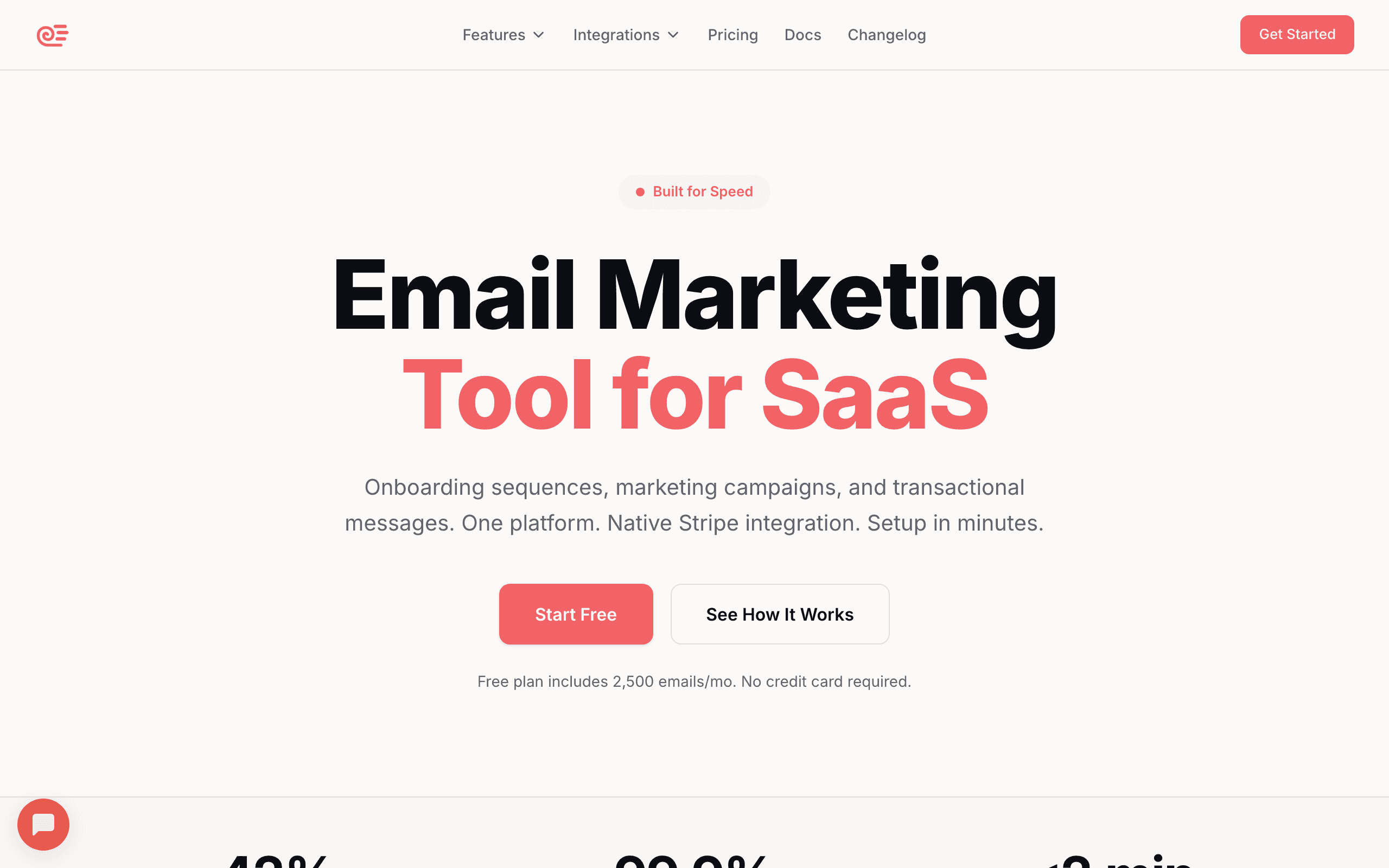
Best for: SaaS teams that want SMTP relay, marketing email, and billing-event automation in one platform
Sequenzy treats the SMTP relay as one entry point into a wider email platform. You create an API key in the dashboard, use it as the password for smtp.sequenzy.com on port 587, 465, or 2525, and keep your sending code unchanged. WordPress sites, legacy invoicing tools, and CRMs can all send through the same account.
Messages sent over SMTP land in the same dashboard as campaigns and sequences, with the same open and click tracking, and they appear in subscriber profiles. The Stripe integration lets billing events such as failed payments trigger emails, replies and inbound mail arrive in a shared inbox, and an MCP server with 200+ tools lets AI agents operate the account.
The trade-off is maturity. Dedicated IPs are available on paid plans as a $30/month add-on per IP, but Sequenzy is newer than the other providers here, its official SDKs cover 4 languages (TypeScript, Python, PHP, and Go), and teams with unusual reputation requirements may still pair it with a dedicated sender.
Key features: SMTP relay and REST API, Stripe-triggered automation, visual automation builder, sequences and campaigns, inbound inbox, webhooks, CLI, MCP server
Pricing: Free up to 2,500 emails/month, from $19/month for 15,000 emails, unlimited contacts. See pricing.
Pros: Transactional and marketing email in one account, no code changes for SMTP apps, SMTP sends tracked beside campaigns
Cons: Newer platform, smaller ecosystem, fewer SDK languages than SendGrid or Mailtrap
2. Mailtrap
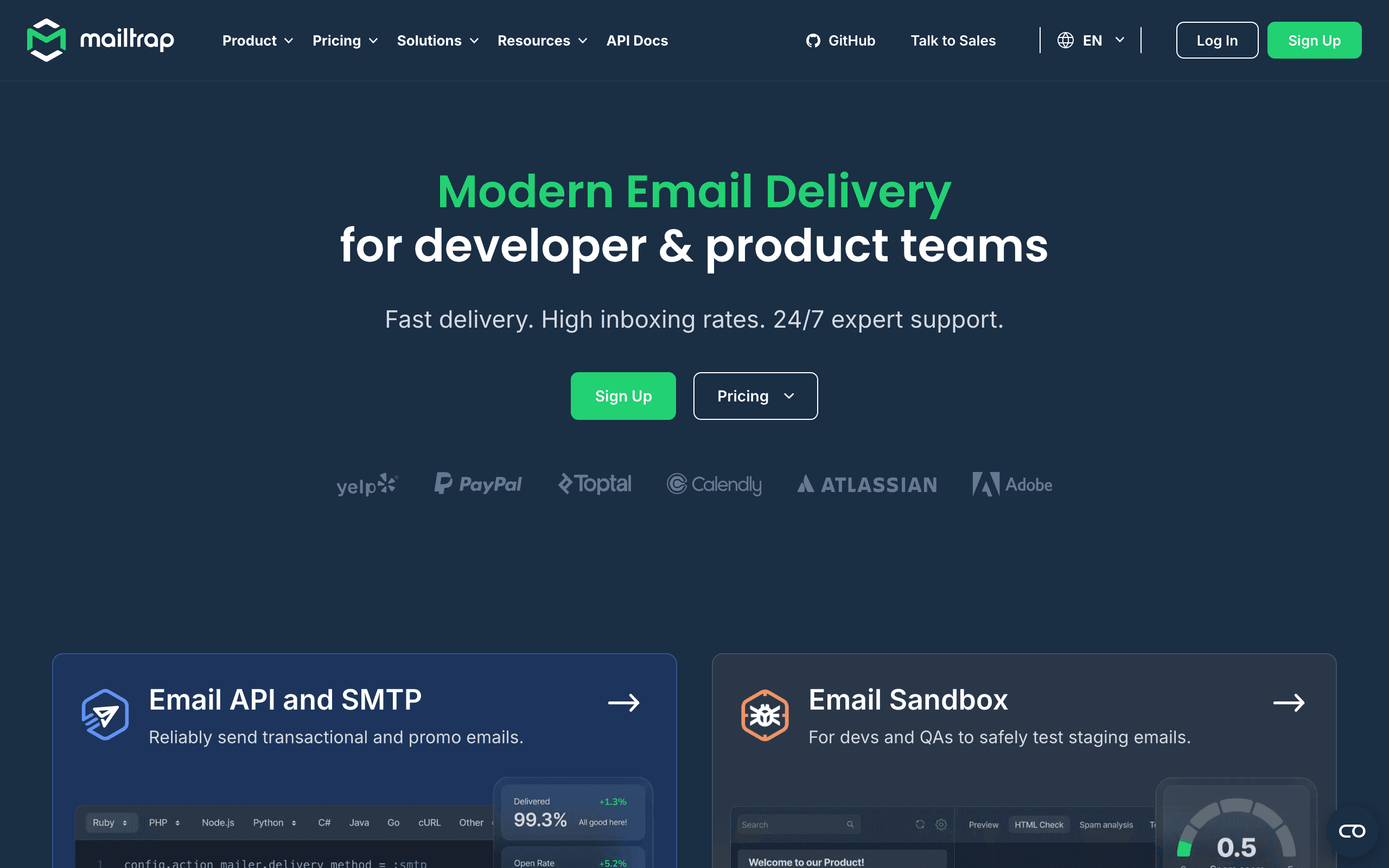
Best for: Developers and product teams that want high deliverability and detailed analytics without configuring them by hand
Mailtrap is an email delivery platform with an SMTP relay and a REST API. Transactional and bulk email run on isolated IP pools by default, even on the free plan, so a marketing send that draws complaints cannot drag down password resets. Its SMTP service for mass email runs as a separate bulk stream.
SPF, DKIM, and DMARC setup is automatic once the DNS records are added, and DKIM keys rotate every month. Analytics break down delivery, bounces, and spam complaints by mailbox provider, with logs kept for 3 to 30 days depending on the plan.
Setup takes about five minutes, with 8 official SDKs and 25+ code snippets. The same API token also covers inbound email, and an email inbox for AI agents handles inbound replies. The trade-off is that dedicated IPs with automatic warmup start on the $85/month Business plan.
Key features: SMTP relay and REST API, separate transactional and bulk streams, automatic DKIM rotation, analytics by mailbox provider, inbound email, MCP server
Pricing: Free for 4,000 emails/month (150/day), from $15/month for 10,000 emails, Business from $85/month with a dedicated IP
Pros: Stream separation on every plan, 8 SDKs, ISO 27001 and SOC 2 Type II
Cons: Dedicated IPs only from Business, no click tracking on free
3. Twilio SendGrid
Best for: High-volume senders that want proven scale and a place inside the Twilio ecosystem
Twilio SendGrid is one of the most widely used email APIs, and its SMTP relay has been a drop-in option for apps for years. The Email API plans cover SMTP and REST sending, webhooks, dynamic templates, and analytics, and Twilio ownership means email can sit beside SMS and voice under one vendor.
Official SDKs cover 7 languages, including Node.js, Python, Ruby, PHP, Java, Go, and C#, which makes it a safe pick for less common stacks. Dedicated IPs and subuser management start on the Pro plan at $89.95/month, and transactional and marketing email are sold as separate products.
The trade-offs are plan structure and entry cost. The free plan is now a 60-day trial at 100 emails a day, so production use starts at Essentials from $19.95/month, and activity history on the lower plans is short at 3 days.
Key features: SMTP relay and REST API, Event Webhook, dynamic templates, subuser management, dedicated IPs and email validation on Pro
Pricing: 60-day trial at 100 emails/day, Essentials from $19.95/month for 50,000 emails, Pro from $89.95/month for 100,000
Pros: Proven scale, SDKs for 7 languages, broad integrations, email beside Twilio SMS and voice
Cons: No permanent free plan, short activity history on lower plans, dedicated IPs only on Pro
4. Mailgun
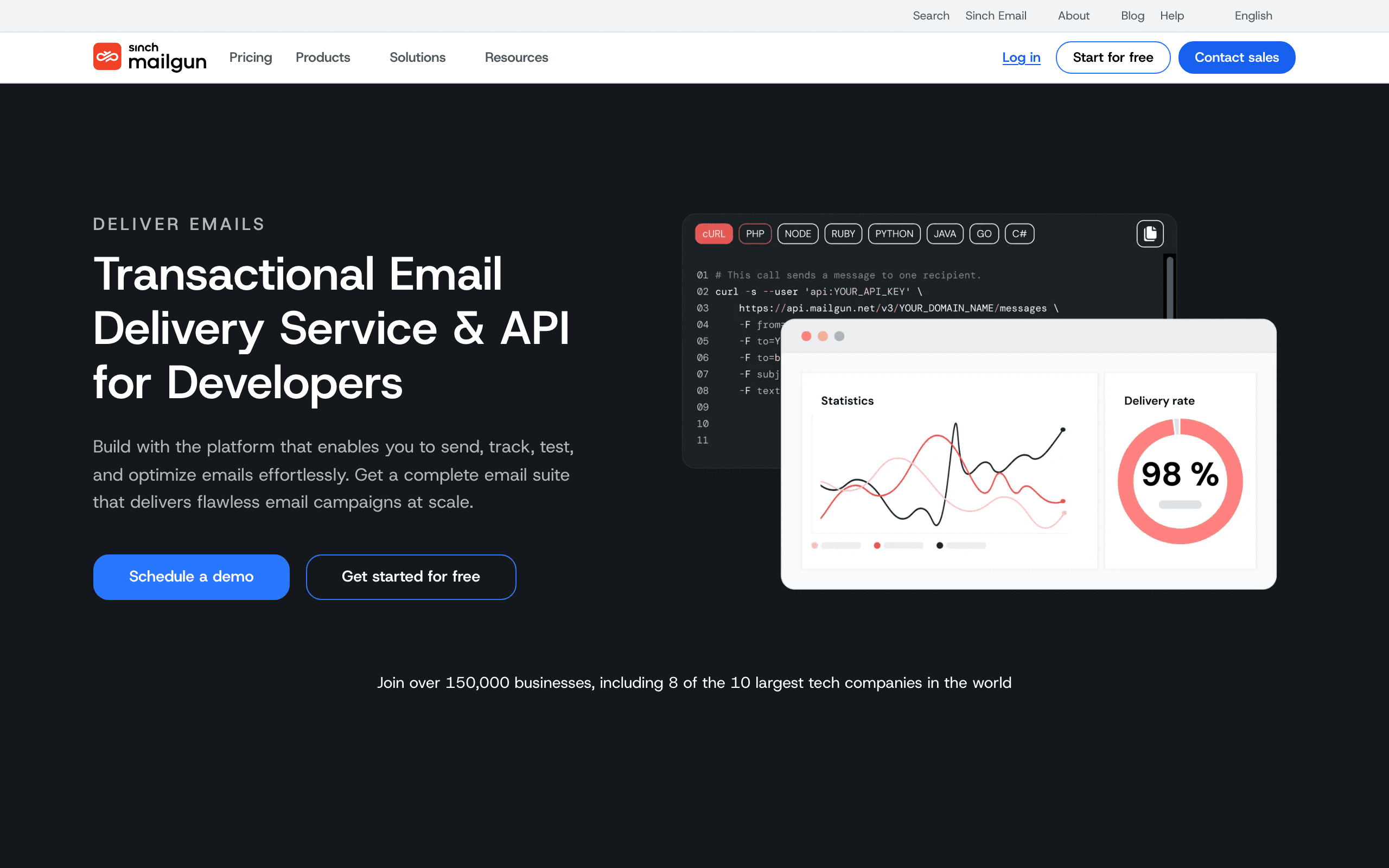
Best for: Developer teams that need inbound email routing and validation alongside SMTP sending
Mailgun is built around email infrastructure primitives. Its SMTP relay and REST API handle sending, and inbound routing rules match incoming messages by recipient, header, or content and forward them to a webhook. That makes it a natural fit for reply-by-email, support inboxes, and ticket parsing.
Mailgun also sells an email validation API that checks syntax, MX records, and disposable domains before a send, with 5,000 validations included on Scale. Dedicated IP pools, SAML SSO, and 30-day log retention arrive on the Scale plan at $90/month, while Basic keeps logs for 1 day and Foundation for 5.
The trade-off is that the extras sit on higher plans. Mailgun is owned by Sinch, the free plan is capped at 100 emails a day, extra dedicated IPs are billed per IP, and phone and chat support arrive only on Scale.
Key features: SMTP relay and REST API, inbound routing, email validation API, webhooks, suppression management, dedicated IP pools on Scale
Pricing: Free for 100 emails/day, Basic $15/month for 10,000 emails, Foundation $35/month for 50,000, Scale $90/month for 100,000
Pros: Strong inbound routing, validation API, flexible API, SMTP on every plan
Cons: Short log retention below Scale, dedicated IPs are an upgrade, phone support only on Scale
5. Postmark
Best for: Teams where fast, reliable delivery of password resets, receipts, and account alerts is the priority
Postmark is no longer a transactional-only service. It now handles email marketing as well, with broadcast sends isolated from transactional traffic through Message Streams, so a newsletter never queues ahead of a password reset. Credentials for the SMTP relay and REST API are available right after signup.
Every paid plan includes 45 days of message history, unlimited emails per day, webhooks, and detailed analytics, and Pro and Platform extend retention up to 365 days. Dedicated IPs cost $50/month per IP, but they are limited to Pro plans and customers sending 300,000 or more emails a month.
Price is the main trade-off. Basic starts at $15/month for 10,000 emails, but 50,000 costs $55 and 125,000 costs $115, above most rivals at volume. The free plan allows only 100 emails a month, and there is no tier between 100 and 10,000 emails.
Key features: SMTP relay and REST API, Message Streams, templates, 45-day message history, webhooks, DMARC monitoring add-on
Pricing: Free for 100 emails/month, Basic from $15/month for 10,000 emails, dedicated IPs $50/month per IP
Pros: Strict separation of transactional and broadcast traffic, unlimited emails per day, clear overage rates
Cons: Higher cost at volume, tiny free plan, dedicated IPs only from 300,000 emails/month
6. Amazon SES
Best for: AWS-native engineering teams that want the lowest cost per email and can run their own deliverability operations
Amazon SES is AWS's email infrastructure, and à-la-carte sending starts at $0.10 per 1,000 emails, the lowest list price in this comparison. SMTP credentials come from the SES console, and the service plugs into Lambda, SNS, S3, and CloudWatch, which suits AWS-hosted apps.
In July 2026, AWS added Essentials, Pro, and Enterprise pricing plans. New accounts start on Essentials, which adds deliverability insights. Pro adds dedicated IPs and inbox placement visibility, and Enterprise adds multi-region resilience and reputation isolation across workloads.
The trade-off is operational work. SES leaves template design, subscriber management, and most bounce handling to you, and new accounts start in a sandbox until AWS approves production access. The SES-specific free tier is also closed to new customers, so only AWS credits of up to $200 remain. Without engineering capacity to cover that work, the savings shrink quickly.
Key features: SMTP relay and API, configuration sets, Virtual Deliverability Manager, dedicated IPs on Pro, Lambda, SNS, and S3 integrations
Pricing: From $0.10 per 1,000 emails à la carte, pricing plans since July 2026, up to $200 in AWS credits for new accounts
Pros: Lowest list price, deep AWS integration, plans that bundle deliverability features
Cons: Sandbox approval for new accounts, DIY templates and subscriber management, no SES-specific free tier
SMTP relay feature comparison
| Service | SMTP relay | REST API | Dedicated IP | Inbound email | Webhooks | Official SDKs |
|---|---|---|---|---|---|---|
| Sequenzy | Yes | Yes | Paid plans ($30/IP/mo) | Yes | Yes | 4 languages |
| Mailtrap | Yes | Yes | Business and above | Yes | Yes | 8 languages |
| Twilio SendGrid | Yes | Yes | Pro | Yes | Yes | 7 languages |
| Mailgun | Yes | Yes | Scale | Yes | Yes | 7 languages |
| Postmark | Yes | Yes | 300K+ emails/mo on Pro | Yes | Yes | 7 languages |
| Amazon SES | Yes | Yes | Pro plan | Yes | Yes (via SNS) | AWS SDKs |
SMTP relay pricing at 10K, 50K, and 100K emails a month
| Service | 10K emails/mo | 50K emails/mo | 100K emails/mo |
|---|---|---|---|
| Sequenzy | $19 | $49 | $99 |
| Mailtrap | $15 | $20 | $30 |
| Twilio SendGrid | $19.95 | $19.95 | $89.95 |
| Mailgun | $15 | $35 | $90 |
| Postmark | $15 | $55 | $115 |
| Amazon SES | $1 | $5 | $10 |
Sequenzy bills by the next tier up (15K, 60K, and 120K emails). Mailtrap shows Basic plans, and Business at $85/month adds a dedicated IP. Twilio SendGrid's 100K price is Pro, and Postmark's is its 125K tier. Amazon SES shows à-la-carte sending only, without add-ons or plan fees.
FAQ
What is an SMTP relay service?
An SMTP relay service accepts email from your app over SMTP and delivers it to recipient mailbox providers using the provider's IP reputation and authentication. You change the host, port, username, and password in your app settings, so migration needs no new code.
What is the difference between SMTP relay and API sending?
SMTP relay needs only credentials in your app settings, which makes it the simple path for WordPress, CMS platforms, and legacy code. API sending needs code but returns richer responses and supports templates, tags, and suppression handling. All six providers support both.
What is the best free SMTP relay service?
Mailtrap has the largest permanent free plan on this list at 4,000 emails a month, capped at 150 per day. Sequenzy offers 2,500 emails a month, Mailgun 100 per day, and Postmark 100 per month. Twilio SendGrid offers only a 60-day trial, and Amazon SES has no SES-specific free tier for new accounts.
Do I need a dedicated IP for SMTP relay?
Most apps do not at low volume, because shared IPs from providers that vet senders perform well. A dedicated IP starts to make sense around 100,000 emails a month, when you want full control of sender reputation. Mailtrap includes one with automatic warmup on Business, and Postmark limits them to 300,000 or more emails a month.
Which SMTP relay services work with AI agents?
Sequenzy and Mailtrap both publish official MCP servers, and Mailgun and Postmark have MCP servers too. Sequenzy's exposes 200+ tools alongside a CLI and an inbox agents can read and reply from. Mailtrap adds agent skills and an inbox for AI agents that handles inbound replies through the same API token.
Final verdict
The best SMTP relay service depends on what else your app sends. Sequenzy suits SaaS teams that want transactional, marketing, and billing emails in one account, and Mailtrap suits teams that want isolated streams, monthly DKIM rotation, and mailbox-provider analytics from the free plan. Twilio SendGrid, Mailgun, Postmark, and Amazon SES cover scale, inbound routing, delivery focus, and cost. Point a staging app at your top two SMTP relay services for a week and compare logs and bounce handling.
For more detail on the sending side, see our guides to the best transactional email services and transactional email deliverability.