
Overview
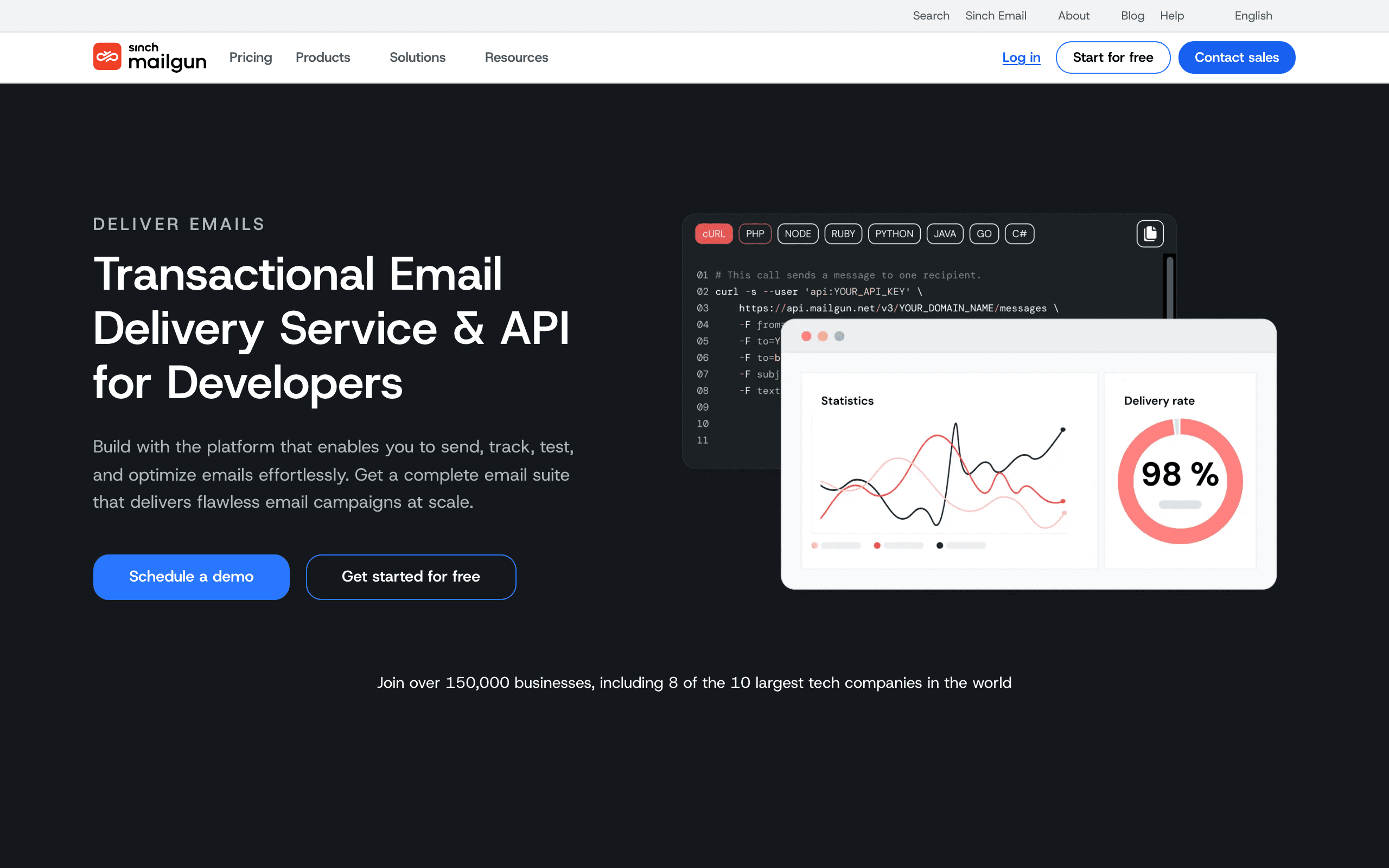
Resend and Mailgun both serve developers building transactional email, but they take different approaches. Resend launched in 2023 with a focus on modern developer experience. Mailgun has been around since 2010, acquired by Sinch in 2021, and offers a more feature-rich but complex platform. If you need help comparing, check our Resend comparison and Mailgun comparison pages.
Developer Experience
Resend wins on simplicity. The API is clean, the SDKs are modern, and React Email support is first-class. Mailgun is more powerful but requires more configuration. If you value getting started fast, Resend is easier. If you need advanced routing or complex setups, Mailgun is more flexible. Both can be integrated into email campaigns and AI-powered sequences.
EU Hosting
Mailgun's biggest advantage for European companies is EU-hosted infrastructure. You can send from the US or EU from a single account. This matters for GDPR compliance and ensuring proper email deliverability. Resend doesn't offer EU hosting yet.
Pricing Changes
Note that Mailgun raised their Flex (pay-as-you-go) pricing from $1 to $2 per 1,000 emails in December 2025. This makes their pay-as-you-go option less competitive. Their monthly plans remain similar to Resend's pricing. For a complete breakdown, see our email guide for 2026.
Email Validation
Mailgun includes email validation in their Foundation and higher plans. Resend doesn't offer this feature. If you need to validate email addresses before sending, Mailgun saves you from needing a separate service.
The Sequenzy Alternative
If you're building a SaaS and need transactional email plus marketing campaigns, consider Sequenzy. We combine transactional emails, smart segmentation, and AI-powered sequences in one platform with native Stripe integration.
The GDPR and EU Compliance Factor
For European companies or any business serving EU customers, Mailgun's EU-hosted infrastructure is a significant advantage. Data processing stays within EU boundaries, simplifying GDPR compliance. Resend does not currently offer EU hosting, which may be a dealbreaker for companies with strict data residency requirements.
This is not just a legal checkbox. Some enterprise customers and regulated industries require proof that email data is processed within specific geographic boundaries. If your sales process includes security questionnaires about data handling, Mailgun's EU option simplifies those conversations.
If EU compliance is not a concern for your business, this advantage disappears and Resend's superior developer experience becomes the deciding factor.
API Maturity vs Modernity
Mailgun's API has been battle-tested for over a decade across millions of applications. This maturity means edge cases are handled, documentation covers unusual scenarios, and community resources are abundant. Stack Overflow has thousands of Mailgun questions with answers.
Resend's API is newer and cleaner, designed with modern web development patterns in mind. If you are building with TypeScript, React, or Next.js, the developer experience is noticeably better. But being newer also means fewer community resources and less coverage of edge cases.
For greenfield projects, Resend's modern API is the clear choice. For migrating existing applications with complex email requirements (inbound processing, validation, complex routing), Mailgun's mature feature set reduces migration risk.
Beyond Transactional: The Marketing Gap
Both Resend and Mailgun focus on transactional email. Neither offers meaningful marketing automation, segmentation, or campaign management. If your SaaS needs to send onboarding sequences, product announcements, or newsletters alongside transactional messages, both platforms leave a gap.
Filling that gap means adding another tool (Loops, Mailchimp, Customer.io) to your stack, which increases cost and complexity. Sequenzy eliminates this by combining transactional sending with AI-powered marketing automation and Stripe-triggered emails in a single platform designed for SaaS.
Use-case matchups
| Need | Better fit | Why |
|---|---|---|
| Developer-first transactional email API | Resend | Resend is stronger when React Email, clean APIs, and developer workflow are the main requirements. |
| developer email infrastructure and routing flexibility | Mailgun | Mailgun is stronger when the buyer needs developer email infrastructure and routing flexibility. |
| Unified SaaS marketing and transactional email | Sequenzy | Sequenzy fits when product lifecycle campaigns, newsletters, Stripe events, and transactionals should share one workflow. |
Best Fit by Modern Transactional APIs and Flexible Email Infrastructure
Best transactional email API for modern product teams
Resend is the better fit when developers want React Email, straightforward APIs, quick setup, and transactional sending without a heavier email infrastructure model.
Best developer email infrastructure for routing and advanced delivery
Mailgun is the better fit when the team needs API and SMTP delivery, routing flexibility, inbound parsing, validation, logs, webhooks, and deeper infrastructure controls.
Best email tool for unified SaaS marketing and transactional workflows
Sequenzy is the better fit when lifecycle campaigns, newsletters, Stripe events, transactional emails, and subscriber profiles should live together instead of adding another marketing tool.
Pricing reality
The page data lists Resend at $0-20/month, Mailgun at $15/month, and Sequenzy at $19/month for the cited comparison tier. Keep the original pricing context: Resend is usually priced around email volume and developer sending, while Mailgun has its own pricing model and scope.
Review signals
For Resend, read reviews for developer experience, API quality, React Email workflow, deliverability, and production maturity. For Mailgun, read reviews for developer email infrastructure and routing flexibility, support, pricing, setup complexity, and operational fit.
Migration checklist
| Workstream | What to verify |
|---|---|
| Domains and authentication | Recreate SPF, DKIM, DMARC, tracking domains, bounce handling, and sender identities. |
| Templates | Move React Email components, dynamic templates, variables, layouts, localization, and test payloads. |
| Webhooks | Rebuild delivery, bounce, complaint, open, click, unsubscribe, and suppression handling. |
| Lists and users | Map contacts, users, companies, consent, unsubscribes, bounces, and suppressions if marketing is in scope. |
| Monitoring | Add alerts for API failures, latency, bounces, complaints, rate limits, and queue delays. |
| Reporting | Export delivery logs, campaign results, lifecycle performance, and support-relevant message history before cutover. |
Decision checklist
- Choose Resend if developer-first transactional sending is the main need.
- Choose Mailgun if developer email infrastructure and routing flexibility is the main requirement.
- Avoid Resend if marketers need a complete lifecycle platform without developer assembly.
- Avoid Mailgun if the team mainly wants a clean transactional API and React Email workflow.
- Consider Sequenzy if SaaS lifecycle campaigns and transactional email should be unified.