
Overview
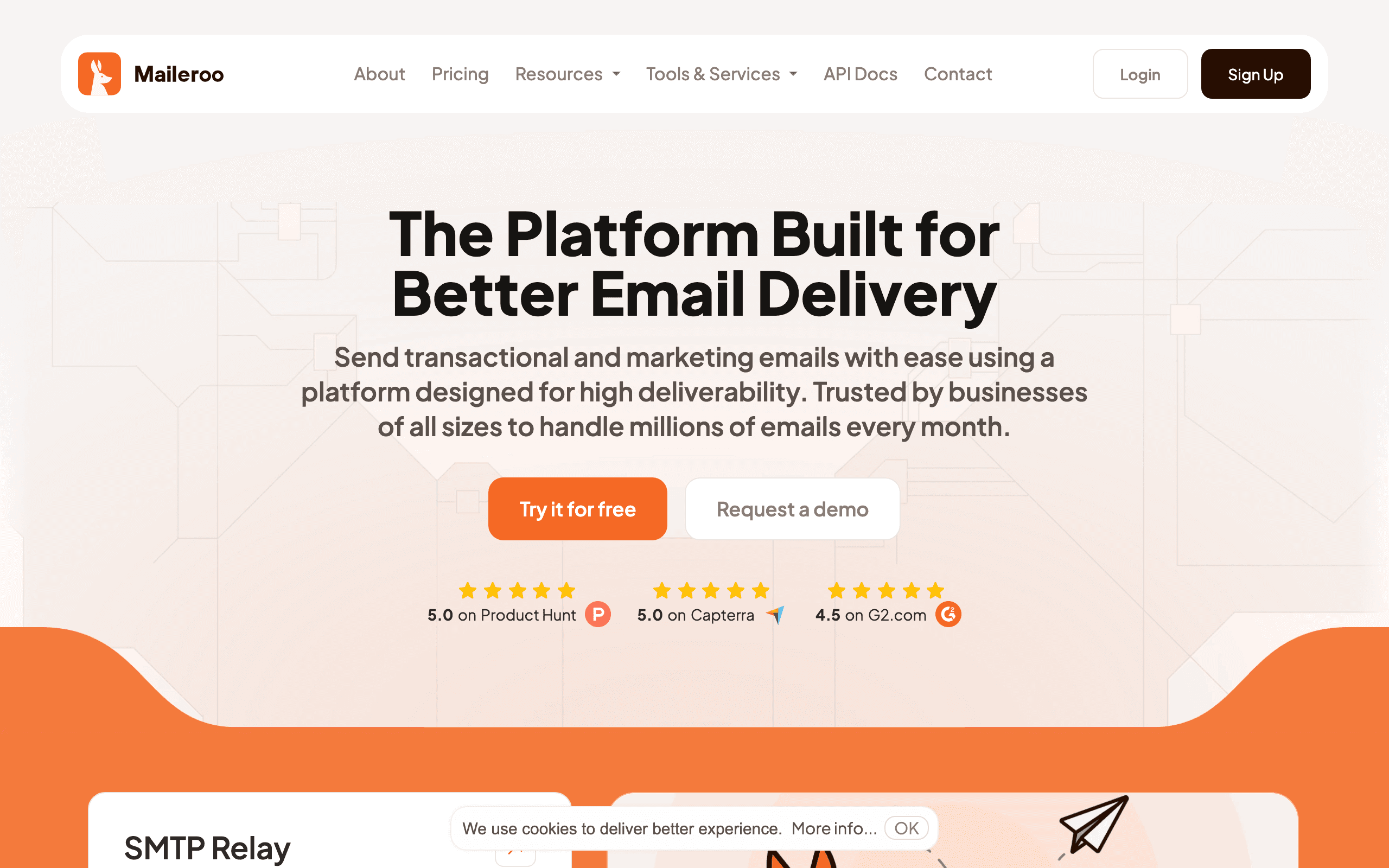
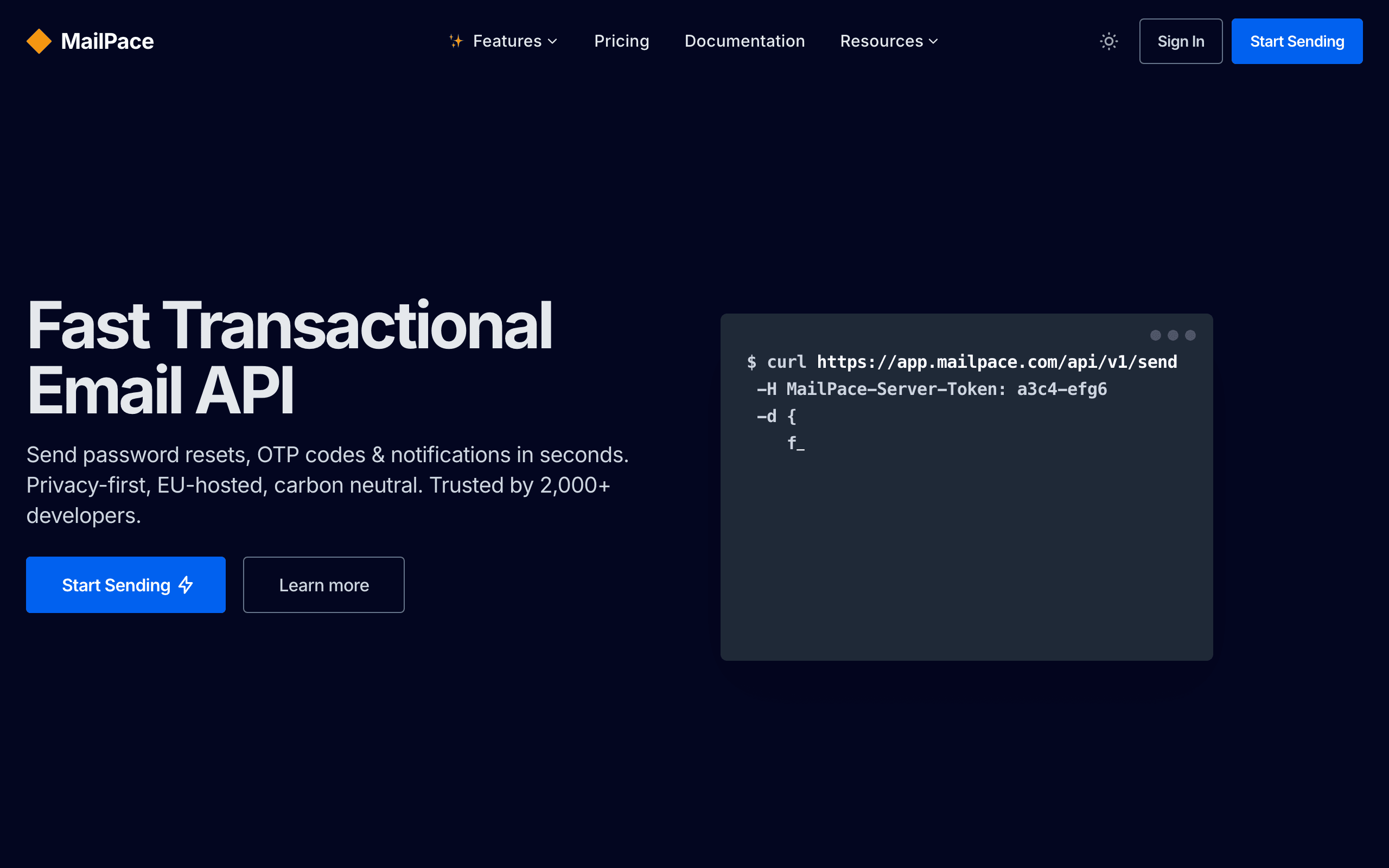
Maileroo and MailPace both handle email delivery but approach it differently. Maileroo is a email delivery service with SMTP relay, REST API, and free email verification. MailPace is a simple transactional email API with privacy focus.
Delivery Approach
Maileroo combines SMTP relay and a REST API with a feature few competitors bundle for free: email verification. Plans start at $8 a month after a free tier of 5,000 emails, undercutting many established transactional providers while still including that verification tooling. For teams that want delivery and address-checking from a single vendor, Maileroo covers both without an extra line item.
MailPace offers privacy focused and simple pricing, providing a clean api alternative in the email delivery space.
Pricing
Maileroo starts free (5,000 emails/mo) with paid plans from $8/month. MailPace $5/mo 1k. Privacy-focused. Simple API. Indie-built.. Maileroo's free email verification API is a genuine differentiator that can save you money on a separate verification service.
Making the Choice
Choose Maileroo for affordable delivery with free email verification. Choose MailPace for privacy focused. For unified SaaS email, consider Sequenzy.
Email Verification Advantage
Most providers charge separately for email verification, but Maileroo bundles it into every plan, including the free tier. Checking addresses before you send catches invalid entries early, which keeps bounce rates down and protects your sending reputation, a factor that feeds directly into deliverability. For teams collecting emails from public forms or user signups, that built-in check removes a cost most competitors would add on.
MailPace's plans, starting at $5 a month for 1,000 emails, don't include address verification, so cleaning your list means adding a separate tool and another integration to maintain. Maileroo folds that step into its own pricing instead, which simplifies the stack for anyone who wants delivery and verification handled by one provider rather than stitched together from two.
Pricing and Value
Maileroo's $8-a-month entry point, with 5,000 free emails before that, undercuts MailPace's $5-per-1,000 structure once volume grows, and the free verification API adds value MailPace doesn't offer at any price. Accounts sending past 250,000 emails a month also get free dedicated IPs, a perk most providers reserve for enterprise pricing tiers, and Maileroo offers a 50% nonprofit discount on top of that.
MailPace charges $5 a month for 1,000 emails, a straightforward per-volume rate without Maileroo's bundled verification or dedicated-IP perks at scale. Whether that's the better deal depends on whether you need address checking or high-volume dedicated IPs, since MailPace's simple pricing model trades those extras for a lower entry cost. Check our pricing page if you want a broader sense of how the two compare against other providers.
Infrastructure and Reliability
Neither Maileroo nor MailPace has the multi-year track record of the largest transactional providers, but MailPace's privacy-focused, indie-built approach and European hosting option appeal to teams that prioritize data handling over scale. Its deliverability is solid for the volumes it's built for, even without the verification tooling Maileroo includes.
Maileroo is still building its reputation, but its combination of SMTP relay, REST API, multiple SDKs and free verification gives teams a reason to try it despite being newer than MailPace or larger incumbents. For anyone weighing the switch, our email warmup calculator can help plan domain warming on either platform.
Use-case matchups
| Situation | Best first look | Why |
|---|---|---|
| Low-cost transactional sending with verification included | Maileroo | Maileroo's bundled verification and free tier are the main reasons to evaluate it first. |
| Indie or privacy-focused app that wants a simple API | MailPace | MailPace is positioned as a focused transactional API with simple pricing and a privacy angle. |
| Team processing many user-submitted addresses | Maileroo | Built-in verification can reduce bounce risk and separate validation-tool cost. |
| Team that wants the smallest possible transactional stack | MailPace | MailPace is more focused if sending email is the only job. |
| SaaS team that needs campaigns plus transactional lifecycle email | Sequenzy | Sequenzy is the better fit when marketing, transactional, and Stripe-triggered emails need to share subscriber context. |
Best Fit by Hosted Delivery and Minimal API Stack
Best low-cost hosted transactional service with verification
Choose Maileroo when the app needs a hosted SMTP/API provider with built-in verification, a free tier, and room to grow into dedicated IP or broader delivery features. It is the better fit when address quality and bounce prevention are part of the production sending workflow.
Best lightweight transactional API for indie apps
Choose MailPace when the team wants the smallest possible email infrastructure surface: simple transactional sending, clear pricing, and a privacy-conscious developer workflow. It is stronger when email sending is important but verification, broad dashboards, and extra delivery services are not the buying reason.
Best SaaS lifecycle alternative to delivery-only tools
Choose Sequenzy when product email is more than transactional delivery. SaaS teams that need campaigns, user journeys, subscription triggers, and transactional templates in one place will get more leverage from a lifecycle platform than from either narrow sending API alone.
Pricing reality
Maileroo and MailPace are both budget-friendly, but they save money in different ways. Maileroo's value is stronger when verification and dedicated-IP economics matter. MailPace's value is stronger when you want a small, focused transactional service with simple pricing.
Do not compare only the headline monthly fee. Include verification costs, expected volume, dedicated IP needs, support expectations, and how much debugging visibility your production app needs.
Sequenzy is not the cheapest delivery API. It is relevant when the buyer needs a broader email system for SaaS lifecycle messaging rather than just SMTP or REST sending.
Review signals
The existing Maileroo reviews emphasize the free verification API, competitive pricing, and reliable delivery, with cautions around maturity and documentation depth.
The existing MailPace reviews point to simple transactional sending and confidence for production workloads, with cautions around limited features, smaller ecosystem, and lack of built-in verification.
Migration checklist
| Workstream | Moving to Maileroo | Moving to MailPace | Moving to Sequenzy |
|---|---|---|---|
| Domains | Recreate SPF, DKIM, DMARC, tracking, and bounce handling before cutover. | Recreate authentication and confirm EU/privacy hosting requirements if relevant. | Authenticate domains for marketing and transactional email. |
| API and SMTP | Replace credentials and test API, SMTP, webhooks, and bounce handling. | Replace credentials and verify all transactional flows against MailPace limits. | Route transactional sends and lifecycle events through Sequenzy. |
| Verification | Decide where Maileroo replaces existing validation or signup-quality checks. | Keep a separate verification process if address quality is a risk. | Clean subscriber imports and preserve suppressions. |
| Observability | Confirm logs, event callbacks, and failure alerts are enough for production. | Confirm lightweight reporting is enough for the app's risk level. | Validate campaign, transactional, and automation reporting together. |
| Cutover | Warm up gradually and monitor bounces, complaints, and delays. | Warm up gradually and watch delivery timing closely. | Cut over campaigns and transactional messages after domain warmup. |
Decision checklist
- Is included email verification a real cost saver for your use case?
- Do you value MailPace's focused simplicity more than Maileroo's broader delivery extras?
- How much reporting and webhook depth do you need for production support?
- Will your sending volume require dedicated IP planning?
- Are you buying a delivery API only, or a full lifecycle email system?









