

Overview
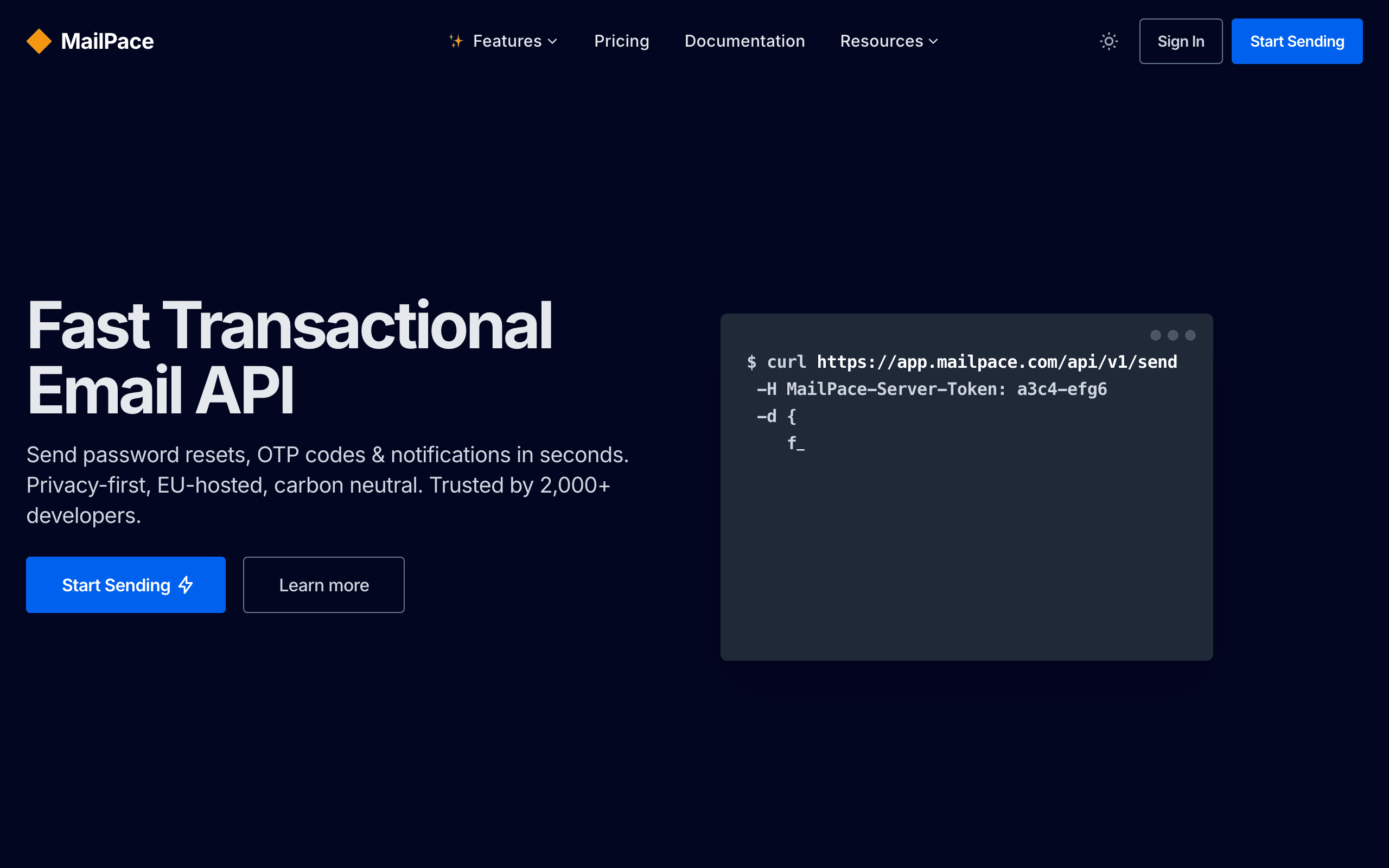
MailPace and Resend serve different needs in the email space. MailPace is a privacy-first EU-hosted transactional email API. Resend is a modern developer-first transactional email API.
The choice depends on what you need: eu-only hosting (MailPace) or best developer experience (Resend). For SaaS businesses specifically, Sequenzy offers purpose-built features that neither tool provides.
Pricing Comparison
- MailPace: $10/month - Transactional only. EU-hosted. Privacy-first.
- Resend: Free (3k/mo), then $20/mo - Developer-first. React Email support. Modern API.
- Sequenzy: $99/month for 120,000 emails, unlimited subscribers, fully managed. See pricing.
Where MailPace Wins
EU-only hosting
MailPace offers eu-only hosting, which is a genuine advantage for teams that need it.
Privacy-first design
MailPace offers privacy-first design, which is a genuine advantage for teams that need it.
Idempotent sending
MailPace offers idempotent sending, which is a genuine advantage for teams that need it.
Inbound email
MailPace offers inbound email, which is a genuine advantage for teams that need it.
Where Resend Wins
Best developer experience
Resend offers best developer experience, which matters for teams that prioritize this.
React Email integration
Resend offers react email integration, which matters for teams that prioritize this.
Clean API
Resend offers clean api, which matters for teams that prioritize this.
Generous free tier
Resend offers generous free tier, which matters for teams that prioritize this.
Why Sequenzy for SaaS
If you are building a SaaS product, Sequenzy offers what neither MailPace nor Resend provides: native Stripe integration for billing-based automation, AI sequences that generate onboarding and retention emails, and unified transactional + marketing email in one platform. Check our pricing page for details.
Developer Experience vs Privacy
Resend has redefined what developer experience means in email with React Email integration, clean API design, and excellent documentation. MailPace prioritizes privacy with EU-only data hosting and minimal tracking. These represent different priorities rather than different quality levels.
For developer-led teams building modern applications where code-first email templates matter, Resend provides a workflow that MailPace cannot match. For teams where data residency and privacy compliance drive infrastructure decisions, MailPace provides guarantees Resend does not.
React Email Integration
Resend's native React Email support allows developers to build email templates as React components, version them in code, and test them like regular code. This integration has changed how many teams think about email development.
MailPace takes a traditional API approach where templates are managed separately from application code. This works well for many teams but does not offer the modern development workflow that React Email enables.
Community and Ecosystem Growth
Resend has built a rapidly growing developer community with strong open-source contributions including React Email. This ecosystem creates value beyond the core email sending product. MailPace has a smaller community focused on privacy and compliance rather than developer tooling.
Delivery Speed and Reliability
MailPace and Resend both prioritize fast, reliable transactional delivery, but they built their APIs around different audiences. MailPace focuses on EU-only hosting and privacy-first sending with idempotent requests. Resend focuses on a clean, modern developer experience, including native React Email support for building templates directly in code.
API Design and Developer Experience
Resend has built a reputation around developer experience specifically, with a clean API and React Email integration that lets you write templates as components. MailPace's API is simpler and its documentation is well-written too, but it does not aim for the same framework-level integration. If your team already builds in React, Resend's tooling fits more naturally into that workflow.
Scaling and Cost at Volume
Resend gives you 3,000 free emails a month before moving to $20 a month, while MailPace charges a flat $10 a month regardless of exact volume within its plan. For low-volume senders, Resend's free tier can cover you longer at zero cost; once you're paying, MailPace's flat rate is the cheaper of the two at comparable usage.
The Developer Experience Comparison
Resend's TypeScript-first SDK and React Email integration represent a modern approach to email development that MailPace cannot match. For React and Next.js teams, Resend lets you write email templates as typed components that live alongside application code, with full IDE support and version control.
MailPace offers a clean, simple API that works well across any programming language but without the framework-specific integrations that make Resend special. The API is functional and well-documented but lacks the developer experience innovations that have made Resend popular with modern web teams.
The DX gap matters most for React-based teams. For Python, Go, Ruby, or PHP backends, both platforms offer comparable API experiences. MailPace's advantage in this scenario is EU-only hosting and privacy-first design -- features that no amount of DX polish can replicate.
The Privacy-First vs Modern-First Philosophy
MailPace's core differentiator is privacy -- EU-only data hosting, minimal tracking, and GDPR compliance by default. Resend's core differentiator is developer experience -- beautiful APIs, React integration, and modern tooling. These are fundamentally different value propositions.
For European companies subject to strict data protection requirements, MailPace provides a compliance advantage that Resend does not explicitly match. Resend processes data across AWS regions, and while it can be configured for specific regions, EU-only processing is not the default guarantee that MailPace provides.
For developer-led companies where engineering productivity and code quality drive decisions, Resend's DX advantages create measurable time savings. The choice between privacy-first and developer-first reflects organizational priorities rather than technical capability.
Use-case matchups
| Need | Better fit | Why |
|---|---|---|
| Privacy-first EU-hosted transactional email | MailPace | MailPace is listed as transactional-only, EU-hosted, privacy-first, and no tracking by default. |
| Modern developer experience with React Email support | Resend | Resend's cited strengths are React Email integration, modern developer experience, clean API, and fast delivery. |
| Lowest-friction developer onboarding | Resend | Resend has a free 3k/month starting point and modern API positioning. |
| SaaS marketing plus transactional email tied to Stripe | Sequenzy | Sequenzy is listed with SaaS marketing, transactional email, Stripe integration, and 10k contacts. |
Pricing reality
MailPace is listed at $10/month for privacy-first transactional email. Resend is listed as free for 3k emails/month, then $20/month, with React Email support and a modern API. Sequenzy is listed at $49/month for SaaS marketing plus transactional email with Stripe integration.
MailPace is cheaper than Resend once both are on paid plans. Resend is easier to justify if React Email integration and developer experience are more important than EU-hosted privacy positioning.
Review signals
MailPace reviews cited here highlight privacy-first sending, transparent pricing, no tracking by default, and good value. The cautions are the small team and limited feature set.
Resend reviews cited here highlight React Email integration, modern developer experience, clean API design, and fast delivery. The tradeoffs are newer-platform maturity, limited marketing features, and remaining enterprise gaps.
Best Fit by Privacy and Developer Workflow
Best transactional email service for EU-hosted privacy requirements
MailPace is the better fit when the main requirement is privacy-first transactional sending with EU-only hosting and minimal tracking. It suits teams where compliance posture, data residency, and simple infrastructure matter more than React-based template authoring.
Best transactional email API for React and Next.js developers
Resend fits product teams that prioritize developer speed and component-based templates. It is the stronger choice when React Email, TypeScript SDKs, clean docs, and a modern dashboard reduce the time needed to ship app-generated emails.
Best SaaS email platform for Stripe-aware marketing and transactionals
Sequenzy fits SaaS teams that need more than privacy-focused delivery or a developer API. When billing status, subscriber lifecycle, campaigns, and transactional email should work together, Sequenzy's unified model is more relevant than choosing only between MailPace and Resend.
Migration checklist
- Export domains, sender identities, API keys, templates, React Email templates if used, webhooks, suppressions, and activity logs.
- If moving to Resend, map API calls, React Email rendering, webhook events, and audience-management usage before cutover.
- If moving to MailPace, confirm which Resend developer-experience features and marketing additions need replacement.
- Reconfigure SPF, DKIM, DMARC, return-path, tracking domains if used, sender identities, and webhook endpoints.
- Test transactional templates, React Email rendering if applicable, bounces, suppressions, retries, and webhook events in staging.
- Roll over production traffic gradually and compare delivery, latency, and errors.
Decision checklist
- Choose MailPace if privacy-first EU-hosted transactional sending matters most.
- Choose Resend if React Email, modern API design, and developer ergonomics matter more.
- Avoid MailPace if you need Resend's newer developer workflow and growing platform features.
- Avoid Resend if newer-platform maturity is a concern.
- Choose Sequenzy if the need is SaaS marketing and transactional email connected to Stripe.
Resend is expanding into marketing territory with its Audiences feature, which allows contact management and broadcast sends. MailPace remains exclusively transactional with no plans for marketing capabilities. This divergence means Resend users may eventually handle both transactional and marketing email in one platform.
MailPace's transactional-only focus protects deliverability by keeping marketing email off its infrastructure. Resend's expansion into marketing creates potential deliverability trade-offs if marketing and transactional sends share infrastructure. How Resend manages this separation will determine whether the expansion helps or hurts transactional users.
For SaaS companies needing both transactional and marketing email, neither platform currently provides subscription-aware automation. Sequenzy offers unified transactional and marketing email with Stripe integration and AI-powered sequences at $49/month, addressing the gap both platforms leave open.









