
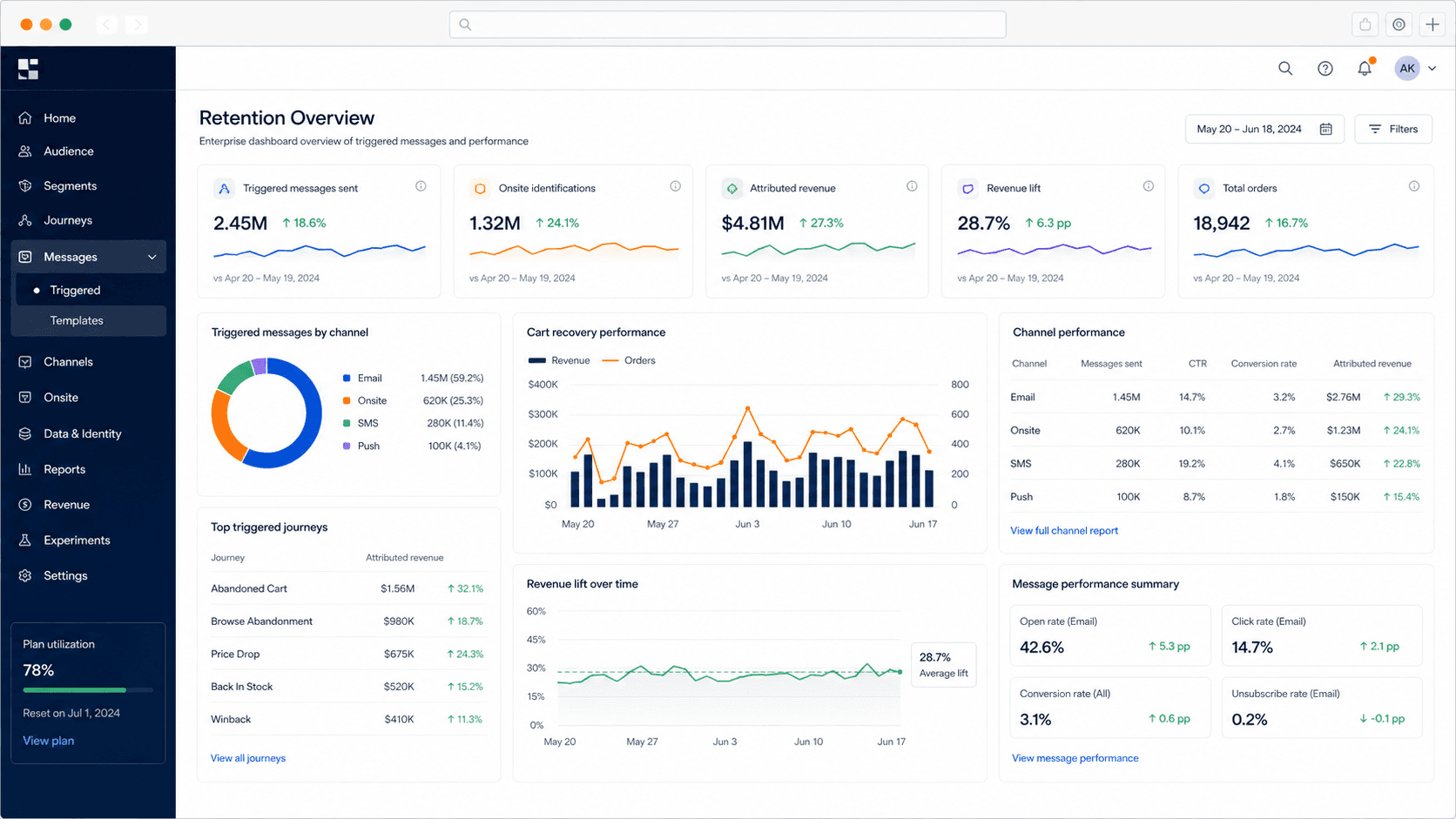
Compare performance recovery against enterprise marketing-cloud architecture
Wunderkind is a focused performance layer for ecommerce identity, triggered email/text messages, and recovered site revenue. Salesforce Marketing Cloud is an enterprise marketing platform for CRM-connected journeys, shared customer data, governance, and multi-team lifecycle operations.
The comparison is less about features and more about architecture: performance recovery layer versus enterprise system of engagement.
Use-case table
| Buying situation | Better starting point | Reason |
|---|---|---|
| Ecommerce brand wants more revenue from site traffic | Wunderkind | Wunderkind is more directly tied to visitor identification and triggered recovery. |
| Enterprise standardizes marketing around Salesforce data | Salesforce Marketing Cloud | SFMC is more relevant when CRM architecture and governance are the buying reasons. |
| Performance team wants vendor-managed triggered messages | Wunderkind | The key proof is incremental recovered revenue, not breadth of campaign tooling. |
| Multiple brands, regions, or teams need shared journey governance | Salesforce Marketing Cloud | Enterprise permissions, data models, and preference management become central. |
| Email-first storefront lifecycle without enterprise rollout | Sequenzy | Sequenzy fits when the scope is practical email automation and transactionals. |
Where Wunderkind is stronger
Wunderkind is stronger when the store has traffic and wants to recover more revenue from visitors who would otherwise remain anonymous or unreached. Evaluation should focus on consent, identity, triggered message logic, incrementality, and how much operational support is included.
It is not the same thing as a full enterprise marketing cloud. Many organizations would still use a separate system for broader campaign management.
Where Salesforce Marketing Cloud is stronger
Salesforce Marketing Cloud is stronger when lifecycle marketing needs to align with Salesforce CRM, enterprise customer data, preference centers, business units, permissions, and partner-led implementation.
Before choosing SFMC as a Wunderkind replacement, identify whether it will actually reproduce the identity-led recovery use case or only replace general campaigns.
Migration checklist
- Separate performance-triggered messages from ordinary lifecycle campaigns.
- Decide where customer identity, consent, preference, and suppression records should live.
- Map Salesforce data extensions, ecommerce events, products, orders, and web behavior.
- Migrate normal journeys before replacing revenue-critical identity triggers.
- Use holdouts or another incrementality method to verify recovered revenue after the switch.
Buying questions to ask
- Is the primary objective incremental recovery or enterprise CRM orchestration?
- Which Salesforce modules and implementation services are required?
- Can SFMC access the same identity and onsite behavior signals?
- Who owns data governance, QA, permissions, and preference management?
- What evidence separates incremental lift from platform-attributed revenue?
Where Sequenzy fits
Sequenzy is the simpler email-first route for Shopify/WooCommerce automations, newsletters, transactional email, and Stripe lifecycle messages when identity recovery and enterprise marketing-cloud governance are outside scope.
Pricing reality
This is a vendor-quote comparison. Validate implementation, governance, data model, channels, contact volume, and contract terms before comparing total cost.
Review signals
Wunderkind's reviews consistently highlight its onsite identification and triggered email and text capabilities for cart recovery, tempered by feedback that its custom enterprise pricing is hard to compare without a direct quote. Salesforce Marketing Cloud's reviews center more on how it handles day-to-day campaign work, how well it fits into an existing Salesforce or marketing stack, and whether its plan tiers and advanced features justify the cost as usage grows. Wunderkind fits identity-led performance marketing; Salesforce Marketing Cloud fits teams already committed to its ecosystem.
Use-case matchups
| Situation | Best first look | Why |
|---|---|---|
| Enterprise ecommerce brand wants identity capture and triggered revenue programs | Wunderkind | Wunderkind is the baseline here when anonymous visitor identification, onsite capture, triggered email, and managed ecommerce revenue programs are central. |
| Team wants enterprise marketing-cloud operations | Salesforce Marketing Cloud | Salesforce Marketing Cloud deserves the first demo when that specialist capability matters more than Wunderkind's identity-led ecommerce model. |
| Store or SaaS team wants simpler lifecycle and transactional email | Sequenzy | Sequenzy is more relevant when email automation and transactional messages matter more than enterprise identity resolution. |
| Team needs a managed service motion | Wunderkind | Wunderkind should be evaluated when services, strategy, and performance programs are part of the buying case. |
| Team wants software-first control | Salesforce Marketing Cloud | Salesforce Marketing Cloud is usually the better first look if the team wants to own configuration and day-to-day execution internally. |
Best Fit by Enterprise Marketing Architecture
Best identity-led revenue partner for ecommerce performance recovery
Wunderkind fits enterprise ecommerce brands that want managed onsite identification, triggered revenue programs, and performance services.
Best marketing cloud for Salesforce-governed enterprise operations
Salesforce Marketing Cloud is the better fit when governance, data extensions, Salesforce alignment, and enterprise marketing operations drive the buying decision.
Best email platform for focused commerce and subscription lifecycle
Sequenzy fits when neither identity-led managed services nor Salesforce Marketing Cloud complexity is needed for the actual email program.
Decision checklist
- Are you paying for a managed, identity-led ecommerce growth service, or for a configurable platform your own team runs?
- Does Salesforce Marketing Cloud's strength in enterprise marketing-cloud operations matter more than Wunderkind's onsite identity and triggered revenue model?
- Ask which vendor can show incremental lift, not just platform-attributed revenue, using your own ecommerce data. For Wunderkind, the key proof is incremental recovered revenue.
- Before signing, confirm who owns implementation and which services are included, since Wunderkind prices on a custom quote and Salesforce Marketing Cloud often relies on partner-led implementation.
- If your current need is lifecycle and transactional email, would a lighter product like Sequenzy cover it without enterprise identity tooling?








