
Untangling the names
Salesforce's marketing products have been renamed several times, so start with a map:
| What people call it | Current name | Built for |
|---|---|---|
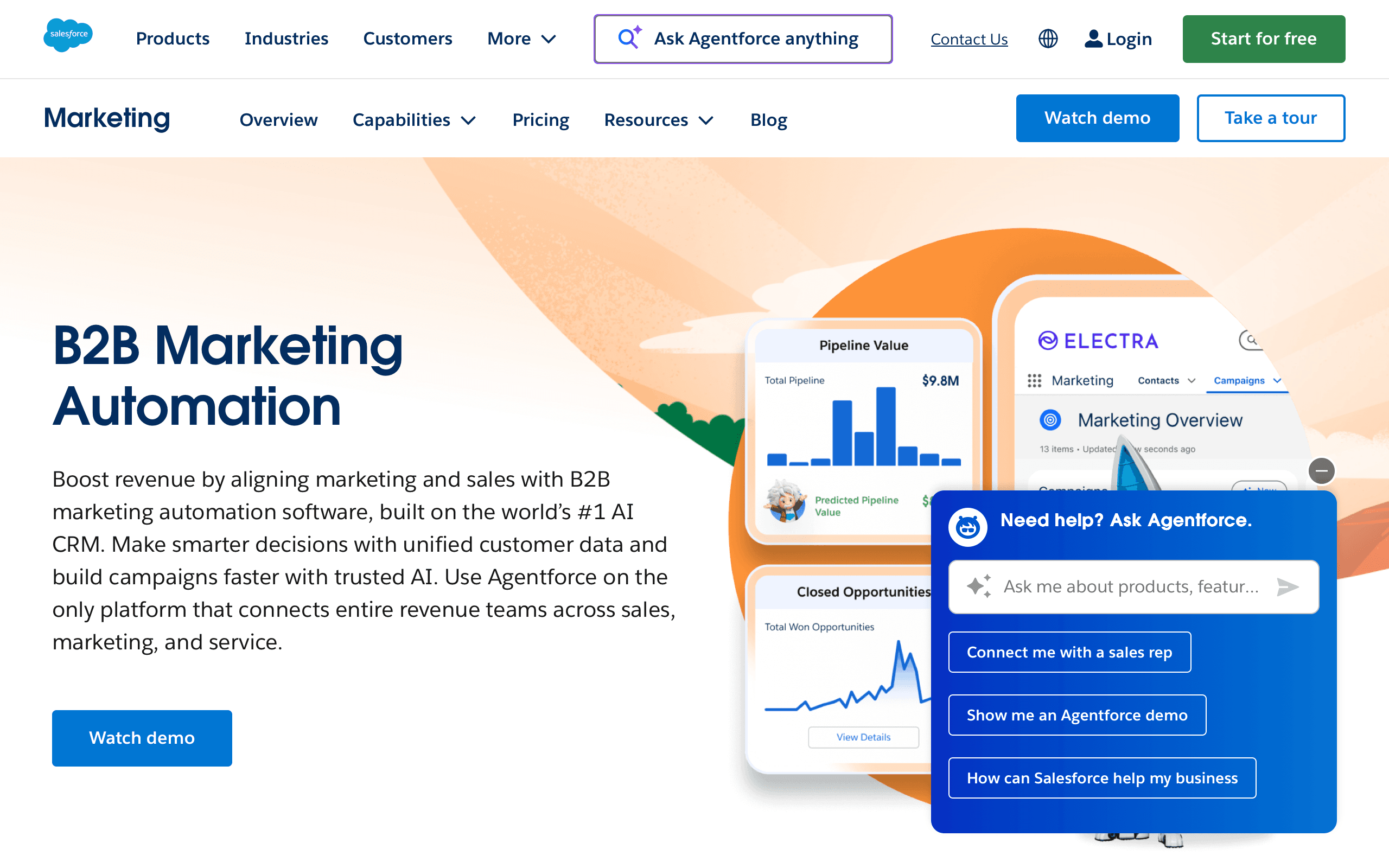
| Pardot | Marketing Cloud Account Engagement | B2B lead generation, nurture and sales alignment |
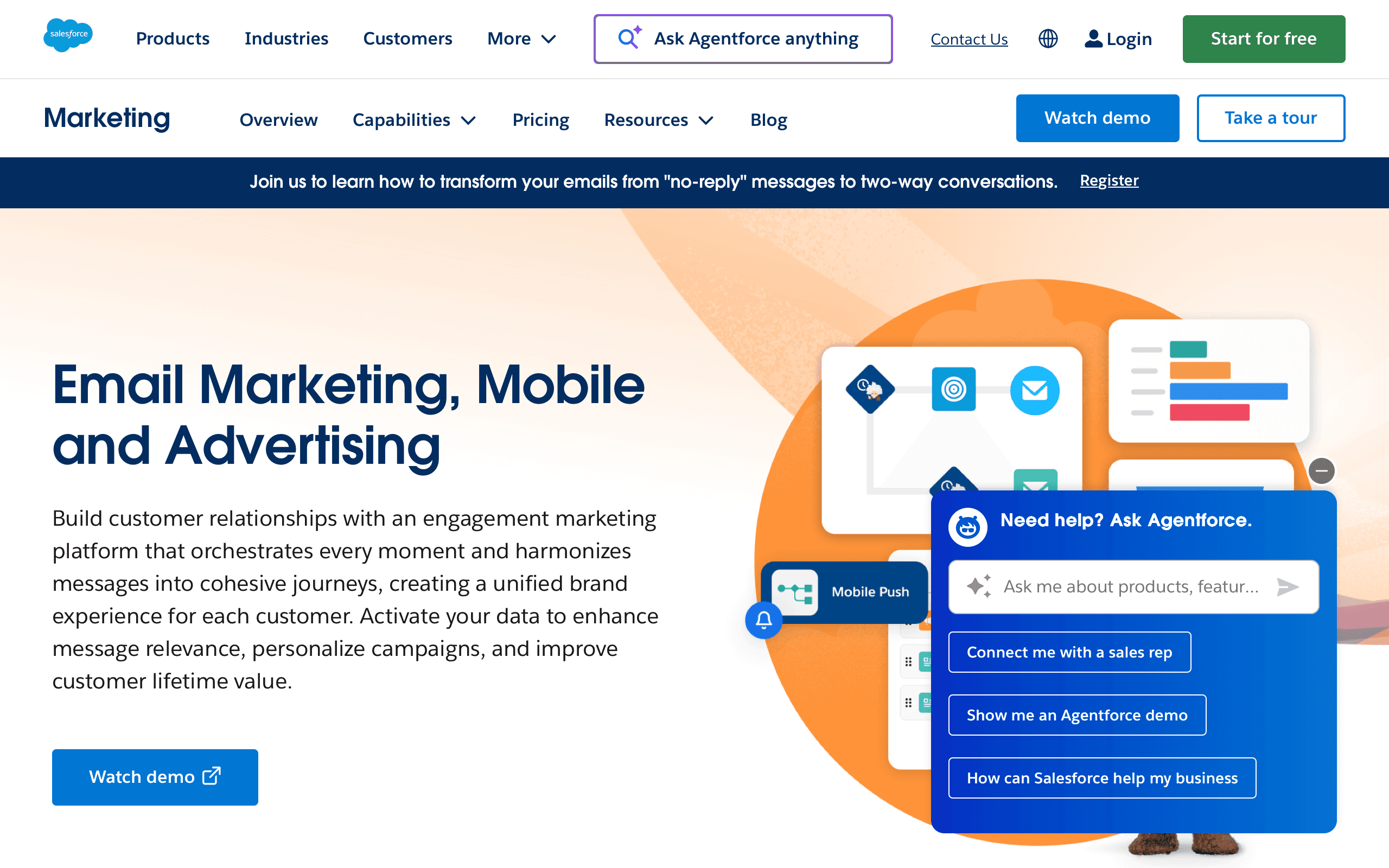
| Salesforce Marketing Cloud, SFMC, ExactTarget | Marketing Cloud Engagement | B2C and high-volume cross-channel messaging |
| The new Marketing Cloud | Marketing Cloud Next (Growth and Advanced editions) | Marketing on Salesforce's core platform and Data Cloud |
This page compares the first two, because that is the choice most buyers face, and explains where the third fits. For each product on its own, see our Pardot comparison and Salesforce Marketing Cloud comparison.
The simplest way to decide
Ask how your company makes money.
If sales reps close deals and marketing's job is to fill and qualify the pipeline, you want Account Engagement. Its world is prospects, forms, scores, grades, nurtures, MQLs and opportunities, all visible to reps in Salesforce.
If customers buy directly in large numbers, online or in stores, and marketing's job is to keep them buying, you want Marketing Cloud Engagement. Its world is audiences of hundreds of thousands to millions, data joined from many systems, and journeys across email, SMS and push.
Most companies fall clearly on one side. The hard cases are covered further down.
How each one works day to day
Account Engagement tracks prospects on your website and forms, adds score for engagement and assigns a grade from A to F for profile fit. Automation rules and completion actions update fields, add to lists and assign leads. Engagement Studio runs nurture programs with steps that check a condition, wait (typically days) and act. Because it is connected to your Salesforce org, reps see prospect activity on the lead or contact record and can get alerts when a hot prospect returns. Plus+ adds account-based marketing, AI-powered scoring and B2B analytics.
Marketing Cloud Engagement stores contacts and attributes in data extensions that you design, and fills them with imports, SQL query activities in Automation Studio and data synced from Sales or Service Cloud through Marketing Cloud Connect. Journey Builder orchestrates email, SMS through MobileConnect and push through MobilePush. Personalisation uses AMPscript and SSJS. It is powerful and flexible, and it expects specialist skills.
Who you need on the team
The two products also imply different hires. Account Engagement is usually run by a marketing operations manager who understands Salesforce objects, campaigns and lead processes, working with a Salesforce admin for connector and permission changes. Many companies manage it without developers.
Marketing Cloud Engagement usually needs at least one person who writes SQL and AMPscript, designs data extensions and understands how Contact Builder, Automation Studio and Journey Builder fit together. Larger programs add developers for SSJS, API integrations and CloudPages, or keep an agency on retainer. Salesforce runs separate certification tracks for each product, which is a good sign of how different the skills are. Budget for these people, not only the licence.
Pricing side by side
All prices are list, per org per month, billed annually, as of September 2026.
| Account Engagement+ | Price | Contacts |
|---|---|---|
| Growth+ | $1,250 | 10,000 |
| Plus+ | $2,750 | 10,000 |
| Advanced+ | $4,400 | 10,000 |
| Premium+ | $15,000 | 75,000 |
| Engagement+ | Price | Contacts | Emails |
|---|---|---|---|
| Pro+ | $2,000 | 15,000 | 2.5M |
| Corporate+ | $5,500 | 45,000 | 10M |
| Enterprise+ | $30,000 | 500,000 | 150M |
Extra Account Engagement contacts cost $100 per 10,000 per month. Both lines include access to Marketing Cloud Next. Neither price includes Salesforce CRM licences or implementation partner fees, which are common for both.
Pricing reality: running both vs one
The B2B2C case is where pricing gets interesting. A company that runs a sales-led B2B program and a consumer program might price the list editions like this, all billed annually:
| Setup | Monthly | Annual | What you get |
|---|---|---|---|
| Account Engagement Growth+ plus Engagement+ Pro+ | $3,250 | $39,000 | 10,000 B2B contacts, plus 15,000 consumer contacts and 2.5M emails |
| Marketing Cloud Next Advanced | $3,250 | $39,000 | Next's journeys, path experimentation and two-way SMS and WhatsApp |
| Account Engagement Plus+ plus Engagement+ Corporate+ | $8,250 | $99,000 | ABM and AI scoring, plus 45,000 consumer contacts, 10M emails and mobile messaging |
The first two lines cost the same on paper, which is exactly why you should ask Salesforce whether Next Advanced covers both motions for your case, or whether you still need Account Engagement's scoring and grading. None of these figures include CRM licences, extra contacts or partner fees.
Where Marketing Cloud Next fits
Marketing Cloud Next is Salesforce's newer marketing product on its core platform and Data Cloud, with Agentforce features for creating campaigns, multi-channel journeys, forms and landing pages. Growth lists at $1,500 per month and Advanced at $3,250. It is bundled into both "+" edition lines above, which suggests where Salesforce is heading. If you are buying fresh, ask your account team how Next relates to the product you are evaluating and what a future migration would involve.
How each handles identity and consent
The two products model people differently, and that shapes both reporting and compliance.
Account Engagement keys prospects on email and links each one to a Salesforce lead or contact. Opt-outs sync with the Email Opt Out field on the Salesforce record, and email preference pages let people choose lists. Because it lives in the CRM, sales and marketing see the same consent status.
Marketing Cloud Engagement keys contacts on a subscriber key (often a Salesforce contact ID or your own customer ID) that you choose during setup and should never change. Consent lives in the All Subscribers list status plus publication lists for categories of email. Choosing the wrong subscriber key strategy early is one of the most expensive SFMC mistakes to fix, because data extensions, journeys and tracking all depend on it.
The hard cases
- B2B2C companies. Some businesses sell to companies and to their employees or customers. Running Account Engagement for the B2B pipeline and Engagement for consumer messaging is common. Decide which product owns each person's consent and profile so nobody gets duplicate emails.
- High-volume B2B. A B2B company with a very large self-serve user base may outgrow Account Engagement's contact-based sizing. That is usually when teams look at Engagement or Next.
- Small B2B teams. If you have a handful of reps and a few thousand leads, Account Engagement's scoring and nurture are useful, but the entry price is still $15,000 a year before Salesforce licences.
Migration checklist
Moves between the two usually happen when a company's motion changes: a B2B firm adds a consumer product, or a consumer-heavy program outgrows Account Engagement.
| Workstream | Account Engagement to Engagement | Engagement to Account Engagement |
|---|---|---|
| Identity | Choose a subscriber key, ideally the Salesforce contact or lead ID | Map subscriber keys to Salesforce leads or contacts by email |
| Consent | Move opt-outs and preference lists into All Subscribers and publication lists | Move All Subscribers status and publication lists into opt-outs and preference lists |
| Data | Design data extensions and connect Sales Cloud with Marketing Cloud Connect | Map fields between prospects and Salesforce objects in the connector |
| Automation | Rebuild Engagement Studio programs in Journey Builder | Rebuild journeys as Engagement Studio programs, without push |
| Templates | Convert HML merge fields to AMPscript | Convert AMPscript to HML, simplifying lookups |
| B2B tooling | Decide where scoring, grading and form handlers will live | Design scoring, grading and assignment rules |
| Reporting | Rebuild campaign influence outside Engagement | Set up Salesforce campaigns and influence models |
Where Sequenzy fits
Sequenzy is relevant to companies that are not built around Salesforce. For a product-led SaaS company, the useful parts of Account Engagement are usually company-level targeting and revenue reporting, not lead grading. Sequenzy covers those with Accounts and revenue attribution from Stripe, and sends lifecycle and transactional email without a CRM dependency. It has no lead scoring, Salesforce sync or SQL-level data tooling. If you need those, stay with Salesforce.
Decision checklist
- Do reps close most revenue from Salesforce opportunities? Account Engagement.
- Do you send millions of emails to consumers? Marketing Cloud Engagement.
- Do you need push or large-scale SMS? Engagement, or Next Advanced for two-way SMS and WhatsApp.
- Do you need MQL scoring, grading and routing? Account Engagement.
- Do you run both B2B and consumer programs? Price both editions against Marketing Cloud Next.
- Do you not use Salesforce at all and mainly need SaaS lifecycle email? Sequenzy.








