
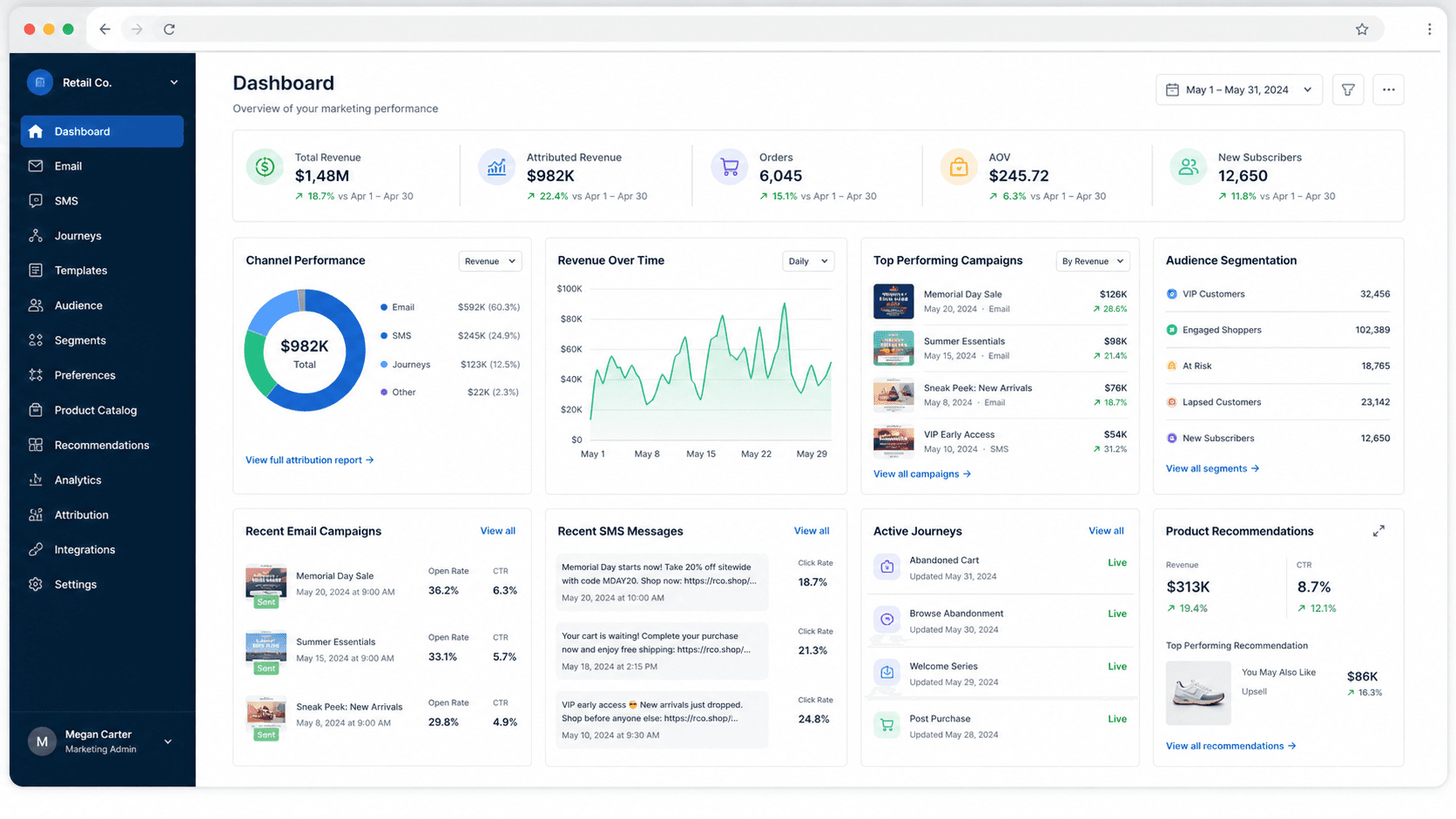

Retail execution or growth journey platform
Listrak is closer to a retail marketing operations platform: ecommerce campaigns, SMS, cart recovery, product recommendations, revenue reporting, and services. Iterable is closer to a growth lifecycle platform: cross-channel journeys, event-driven messages, experimentation, and audience orchestration.
The better choice depends on the team that will operate it. Retail retention teams often get more direct value from Listrak. Growth and lifecycle teams that test journeys across many channels may prefer Iterable.
Why Listrak can be the better fit
Listrak is strongest when the roadmap is retail-specific. If the team wants to improve cart recovery, merchandising-driven campaigns, product recommendations, SMS, and ecommerce revenue attribution, Listrak maps directly to that work.
It is less compelling if the team needs a general journey platform for non-retail product events, app behavior, or broad experimentation.
Why Iterable can be the better fit
Iterable is stronger when the team needs to coordinate lifecycle campaigns across a more flexible event model. It is especially relevant for brands with multiple products, regions, channels, and growth experiments that go beyond retail campaign execution.
The tradeoff is operational maturity. Iterable works best when events, segments, experiments, and channel rules are governed well.
Where Sequenzy fits
Sequenzy fits when both platforms are wider than the actual job. It focuses on Shopify and WooCommerce email automation, transactional email, newsletters, and Stripe-aware lifecycle messages.
Use-case matchups
| Decision point | Listrak | Iterable | Sequenzy |
|---|---|---|---|
| Retail campaign execution and services are the center | Stronger fit | Possible but less retail-service-led | No retail services. |
| Cross-channel lifecycle journeys and experiments are the project | Strong in retail channels | Stronger growth orchestration fit | Email-only. |
| Product recommendations and cart recovery need ecommerce depth | Stronger fit | Partial | Email recovery only. |
| Growth team wants to test audience branches and message timing | Heavier | Stronger fit | Narrower. |
| SMS is required | Strong retail fit | Depends on setup | No SMS. |
| Core need is store-triggered email | Too heavy | Too heavy | Stronger fit. |
Best Fit by Journey Operating Model
Best retail retention suite for campaign execution and services
Listrak fits retail teams that want ecommerce campaign support, SMS, recommendations, and a vendor close to retention operations.
Best journey platform for cross-channel lifecycle experiments
Iterable is the better fit when growth teams need flexible audience branches, message timing tests, and cross-channel journeys beyond retail-specific workflows.
Best email platform for store-triggered lifecycle messages
Sequenzy fits when both platforms are heavier than needed and the core job is store-triggered email, newsletters, and transactionals.
When Iterable is the real alternative
Iterable is the stronger alternative when the team is building cross-channel lifecycle programs and wants to experiment with audiences, branches, timing, and campaign logic across a broader journey layer.
Listrak is stronger when the team wants retail-specific execution and services around ecommerce campaigns, SMS, recommendations, and triggered retention workflows.
Sequenzy is the right comparison only when the journey-platform scope is not needed and the work can stay inside lifecycle email and transactional messages.
Pricing reality
Listrak pricing should be scoped around retail campaign channels, SMS, recommendations, services, integrations, and reporting support.
Iterable pricing should be modeled around users/profiles, message volume, channel mix, data integrations, experimentation needs, and whether the journey builder replaces other lifecycle tools.
Sequenzy should be evaluated against email-first scope and should not be credited for SMS, in-app, or enterprise journey orchestration.
Review signals
The cited Listrak review themes point to retail marketing workflows, reporting, ecommerce retention fit, setup effort, and pricing clarity. The cited Iterable review themes should be read for cross-channel orchestration, experimentation, send-time optimization, data setup, and journey governance. Read reviews through that lens: Listrak risk is retail-suite scope; Iterable risk is implementation complexity if the team does not need a full journey platform.
Migration checklist
| Area | Moving toward Listrak | Moving toward Iterable | Moving toward Sequenzy |
|---|---|---|---|
| Data readiness | Prepare customers, products, orders, consent, SMS consent, and recommendation data. | Prepare user profiles, events, segments, channel consent, campaign taxonomy, and message history. | Map subscribers, consent, tags, attributes, ecommerce events, and transactional triggers. |
| Journey design | Rebuild retail lifecycle triggers, SMS, product recommendations, and campaign operations. | Rebuild cross-channel journeys, experiments, audience branches, and lifecycle campaigns. | Rebuild welcome, cart, post-purchase, winback, campaign, and transactional email. |
| Team ownership | Assign retention owners and vendor-service responsibilities. | Align lifecycle marketing, growth, data, and channel owners. | Assign email lifecycle and deliverability owners. |
| Reporting | Measure campaign revenue, SMS lift, recommendation impact, and services contribution. | Measure journey conversion, experiment lift, cross-channel engagement, and revenue impact. | Measure flow revenue, campaign performance, deliverability, and transactional reliability. |
| Rollout risk | Plan services-led onboarding and channel migration. | Plan event/data mapping, journey QA, and experiment governance. | Keep scope focused and ship email first. |
Decision checklist
- Is the team buying retail execution or cross-channel journey orchestration?
- Will growth marketers run experiments frequently enough to justify Iterable?
- Are Listrak's recommendations and services required in phase one?
- Which channels must be coordinated now versus later?
- Would a narrower email rollout create measurable value before a journey-platform migration?








