
Retail platform or custom lifecycle engine
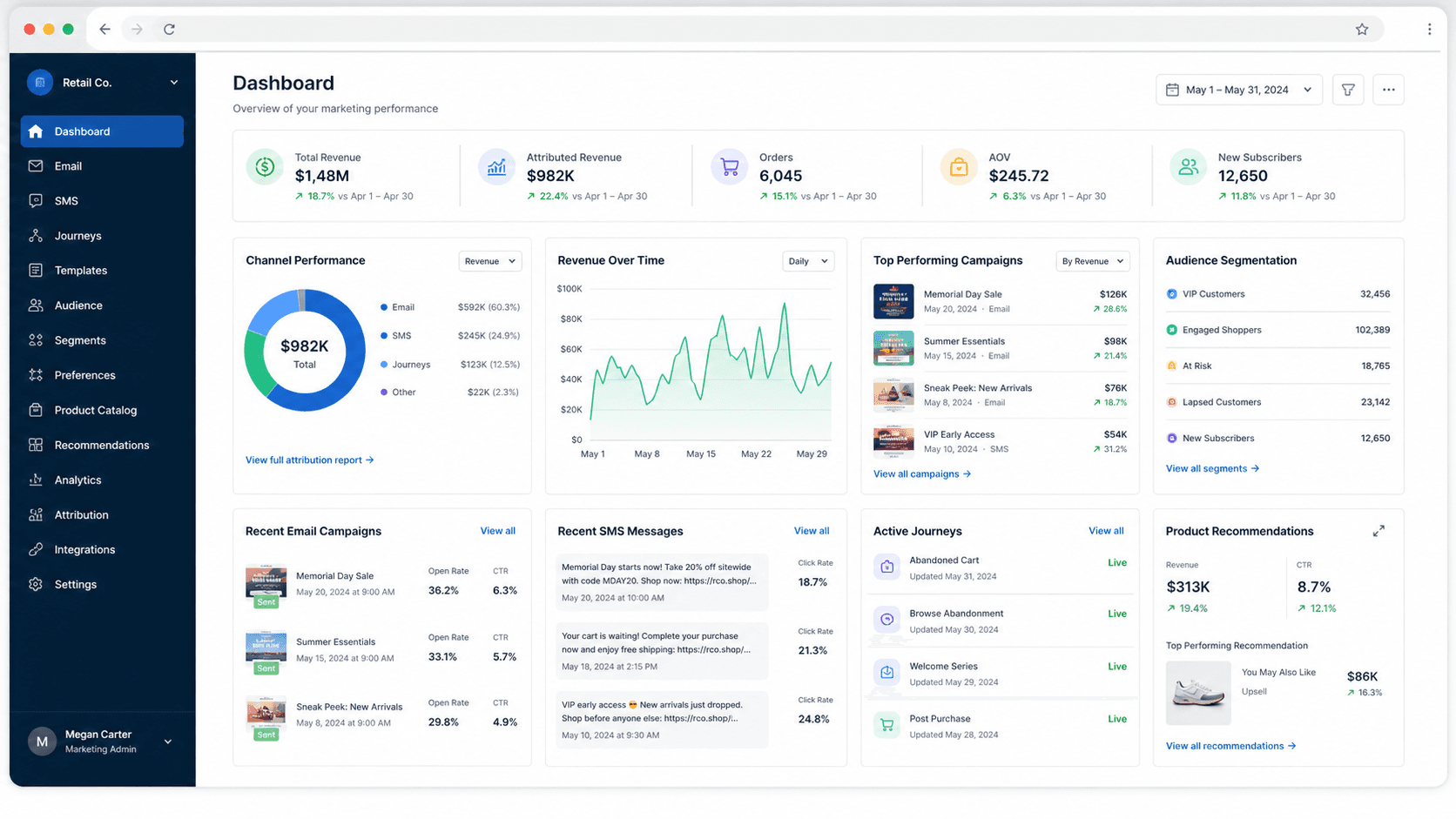
Listrak is built for retail marketers who want ecommerce campaigns, cart recovery, product recommendations, SMS, and support around retail retention. Customer.io is built for teams that want to trigger messages from custom events, attributes, APIs, and lifecycle states. The better choice depends on whether your marketing model is retail-led or event-led.
If your key flows are browse abandonment, cart recovery, replenishment, product recommendations, and retail campaign execution, Listrak is closer to the work. If your key flows depend on product usage, subscription states, account events, or a custom data model, Customer.io has the more flexible foundation.
Why Listrak can be the better fit
Listrak is strongest when ecommerce data and retail merchandising logic need to be close to campaign execution. It is more natural for teams that want vendor support around store retention, recommendations, SMS, and revenue reporting.
The tradeoff is flexibility. Listrak is not usually the first choice when engineering wants to define a broad event stream and use it across product-led lifecycle journeys.
Why Customer.io can be the better fit
Customer.io is stronger when the team can own event instrumentation and wants to design journeys from custom behavior. That makes it relevant for stores with subscription products, SaaS elements, marketplaces, apps, or lifecycle states that go beyond ordinary retail events.
The tradeoff is implementation ownership. Customer.io can be powerful, but only if identifiers, events, attributes, and suppression rules are well maintained.
Where Sequenzy fits
Sequenzy is narrower than both: Shopify and WooCommerce email automation, Stripe-aware lifecycle email, newsletters, and transactional messages. It fits when supported ecommerce and billing events cover the real need.
Use-case matchups
| Decision point | Listrak | Customer.io | Sequenzy |
|---|---|---|---|
| Retail campaigns, SMS, recommendations, and services are required | Stronger fit | Partial | No SMS/recommendations. |
| Product/app events should drive custom lifecycle messages | Less flexible | Stronger fit | Strong for supported store/billing events. |
| Engineering owns event instrumentation | Not the main model | Stronger fit | Simpler integration path. |
| Ecommerce cart recovery and product recommendations need retail support | Stronger fit | Partial | Email recovery only. |
| SaaS or product-led lifecycle is also in scope | Weak | Stronger fit | Strong for Stripe-aware email. |
| Team wants a vendor close to retail marketing operations | Stronger fit | More technical/self-serve | Direct support, not services-led. |
Best Fit by Lifecycle Data Model
Best retail marketing suite for ecommerce campaigns and services
Listrak fits retailers that need campaign support, SMS, recommendations, cart recovery, and product-aware retention operations. It should be evaluated first when the buying case includes services, merchandising context, and revenue programs around onsite and shopper behavior.
Best lifecycle platform for custom product and app events
Customer.io is the better fit when engineering-owned events, custom lifecycle states, and product-led journeys drive the messaging program. Choose it when the team wants software-first control over event schemas, lifecycle branches, and behavioral campaigns instead of a retail-services model.
Best email platform for supported store and billing events
Sequenzy fits when the team needs Shopify, WooCommerce, or Stripe-aware lifecycle email without a technical event-infrastructure project. It is the simpler option when email automation and transactionals matter more than SMS, recommendations, or managed retail strategy.
When Customer.io is the better fit
Customer.io is the better fit when the team thinks in events, attributes, APIs, and lifecycle states. It is especially relevant when ecommerce is only part of a broader product-led or SaaS lifecycle messaging model.
Listrak is the better fit when the team wants a retail marketing platform: campaign execution, SMS, recommendations, cart recovery, and vendor support around ecommerce retention.
Sequenzy is the narrower fit when the event model is mostly Shopify, WooCommerce, Stripe, campaigns, and transactional email rather than a broad custom event stream.
Pricing reality
Listrak pricing should be scoped around retail channels, SMS, recommendations, services, integrations, send volume, and support expectations.
Customer.io pricing should be modeled around profiles, message volume, data pipelines, event instrumentation, technical setup, and whether marketing can own journeys without engineering bottlenecks.
Sequenzy should be evaluated when supported ecommerce and billing triggers cover the needed lifecycle messages.
Review signals
The cited Listrak review themes point to retail marketing workflows, reporting, ecommerce retention fit, setup effort, and pricing clarity. The cited Customer.io review themes point to campaign usability, integrations, day-to-day workflow, and the need to check advanced features against real usage. Read reviews through that lens: Listrak risk is retail-suite complexity; Customer.io risk is whether the team can maintain the event model and journey logic cleanly.
Migration checklist
| Area | Moving toward Listrak | Moving toward Customer.io | Moving toward Sequenzy |
|---|---|---|---|
| Data readiness | Prepare customers, orders, products, email consent, SMS consent, and recommendation data. | Define event taxonomy, person attributes, identifiers, segments, API sources, and suppression rules. | Map subscribers, consent, tags, attributes, ecommerce events, and Stripe events. |
| Technical setup | Connect ecommerce data, campaign history, templates, and channel permissions. | Instrument events, test webhooks/API calls, and document source-of-truth rules. | Connect supported integrations and import subscriber context. |
| Automation | Rebuild retail triggers, SMS, recommendations, and campaign reporting. | Build event-triggered journeys from product, app, ecommerce, or lifecycle events. | Build lifecycle flows, campaigns, and transactional messages. |
| Ownership | Assign retention owners and vendor-service responsibilities. | Align lifecycle, product, engineering, and data owners. | Assign email lifecycle and deliverability owners. |
| Success metrics | Measure campaign revenue, SMS lift, recommendations, and services impact. | Measure event-to-message conversion, activation, retention, and lifecycle revenue. | Measure flow revenue, campaign performance, deliverability, and transactional reliability. |
Decision checklist
- Is the lifecycle model retail-led or event/API-led?
- Does engineering have capacity to maintain Customer.io instrumentation?
- Are SMS and product recommendations required in phase one?
- Is SaaS or product-led messaging part of the same system?
- Would supported ecommerce and Stripe triggers cover the immediate email work?








