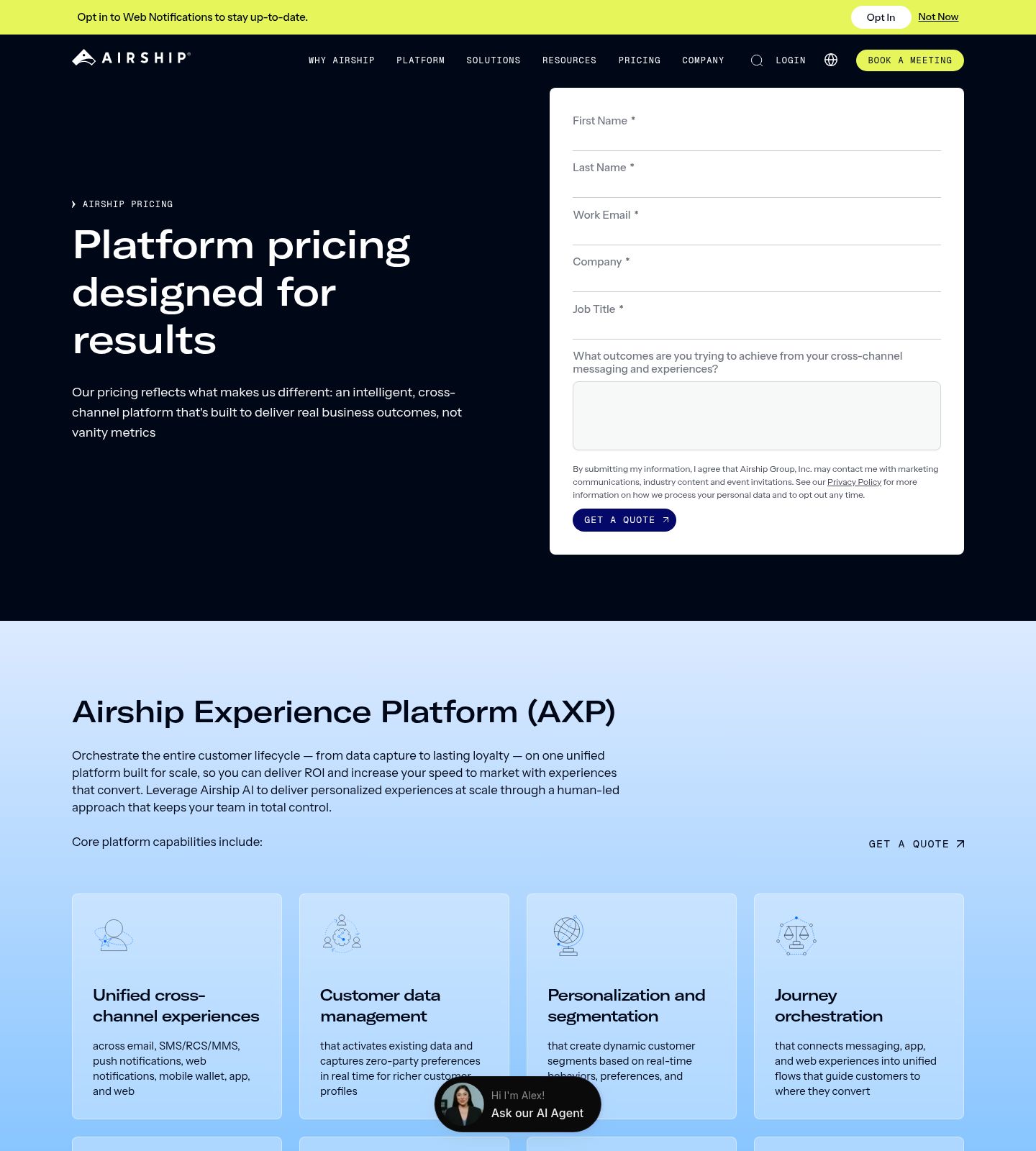
Airship's pricing page
Captured from airship.com. Pricing changes often, so confirm the current numbers on the live page.
Buying shortcut
Which Airship plan should you choose?
Start here
Essentials Starter
Small app teams starting with push and in-app messaging. It is the first tier to check when you only need the core Airship workflow. Watch for: 25 active and 50 total automations
Public price
Not published
Self-serve sign-up. Usage and payment history are in the dashboard.
Main upgrade
Essentials
Growth teams building app and web experiences without a sales cycle. Inspect this tier when the lower tier starts blocking reporting, automation, collaboration, or support needs. Watch for: No email, SMS or Wallet
Public price
Not published
Self-serve plan, upgradeable from Starter in the dashboard.
High-volume or advanced
AXP Enterprise
Larger brands that want every channel plus data and services. Treat this as the serious-operations tier, especially if the first two plans leave key limits or add-ons unresolved. Watch for: Sales-led pricing
Public price
Custom
Annual or multi-year contract, quoted on your audience count.
Cost scenarios
Pricing pages show the entry point. These scenarios show what the plan means in real buying situations.
Subscription app that needs email plus push
Airship: Email is available only on AXP Enterprise, as a separate package on a quoted contract. Vendr's median Airship contract is about $37,800 a year.. Sequenzy: Email, push, in-app and content cards are on every plan. Push and in-app are unlimited, and 20,000 users sending three emails a month (60,000 sends) is the $49/mo plan.. If email is part of the program, Airship pushes you to Enterprise. Sequenzy includes it from the free plan.
App that lives on push, in-app screens and Wallet passes
Airship: Essentials covers push, in-app and Scenes by self-serve sign-up. Wallet requires Enterprise.. Sequenzy: Sequenzy has push, in-app, content cards and iOS Live Activities, but no Wallet passes or native multi-screen Scenes.. Airship wins when app experiences and Wallet are the core of the program.
Large consumer app negotiating a contract
Airship: Vendr groups deals under 1 million MAU at roughly $25,000 to $75,000 a year, and says three-year terms often price 15-30% better than one-year deals.. Sequenzy: Published prices at every volume, monthly or yearly, with no contract required.. Airship is cheaper than Braze for many apps, but you still need procurement and a multi-year view.
Anonymous users who never sign in
Airship: Airship registers channels per device, so anonymous app users can receive push.. Sequenzy: Every Sequenzy contact needs an email address, so users get push only after they sign in.. Airship is the better fit for apps that monetize logged-out users.
What to watch for
Airship publishes no prices for any plan, so you cannot estimate a bill without a quote or a self-serve sign-up.
Email, SMS/MMS/RCS and Wallet are add-on packages on Enterprise only. The self-serve Essentials plans cannot send email or SMS.
Scene impressions, feature flags, Boost delivery speed and extra data-streaming connectors are metered on top, and committed volumes do not roll over.
Essentials Starter caps you at 25 active automations and 50 in total, and Scenes are an add-on on that plan.
Reporting history in Performance Analytics is 3 months on every plan, and only Enterprise can buy more.
How Airship pricing works
Airship's pricing page has two buttons and no numbers. The Airship Experience Platform (AXP), which Airship's docs call the Enterprise plan, leads to a quote form. Airship Essentials leads to a self-serve sign-up that starts with a free account. Airship's docs list three current plans, AXP Enterprise, Essentials and Essentials Starter, and you can see which one you are on under Usage and Plan in the dashboard.
Enterprise contracts are priced on an audience count that the contract defines. It can be monthly active app users, monthly unique web visitors, contacts, or a mix. Airship counts an MAU when a user opens your app in a calendar month, tracked per channel ID. A contact is counted once per channel, so a user with an iPhone and an Android tablet can count twice. On top of the audience, several things are metered:
| What is metered | How Airship bills it |
|---|---|
| Scene impressions | Minimum fee for the first 1,000, then contracted rate per display |
| Feature flags | Peak daily active flags, with a minimum fee |
| SMS | Per message segment (160 GSM-7 characters, 70 with emoji) |
| Email, SMS, Wallet packages | Committed minimum volumes that do not roll over |
| Boost delivery speed | Add-on on every plan |
Essentials cannot send email
This is the detail most comparison articles miss. Airship's feature packages list email, SMS/MMS/RCS and Wallet as add-ons on AXP Enterprise only. Essentials and Essentials Starter cover push, in-app messages, Message Center, Scenes, web push, Live Activities and journeys, which is a solid app-messaging stack, but if your lifecycle program includes email you are buying Enterprise.
Essentials Starter has two more limits worth knowing: 25 active automations (50 in total) instead of 1,000, and Scenes as a paid add-on. Every plan gets 3 months of Performance Analytics, and only Enterprise can buy more.
What Airship contracts cost
Vendr reports a median Airship contract of about $37,800 a year, with a range of roughly $21,000 to $135,000. Vendr's deal categories put apps under 1 million MAU at around $25,000 to $75,000 a year, with implementation adding $10,000 or more. It also reports that three-year terms often price 15-30% better than one-year terms, and that Airship's fiscal year ends on December 31. Push is usually included in the base price, while email, SMS and Wallet carry their own fees.
On price, Airship usually sits below Braze and above OneSignal, whose Growth plan starts at $19 a month plus $0.012 per mobile MAU. CleverTap is the only rival in this group with a published per-MAU price. For a full shortlist, see our Airship alternatives guide.
Airship vs Sequenzy on cost
Airship meters your audience and adds channel packages on top. Sequenzy bills for emails sent and includes web push, iOS and Android push, in-app messages and content cards on every plan, including the free one. A subscription app with 20,000 users sending three lifecycle emails per user a month needs 60,000 sends, which is the $49/mo plan, with push and in-app unlimited. RevenueCat sends events to both Airship and Sequenzy natively, and Sequenzy also connects to Superwall and Adapty, where Superwall still lists Airship as coming soon.
Airship is ahead on app experiences. It has Wallet passes, multi-screen Scenes, feature flags and a long list of SDKs, including tvOS and Fire OS. And every Sequenzy contact needs an email address, so anonymous users who never sign in cannot receive push. If those matter more than email, Airship is the better tool.
Airship vs Sequenzy
How Airship compares with Sequenzy, which bills on emails sent rather than contact count.
How Sequenzy prices the same volume
Sequenzy price per 1k emails
$0.82 / 1k at $49/mo for 60k emails
Verdict
Airship is a strong choice for push-first apps that care about delivery speed, native in-app screens, Live Activities and Wallet. Its pricing is opaque at every level, and email and SMS only come with an Enterprise contract. For apps that want email, push and in-app driven by subscription events, Sequenzy gives you all three on a published, send-based plan.
FAQ
Sources checked · Nov 8, 2026
Written by Nic Polotnianko, co-founder of Sequenzy, which appears in this comparison. How we compare tools