
14 Best Marketing Automation Platforms for E-Commerce in 2026

"Marketing automation" is a category name that hides more than it reveals. It covers a $16 per month tool that sends a welcome series and a six-figure platform that unifies point-of-sale, loyalty, app, and web behavior into one customer record.
Both are automation. Only one of them is right for your store, and the gap between them is not features. It is whether you have the data, the traffic, and the team to make depth pay.
I compared 14 platforms against what a store actually builds: the seven flows that produce nearly all automated revenue, the event fidelity required to trigger them, the segmentation needed to make them relevant, and the attribution needed to know whether they worked. I also weighted implementation cost heavily, because a platform you never finish configuring produces zero revenue regardless of its capabilities.
One finding worth stating up front: at every tier I looked at, the difference between stores was almost never the platform. It was whether the top four flows existed and had been tuned.
For the email-only version of this comparison, see the best email marketing platforms for e-commerce. For the messaging-specific view, see the best email and SMS marketing platforms.
This guide is part of our best email automation software comparison.
Quick comparison table
| Platform | Tier | Billing | Entry cost | Channels | Implementation |
|---|---|---|---|---|---|
| Klaviyo | Mid-market to upper-mid | Active profiles | About $20/mo, $150/mo at 10k | Email, SMS, push | 2 to 4 weeks |
| Omnisend | SMB to mid-market | Contacts | From about $16/mo | Email, SMS, push | 1 to 2 weeks |
| Sendlane | Mid-market | Sends, unlimited contacts | $100/mo for 50k sends | Email, SMS | 2 to 3 weeks |
| Drip | SMB to mid-market | Contacts | $39/mo at 2.5k, $154/mo at 10k | 1 to 3 weeks | |
| ActiveCampaign | SMB to mid-market | Contacts | From about $15/mo at 1k | Email, SMS via provider | 2 to 4 weeks |
| Sequenzy | SMB to mid-market | Sends | Paid plans from $19/mo | Email, push, SMS add-on | 1 to 2 weeks |
| Brevo | SMB | Sends, unlimited contacts | From about $9/mo | Email, SMS, transactional | 1 to 2 weeks |
| Mailchimp | SMB | Contacts | From about $13/mo | Email, limited SMS | 1 week |
| Attentive | Upper-mid to enterprise | Custom, committed | $2,000 to $3,000 per quarter minimum | SMS, email, RCS, push | 4 to 8 weeks |
| Listrak | Mid-market to enterprise | Custom | Custom quote | Email, SMS, identity | 2 to 4 months |
| Bloomreach | Enterprise | Custom | Custom quote | Full CDP plus channels | 3 to 9 months |
| Braze | Enterprise | Custom | Custom quote | Full cross-channel | 3 to 9 months |
| Iterable | Enterprise | Custom | Custom quote | Full cross-channel | 3 to 6 months |
| Shopify Email | Entry | Per email after allowance | Free under 10k emails | Email, plus Shopify Messaging | Same day |
Pricing changes frequently. Confirm current rates and implementation scope directly with each vendor.
What actually separates these platforms
Feature lists all look similar. Four things genuinely differ.
1. Event fidelity, not integration count
Every platform lists Shopify. What varies is what arrives and how reliably: does browse behavior include product IDs, does the abandoned checkout event include cart contents and a working checkout URL, do refunds propagate, does fulfillment status update, does consent stay synchronized.
Klaviyo captures the most on Shopify. On WooCommerce the ranking changes, and Omnisend's plugin maintenance becomes the differentiator. On a custom stack, an API-first platform often beats any prebuilt connector because you control what fires.
Test this before anything else. A platform with perfect segmentation and a missing cart event is worse than a simpler platform with reliable data.
2. Whether the flow can change its mind
The difference between a sequence and an automation is what happens after message one. Can the flow check whether the email was opened, whether the order was placed, whether the customer bought something else, or whether a refund happened, and change course?
Ask to build this in a trial: "send email, wait 6 hours, if not purchased and not opened send SMS, if purchased exit and enter post-purchase." Platforms that struggle with that are running sequences, not automation.
3. Whether attribution can be challenged
Every platform reports flow revenue. Only some let you inspect the attribution window, see order-level detail, and run a holdout.
A platform that presents one confident number and no way to check it is not giving you a measurement. It is giving you a marketing asset.
4. Implementation reality
An enterprise platform with a nine-month implementation produces nothing for nine months. A mid-market platform live in three weeks starts compounding immediately.
The correct platform is frequently the one you will actually finish configuring.
How I evaluated these platforms
- Connected a Shopify store and a WooCommerce store to each and compared what arrived: orders, line items, browse events, checkout events, refunds, fulfillment, and consent.
- Built the same conditional flow on each: email, wait, branch on open and purchase, SMS to non-converters, exit on purchase.
- Placed a refund and confirmed whether downstream messages were suppressed.
- Attempted three segments of increasing complexity and recorded which were expressible.
- Ran a 10 percent holdout on a cart flow and compared incremental revenue against reported revenue.
- Priced each platform at 10,000 and 25,000 contacts with a realistic send volume.
- Recorded time from account creation to first live, validated flow.
The 14 best e-commerce marketing automation platforms
1. Klaviyo
Best for: Mid-market stores where customer data should drive what gets sent.
Pricing: Email from about $20/month at 251 to 500 active profiles, roughly $150/month at 10,000. Email and SMS plans from around $35/month including 1,250 credits.
Klaviyo is the default for a reason that survives scrutiny: it has the deepest commerce data model available at a self-serve price, and the prebuilt flow library encodes more accumulated practice than anything else in the category.
Its differentiators are concrete. Predicted lifetime value and churn risk make VIP and win-back segments behavioral rather than rule-based. Browse abandonment on Shopify has real event fidelity. Flow-level revenue reporting lets you evaluate an individual step rather than a channel total. And email, SMS, and push share one profile, so cross-channel suppression works.
The costs are equally concrete. Active-profile billing punishes a large dormant list. The learning curve is real, and the failure mode is a store that builds an impressive flow nobody understands well enough to maintain. On WooCommerce, the integration advantage largely evaporates.
- Pros: Deepest data model, predictive fields, best flow library, genuine cross-channel suppression, flow-level attribution you can interrogate.
- Cons: Active-profile billing, real learning curve, easy to over-build, WooCommerce integration is much weaker than Shopify.
Verdict: The right default for mid-market Shopify commerce, and worth its price only if the depth gets used.
2. Omnisend
Best for: Stores that want working automation in a week rather than a quarter.
Pricing: Standard from about $16/month, roughly $115 to $132/month at 10,000 contacts. SMS on Pro from about $0.009 down to $0.007 per US message, with bundles from around $10/month.
Omnisend's advantage is time to value. The prebuilt commerce workflows cover welcome, cart, browse, and post-purchase competently out of the box, and the same canvas handles email, SMS, and push with shared subscriber data.
Its WooCommerce plugin is better maintained than most, which makes it the more reliable choice outside Shopify. The product picker makes catalog-driven emails fast, and the interface is genuinely usable by a non-specialist.
The ceiling arrives around the point where segmentation needs to get precise. There are no predictive fields, reporting is less granular, and SMS sits behind the Pro plan on current pricing.
- Pros: Fastest time to live, three channels on one canvas, strong WooCommerce plugin, excellent value under 10k contacts.
- Cons: Segmentation ceiling, no predictive data, SMS gated to Pro, contact-based billing.
Verdict: The best value in the category below roughly 10,000 contacts.
3. Sendlane
Best for: Established stores with large databases and moderate send calendars.
Pricing: Professional from $100/month for 50,000 email sends with unlimited contacts. SMS from about $0.009 per credit.
Sendlane is the most consistently overlooked platform in this category. Its commerce automation, segmentation, and attribution are competitive with Klaviyo's for most practical purposes, and its billing shape is fundamentally better for a store carrying years of accumulated subscribers.
Unlimited contacts on send-based pricing means a 50,000-profile database with a 12,000-person engaged segment costs the same as a 12,000-profile one. For a mature store, that difference frequently exceeds every other cost consideration.
The $100 floor makes it poor value below roughly 8,000 contacts. The ecosystem is smaller, so fewer agencies know it and fewer community answers exist.
- Pros: Unlimited contacts on send-based pricing, commerce depth close to Klaviyo, email and SMS integrated, strong multi-store support.
- Cons: $100/month floor, smaller ecosystem and agency network, less brand recognition, regional SMS needs verification.
Verdict: The best value at scale for stores with big dormant lists. Price it before renewing anything.
4. ActiveCampaign
Best for: Stores whose journeys are more complex than their merchandising.
Pricing: Starter from about $15/month at 1,000 contacts on annual billing, with automation, CRM, and advanced features gated by tier.
ActiveCampaign has the most expressive automation builder in this comparison, full stop. Conditions, goals, lead scoring, waits, split paths, and CRM tasks let you model journeys that commerce-first platforms handle awkwardly or not at all.
That matters for a specific kind of store: one selling retail and wholesale, one with a sales-assisted motion for high-value orders, one with B2B accounts alongside DTC, or one where the customer journey spans months and multiple decision-makers.
It is not commerce-first. Product merchandising is weaker, you build more from scratch, SMS is not native, and the genuinely useful automation features sit on higher tiers.
- Pros: Best conditional logic available, CRM and sales workflows, works across business models, enormous integration ecosystem.
- Cons: Not commerce-first, weaker merchandising, features gated by tier, SMS via a connected provider, more build effort.
Verdict: Choose it for journey complexity, not for store data.
5. Drip
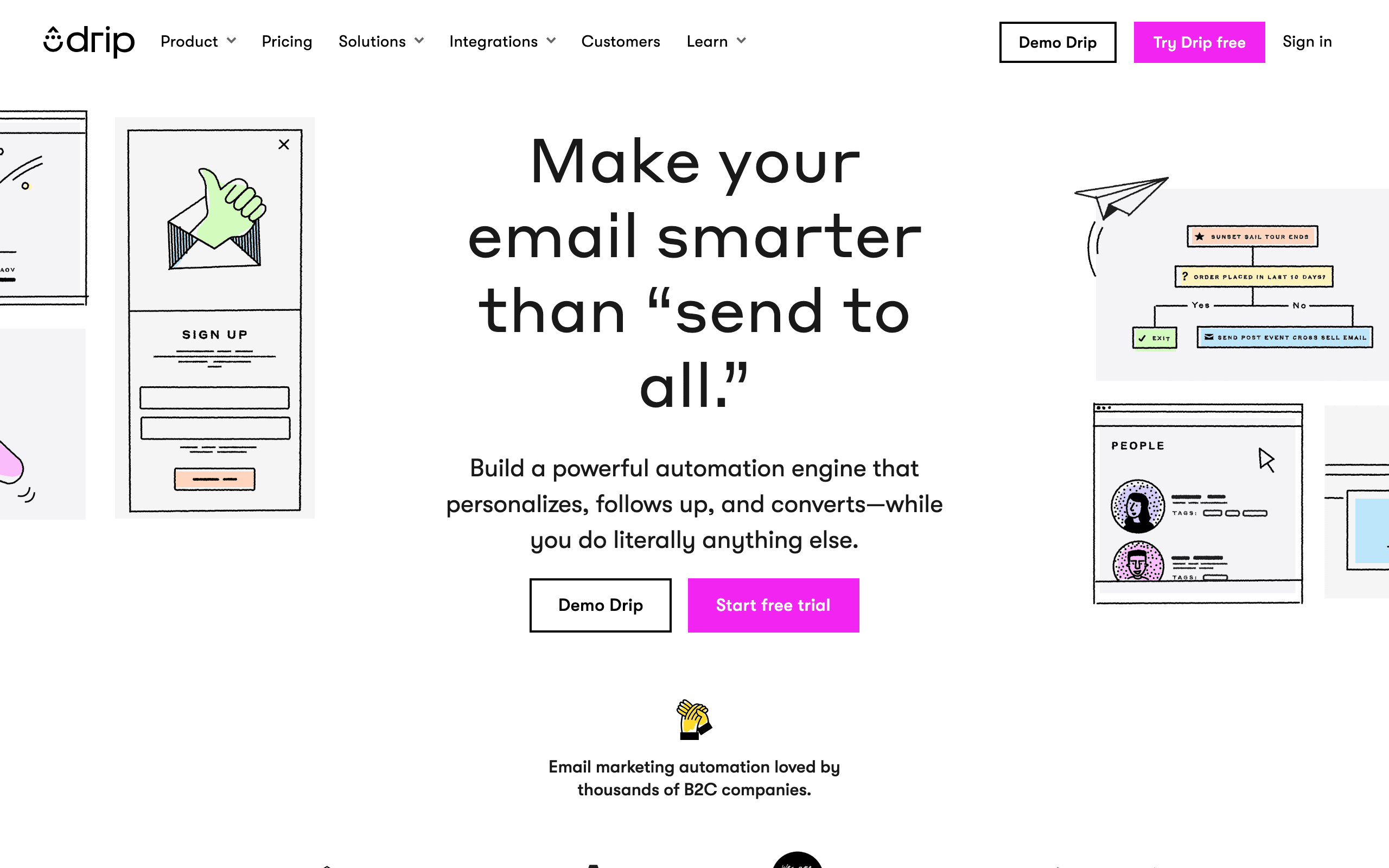
Best for: Email-first stores that want behavioral depth with no feature gating.
Pricing: From about $39/month at 2,500 contacts, rising to roughly $154/month at 10,000, with all features included at every tier.
Drip sits philosophically close to Klaviyo but with less platform weight. The visual workflow builder handles branching, delays, and purchase-based segments well, and revenue reporting is oriented around which flow made money.
The flat feature model is a genuine differentiator: nothing is locked behind a tier, so a small store gets the same automation capability as a large one.
It is not cheaper than Klaviyo at 10,000 contacts, which limits its use as a cost play, and it is email-first without a serious SMS story.
- Pros: All features on every plan, strong behavioral automation, good revenue attribution, commerce-oriented.
- Cons: Not cheaper at 10k contacts, no free tier, no real SMS, smaller ecosystem than the leaders.
Verdict: A solid email-first automation platform with an unusually fair feature model.
6. Sequenzy
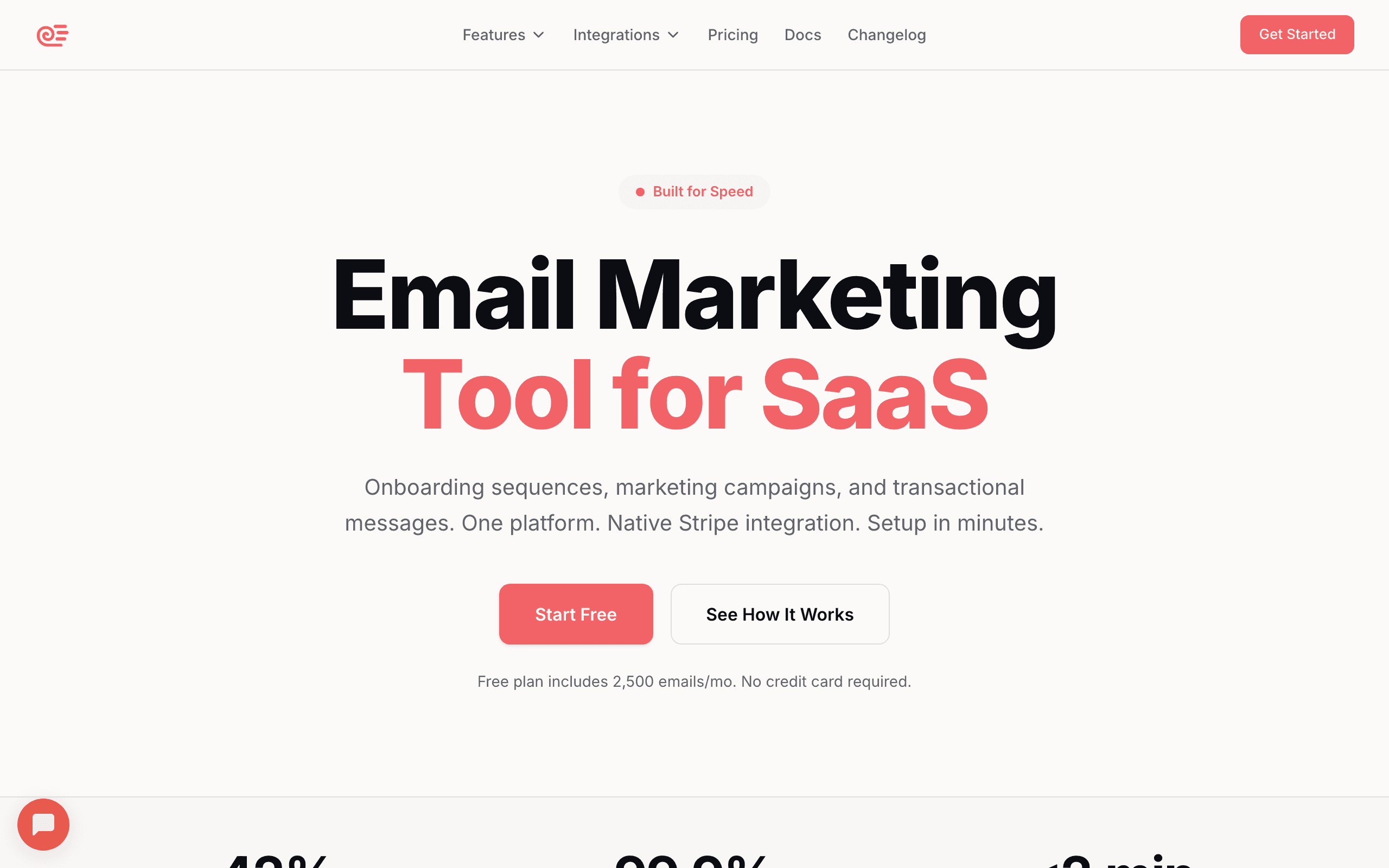
Best for: Lifecycle-led stores and hybrid businesses selling both products and subscriptions.
Pricing: Paid plans from $19/month with send-based email pricing, plus an SMS add-on from $16/month including 1,000 credits.
Disclosure: I build Sequenzy. For a pure Shopify store where merchandising depth is the priority, Klaviyo and Omnisend will outperform it, and that is the honest ranking.
The case it does fit is a business whose revenue comes from more than one system. Native Shopify and Stripe integrations plus Paddle, Polar, Creem, and Dodo Payments mean a store selling physical product alongside memberships, subscriptions, or digital goods keeps one subscriber profile instead of splitting customers across two platforms. Transactional and marketing email also live in the same place, which most platforms here treat as separate products.
Operationally, sequences handle branching, waits, and conditions; catalog sync and dynamic product blocks cover product-driven emails; goals and revenue attribution tie orders back to steps; and SMS drops in as a step with managed toll-free provisioning, separate consent, and enforced quiet hours. Everything is exposed through a full API, CLI, and MCP server, which is unusual in this category and matters for teams that script operations.
Honest limits: no predictive analytics or AI product recommendations, WooCommerce sync is beta, and no in-app two-way SMS inbox.
- Pros: Send-based pricing, Shopify plus multiple billing platforms in one profile, transactional and marketing together, strong API, CLI, and MCP, SMS inside the same sequences.
- Cons: No predictive analytics, WooCommerce sync is beta, lighter merchandising than Klaviyo.
Verdict: Right for hybrid and lifecycle-led businesses. Not the deepest pure-commerce platform here.
7. Brevo
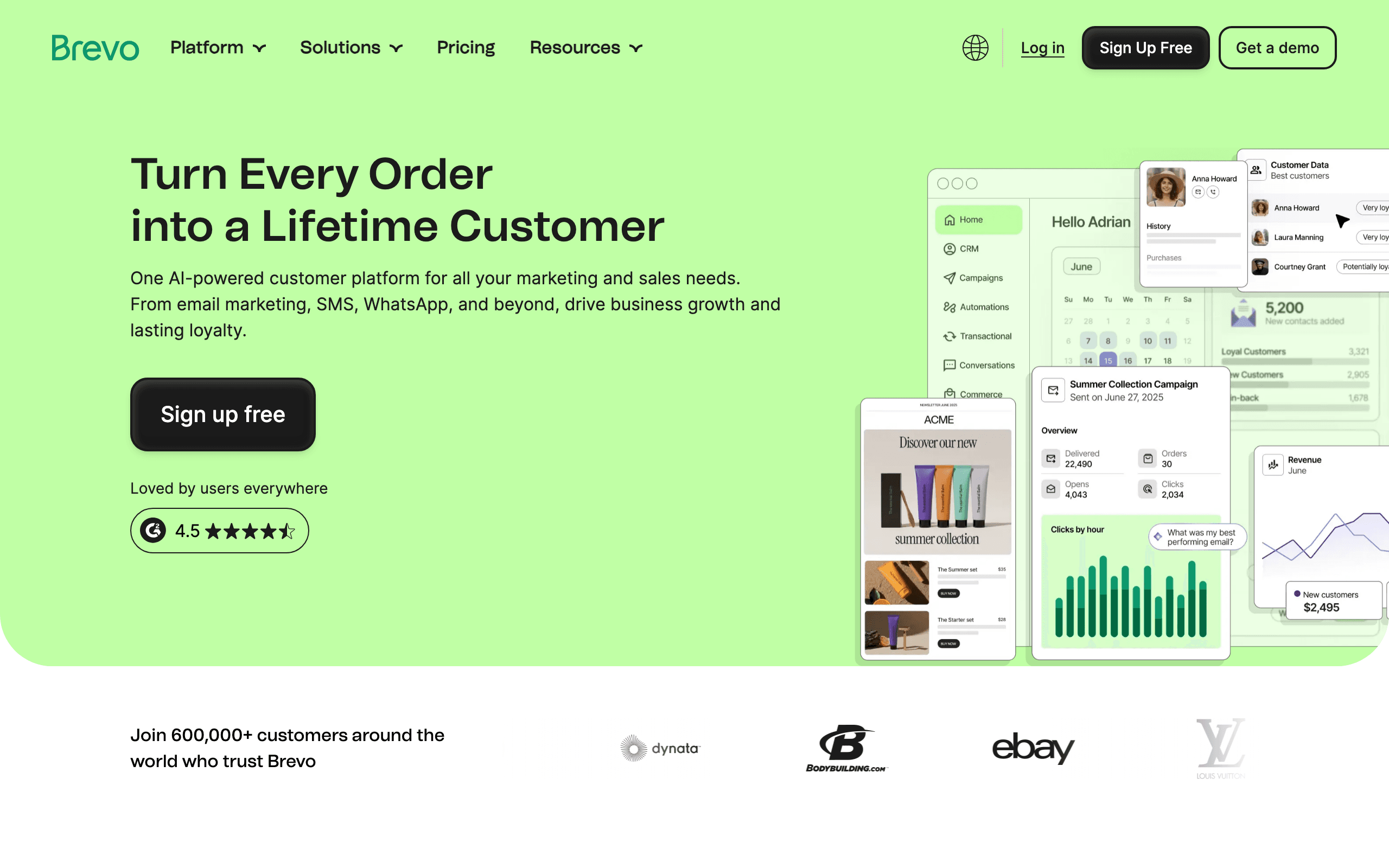
Best for: Cost-sensitive stores with large lists and heavy transactional volume.
Pricing: Free plan with a daily allowance, then Starter from around $9/month for 5,000 emails, with unlimited contacts. SMS is credit-based and priced per destination.
Brevo is the cheapest credible automation platform for a store with a big list and a modest send calendar. Unlimited contacts on send-based billing removes the database cost entirely, and transactional email plus international SMS sit in the same account.
For a store whose automation needs are a welcome series, a cart reminder, and order notifications, this covers the job at a fraction of the price of a commerce specialist.
The automation depth is the weakest of the mid-tier options. Branching is limited, prebuilt commerce flows are thin, product merchandising is basic, and reporting will not answer flow-level revenue questions well.
- Pros: Lowest real cost, unlimited contacts, transactional included, broad international SMS, no SMS plan gate.
- Cons: Shallow automation and branching, thin commerce flows, basic reporting, weak merchandising.
Verdict: The budget floor with genuine transactional value. Not a serious automation platform.
8. Mailchimp
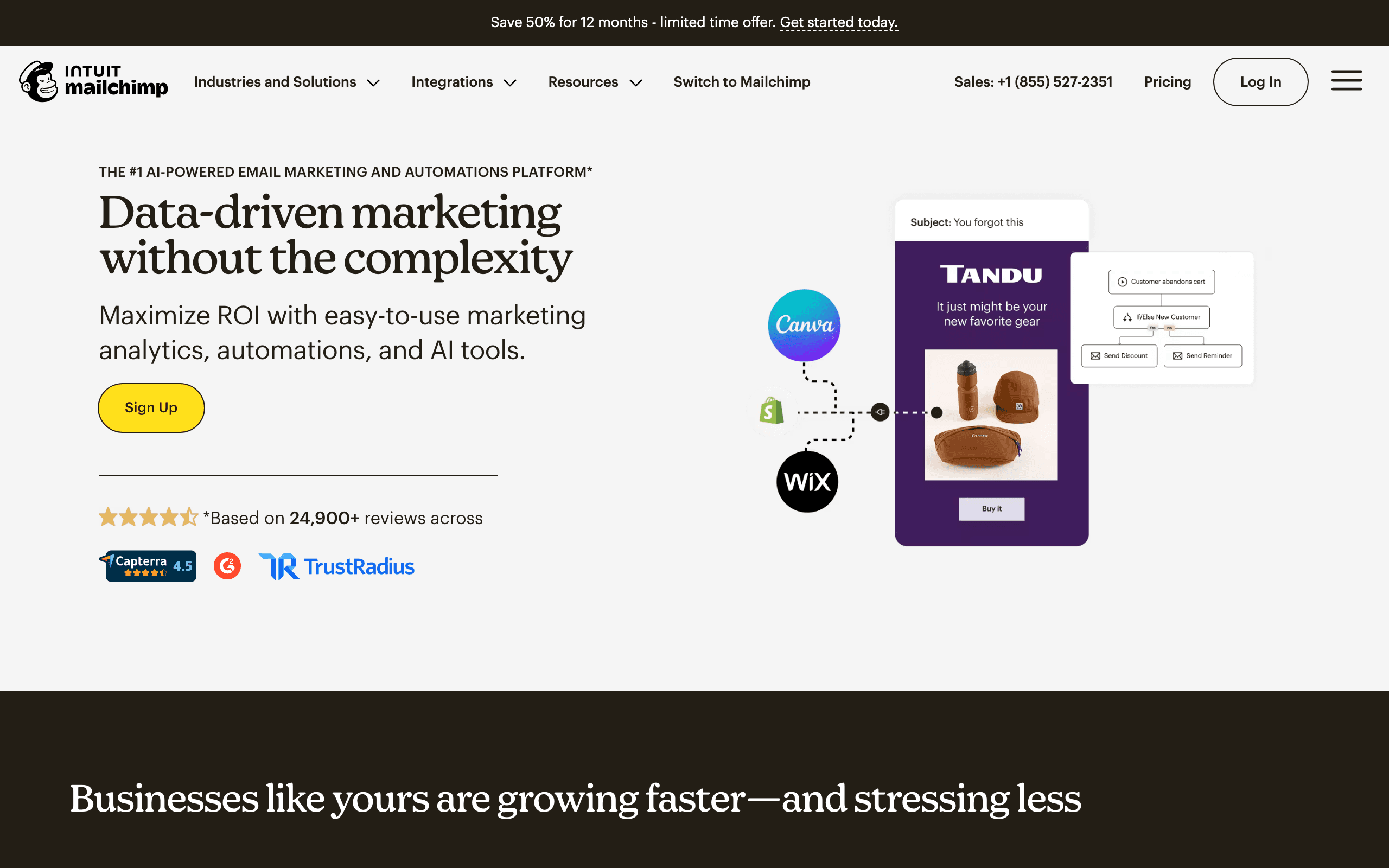
Best for: Small stores that need a broad marketing suite more than deep commerce logic.
Pricing: Free tier for small lists, then paid marketing plans from about $13/month, billed by contacts.
Mailchimp is in this comparison because it is where a large number of stores actually are. Its connectors sync customers and orders adequately, its template ecosystem is unmatched, and it covers landing pages, forms, and ads beyond email.
Its automation has improved, and for a store sending campaigns with a couple of simple triggered sequences it is workable.
As a commerce automation platform it is weak. Cart, browse, product, and revenue workflows are peripheral to the product, branching is limited, contact billing climbs fast, and SMS is not dependable globally.
- Pros: Familiar, best template library, broad marketing surface, easy to hire for.
- Cons: Weak commerce automation, limited branching, contact billing climbs, SMS varies by region.
Verdict: A general marketing tool that also sends store emails. Rarely the right automation choice.
9. Attentive
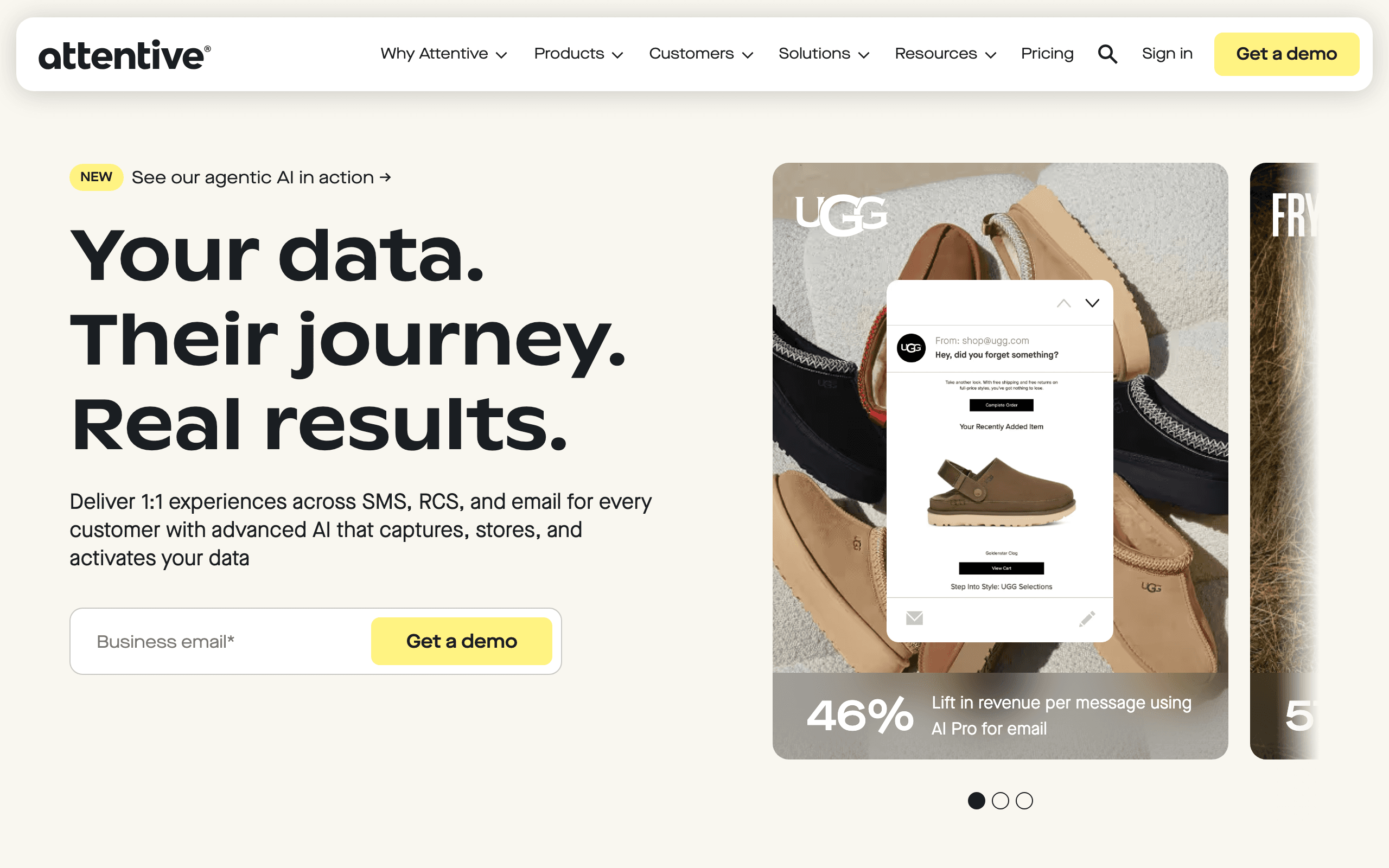
Best for: Brands where mobile messaging is the primary automation surface.
Pricing: Custom and consumption-based. Reported minimums commonly sit around $2,000 to $3,000 per quarter, with roughly $0.01 per SMS and volume commitments often starting near 50,000 messages a month.
Attentive belongs in an automation comparison because for some brands the automation that matters most runs on SMS and RCS rather than email. Its cross-channel journeys, capture units, and conversational infrastructure are built around that assumption.
The two-tap signup experience is the best available and often the single largest driver of program growth, and the strategic support meaningfully offsets internal headcount.
It is sales-led, contract-based, and priced for volume, with commitments that survive a volume drop. Below roughly $5M in revenue the minimums are very hard to justify.
- Pros: Best-in-class mobile capture, RCS and conversational commerce, cross-channel journeys, strategic support included.
- Cons: Enterprise minimums and commitments, no published pricing, contract complexity, mobile-first rather than data-first.
Verdict: The right automation platform when the channel that matters most is the phone.
10. Listrak
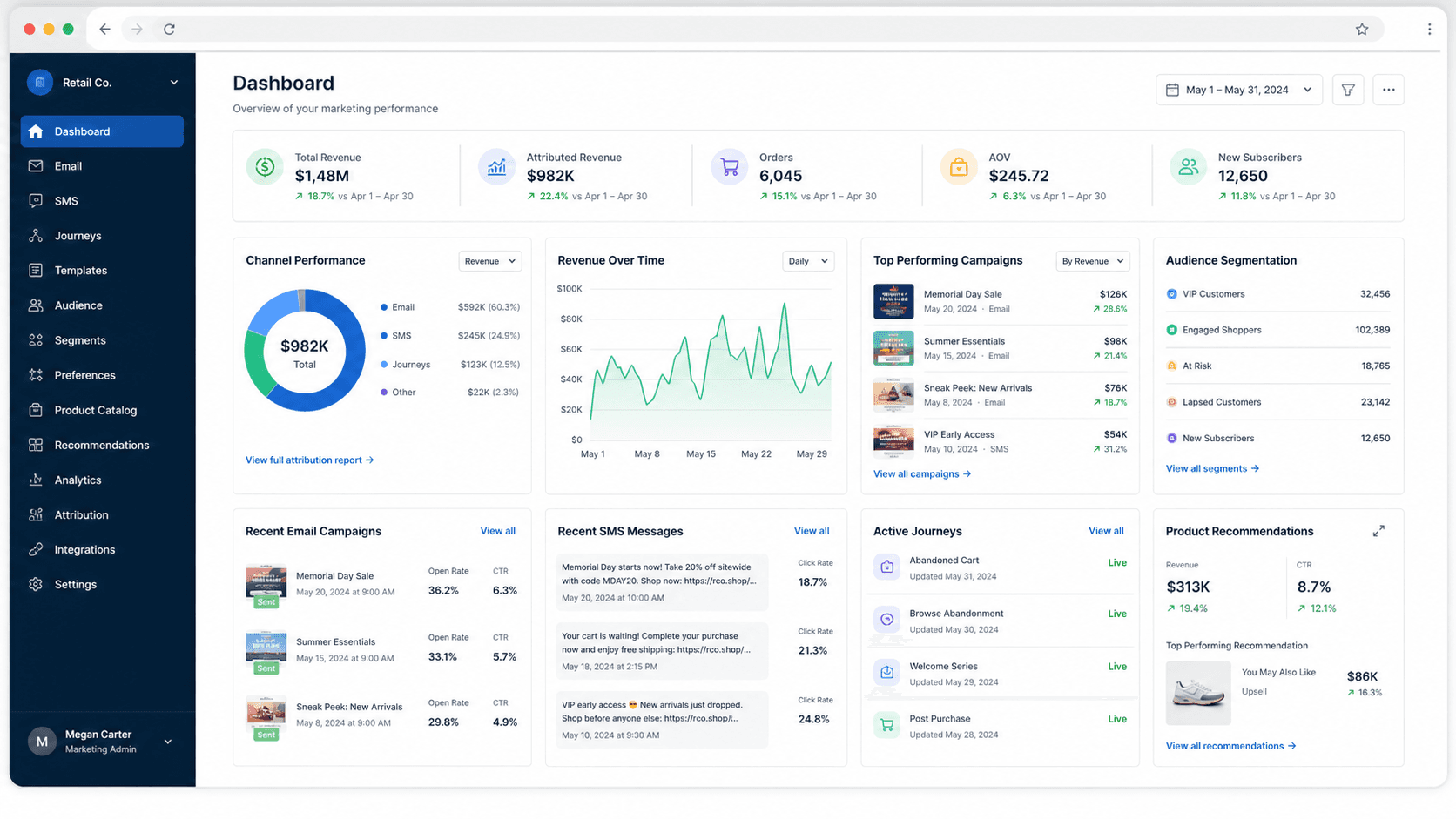
Best for: Mid-market and enterprise retailers that want a managed program.
Pricing: Custom, sales-led quote.
Listrak sits between the self-serve platforms and the full CDPs. It brings email, SMS, identity resolution, and personalization together for retail specifically, with a service model that includes real strategic involvement.
That suits a retailer with a merchandising calendar, multiple categories, and a marketing team that wants a partner rather than a tool. Identity resolution across sessions and devices is a genuine capability that self-serve platforms lack.
It is a sales-led purchase with a multi-month implementation and no published pricing, which makes comparison work harder and slows time to value considerably.
- Pros: Retail-specific depth, identity resolution, email and SMS unified, substantive service model.
- Cons: No published pricing, 2 to 4 month implementation, sales-led, overkill below mid-market.
Verdict: A managed retail platform for teams that want a partner, not a dashboard.
11. Bloomreach Engagement
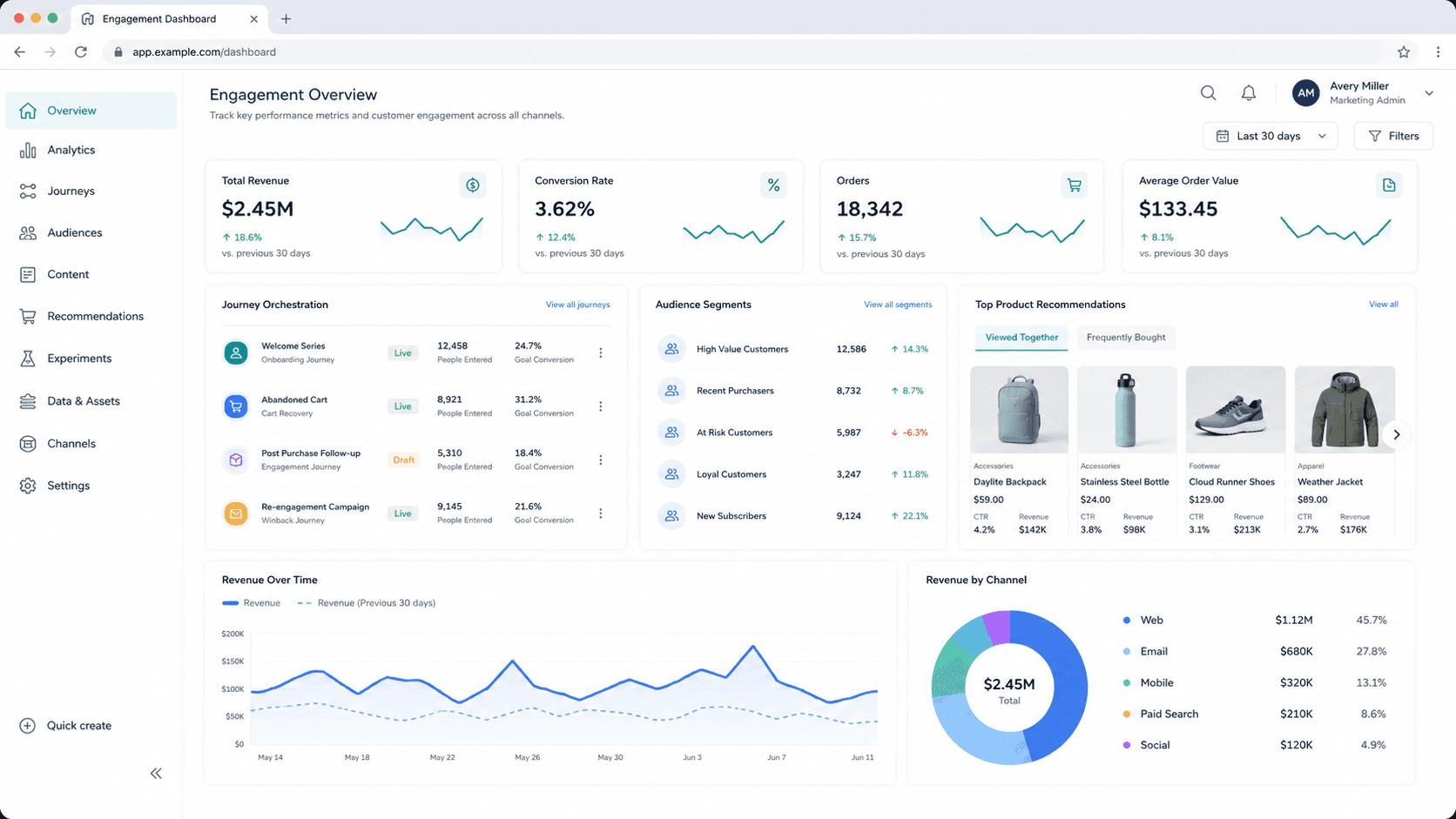
Best for: Enterprise retailers whose constraint is the data layer, not the messages.
Pricing: Enterprise quote based on customers, catalog size, and event volume.
Bloomreach is a customer data platform with commerce search, merchandising, personalization, and messaging on top. That combination matters when the same customer appears in a store, an app, a loyalty program, and a physical location, and no marketing tool can see all four.
For that retailer, the automation is downstream of the real problem, which is unifying identity and behavior. Bloomreach solves that and then messages from it.
It is a large purchase with a three to nine month implementation and a dedicated team requirement. For any store that can hold its customer data in a commerce marketing platform, it is unnecessary cost and delay.
- Pros: Full CDP with unified identity, commerce search and merchandising, web personalization, enterprise orchestration.
- Cons: Enterprise cost, 3 to 9 month implementation, needs a dedicated team, far beyond most stores.
Verdict: Right when the data layer is the constraint. Wrong for everyone else.
12. Braze
Best for: Enterprise teams where the app is a primary commerce surface.
Pricing: Enterprise quote.
Braze is the strongest platform here for cross-channel orchestration that includes mobile app push, in-app messaging, and web as first-class channels alongside email and SMS.
For a commerce business where a meaningful share of orders come through an app, that changes the automation problem entirely: the highest-value trigger may be an in-app behavior, not a web session.
It is enterprise-priced, requires engineering integration rather than a plugin, and takes months to implement. It is also not merchandising-first, so catalog-driven email is less turnkey than in a commerce specialist.
- Pros: Best app and in-app messaging orchestration, genuine cross-channel journeys, enterprise-grade scale and reliability.
- Cons: Enterprise cost and implementation, engineering-led integration, less commerce merchandising depth, long time to value.
Verdict: The right choice when the app is where commerce happens.
13. Iterable
Best for: Enterprise teams that want composable cross-channel workflows.
Pricing: Enterprise quote.
Iterable is built around flexible, composable journeys across email, SMS, push, in-app, and web, with a data model you shape rather than one shaped for retail.
That flexibility suits businesses whose customer lifecycle does not look like a standard store: marketplaces, subscription boxes with complex states, or businesses combining commerce with content or services.
The flip side of flexibility is that nothing is prebuilt for commerce. You will define your own events, your own catalog handling, and your own flow patterns, which requires a team.
- Pros: Highly composable journeys, strong cross-channel coverage, flexible data model, enterprise scale.
- Cons: Enterprise cost, nothing prebuilt for commerce, requires a dedicated team, 3 to 6 month implementation.
Verdict: Flexible enterprise orchestration for businesses that do not fit a retail template.
14. Shopify Email plus Shopify Messaging
Best for: New Shopify stores that need something running today.
Pricing: Shopify Email is included with eligible Shopify plans with the first 10,000 marketing emails each month at no charge. Shopify Messaging is $2.15/month per approved toll-free number plus per-message costs.
This is the entry point, and it is a legitimate one. There is no integration to validate, no second bill, and native access to catalog, customer, and order data.
For a store proving demand, the correct move is often to run basic campaigns and Shopify's own abandoned-checkout messaging while spending the saved money on traffic and capture.
Do not confuse it with automation. Segmentation is basic, branching is minimal, there is no browse behavior, and attribution is thin. Shopify's abandoned-checkout message is one message, not a tuned recovery flow.
- Pros: No platform bill under 10k emails, same-day setup, native store data, cheap SMS via Messaging.
- Cons: Shopify only, minimal automation and branching, no browse behavior, no real attribution.
Verdict: The right starting point, and a clear signal to upgrade once unbuilt flows cost more than a subscription.
The seven automations that produce the revenue
Build in this order. Tune each before starting the next. Most stores running 30 automations get the majority of their results from the first three.
| Order | Automation | Trigger | Typical shape | Why here |
|---|---|---|---|---|
| 1 | Welcome | New subscriber, no order | 3 to 4 emails over 7 days | Highest engagement window you will ever get. |
| 2 | Abandoned checkout | Checkout started, not completed | Email at 1h, email at 24h, optional SMS at 48h | Highest-intent audience in the store. See cart recovery. |
| 3 | Post-purchase | Order placed or fulfilled | Confirmation, education, review request | Lowers support load and sets up the second order. |
| 4 | Browse abandonment | Product viewed, not added | 1 to 2 emails | Larger audience than cart, lower conversion. Needs real event fidelity. |
| 5 | Replenishment | Purchase plus product cadence | 1 to 2 messages timed to actual usage | Only works if the cadence is real, not a generic 60 days. |
| 6 | Win-back | No purchase past repurchase window | 2 to 3 emails, ending in a sunset | Protects deliverability as well as revenue. See win-back. |
| 7 | Back in stock and price drop | Inventory or price event | Single message, often SMS | Genuinely welcome, genuinely time-sensitive. |
Three rules that matter more than the platform:
Suppress across flows. A customer in post-purchase should not receive a cart reminder for the item they just bought. This is the most common broken thing I see in real accounts.
Cap total frequency. Automated messages plus campaigns is what the customer experiences. Cap the total, not each program separately.
Delete what does not work. An automation producing nothing incremental in 90 days is a liability: it consumes frequency budget and creates opt-outs. Turn it off.
Choosing by store stage
| Stage | Shortlist | The real question |
|---|---|---|
| Pre-$10k/mo | Shopify Email, MailerLite, Omnisend free tier | Can you afford to spend the money on traffic instead? |
| $10k to $50k/mo | Omnisend, Sequenzy, Drip | Are the top three flows built and tuned yet? |
| $50k to $250k/mo | Klaviyo, Omnisend, Sendlane | Does segmentation actually change what you send? |
| $250k to $1M/mo | Klaviyo, Sendlane, Listrak, Attentive | Is the data model or the messaging channel the constraint? |
| $1M+/mo | Bloomreach, Braze, Iterable, Listrak, Klaviyo | Is customer data fragmented across systems your platform cannot reach? |
| Hybrid store plus subscriptions | Sequenzy, ActiveCampaign, Klaviyo | Which system holds the customer record? |
| App-led commerce | Braze, Iterable | Is the highest-value trigger happening in the app? |
The pattern worth noticing: you move up this table when a specific constraint binds, not when revenue crosses a threshold. A $2M store with clean Shopify data and seven working flows has no reason to buy a CDP.
Measuring automation honestly
Every platform will report impressive flow revenue. Attribution windows catch customers who were going to buy anyway, and abandoned cart is the worst offender because the audience is self-selected high intent.
Run this on your largest flow once a quarter:
- Randomly hold back 10 percent of the eligible audience and send them nothing.
- Compare purchase rate and revenue per person across the two groups over the same window.
- Multiply the difference by the treated population. That is your incremental revenue.
- Subtract message cost, carrier fees where relevant, and discount cost to get contribution.
- Compare that against the platform's reported number so you know your own inflation factor.
Most stores find flows are strongly incremental and broad promotional campaigns much less so. That is usually an argument for tuning flows and sending fewer campaigns, not for changing platforms.
For the email-specific version of this, see e-commerce email revenue attribution.
Frequently asked questions
What is the best marketing automation platform for e-commerce?
Klaviyo is the default answer for most mid-market stores because its commerce data model, prebuilt flow library, and flow-level attribution are deeper than anything else at that price. Omnisend is better value under roughly 10,000 contacts, Sendlane is better if you have a large dormant database, and Bloomreach, Listrak, or Braze become relevant once you need a real customer data platform and have a team to run it.
What is the difference between marketing automation and an email platform?
An email platform sends campaigns and simple sequences on a schedule. A marketing automation platform reacts to behavior: it holds a customer profile, listens for events like a cart abandonment or a refund, evaluates conditions, waits, branches, and suppresses. The practical test is whether you can build a flow that checks what happened after the first message and changes what happens next.
How many automations does an e-commerce store actually need?
Seven cover almost all of the achievable revenue: welcome, abandoned checkout, browse abandonment, post-purchase, replenishment, win-back, and back-in-stock. Most stores that run 30 automations are getting the majority of their results from three of them. Build in order, tune each one before adding the next, and delete anything that has produced nothing in 90 days.
How much should e-commerce marketing automation cost?
Mid-market stores commonly spend between $100 and $500 per month at 10,000 to 25,000 contacts, before SMS. Enterprise platforms with a customer data platform start in the thousands per month plus a real implementation budget. A useful sanity check is that platform cost should stay well under 5 percent of the revenue the automations actually generate incrementally.
Is reported flow revenue trustworthy?
Not without a holdout. Attribution windows catch customers who were going to buy anyway, which inflates every platform's reported numbers, especially for abandoned cart. Hold back 10 percent of an eligible audience, compare purchase rates, and treat the difference as your incremental revenue. The dashboard number is a ceiling, not a measurement.
Do I need a customer data platform?
Only when your data lives in more places than your marketing platform can reach: a physical retail estate, a loyalty program, an app, a support desk, and a warehouse system that all describe the same customer. Below that, a commerce marketing platform with a good store integration holds enough data, and a CDP adds cost and implementation time without adding messages.
Should marketing automation include SMS?
It should be able to, because the value of automation is deciding which channel a moment deserves and suppressing the other. Whether you use it is separate: SMS costs more per message and interrupts, so reserve it for genuinely time-sensitive moments. A platform that cannot suppress an SMS when the email already converted is running two programs, not one.
How long does implementation take?
Two to four weeks for a mid-market platform if you build the top four flows and validate the store integration properly. Three to nine months for an enterprise platform with a customer data layer, data mapping, and integrations across multiple systems. Budget the validation time either way; the failure mode is a beautiful flow triggered by an event that never arrives.
Final recommendation
- Mid-market Shopify store: Klaviyo. Deepest data, best flows, attribution you can challenge.
- Under 10,000 contacts: Omnisend. Fastest to live, three channels, best value.
- Large dormant database: Sendlane. The billing shape is worth more than most feature differences.
- Complex branching or a sales motion: ActiveCampaign.
- Flat feature access matters: Drip.
- Hybrid store plus subscriptions: Sequenzy, so one profile covers both revenue streams.
- Tight budget with a big list: Brevo.
- Messaging is the primary surface: Attentive.
- Managed retail program: Listrak.
- Fragmented customer data across systems: Bloomreach, or Braze if the app is central, or Iterable if your lifecycle is unusual.
- Brand new store: Shopify Email and Shopify Messaging, and spend the difference on traffic.
The uncomfortable finding from comparing these platforms is how little the choice explains. Stores with seven tuned flows on Omnisend consistently outperform stores with two untuned flows on Klaviyo. Pick something adequate, build the flows in order, and measure them against a holdout.
Related resources
- Best email marketing platforms for e-commerce - the email-only comparison
- Best email and SMS marketing platforms - combined-channel platforms
- Best Klaviyo alternatives - if the leader is not the fit
- E-commerce cart abandonment strategies - the highest-value flow
- E-commerce email segmentation - making the depth pay off